
Decating: Wool Fabric Finishing

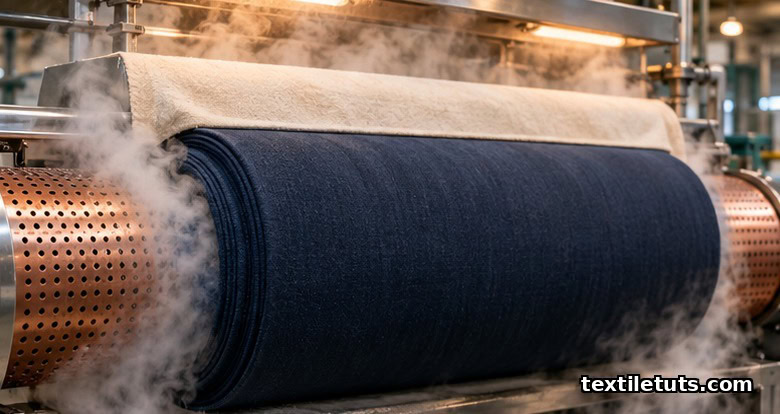
Decating (also called decatising) is a wool finishing process that passes steam at 110 to 130 °C through fabric wound under tension on a perforated roller, producing dimensional shrinkage reduction of 1 to 3 percent and a measurable lift in surface luster on worsted and woolen cloths. The treatment permanently sets the yarn twist and fiber arrangement, which is why a fully decated suit fabric holds its shape through years of wear and cleaning while an undecated fabric cockles and shrinks visibly after a single steam press.
This guide explains how decating works, the two industrial methods (open and pressure decating), the temperatures and times mills actually run, the effects on hand and luster, and the standards mills use to verify the finish.
What Decating Does to Wool
Wool is a protein fiber covered with microscopic scales that open and close with moisture and heat. During weaving, scouring, and dyeing, the fabric is stretched, scoured in hot liquor, and dried under tension. Those mechanical stresses leave the cloth dimensionally unstable: cut pieces relax, panels shrink unevenly, and finished garments pucker at seams after the first steam press.
Decating reverses those stresses. Steam at near-boiling temperature relaxes the fibers, the wrapper applies uniform pressure, and the cooling phase re-sets the yarn twist in a flat, stable configuration. The IWTO (International Wool Textile Organisation) recognises decating as the standard pre-shrink and setting treatment for wool suitings, and most worsted mills decate every cloth before shipping.
The visible benefits are:
- Improved dimensional stability. Residual shrinkage drops to under 1 percent in both warp and weft.
- Higher luster. Fibers lie flat, so reflected light reads as a clean sheen rather than a fuzzy matte.
- Softened handle. Steamed yarn twist feels fuller and less wiry than loom-state yarn.
- Reduced pilling. Loose fiber ends are anchored into the yarn body.
- Cockle and mill rig removed. Wavy weft bars and weft streaks from finishing wash off the surface.
Open Decating (Dry Batch Decating)
Open decating is the most common method for woolen and worsted suitings. The cloth is rolled face-in on a hollow perforated copper or stainless roller (called a decating spindle or cylinder) together with a wrapper fabric. Mills use either 100 percent cotton wrapper or a cotton and polyester blend wrapper; the wrapper protects the face yarn from the direct steam blast and gives a uniform pressure.
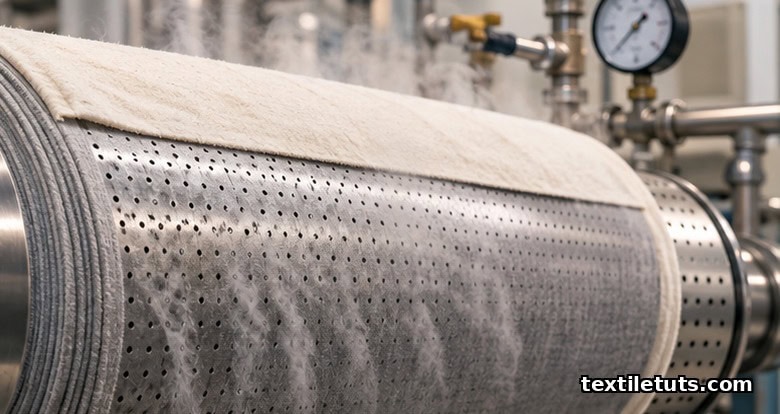
The procedure runs in four phases:
- Winding. Cloth and wrapper are wound together under uniform tension (typically 3 to 5 kg per 10 cm fabric width) onto the perforated roller.
- Steam cycle. Steam at 120 to 130 °C is pulled through the roll from the center outward by a vacuum pump, for 3 to 5 minutes.
- Vacuum cooling. Steam supply stops and vacuum continues, drawing cool air through the roll for 5 to 10 minutes. Cooling under tension is what sets the finish.
- Unwinding and resting. The roll is unwound and the cloth is conditioned on a cooling conveyor for at least 12 hours before cutting.
Open decating runs at atmospheric pressure, so the maximum temperature is the saturation steam temperature of about 100 °C inside the roll, with brief peaks to 105 to 110 °C in the leading face. Mills chasing a crisper, more permanent finish run a second cycle in the reverse direction (a double decat).
Pressure Decating (Closed Decating)
Pressure decating runs the same wound roll inside a sealed pressure vessel, a horizontal autoclave fitted with internal steam piping and a vacuum pump. Steam enters at 1.5 to 2.0 bar gauge pressure (a temperature of about 110 to 115 °C) and the cycle is shorter, usually 2 to 4 minutes of steam followed by 6 to 8 minutes of vacuum cooling.
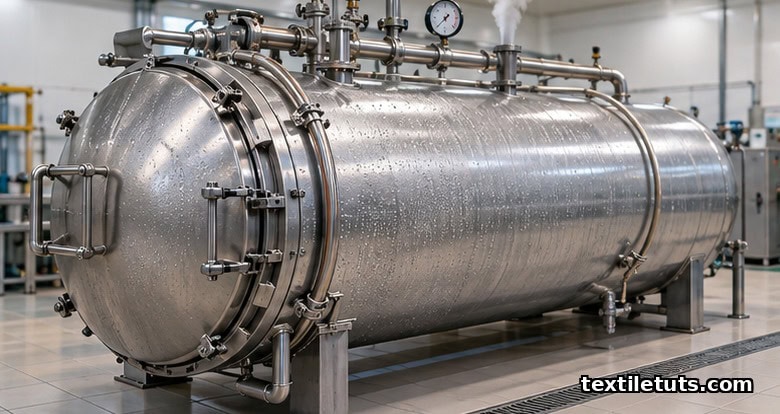
The higher temperature and uniform pressure inside the vessel produces a finish that lasts longer on the bolt and survives more aggressive garment pressing. Pressure decating is standard on fine worsteds for tailored suits, where the mill charges a premium for a finish that holds a sharp crease and a flat front through years of dry cleaning.
The trade-off is handle. Pressure decating at the upper temperature range can flatten the cloth and reduce loft, so mills handling woolen and tweed fabrics (where a soft, full hand matters more than crease retention) usually stay with open decating.
Wet Decating and Continuous Decating
Wet decating skips the steam and uses hot water. The cloth passes through a water bath at 80 to 90 °C, then winds onto a roller with a wrapper. Hot water swells the wool fiber, the wrapper compresses the cloth uniformly, and the roll cools slowly over 8 to 12 hours. Wet decating gives the softest handle of the three methods, but the dimensional stability gain is smaller than dry decating, so it is used for knitwear, scarves, and loosely woven woolens where softness matters more than crease retention.
Continuous decating machines (Kleinewefers and similar designs) run open-width cloth through a steam chest with upper and lower conveyor blankets. The throughput is much higher than batch decating, but the finish is lighter, and continuous decating is mostly reserved for woolen blankets, melton, and piece goods where a heavy permanent press is not required.
Process Parameters at a Glance
| Parameter | Open Decating | Pressure Decating | Wet Decating |
|---|---|---|---|
| Steam / bath temperature | 100 to 110 °C | 110 to 115 °C | 80 to 90 °C (water) |
| Vessel pressure | atmospheric | 1.5 to 2.0 bar (gauge) | atmospheric |
| Steam / contact time | 3 to 5 min | 2 to 4 min | continuous immersion |
| Cooling time | 5 to 10 min vacuum | 6 to 8 min vacuum | 8 to 12 h slow cool |
| Wrapper material | cotton or cotton/polyester | cotton or nylon | cotton |
| Residual shrinkage after treatment | 1 to 2 percent | under 1 percent | 2 to 3 percent |
| Best suited for | woolen and tweed cloths | fine worsted suitings | knitwear and scarves |
Decating Versus Crabbing
Crabbing is the closest cousin to decating, and the two terms get confused. Crabbing runs the cloth through hot water (85 to 95 °C) and winds it on a roller without a wrapper, so the heat sets the weft yarn but leaves the warp under less compression. Crabbing is the setting step for piece-dyed worsteds before milling; decating is the final setting step before delivery.
In a typical worsted finishing sequence, a cloth is scoured, dyed, dried, crabbed, milled (lightly), cropped, sheared, and finally decated. Skipping the decating step leaves residual shrinkage that the cutter sees as misaligned patterns and the tailor sees as panels that grow after pressing.
Testing the Decated Finish
Mills verify a decating run with three standard tests.
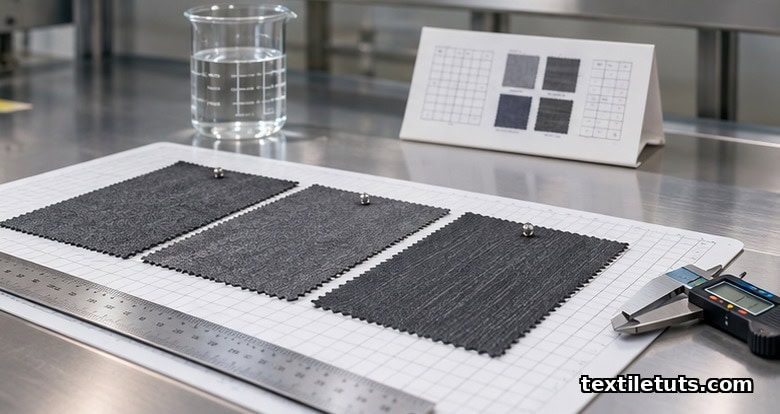
Dimensional change after relaxation. AATCC TM135 and ISO 6330 both specify a controlled home-laundering cycle; a properly decated worsted records less than 1 percent shrinkage in warp and weft. ISO 675 covers the same property under commercial laundering conditions near the boil.
Felting shrinkage. IWTO-30 specifies the cubical felting shrinkage test for machine-washable wool. A wool fabric that passes the Woolmark machine-wash specification TM31 (a derivative of IWTO test methods) will record under 3 percent area shrinkage across five 1-hour wash cycles, which is only achievable on cloth that has been fully decated.
Steam shrinkage and press performance. ASTM D2724 measures dimensional change of woven fabrics after steam pressing, the test tailors and garment makers rely on most. A decated fabric records less than 0.5 percent change after three steam presses at 150 °C.
Common Decating Defects
When a finish goes wrong, the cause is usually one of four issues:
- Wavy face (crowsfooting). Wrapper tension was too low, or the steam cycle ran too short. Correct with a re-decate at higher tension.
- Glazing on the face. Steam was too wet (carrying entrained water droplets) or the wrapper was so tightly wound that condensed water sat on the face. Trim the glaze with a light crop and shear.
- Uneven luster. Roll winding tension varied across the width. Check the winding brakes and re-decate with a balanced wrap.
- Residual shrinkage above 1 percent. Cooling was too short, or the cloth was cut before the 12-hour conditioning rest. Re-decate and lengthen the rest period.
Frequently Asked Questions
What temperature is used in decating wool?
Open decating uses saturated steam at 100 to 110 °C at atmospheric pressure; pressure decating uses steam at 110 to 115 °C inside a sealed vessel held at 1.5 to 2.0 bar gauge. Both methods then cool the cloth under vacuum or natural cooling to lock in the set.
How much does decating reduce wool shrinkage?
A properly decated worsted records under 1 percent residual shrinkage in both warp and weft under AATCC TM135 home-laundering cycles, against 3 to 6 percent for the same fabric before decating. Pressure decating pushes the figure closer to 0.5 percent, which is the typical tolerance for a tailored suiting.
Can you decat at home with a domestic iron?
No. A household iron or garment steamer reaches 100 °C at best, with no uniform wrapper pressure, and cannot reproduce the controlled steam and vacuum cooling of a decating machine. Garment pressing relaxes surface fibers temporarily, but it cannot permanently set yarn twist the way industrial decating does.
What is the difference between decating and decatising?
There is no difference. Both terms describe the same finishing process. Decating is the modern international spelling; decatising is the older British spelling that still appears in IWTO documents and UK mill literature.
Does decating affect the softness of wool fabric?
Yes. Steam and wrapper pressure relax the yarn twist and flatten the fiber scales, producing a softer, fuller handle compared with loom-state cloth. Pressure decating at the high end of the temperature range gives a crisper, flatter hand; open decating at 100 to 110 °C gives a softer, loftier hand; wet decating gives the softest handle of the three.
References
- ISO 6330:2021. Textiles — Domestic washing and drying procedures for textile testing. iso.org — defines the wash cycles used to measure post-decating dimensional change.
- ISO 675:2014. Textiles — Woven fabrics — Determination of dimensional change on commercial laundering near the boiling point. iso.org — boil-test method for wool finishing verification.
- AATCC TM135. Dimensional Changes of Fabrics after Home Laundering. aatcc.org — the workhorse test for residual shrinkage on decated wool.
- ASTM D2724. Standard Test Method for Bonded, Fused, and Laminated Apparel Fabrics. astm.org — referenced for steam-press dimensional change of finished wool.
- IWTO-30. Determination of Felting Shrinkage (Cubical Test). textileinstitute.org / iwto.org — the international standard for felting shrinkage of machine-washable wool.
- Woolmark TM31. Machine Washable Wool — Specification. wool.com — performance specification built on IWTO test methods.
- Johnson, N.A.G., and Russell, I. (eds.). Advances in Wool Technology. Woodhead Publishing (now part of Elsevier), sciencedirect.com — peer-reviewed chapters on wool finishing including decating parameters.
Editorial by Shahrukh Islam, TextileTuts. Sources: ISO 6330, ISO 675, AATCC TM135, ASTM D2724, IWTO-30, Woolmark TM31, and Advances in Wool Technology as cited above.


