
Calendaring: Surface Smoothing

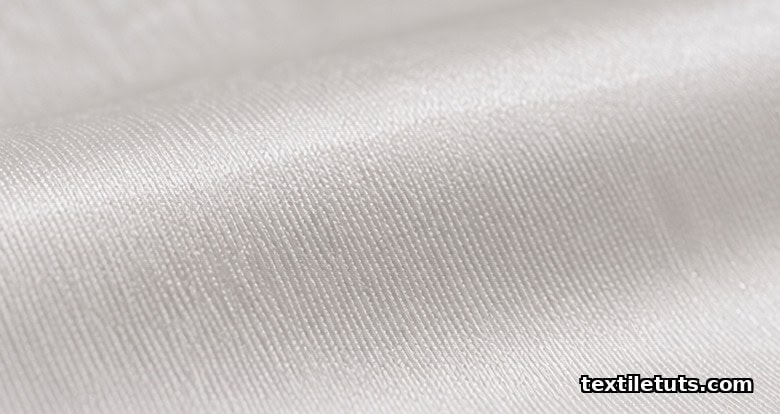
Surface-smoothing calendaring compresses fabric between two or more heated rollers at 100 to 180 °C and 20 to 60 N/mm linear nip load, reducing fabric surface hairiness by 30 to 50 percent and raising the AATCC smoothness-appearance grade by 1.5 to 2.5 in a single pass.
It is the most common calendaring variant in cotton and cotton-blend finishing and runs as the final dry-finishing step before inspection, raising fabric luster and dimensional stability without the chemistry cost of resin finishing.
This guide covers the mechanics of surface smoothing, the process windows for common fibers, the measurable changes it produces, and how it compares to singeing and mercerization when the goal is a flatter, cleaner fabric face.
What Surface-Smoothing Calendaring Does to a Fabric
Calendaring is a mechanical finishing process in which fabric passes through the nips of two or more rollers under controlled heat and pressure. The nips flatten protruding fibers and yarns, reduce fabric thickness, and align surface geometry, producing the smooth, slightly lustrous face that consumers associate with quality shirting, sheeting, and light bottom-weight fabrics.
Surface-smoothing calendaring (sometimes called simple or polishing calendaring) is the gentlest member of the calendaring family. It uses a small number of rollers, moderate temperatures, and modest pressure specifically to flatten the surface without driving major dimensional change or high glaze. Heavier variants, friction calendaring, Schreiner calendaring, and embossing calendaring, produce luster, pattern, or surface relief through much higher temperatures, roller-to-fabric speed differentials, or engraved rollers.
For most cotton-rich fabrics, surface-smoothing calendaring is paired with singeing on the front end to burn off loose surface fibers, leaving the calendar to finish the job of compressing what remains. ISO 7211-3:1984 (Textiles, Determination of mass per unit area using small samples) and AATCC TM 110-2015 (Smoothness Appearance of Fabrics After Repeated Home Laundering) are the standard references for measuring what calendaring changes and how durable that change is.
How a Smoothing Calendar Works: Roller Stack and Nips
A smoothing calendar typically uses a stack of two to four rollers arranged vertically. The fabric enters the nip between the top roller (usually steel or chilled iron) and the bottom roller (usually a softer elastomer-covered bowl whose hardness is measured in Shore A durometers, typically 70 to 95 Shore A for smoothing work).
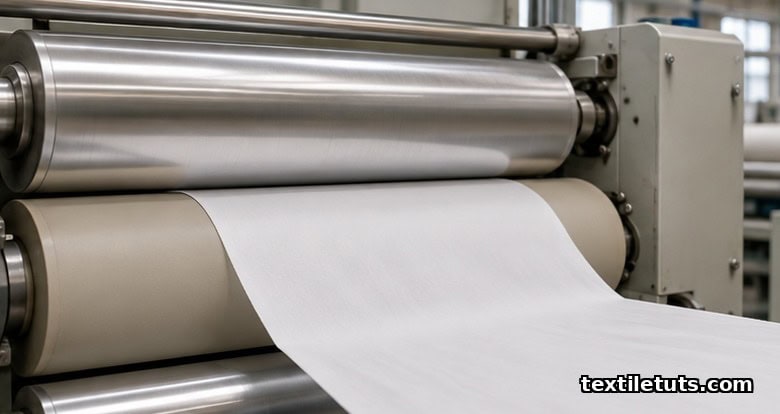
The nip line is where compression happens. The bottom bowl elastomer cover deforms under load, creating a wider contact zone than a steel-on-steel nip would. This wider contact is what allows the calendar to smooth fibers across the full yarn width rather than merely creasing the fabric at a single line.
For an asymmetric smoothing calendar, only the steel roller is heated; the elastomer bowl stays unheated or slightly warmed. For a symmetric stack, both top and bottom rollers can be heated independently. The fabric may pass through the stack once for a single-sided effect or twice (with a turn in between) for a balanced face on both sides.
Process Parameters: Temperature, Pressure, Speed, and Moisture
The four operating variables in surface smoothing are roller temperature, linear nip load, line speed, and residual fabric moisture entering the nip. Each one independently changes the outcome.
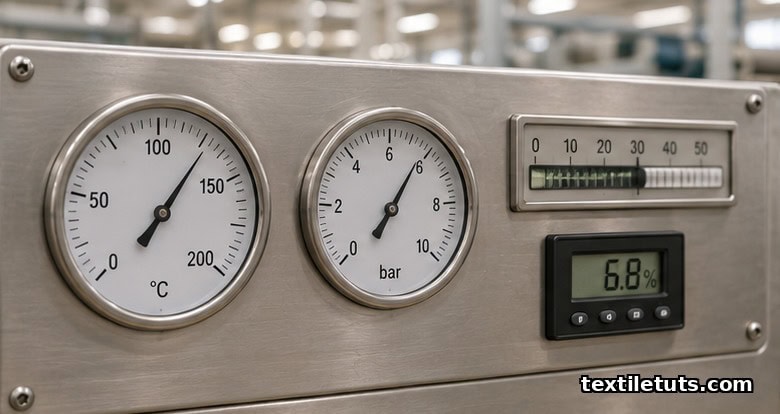
- Roller temperature: 100 to 180 °C for cotton, lower (80 to 130 °C) for heat-sensitive synthetics, higher (up to 220 °C) for thermoplastic blends where surface glazing is acceptable.
- Linear nip load: 20 to 60 N/mm for smoothing; above 80 N/mm crosses into glazing territory and can produce a harsh, papery hand.
- Line speed: 15 to 60 m/min. Slower speeds give longer dwell in the nip, more fiber flattening per pass, but lower throughput.
- Residual moisture: 6 to 10 percent on weight of fabric entering the nip is typical. Moisture plasticizes cotton fibers, letting them reshape under heat and pressure rather than break.
A standard cotton poplin running at 150 °C, 40 N/mm, 30 m/min, and 8 percent moisture will typically show a 5 to 10 percent drop in fabric thickness, a 25 to 40 percent drop in hairiness index measured per ASTM D5646-style optical counting, and a 1.5 to 2.5 grade rise on AATCC TM 110 smoothness appearance.
Measured Effects on Fabric Properties
Surface-smoothing calendaring changes five measurable fabric properties:
- Thickness: usually drops 5 to 12 percent on cotton, slightly more on loose knit constructions.
- Surface hairiness: drops 30 to 50 percent on cotton sheeting and poplin; less change on long-staple combed yarns that start smoother.
- Luster: increases by 1.5 to 3 units on a typical 1 to 5 visual luster scale for cotton, due to flatter yarn geometry reflecting more parallel light.
- Air permeability: usually drops 5 to 15 percent as compressed yarns close inter-yarn gaps.
- Tensile strength: typically unchanged or 2 to 5 percent lower in the warp due to slight fiber damage; well-tuned calendars do not affect tensile meaningfully.
The durability of the smoothness gain depends on fiber content and post-calendar finishing. Mercerized cotton retains the smooth surface through many wash cycles. Resin-treated cotton retains it longer still. Untreated cotton loses 0.5 to 1 AATCC grade per 5 home launderings as fibers relax back out. This is why textile mills often pair surface smoothing with a light crosslinking resin finish when durable-press smoothness is the goal.
Smoothing Calendar vs. Other Surface Treatments
Surface smoothing is one of three finishing routes to a smoother, cleaner fabric face. Each has a different mechanism and cost.
| Property | Surface-Smoothing Calendaring | Singeing | Mercerization |
|---|---|---|---|
| Mechanism | Mechanical compression of fibers and yarns | Thermal burning of protruding fibers | Chemical swelling of cotton in NaOH |
| What it removes | Nothing (redistributes surface) | Loose surface hairs | None (changes fiber cross-section) |
| Typical change in hairiness | −30 to −50% | −60 to −90% | −10 to −25% (incidental) |
| Effect on luster | +1.5 to +3 luster units | None to slight | +2 to +4 luster units (strong) |
| Effect on tensile | Neutral to −5% | Neutral | +10 to +25% |
| Effect on dye uptake | Slight reduction (compressed surface) | Improved uniformity | Improved (more amorphous regions) |
| Capital cost | Medium (calendar and bowl) | Low (gas singe plus cool zone) | High (caustic recovery system) |
| Operating cost per kg | Low | Lowest | Highest (chemicals plus recovery) |
Most woven cotton finishing sequences place singeing first (to remove long protruding hairs), then mercerize (to build luster and strength), then surface-smooth calender (to lock in the smooth face). Each step adds value; removing any one of them changes the final hand and appearance that the customer sees.
Common Defects and Quality Control
When the smoothing calendar drifts out of its process window, five defects appear predictably:
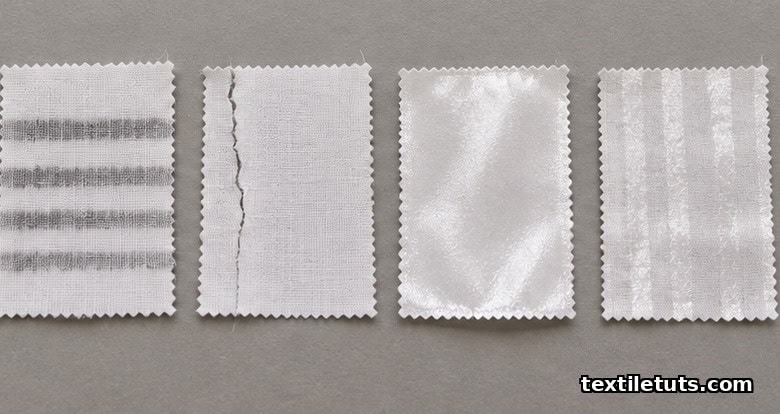
- Bowl marks and barring: repeating dark or light bands across the width, caused by worn or out-of-round elastomer cover. Replace or re-grind the bowl.
- Edge cracking: small cracks along the selvedge, caused by selvedge threads being too tight or the bowl being too hard at the edges. Loosen selvedge tension or use a softer bowl compound at the edges.
- Glazing: an excessively shiny, papery surface caused by temperatures or pressures above the smoothing window. Drop temperature by 15 to 20 °C and pressure by 10 to 15 N/mm.
- Loss of hand: fabric feels board-like or dead. Usually caused by too-high pressure combined with too-low residual moisture. Increase moisture to 10 to 12 percent before the nip.
- Uneven luster: a striped or mottled appearance, often a moisture or speed issue. Check that pre-calender moisture is uniform across the width and that line speed is stable.
Standard QC checks after a smoothing calendar include fabric mass per ISO 3801, thickness per ISO 5084, smoothness appearance per AATCC TM 110, and hairiness count via optical methods aligned to ASTM D5646 terminology.
Frequently Asked Questions
What is the difference between calendaring and surface smoothing?
Calendaring is the broad family of roller-finishing processes (smoothing, friction, Schreiner, embossing, and Moiré). Surface-smoothing calendaring is the specific gentlest variant, focused only on flattening protruding fibers and yarns for a smooth face, with no significant glaze, friction polish, or pattern.
Does calendaring weaken the fabric?
A well-tuned smoothing calendar does not affect tensile strength meaningfully. Mills typically see warp strength change within ±5 percent. Heavy glazing or embossing at very high pressure can damage fibers and reduce tensile, but smoothing-only calendars stay inside the safe zone for woven cotton and most polyester blends.
Can surface smoothing replace singeing?
No. Singeing removes protruding fibers; smoothing compresses them into the fabric surface. They do different jobs. A singed-then-smoothed fabric is visibly cleaner than a fabric that has only been calendared. Most mills run singeing ahead of the calendar for exactly this reason.
Is the smoothing effect permanent?
Partially. Smoothness appearance drops about 0.5 to 1 AATCC grade per 5 home launderings on untreated cotton, because fibers relax back out. Crosslinking resin finishing applied after calendaring locks in the smoothness for the life of the garment. Mercerization before calendaring also improves durability because the swollen, round cotton fibers hold their flattened shape longer.
Which fibers respond best to surface-smoothing calendaring?
Long-staple combed cotton, mercerized cotton, and fine polyester-cotton blends respond best, because they start smoother and the calendar compression is preserved through finishing. Wool and most knits are rarely calendared, since the high temperatures and pressures collapse the loft the fabric is valued for. Thermoplastic fibers like polyester can take higher temperatures and emerge with a more durable smooth surface.
References
- ISO. ISO 7211-3:1984 Textiles, Determination of mass per unit area using small samples. iso.org, method for measuring fabric mass per unit area, used to track the calendaring effect on fabric.
- ISO. ISO 3801:1977 Textiles, Woven fabrics, Determination of mass per unit area. iso.org, reference method for fabric mass used in process control after calendaring.
- ISO. ISO 5084:1996 Textiles, Determination of thickness of textiles and textile products. iso.org, standard method for measuring thickness change from calendaring.
- AATCC. AATCC Test Method 110-2015: Smoothness Appearance of Fabrics After Repeated Home Laundering. aatcc.org, standard test for grading smoothness retention, the key durability metric for calendared fabric.
- ASTM. ASTM D5646-14 Standard Terminology Relating to Fabric Hairiness. astm.org, definitions and optical methods used to quantify surface hairiness change after calendaring.
- Schindler, W. D., and Hauser, P. J. Chemical Finishing of Textiles. Woodhead Publishing, 2004. sciencedirect.com, peer-reviewed reference covering mechanical finishing processes including calendaring and roller configurations.
- Hashemi, S. A., and co-authors. Surface Modification of Woven Cotton Fabric through Calendaring: Effects on Physical and Mechanical Properties. researchgate.net, peer-reviewed study quantifying hairiness, luster, and tensile changes after smoothing calendaring.
Editorial by Shahrukh Islam, TextileTuts. Sources: ISO 7211-3, ISO 3801, ISO 5084, AATCC TM 110-2015, ASTM D5646, Woodhead Publishing (Schindler and Hauser 2004), as cited.


