
Textile Engineering Thesis: Topic Selection and Guide

A textile engineering bachelor’s thesis at a Bangladesh university is typically a 15,000 to 25,000 word experimental research report completed over 6 to 12 months, structured around the IMRaD format (Introduction, Methodology, Results, and Discussion) and defended orally before a faculty panel of three to five members.
The right topic is what separates a thesis that earns distinction from one that drags across two semesters. A strong selection ties directly to your specialization, gives you access to the lab equipment you need, and targets a measurable gap in the peer-reviewed textile literature.
This guide explains how textile engineering students should approach topic selection, the structural standards institutions expect, the categories of research that produce publishable results, and the common pitfalls to avoid before you sign your topic approval form.
What Your Faculty Panel Expects From a Textile Engineering Thesis
Textile engineering theses at institutions such as the Bangladesh University of Textiles (BUTEX) and Ahsanullah University of Science and Technology (AUST) follow a research methodology pattern rooted in engineering science, not literature review alone. Your supervisor and panel members evaluate four core criteria:
- Originality of the experimental contribution (the thesis must generate new data, not summarize existing work).
- Methodological rigor (controlled variables, statistical analysis, replicates of at least three specimens per condition).
- Reproducibility (documented materials, machinery settings, and testing standards).
- Defensibility (you must be able to explain and defend every choice during the oral viva).
Most institutions require at least one standardized test method from ISO, AATCC, or ASTM to anchor your methodology. Without a recognized standard, your results cannot be benchmarked against industry practice and your panel will flag the work as ungrounded.
Standard Structure and Word Count
The conventional textile engineering thesis runs between 15,000 and 25,000 words across roughly 60 to 100 formatted pages. The IMRaD layout dominates:
| Section | Typical Length | Purpose |
|---|---|---|
| Introduction | 2,000 to 3,500 words | Problem statement, objectives, scope, significance |
| Literature Review | 3,000 to 5,000 words | Synthesis of 30 to 60 peer-reviewed sources |
| Methodology | 2,500 to 4,000 words | Materials, machinery, test standards, parameters |
| Results and Discussion | 4,000 to 7,000 words | Findings with statistical analysis, figures, tables |
| Conclusion and Recommendations | 800 to 1,500 words | Summary of contributions, future work |
| References | 30 to 60 entries | ISO/AATCC/ASTM standards plus peer-reviewed journals |
Word count is a guideline, not a target. A tight 17,000-word thesis with clear methodology beats a padded 24,000-word manuscript with weak analysis. Supervisors commonly flag the Literature Review for being too long and the Methodology for being too short.
Finding a Real Research Gap
A research gap is a question the existing peer-reviewed literature has not answered or has answered incompletely. To identify one, follow a structured search:

- Pick a specialization (yarn manufacturing, weaving, knitting, wet processing, apparel, or technical textile).
- Run keyword searches on ScienceDirect, Springer Link, MDPI, ResearchGate, and Google Scholar using Boolean form such as
("cotton" OR "jute") AND ("yarn strength") AND ("enzyme treatment"). - Filter results to papers from the last five years; older work is useful only as foundational reference.
- Sort results by citations to identify seminal papers, then read their “future work” and “limitations” sections.
- Cross-check local industry gaps with Bangladesh-focused sources, including BUTEX research bulletins and Bangladesh Textile Today academic issues.
If you find 10 or more recent papers on the exact same fiber, treatment, and property combination, the topic is saturated. Shift to a less-studied variable: a different blend ratio, a new finishing agent, a localized fiber (jute, pineapple leaf fiber, hemp from Bangladesh’s northern districts), or a hybrid treatment that combines two existing methods.
Topic Categories That Produce Defensible Results
The strongest textile engineering theses fall into one of these five categories. Each offers measurable variables and a clear methodology path.
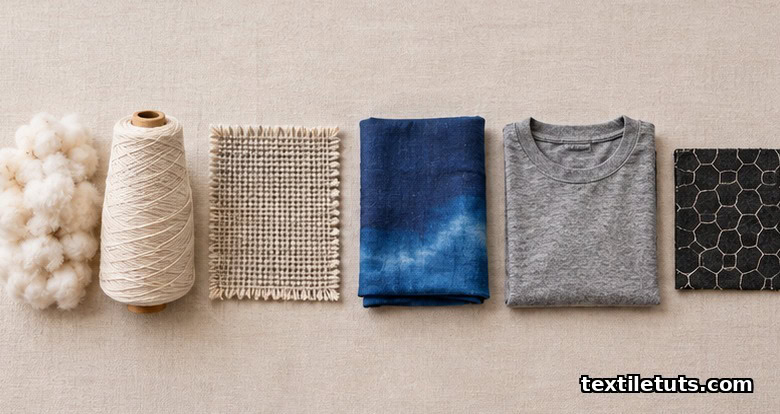
1. Fiber and Yarn Engineering. Topics like tensile behavior of blended yarns, the effect of twist multiplier on hairiness, or comparative analysis of ring, rotor, and air-jet spun yarns. Standard tests include ASTM D2256 (yarn tensile), ISO 20645 (yarn evenness), and Uster Statistics.
2. Fabric Manufacturing and Structure. Woven and knitted fabric property studies, including GSM optimization, dimensional stability after repeated wash cycles (AATCC 135), bursting strength (ISO 13938-1), and seam slippage (ISO 13936-1).
3. Dyeing and Finishing Chemistry. Reactive, disperse, acid, and natural dye studies on specific substrates. Common variables include temperature (60 to 95 °C), time (15 to 90 min), liquor ratio (1:6 to 1:20), pH (4 to 11), and electrolyte concentration. Standard tests include ISO 105-C06 (color fastness to washing), ISO 105-X12 (crocking), and AATCC 8.
4. Garment Performance and Comfort. Air permeability, moisture management, and thermal resistance on finished garments. Standards include ASTM D737 (air permeability), ISO 11092 (thermal and water-vapour resistance), and AATCC 195 (moisture management).
5. Technical and Smart Textiles. Conductive fabric characterization, antimicrobial textile testing (ISO 20743), geotextile tensile strength (ASTM D4595), or medical textile absorbency (ISO 17190). This category is the fastest-growing in published textile research.
Choosing Experimental, Industrial, or Review Methodology
Textile engineering theses are almost always experimental: you produce samples and test them under controlled conditions. An industrial attachment thesis is the second most common format, where you collect production-floor data and analyze it statistically. Pure literature review theses are rare and often limited to coursework in master’s programs.
For an experimental thesis, lock down these items before topic approval:
- Material source and quantity (for example, 50 kg of 30s Ne ring-spun cotton yarn from a named supplier).
- Machinery access (which lab machines are available, which require external lab booking, which are off-limits for student use).
- Test instruments and their calibration dates.
- Budget for consumables, dyes, and auxiliaries (typically 5,000 to 25,000 BDT for a BSc project).
- Estimated timeline from sample production to final test report (4 to 9 months for experimental work alone).
If your methodology references ISO, AATCC, and ASTM standards for every quantitative claim, your results can be benchmarked against published industry data. Skipping standardized tests is the most common reason for a thesis revision request from the panel.
Common Topic Selection Mistakes
These recurring errors delay defenses and force topic changes mid-semester:
- Topic is too broad. “Effect of dyeing on cotton” is not a thesis; “Effect of enzymatic pre-treatment on reactive dye exhaustion of single-jersey cotton knit fabric at 60 °C and 80 °C” is a thesis.
- No access to required equipment. If the only scanning electron microscope (SEM) in your city is at a private lab that charges 8,000 BDT per sample, build that into your budget before approval.
- Impossible sample sizes. Running 200 specimens through 9 test conditions is feasible; running them through 25 conditions is not.
- Weak statistical design. Plan ANOVA or t-test analysis before data collection. Without it, your results are descriptive, not analytical.
- No industry or supervisor support. A topic requiring proprietary fabric from a specific factory needs that factory’s letter of cooperation signed before submission.
Frequently Asked Questions
How long does a textile engineering thesis take from topic approval to defense?
Plan for 6 to 12 months total. Topic selection and proposal approval take 4 to 8 weeks; experimental work and data collection run 3 to 6 months; writing and revision take 6 to 10 weeks. Most Bangladesh universities require the defense within 12 months of topic approval, or the topic must be re-registered through the department.
How many references should a BSc textile engineering thesis include?
30 to 60 references is the standard range for a BSc thesis and 60 to 120 for a master’s thesis. At least 70% should be peer-reviewed journal articles from the last five years, with the remainder drawn from recognized textile textbooks (such as Tortora’s dictionary or Booth’s textile testing reference), international standards (ISO/AATCC/ASTM), and credible industry research from .edu or .gov sources.
Can I do a thesis on a topic with no prior research at all?
No. A thesis must position itself against existing literature. If no one has studied your exact fiber, treatment, and property combination, you will struggle to write the Literature Review and your panel will reject the proposal. A small modification of an existing study (different blend ratio, different mordant, different test temperature) is the safer path.
What is the difference between a thesis and an industrial attachment report at BUTEX or AUST?
At BUTEX, the final-year requirement is typically a thesis; at AUST, fourth-year students complete a thesis plus a separate industrial attachment report. Both involve experimental or production-floor work, but the thesis is defended orally before an academic panel, while the industrial report is graded by the university training office with input from the industry supervisor. Check your department’s current syllabus for the exact weightings.
What should I do if my topic is rejected by the supervisor?
Ask for specific written feedback on the rejected topic, then revise based on the comments. Most supervisors will accept a revised version that addresses scope, methodology, or feasibility concerns. If the rejection stands, schedule a meeting with the department head to discuss alternative supervisors; switching supervisors is permitted but typically requires a new topic approval cycle, costing 4 to 6 weeks of calendar time.
References
- ASTM International. ASTM D2256 / D2256M-21: Standard Test Method for Tensile Properties of Yarns by the Single-Strand Method. ASTM — describes specimen preparation, gauge length, and rate of extension for yarn tensile testing.
- ISO. ISO 105-C06:2010 — Textiles — Tests for colour fastness — Part C06: Colour fastness to domestic and commercial laundering. ISO — specifies the standard wash cycle, temperature, and soap solution used in color fastness studies.
- ISO. ISO 13938-1:2019 — Textiles — Bursting properties of fabrics — Part 1: Hydraulic method for determination of bursting strength and bursting distension. ISO — defines the hydraulic procedure for measuring fabric burst strength.
- AATCC. AATCC Test Method 135-2018: Dimensional Changes of Fabrics after Home Laundering. AATCC — the standard wash-and-dry procedure used to measure fabric shrinkage and growth.
- ISO. ISO 11092:2014 — Textiles — Physiological effects — Measurement of thermal and water-vapour resistance under steady-state conditions (sweating guarded-hotplate test). ISO — defines thermal resistance and water-vapour permeability test conditions for fabric comfort studies.
- ASTM International. ASTM D737-18: Standard Test Method for Air Permeability of Textile Fabrics. ASTM — gives the air permeability test rate and pressure drop used in fabric comfort research.
- Tortora, P. G., & Merkel, R. S. (2020). Fairchild’s Dictionary of Textiles, 10th Edition. Fairchild Books — canonical textile terminology reference used across textile engineering programs.
This article is the working reference for textile engineering thesis topic selection at the BSc level. Editorial by Iftay Khairul Alam, TextileTuts. Sources: ASTM D2256, ISO 105-C06, ISO 13938-1, AATCC 135, ISO 11092, ASTM D737, and Fairchild’s Dictionary of Textiles (Tortora & Merkel, 2020) as cited.


