
Colorfastness to Washing Experiment (ISO 105 C06)

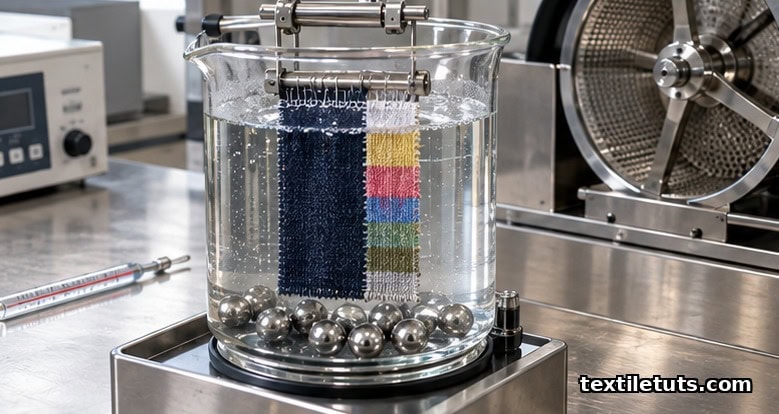
ISO 105 C06 tests colorfastness by agitating a 40 mm x 100 mm specimen sewn to a multifiber adjacent fabric in an ECE reference detergent bath at 40 to 95 °C for 30 minutes, with optional sodium perborate and 10 stainless steel balls depending on the chosen test condition. Shade change is rated 1 to 5 against the ISO 105-A02 grey scale, and cross-staining on each of the six fibers in the multifiber strip is rated 1 to 5 against the ISO 105-A03 grey scale.
If a customer has ever complained about a red sock turning a pink shirt grey in the wash, the answer almost always traces back to a test that should have predicted that exact failure. ISO 105 C06 is the standard that simulates the conditions of a domestic or commercial laundry cycle, and it is the test that most buyer specifications for dyed or printed fabrics call out by name.
What ISO 105 C06 actually measures
ISO 105 C06, formally titled “Textiles, Tests for colour fastness, Part C06: Colour fastness to domestic and commercial laundering,” sits inside the ISO 105 family of colorfastness tests. The standard subjects a textile specimen to a controlled combination of mechanical action, temperature, water, detergent, and (optionally) an oxidising bleach plus steel balls that intensify abrasion. After the wash cycle, two outcomes are measured: how much the specimen itself changes shade, and how much of its dye bleeds onto adjacent fibers it is sewn against.
The “C06” matters because it is specifically built to mimic household or commercial laundry, rather than dry cleaning (covered by C09), chlorinated water (C05), or industrial laundering (C08). When a buyer writes “must pass ISO 105 C06” in a purchase order, they are demanding evidence that the dye will survive ordinary machine washing for a defined number of cycles without ruining neighbouring garments.
The 24 test conditions: choosing A1S, C2S, or anything in between
ISO 105 C06 is not a single test. It defines 24 separate conditions, labelled by three variables stacked together. Picking the wrong condition is one of the most common reasons a lab and a customer disagree about whether a fabric passed.
| Letter | Temperature | Number | Sodium perborate | Suffix | Steel balls (6 mm) |
|---|---|---|---|---|---|
| A | 40 °C | 1 | None | S | 10 |
| B | 50 °C | 2 | Added | M | None |
| C | 60 °C | ||||
| D | 70 °C | ||||
| E, F, G | 95 °C |
So a condition labelled A1S means 40 °C, no sodium perborate, with 10 steel balls. C2S means 60 °C, with perborate, with steel balls. E1M means 95 °C, no perborate, no steel balls (a mild 95 °C wash). Most retail and brand specifications quote either C1S (the most common single condition for everyday apparel) or a multi-condition matrix such as A1S at 40 °C, C1S at 60 °C, and E1S at 95 °C to cover different care labels.
Materials and apparatus: ECE detergent, multifiber strip, steel balls
Three consumables control whether the test is reproducible across labs.
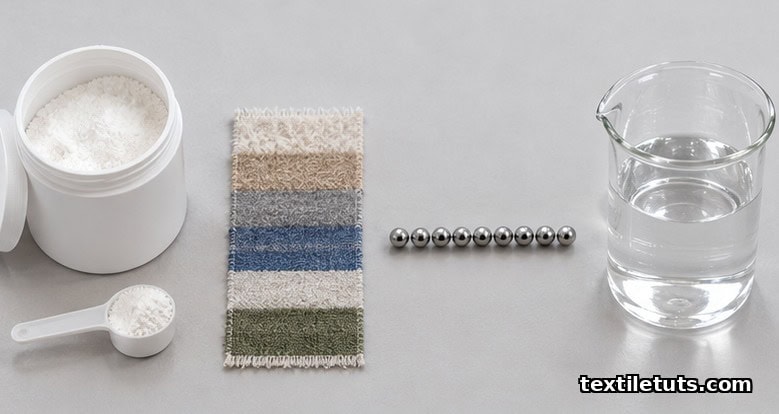
ECE reference detergent. The standard requires ECE Formulation Non-Phosphate Reference Detergent (sometimes written ECE-98), without optical brightener, with the exact composition published in the standard. It is the same detergent specified in ISO 105 C08 and several AATCC wash methods. Home detergents are not interchangeable, because their surfactant and builder composition varies by brand and batch, and would distort the result.
Multifiber adjacent fabric. The specimen is sewn to a 40 mm x 100 mm strip of multifiber fabric that contains six fiber bands: wool, acrylic, polyester, polyamide (nylon), cotton, and viscose (acetate is also an option in some multifiber types). The whole point of the test is to see which of them takes up the dye that bleeds out of the specimen.
Steel balls. When the condition calls for them, ten stainless-steel balls approximately 6 mm in diameter are added to each wash pot. They provide mechanical abrasion that mimics the rubbing a fabric experiences against a real machine drum and accelerates the action of any unfixed surface dye.
Liquor ratio and bath. The bath is set at a 1:50 ratio of specimen mass to liquor volume (so 2 g of specimen in 100 mL of solution). Sodium perborate is added at 1 g/L when the condition requires it. The bath temperature is held within ±2 °C of the condition’s target.
Step-by-step test procedure
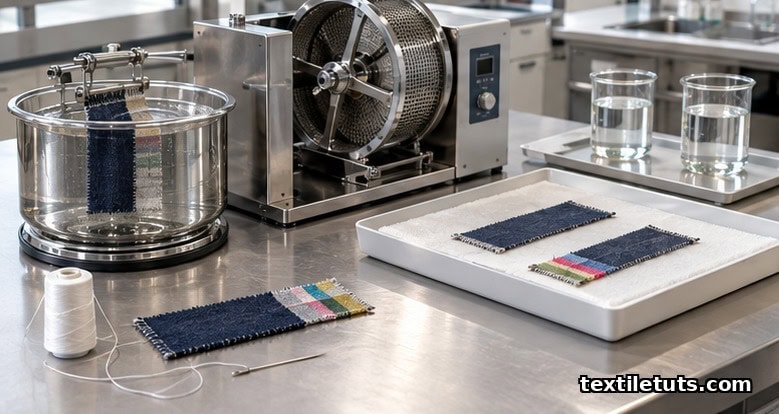
- Cut a 40 mm x 100 mm specimen and a same-size strip of multifiber adjacent fabric. Sew them together along one short edge with polyester thread.
- Prepare a fresh bath of ECE reference detergent at 5 g/L, with sodium perborate at 1 g/L added if the condition calls for it.
- Place the composite specimen, plus the specified number of steel balls, into the wash pot. Add the bath at the target temperature (40, 50, 60, 70, or 95 °C).
- Run the wash cycle for 30 minutes in a wash-wheel apparatus, or any equivalent mechanical-agitation bath approved in the standard.
- Rinse the composite in two changes of cold distilled water, then squeeze (do not wring) and dry flat at room temperature.
- Condition the dried composite for 4 hours at 20 °C and 65 % relative humidity before grading.
- Rate the change in shade of the specimen against the ISO 105-A02 grey scale, and rate the staining on each fiber band of the multifabric against the ISO 105-A03 grey scale.
Each grade is an integer from 1 (severe change, heavy staining) to 5 (no perceptible change or staining), with half-steps allowed. Most apparel buyers require a minimum of 3 to 4 on both shade change and staining.
Reading the results: the grey scales
Visual grading against grey scales is still the official method under ISO 105, even though instrumental colorimeters are now routinely used alongside it. The grey scale for change (ISO 105-A02) is a series of nine pairs of grey chips whose contrast steps are calibrated to perceived shade differences. The grey scale for staining (ISO 105-A03) does the same job for transferred dye, but the chips differ only in lightness, not hue. Both scales run from grade 5 (no perceptible difference) to grade 1 (large difference).
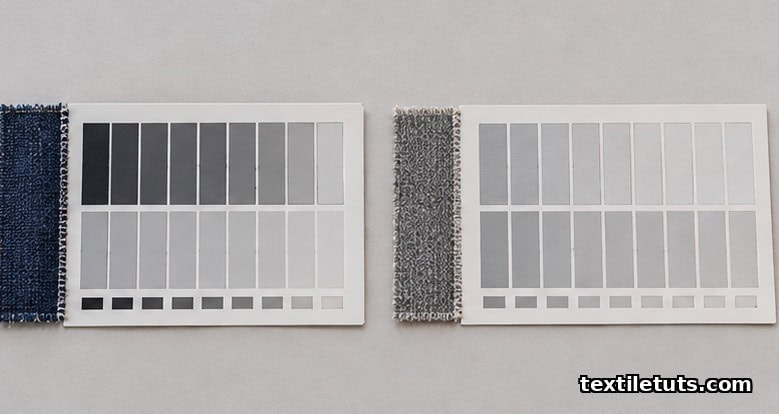
Under ISO 105-A02, grade 4 corresponds to a ΔE of roughly 2 to 3 in CIELAB units. Grade 3 covers ΔE up to around 6.5. Most retail buyers accept 4 as good enough for everyday wear, and 3 as the minimum for cost-sensitive product lines.
ISO 105 C06 vs AATCC 61 vs ISO 105 C08
| Parameter | ISO 105 C06 | AATCC TM 61 | ISO 105 C08 |
|---|---|---|---|
| Cycle length | 30 minutes | 45 minutes (most conditions) | 30 minutes |
| Detergent | ECE reference (5 g/L) | WOB (with or without bleach) | ECE reference |
| Steel balls | Optional, condition-dependent | Yes, more than 100 | Yes, around 25 |
| Temperature range | 40 to 95 °C | 30 to 71 °C | 40 to 92 °C |
| Typical end use | Apparel, home textiles | Same, US markets | Hospital and workwear |
AATCC Test Method 61 is the American equivalent and the one most US buyers will quote instead of C06. It runs at higher mechanical agitation for a shorter overall time, which makes it “accelerated”: a single AATCC 61 cycle is designed to simulate several domestic washes. ISO 105 C08 targets industrial laundering at hospital and workwear level, with more steel balls and hotter water than C06.
Common failure modes and what they really mean
A grade of 3 on shade change on a navy reactive-dyed cotton almost always points to incomplete wash-off after dyeing, especially of hydrolyzed reactive dye that is not covalently bonded to the fiber. A grade of 2 on cotton-band staining from a red reactive dye typically means the dyeing stage cut the soaping time short, or the dye-fixation rate was lower than the recipe assumed.
For disperse-dyed polyester, a grade of 3 on polyester-band staining usually traces back to insufficient reduction clearing, because residual surface dye on hydrophobic fiber is the first thing to bleed in a hot C06 cycle. For acid-dyed nylon, bleeding onto the polyamide band of the multifiber is the usual tell-tale sign that the dyebath pH drifted above the isoelectric range where the dye is supposed to be locked onto the fiber.
When only one or two specimens out of a batch fail, the lab usually repeats the test on a fresh sample before flagging a non-conformance. When three or more consecutive specimens fail at the same condition, the buyer almost always has grounds to reject the lot.
Frequently Asked Questions
What is the difference between ISO 105 C06 and AATCC Test Method 61?
Both simulate domestic laundering, but AATCC 61 runs at higher mechanical agitation for a shorter total time, so each condition is treated as accelerated, meaning one cycle of AATCC 61 approximates several domestic washes. C06 is closer to a single real wash. The choice between them is usually driven by where the buyer is based and what their internal specification calls out.
Why are steel balls added to some conditions but not others?
Steel balls are mechanical-agitation multipliers. They reproduce the abrasion a fabric experiences against the drum of a real washing machine. The “M” (mild) suffix means no steel balls and is used when a customer wants to isolate the effect of chemistry from the effect of rubbing, for example on delicate knits or open weaves.
What is ECE reference detergent and why is it specified?
ECE Formulation Non-Phosphate Reference Detergent is a fixed-composition detergent whose recipe is published in the standard so any lab in any country can run a comparable test. Commercial laundry detergents vary in surfactant, builder, and optical-brightener content from batch to batch, so using one would make results non-reproducible.
Which test condition (A1S, C1S, etc.) should I choose?
Pick the condition that matches the care label on the finished garment. A garment labelled “machine wash cold” maps to A1S or A1M at 40 °C. A garment labelled “machine wash warm” maps to C1S at 60 °C. A towel or workwear labelled “machine wash hot” maps to E1S or G1S at 95 °C. Add perborate (the “2” series) when the spec calls for bleach-safe.
Can a failed ISO 105 C06 result mean a fabric cannot be sold?
It depends on the buyer’s grade threshold and the lot’s repeat-test record. A single failing specimen is usually retested before any commercial decision. A consistent failure across multiple specimens at the same condition, however, gives most buyers the contractual right to reject the lot or demand a discount, especially if the end customer has written the grade into their technical specification up front.
References
- ISO. ISO 105-C06:2010, Textiles, Tests for colour fastness, Part C06: Colour fastness to domestic and commercial laundering. International Organization for Standardization, Geneva.
- ISO. ISO 105-A02:1993, Textiles, Tests for colour fastness, Part A02: Grey scale for assessing change in colour. International Organization for Standardization, Geneva.
- ISO. ISO 105-A03:2019, Textiles, Tests for colour fastness, Part A03: Grey scale for assessing staining. International Organization for Standardization, Geneva.
- AATCC. AATCC Test Method 61-2013, Colorfastness to Laundering: Accelerated. American Association of Textile Chemists and Colorists, Research Triangle Park, NC.
- ISO. ISO 105-C08:2010, Textiles, Tests for colour fastness, Part C08: Colour fastness to industrial laundering. International Organization for Standardization, Geneva.
- Testex. ISO 105 C06, Colorfastness to Laundering Test. Testex Textile Testing Services, Hong Kong.
- Christie, R. M. Colour Chemistry. Royal Society of Chemistry, 2nd edition, Cambridge. (Background reference for dye-fiber bonding and wash-fastness chemistry.)
This article is the working reference for the ISO 105 C06 colorfastness to washing test. Editorial by Iftay Khairul Alam, TextileTuts. Sources: ISO 105-C06:2010, ISO 105-A02:1993, ISO 105-A03:2019, AATCC TM 61-2013, ISO 105-C08:2010, Testex, Christie (2015) as cited.


