
How to Write a Textile Engineering Thesis

A textile engineering thesis is a 15,000–25,000-word technical document built on standardized test methods (ISO 139, AATCC TM 135, ASTM D5034) in which 30–40% of the content is reserved for a literature review and the remaining 60–70% presents original experimental work that is defended orally for 20–40 minutes before a panel of three to five examiners under a published university rubric.
That single sentence carries every structural commitment a textile-engineering student signs when they register their thesis topic: a fixed word envelope, a fixed ratio of survey to experiment, and a fixed window of oral examination time. The rest of this article shows how to hit each of those numbers without losing marks on the ones that matter most: methodology, statistical treatment, and reproducibility.
You will see what each of the six to eight standard chapters does, how to anchor every test in an ISO/AATCC/ASTM method so your examiner cannot fault your procedure, and which writing mistakes drop marks on otherwise strong work.
What a Textile Engineering Thesis Actually Requires
Most universities publishing a thesis handbook specify a word band, a chapter template, and a citation style. Bangladesh University of Textiles (BUTEX) and Ahsanullah University of Science & Technology (AUST), for example, both expect a 15,000–25,000-word manuscript in six to eight chapters, an oral viva voce of 20–40 minutes, and external examiner reports. The same envelope applies at most South Asian and European textile-engineering departments, though individual rubrics vary.
A textile-engineering thesis differs from a generic engineering thesis in three ways that examiners actively test for. First, every physical property you report (tensile strength, air permeability, colorfastness, GSM, dimensional change) must reference a published standard method, and the conditioning atmosphere you used must be reported. Second, the literature review must trace fiber-to-fabric-to-finishing process logic, not just list citations, because textile problems live in the interaction between those three layers. Third, your experimental design must include a statistical plan (replicates, control treatment, significance level), because textile processes are inherently variable and a single run is not publishable.
Choosing a Topic That Survives Scrutiny
Strong textile-engineering thesis topics share four properties: they answer a question an industry reader cares about, they are answerable inside one academic year on equipment your lab actually has, they reference at least one international standard for the principal measurement, and they leave room for a statistical comparison. Weak topics fail one of those four tests, usually the equipment test.
Use this shortlist as a sanity check before you commit a topic to your supervisor:
- Process improvement (e.g. optimizing a singeing, desizing, or mercerizing parameter against a quality output measured on a published standard).
- Material comparison (e.g. comparing a woven geotextile to a nonwoven counterpart under ASTM D4595 wide-width tensile testing).
- Finish or dye performance (e.g. evaluating a new softener or natural-dye mordant against ISO 105-C06 wash-fastness cycles).
- Functional textile development (e.g. producing an antibacterial cotton fabric and testing it under AATCC TM 100 or ISO 20645).
Avoid topics that ask you to invent a new instrument, topics where your lab cannot produce 30+ replicate samples, and topics that depend on confidential industrial data. Those three categories produce thesis projects that stall in month four.
Literature Review Methodology
The literature review is not a list of paper titles. It is a structured argument that the gap your thesis fills actually exists, and that filling it is worth the effort. Plan it as a 4,500–10,000-word chapter (30–40% of a 15,000–25,000-word total) organized by sub-topic, not by author or year.
For a textile-engineering thesis, a useful literature review traces five threads:
- Fiber properties relevant to your substrate (cite a fiber-science textbook or an MDPI/ScienceDirect fiber review).
- Yarn or fabric construction relevant to your sample set (cite a peer-reviewed paper, not a generic encyclopedia entry).
- Chemical or mechanical processing in your topic area (cite the original method paper plus one or two follow-up studies).
- Standardized test methods you will use (cite ISO/AATCC/ASTM by standard number, not just by topic).
- Identified gap that your work addresses (the last paragraph of the review).
Cite peer-reviewed sources preferentially. Aim for at least 25 distinct references across the whole thesis, with at least 60% from peer-reviewed journals (ScienceDirect, MDPI, ResearchGate, Springer, Wiley) and at least 10% from international standards bodies (ISO, AATCC, ASTM). Encyclopedic sources (Wikipedia, Britannica) are acceptable only for definitions, never as primary evidence.
Experimental Design and Standardized Testing
This chapter is where textile-engineering theses live or die. Examiners look for three things in order: did you condition the samples correctly, did you pick the right standard method, and did you run enough replicates to support your statistical claims?
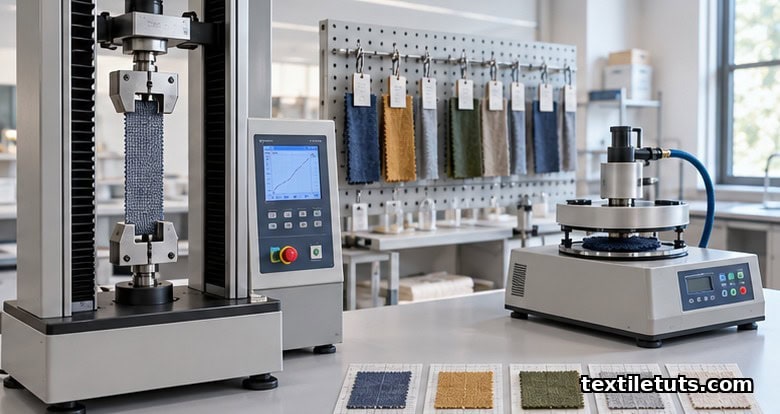
Sample conditioning is non-negotiable. ISO 139 specifies the standard atmosphere for textile testing as 20 ± 2 °C and 65 ± 2% relative humidity, with samples conditioned for 24 hours before weighing and testing. If your lab conditions differ, report what you actually used and acknowledge the deviation in your methodology section.
Pick the standard test method before you start running samples, not after. Common textile-engineering test standards include:
| Property | Standard | What it specifies |
|---|---|---|
| Tensile strength (grab) | ASTM D5034 | Breaking strength and elongation of woven fabrics |
| Tensile strength (strip) | ASTM D5035 | Breaking strength and elongation of textile fabrics (strip method) |
| Air permeability | ASTM D737 | Rate of air flow through a fabric under differential pressure |
| Colorfastness to washing | AATCC TM 135 / ISO 105-C06 | Dimensional change and color change after home laundering cycles |
| Colorfastness to light | ISO 105-B02 | Resistance to artificial light (xenon arc) |
| Colorfastness to crocking | AATCC TM 8 | Transfer of color from fabric to crocking cloth by rubbing |
| Fabric weight (GSM) | ISO 3801 / ASTM D3776 | Mass per unit area of woven or knitted fabric |
| Dimensional change | AATCC TM 135 | Shrinkage or growth after repeated home laundering |
| Formaldehyde release | ISO 14184-1 / AATCC TM 112 | Free and hydrolyzed formaldehyde in textiles |
| Bursting strength (knits) | ASTM D3786 | Bursting strength of knitted fabrics (ball-burst method) |
Run at least five replicates per treatment per direction (warp and weft, or course and wale for knits). Report the mean, the standard deviation, and the result of a t-test or ANOVA at a stated significance level (commonly α = 0.05). A single run, or three replicates, is a common reason examiners mark a textile thesis down for “insufficient statistical evidence.”
Writing Structure: Six to Eight Standard Chapters
Most textile-engineering departments expect the following chapter template. Adjust chapter numbering to your university’s handbook, but keep the order of logic.
- Introduction (800–1,500 words): states the problem, the gap, and the aim.
- Literature Review (4,500–10,000 words): the structured argument described above.
- Materials and Methods (2,000–3,500 words): substrates, chemicals, equipment, standards used, conditioning atmosphere, statistical plan.
- Results and Discussion (4,000–6,000 words): tables, graphs, and interpretation against the literature.
- Conclusion and Recommendations (500–1,000 words): what you proved, what you did not prove, and what the next study should address.
- References (as long as it needs to be; aim for 25–50 entries).
- Appendices (raw data, sample calculations, statistical outputs).
Keep the introduction under 1,500 words. Examiners penalize bloated introductions that re-teach the reader the entire history of textile engineering before arriving at the aim. The first paragraph of the introduction should state the problem; the last paragraph of the introduction should state the aim in a single sentence.
Defense Preparation
The viva voce is a 20–40 minute oral examination, usually split into a 10–15 minute student presentation and a 10–25 minute examiner question period. Prepare three things in advance: a 10–12-slide presentation that walks the panel through aim, methodology, key results, and conclusion; a one-page summary of every standard you used and the deviation you allowed; and a printed copy of every reference cited, in case an examiner asks you to defend a citation.

The questions examiners typically ask fall into four buckets: why you chose this topic, why you chose this method, what your statistical evidence supports, and what you would do differently with another six months. Prepare a one-sentence answer to each. If your answer to the last question is “nothing,” your examiner will mark you down for a lack of reflective practice.
Frequently Asked Questions
How long does it take to write a textile engineering thesis?
Most full-time textile-engineering students register their topic in semester six or seven, finish their experimental work by semester seven, and submit the manuscript in semester eight. That gives roughly 12 months from topic registration to submission. Part-time students typically extend to 18–24 months. Plan your literature review to be 80% complete before you begin your first lab run, because literature gaps surface during writing, not during experimentation.
How many references does a textile engineering thesis need?
Aim for 25–50 distinct references. At least 60% should come from peer-reviewed journals (ScienceDirect, MDPI, ResearchGate, Springer, Wiley), at least 10% from international standards (ISO, AATCC, ASTM), and the remainder from textbooks, conference proceedings, or technical reports. A literature review dominated by websites and trade magazines will be marked down, even if the writing itself is strong.
What is the biggest mistake students make in a textile engineering thesis?
Running experiments before finalizing the methodology. If you change your standard test method halfway through sampling, your data sets are no longer comparable, and your ANOVA loses power. Lock the standard method (with standard number), the conditioning atmosphere, the sample size, and the statistical plan in writing, and submit that lock to your supervisor for approval before you start the first run.
Do I need to publish a journal paper from my thesis?
Most universities do not require it for graduation, but a thesis that produces one peer-reviewed conference paper or one short journal article is significantly stronger on a CV and on the examiner’s report. Plan for one journal submission in the final semester, using the thesis results as the data backbone. Target a journal indexed in Scopus or Web of Science in the textile-engineering subfield (e.g. Journal of the Textile Institute, Cellulose, Fibers and Polymers, Textile Research Journal).
Can I use AI tools to help write my thesis?
You can use AI tools for language polishing, reference formatting, and figure captions, but the experimental work, the data interpretation, and the original argument must be yours. Your university’s academic-integrity policy will treat undisclosed AI authorship as plagiarism. Disclose any AI assistance in your acknowledgements or methodology section, and keep drafts you can show your supervisor so the writing process is auditable.
References
- International Organization for Standardization. ISO 139:2005 — Textiles: Standard atmospheres for conditioning and testing. iso.org — specifies the 20 ± 2 °C and 65 ± 2% RH conditioning atmosphere for all textile physical testing.
- ASTM International. ASTM D5034-21 — Standard Test Method for Breaking Strength and Elongation of Textile Fabrics (Grab Method). astm.org — the primary standard for woven-fabric tensile strength in textile-engineering laboratories.
- ASTM International. ASTM D737-18 — Standard Test Method for Air Permeability of Textile Fabrics. astm.org — air-flow rate measurement under differential pressure, used in technical-textile and finishing studies.
- AATCC. AATCC TM 135 — Dimensional Changes of Fabrics after Home Laundering. aatcc.org — the standard wash-cycle protocol used in most shrinkage and colorfastness thesis work.
- International Organization for Standardization. ISO 105-B02:2014 — Textiles: Tests for color fastness, Part B02: Color fastness to artificial light (xenon arc fading lamp test). iso.org — the light-fastness standard required for any thesis claiming UV resistance.
- International Organization for Standardization. ISO 14184-1:2011 — Textiles: Determination of formaldehyde, Part 1: Free and hydrolyzed formaldehyde (water extraction method). iso.org — the formaldehyde-release standard required for any thesis on resin-finished or easy-care textiles.
- ResearchGate / MDPI textile-engineering journal articles (e.g. Fibers, Polymers, Materials) — peer-reviewed primary literature for the literature-review chapter.
This article is the working reference for thesis writing in textile engineering. Editorial by Iftay Khairul Alam, TextileTuts. Sources: ISO 139, ISO 105-B02, ISO 14184-1, ASTM D5034, ASTM D737, AATCC TM 135 as cited.


