
Diploma vs BSc in Textile Engineering in the US

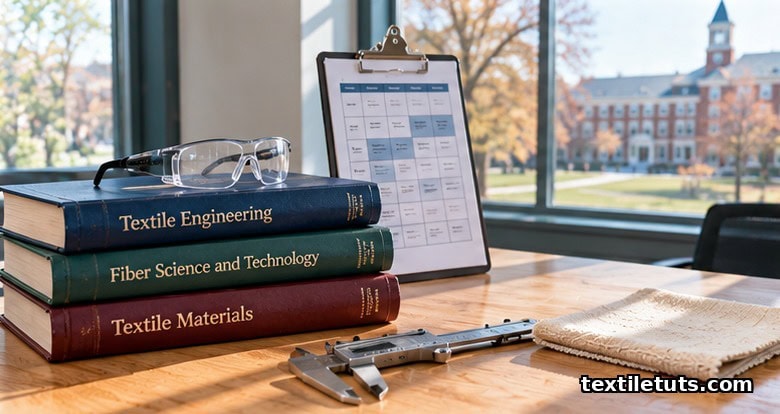
In the United States, a Bachelor of Science in Textile Engineering is a 4-year, 120 to 130 credit-hour program offered at fewer than 15 universities, while the post-secondary credential closest to a “diploma” is a 2-year Associate of Applied Science (AAS) at schools like the Fashion Institute of Technology, or a 9 to 18 month private vocational “diploma” that is not accredited by ABET and does not transfer into a BSc.
The label itself signals a mismatch worth understanding before enrollment: “diploma” in the South Asian or European sense, a 3 to 4 year technology credential that sits below a bachelor’s degree, does not exist as a separate classification in the US Department of Education’s post-secondary system, so the honest comparison is between a BSc, an AAS, and a short vocational certificate.
Below is what each pathway covers, what it costs in the US, what jobs it leads to, and how hiring managers read the credential on a resume.
How the US classifies textile credentials
The US Department of Education’s Classification of Instructional Programs (CIP) lists Textile Sciences and Engineering under CIP code 19.0902. Programs in this family are delivered as bachelor’s, master’s, and doctoral degrees by research universities, and as 2-year associate degrees by community colleges and fashion institutes. The word “diploma” appears in US higher-education vocabulary mainly in three places: a high school diploma (not post-secondary), a hospital or nursing school diploma (a 2 to 3 year hospital-run credential), or a private vocational school’s “diploma” certificate, which is usually 1 year or less and is generally not recognized for transfer credit by ABET-accredited universities.
For a student comparing programs in 2026, this means a US “diploma in textile engineering” offered by a private trade school is, in practice, a non-credit-bearing certificate with no transfer pathway into a BSc and no engineering accreditation. That single fact reframes the rest of the comparison and is the reason most textile engineers in the US either hold a BSc or come up through a 2-year AAS that ladders into a 4-year degree.
What a BSc in Textile Engineering covers in the US
A US BSc in Textile Engineering, Textile Technology, or Textile Chemistry is a 4-year program that combines roughly 60 credits of general education, calculus, statistics, and chemistry prerequisites with 60 to 70 credits of major-specific engineering coursework. The Wilson College of Textiles at NC State University, the School of Materials Science and Engineering at the Georgia Institute of Technology, the Department of Plastics and Textiles Engineering at the University of Massachusetts Lowell, and the School of Textiles and Design at Thomas Jefferson University are the four most cited textile engineering programs in the US. Each requires a foundation in calculus, statistics, organic chemistry, polymer science, and thermodynamics before students move into yarn formation, woven and knitted fabric design, dyeing and finishing chemistry, and nonwoven process engineering.
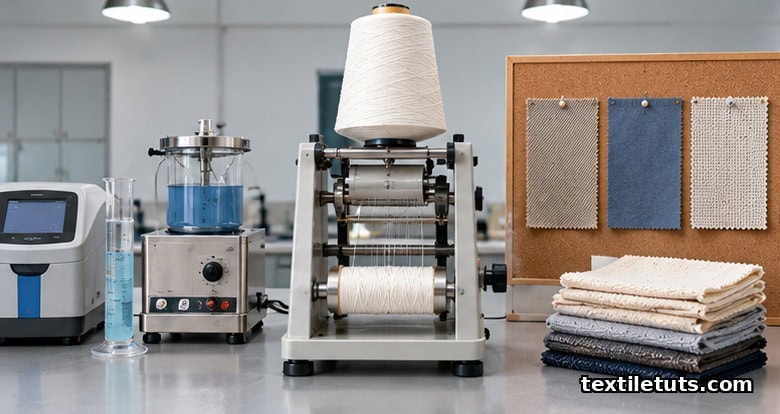
ABET-accredited programs in textile-related fields (typically Materials Engineering or Chemical Engineering criteria) require documented student outcomes in mathematics, experimentation, design, and professional responsibility, which is the structural reason why a BSc graduate can sign engineering drawings, sit for the Fundamentals of Engineering (FE) exam, and qualify for Engineer-in-Training (EIT) status on the path to a Professional Engineer license.
What an AAS in a textile-related field covers
An Associate of Applied Science is a 2-year, roughly 60-credit terminal degree designed to prepare students for specific technical jobs rather than to transfer into a 4-year program. Fashion Institute of Technology’s AAS majors in Textile Design, Fabric Styling, and Textile Development and Marketing are typical: the curriculum covers hand and digital loom weaving, print and pattern repeat construction, color theory, textile testing basics (often mapped to AATCC and ASTM test methods), and computer-aided design for textile surface work. Lab and studio hours are heavy, but the calculus, physics, and polymer science requirements that anchor a BSc are usually electives rather than core.

An AAS is well suited to a student who wants to be a textile designer, fabric sourcer, or quality control technician within 2 years. It is poorly suited to a student who later wants to become a process engineer, a research scientist, or a manufacturing manager, because those roles expect the calculus and polymer science foundation that an AAS does not require.
What a 1 to 2 year trade school diploma covers
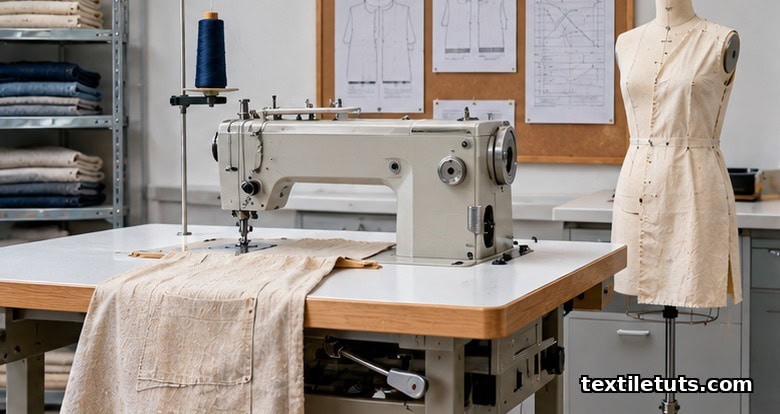
For-profit trade schools in the US do advertise “diploma” programs in fashion design, sewing, or alteration that run 9 to 18 months and focus almost entirely on studio practice. These programs are usually accredited by the National Association of Schools of Art and Design (NASAD) or by the Accrediting Commission of Career Schools and Colleges (ACCSC). They are not accredited by ABET and do not articulate into a BSc at a research university. Graduates typically enter the workforce as pattern makers, sewing machine operators, alteration specialists, or small-batch garment producers rather than as engineers or technical textile designers.
The total cost is the main reason a student might consider one. Published tuition at for-profit trade schools for a 1-year diploma is often USD 15,000 to 25,000 total versus USD 12,000 to 30,000 per year for in-state public BSc tuition, or USD 40,000 to 60,000 per year at a private US university. The trade-off is access: a trade-school diploma rarely qualifies its holder for jobs posted as “engineer” or “scientist.”
Cost, time, and accreditation comparison
| Factor | BSc Textile Engineering | AAS Textile-Related | Trade-School Diploma |
|---|---|---|---|
| Duration (full-time) | 4 years | 2 years | 9 to 18 months |
| Total credits | 120 to 130 | ~60 | Not credit-bearing |
| Engineering accreditation | ABET (where applicable) | Regional accreditation only | ACCSC or NASAD (vocational) |
| Tuition range (US) | USD 12,000 to 30,000/year (in-state public); USD 40,000 to 60,000/year (private) | USD 4,000 to 10,000/year (community college); USD 15,000 to 25,000/year (FIT) | USD 15,000 to 25,000 total |
| Common job titles | Process Engineer, R&D Engineer, Quality Manager | Textile Designer, Fabric Sourcer, QC Technician | Pattern Maker, Sewing Operator, Alteration Specialist |
| Median US salary band (2023 BLS) | USD 99,000 to 108,000 (engineering categories) | USD 40,000 to 55,000 (textile/apparel technician band) | USD 28,000 to 38,000 (sewing machine operator band) |
Career outcomes and salary data
The US Bureau of Labor Statistics classifies textile engineers under Materials Engineers (SOC 17-2131) and Industrial Engineers (SOC 17-2112). The BLS May 2023 Occupational Employment and Wages report lists the median annual wage for materials engineers at approximately USD 108,310 and for industrial engineers at approximately USD 99,380. For textile and apparel workers in sewing- and fabric-related occupations, BLS reports a much lower median, in the USD 30,000 to 40,000 band depending on the specific occupation.
The gap is structural, not just nominal. A BSc graduate can enter roles that BLS categorizes under engineering, where median pay is roughly 2.5 to 3x the apparel worker median, while an AAS or trade-school graduate typically enters roles that BLS categorizes under textile, apparel, and furnishings occupations, where the median is closer to USD 32,000 to 36,000. Over a 30-year career, that gap compounds into a six-figure lifetime earnings difference that far outweighs the tuition savings of a shorter credential.
Which path makes sense for which student
A BSc is the right path for a student who wants to design manufacturing processes, work in technical textiles (medical, automotive, geotextile, protective wear), pursue a master’s or PhD later, or sit for the Fundamentals of Engineering exam on the way to a Professional Engineer license. The 4-year cost is high, but the BSc opens the engineering job band and, with it, the salary band that BLS reports for materials and industrial engineers.
An AAS at a school like FIT is the right path for a student who wants a hands-on textile design or sourcing career within 2 years and is comfortable staying in design, merchandising, or quality control roles. Several community colleges and FIT will allow AAS credits to transfer partially into a BSc at a 4-year institution, which means an AAS can also be a 2+2 stepping stone if the student later decides to upgrade.
A trade-school diploma is the right path only for a student who wants to enter sewing, alteration, or small-batch garment production quickly and who is not aiming for engineering or technical textile roles. The cost is the lowest, but the credential ceiling is the lowest too, and the lack of accreditation means there is no clean path back into a BSc if plans change.
Frequently Asked Questions
Is there a 3-year diploma in textile engineering in the US?
No. The US Department of Education does not classify a 3-year technology diploma as a separate post-secondary credential. The closest US equivalent to a 3-year South Asian or European diploma is the 2-year AAS, which transfers some credits but does not carry engineering accreditation.
Can a US trade-school diploma transfer into a BSc program?
Generally no. Most ABET-accredited universities accept transfer credit only from regionally accredited institutions, and for-profit trade schools usually hold national rather than regional accreditation. Some credits may transfer on a case-by-case basis through a portfolio review, but no universal pathway exists.
Which US universities offer the strongest textile engineering BSc?
NC State University’s Wilson College of Textiles, Georgia Tech’s School of Materials Science and Engineering, the University of Massachusetts Lowell, and Thomas Jefferson University are the four most cited textile engineering programs in the US. NC State is the only US institution with a standalone college devoted to textiles.
Will I earn more with a BSc than with an AAS in textiles?
BLS May 2023 data places materials engineers at a USD 108,310 median annual wage and textile or apparel workers in the USD 30,000 to 40,000 range. The credential choice pushes the new graduate into one band or the other, which is roughly a 2.5 to 3x earnings gap that compounds over a career.
Is the textile engineering BSc market in the US shrinking or growing?
Traditional US apparel manufacturing has shrunk since the 1990s, but technical textiles (medical, automotive, geotextile, protective wear) and nonwovens continue to grow. The BLS projects 2 to 4% employment growth for materials engineers from 2023 to 2033, in line with the average for all occupations.
References
- US Bureau of Labor Statistics. Occupational Employment and Wages, May 2023: Materials Engineers (17-2131). https://www.bls.gov/oes/current/oes172131.htm
- US Bureau of Labor Statistics. Occupational Outlook Handbook: Industrial Engineers. https://www.bls.gov/ooh/architecture-and-engineering/industrial-engineers.htm
- ABET. Find Accredited Programs: Textile, Materials, and Related Engineering Programs. https://amspub.abet.org/apa/name/
- NC State University. Wilson College of Textiles. https://textiles.ncsu.edu/
- US Department of Education. Classification of Instructional Programs (CIP) 19.0902: Textile Sciences and Engineering. https://nces.ed.gov/ipeds/cipcode/cipdetail.aspx?y=56&cipid=89041
- AATCC. AATCC Technical Manual. https://www.aatcc.org/
- Fashion Institute of Technology. Textile Design (AAS). https://www.fitnyc.edu/academics/academic-catalog/undergraduate/textile-design-aas.php
This article is the working reference for diploma vs BSc in textile engineering in the US. Editorial by Iftay Khairul Alam, TextileTuts. Sources: US Bureau of Labor Statistics, ABET, NC State University Wilson College of Textiles, US Department of Education, AATCC, and Fashion Institute of Technology, as cited.


