
Textile Engineering Curriculum: Year-by-Year

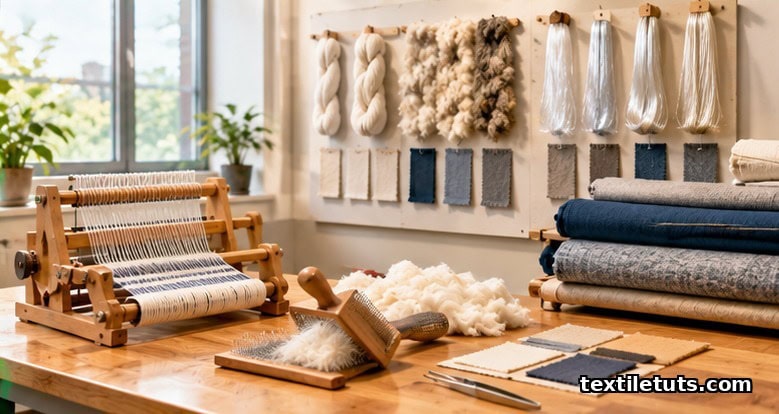
A four-year BSc in Textile Engineering in Bangladesh delivers 145 to 160 credit hours across eight semesters, with Year 1 reserving about 60% of contact hours for foundational sciences (chemistry, physics, mathematics, English) and Year 4 shifting to roughly 80% specialization plus a mandatory 12-week industrial attachment.
This curriculum shape is broadly consistent across Bangladesh University of Textiles (BUTEX), Ahsanullah University of Science & Technology (AUST), and the textile-engineering departments of Southeast University, Daffodil International University, European University of Bangladesh, and Port City International University, even where individual course titles vary. Students who complete the program graduate as textile engineers with hands-on exposure to fibers, yarns, fabric forming, wet processing, and apparel manufacturing, validated by standardized tests such as ASTM D5034 for tensile strength and AATCC 8 for crocking fastness.
Below is a year-by-year walkthrough of what a textile-engineering student typically studies, why each year is structured that way, and what graduates can expect at the end of the program.
Year 1: The Foundation Year (About 60% General Sciences)
The first year exists to bring every student, regardless of whether they entered from a science or vocational background, up to a common engineering platform. Most universities allocate about 36 to 40 credit hours across two semesters, of which roughly 22 to 24 credits are in basic sciences and the remaining 12 to 16 credits are textile-specific introductions.
Typical Year 1 courses include:
- Engineering Mathematics I & II (calculus, linear algebra, differential equations, statistics)
- Physics I & II (mechanics, heat, optics, electricity and magnetism, with a physics lab)
- Chemistry I & II (inorganic, organic, and physical chemistry, with wet-lab hours)
- English and Communication Skills (technical writing, oral presentation, report structure)
- Introduction to Textile Engineering (a survey course covering fiber to fabric, dyes, finishes, and the apparel supply chain)
- Engineering Drawing and CAD (2D drafting, pattern fundamentals)
The intent here is calibration. Textile processes are chemical, mechanical, and statistical at their core, so a student who cannot read a stress-strain curve or write a balanced chemical equation will struggle in Year 2. The first year also exposes students to a working textile lab, where they learn conditioning under ISO 139 (the standard atmosphere of 20 plus or minus 2 degrees Celsius and 65 plus or minus 2% relative humidity for textile testing) before they ever test a fabric.
Year 2: Yarn and Fabric Forming (About 50% Manufacturing, 50% Science)
Year 2 is where textile-engineering students first touch the machines that define the industry. Credit load typically rises to 38 to 42 hours, distributed between yarn manufacturing, fabric manufacturing, and supporting science courses such as polymer chemistry and mechanics of textiles.
Yarn Manufacturing Track
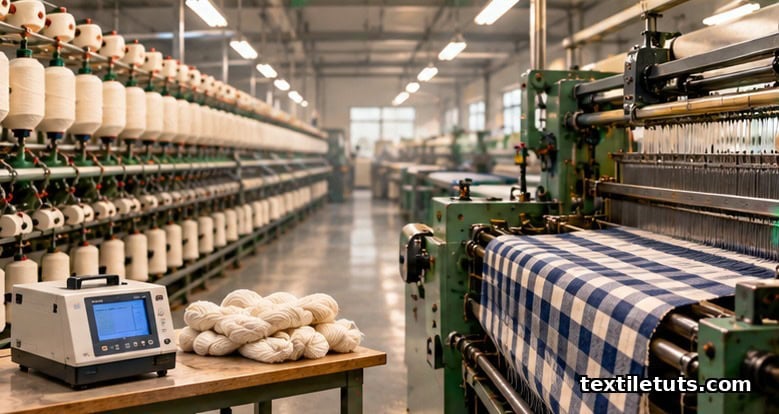
Students study the entire short-staple and long-staple spinning sequence: blowroom, carding, drawing, roving, ring spinning, and modern compact, rotor, and air-jet spinning. Lab work covers sliver hank, roving hank, yarn count (Ne, Nm, Tex, Denier), yarn twist multiplier, and evenness testing using Uster-class instruments. The objective is to understand how fiber properties (length, fineness, maturity, crimp) translate into yarn properties (strength, hairiness, CV%) once the fibers are drafted and twisted.
Fabric Manufacturing Track
Parallel to yarn, students learn weaving preparation (winding, warping, sizing, drawing-in) and the fundamentals of weaving (shedding, picking, beat-up, take-up) on both conventional and modern looms. Knitting is introduced, including weft knitting (jersey, rib, interlock) and warp knitting (tricot, raschel) structures, with hands-on machine work.
Typical Year 2 courses:
- Yarn Manufacturing I & II (with lab)
- Weaving Preparatory and Weaving I (with lab)
- Knitting I (weft knit fundamentals)
- Polymer Chemistry and Fiber Science
- Mechanics of Textile Structures
- Textile Testing I (physical testing of fibers and yarns)
- Statistics for Engineers
Testing in Year 2 introduces standardized methods such as ASTM D3776 for fabric mass per unit area (GSM), ASTM D5034 for tensile strength, and ASTM D1424 for tearing strength. These three tests are foundational because every later claim about a fabric’s quality is reported against them.
Year 3: Wet Processing and Apparel (About 60% Process, 40% Application)
Year 3 is the pivot from “making the fabric” to “coloring, finishing, and assembling it.” Students typically take 38 to 42 credits concentrated in three streams.
Wet Processing Stream
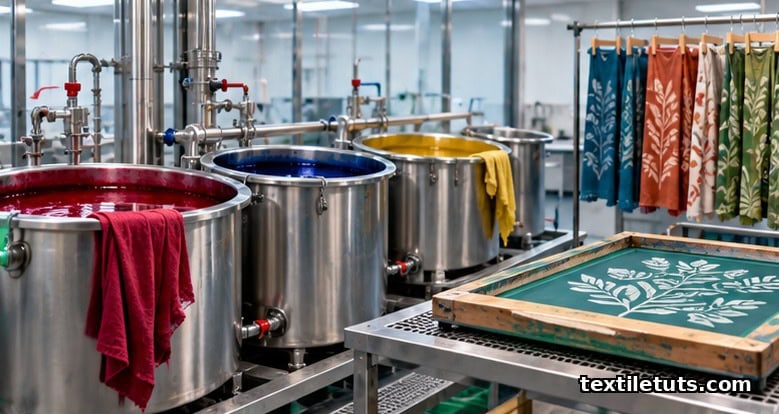
This stream covers pretreatment (desizing, scouring, bleaching), dyeing (reactive, disperse, acid, vat, direct dyes), printing (screen, rotary, digital), and finishing (softening, anti-crease, water-repellent, flame-retardant). Lab work trains students to set a dyeing recipe, run a pilot dyeing machine, evaluate color fastness, and identify defects like barriness, listing, or uneven shade. Color fastness standards introduced in this year include AATCC 8 (crocking), AATCC 16 (lightfastness), AATCC 61 (laundering), and ISO 105-C06 (single-cycle domestic laundering colorfastness).
Apparel Manufacturing Stream
This is where pattern making, cutting, sewing, and assembly become concrete. Courses cover garment construction, marker planning, fabric consumption calculation (a working skill reinforced by TextileTuts’ woven-shirt and T-shirt fabric-consumption calculators), industrial engineering in apparel, and quality control in sewn products.
Technical Textiles and Management Electives
Year 3 also introduces technical textiles (medical, geotextile, protective, agrotextile) and textile management subjects such as production planning, supply-chain fundamentals, and lean manufacturing. These electives are where a student starts to lean toward a career path.
Typical Year 3 courses:
- Textile Dyeing I & II (with lab)
- Textile Printing and Finishing
- Apparel Manufacturing I & II
- Pattern Making and CAD
- Technical Textiles
- Textile Testing II (chemical testing, color measurement, fastness)
- Industrial Engineering in Textiles
Year 4: Specialization, Industrial Attachment, and Thesis (About 80% Specialization)
Year 4 is the shortest in credits (about 30 to 36 hours) but the heaviest in independent work. Students take departmental electives in their chosen stream, complete a 12-week industrial attachment (also called industrial training or internship), and submit a thesis or project, typically a 6 to 12 month experimental study on a textile problem, often co-supervised by an industry mentor.
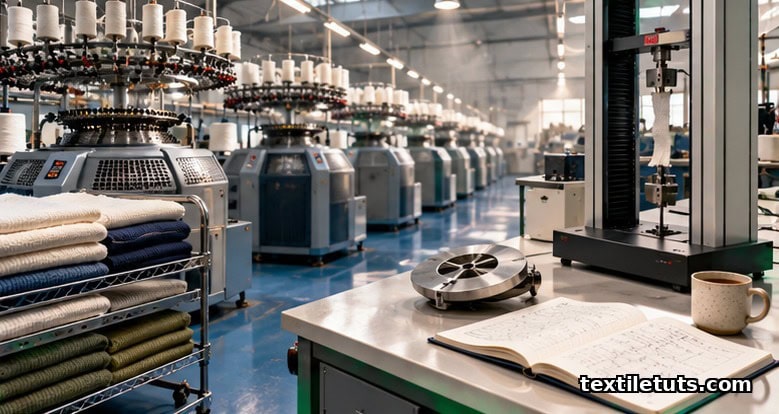
Common Specialization Tracks
- Yarn Engineering: advanced spinning, fancy yarn, yarn structure optimization, composite yarn.
- Fabric Engineering: advanced weaving, knit structure engineering, nonwoven technology, smart fabric development.
- Wet Process Engineering: advanced dyeing and finishing, sustainable chemistry, effluent treatment, dye-house management.
- Apparel Engineering: garment merchandising, lean manufacturing, work-study, compliance and social auditing.
- Textile Chemistry: dye chemistry, polymer synthesis, textile auxiliaries, analytical chemistry.
Industrial Attachment
Twelve weeks on a factory floor is not optional at most Bangladesh universities. Students are placed in spinning mills, weaving factories, dyehouses, knit composite units, or technical-textile plants. They submit a daily log, a mid-attachment review, and a final report that is defended before a faculty panel. For students who intend to work in operations rather than research, this attachment often functions as their first real job interview.
Thesis / Project Work
The thesis runs alongside coursework in Year 4. Common thesis formats include experimental work (e.g., “Effect of plasma pretreatment on dye uptake of PET fabric”), industrial problem studies (e.g., “Reducing needle marks in knit garments through alternative machine settings”), and literature-based critical reviews. Theses are read by an internal examiner and an external examiner, then defended orally.
Credit Distribution and Subject Weighting
The table below summarizes how credits typically distribute across the four years in a Bangladesh BSc Textile Engineering program, based on BUTEX, AUST, and Southeast University curricula.
| Subject Area | Year 1 | Year 2 | Year 3 | Year 4 | Total Share |
|---|---|---|---|---|---|
| Basic Sciences (Chemistry, Physics, Math) | 22 to 24 | 6 to 8 | 0 to 2 | 0 | 20 to 22% |
| Yarn Manufacturing | 0 to 2 | 8 to 10 | 4 to 6 | 3 to 5 | 14 to 16% |
| Fabric Manufacturing (Weaving, Knitting, Nonwoven) | 0 to 2 | 8 to 10 | 4 to 6 | 3 to 5 | 14 to 16% |
| Wet Processing (Dyeing, Printing, Finishing) | 0 | 0 to 2 | 10 to 12 | 4 to 6 | 12 to 14% |
| Apparel Manufacturing | 0 | 0 to 2 | 8 to 10 | 4 to 6 | 10 to 12% |
| Textile Testing and Quality Control | 2 | 4 | 4 | 2 | 8 to 10% |
| Technical Textiles and Management | 0 | 0 | 4 to 6 | 6 to 8 | 8 to 10% |
| Industrial Attachment and Thesis | 0 | 0 | 0 | 10 to 12 | 8 to 10% |
| Humanities, Communication, Electives | 6 to 8 | 2 to 4 | 2 | 0 to 2 | 8 to 10% |
The numbers above reflect credit-weight percentages, not contact hours, and individual universities vary. Two takeaways are consistent across institutions: basic sciences dominate Year 1, and applied specialization (yarn, fabric, wet, apparel) only becomes the majority of the load from Year 2 onward.
Frequently Asked Questions
How long is a textile engineering degree?
A BSc in Textile Engineering is a four-year, eight-semester program totaling 145 to 160 credit hours. Some universities offer a five-year combined BSc-Master’s track, but the standard undergraduate credential takes four years plus a 12-week industrial attachment in the final year.
What is the difference between textile engineering and fashion design?
Textile engineering focuses on the science and manufacturing of fibers, yarns, fabrics, dyes, finishes, and garment production systems, with heavy emphasis on chemistry, testing standards, and process engineering. Fashion design focuses on aesthetic design, garment styling, illustration, and trend forecasting. Textile engineers run the machines; fashion designers decide what the machines make.
Is textile engineering hard, and will I need chemistry?
Yes, and yes. The Year 1 chemistry load (inorganic, organic, physical) is comparable to any other engineering branch. The good news is that most textile chemistry is applied and lab-based, so students who prefer hands-on work over abstract theory tend to do well. The single most-cited reason students drop the program is the chemistry load, not the math.
Can I get a textile engineering job without a master’s degree?
Yes. Most entry-level roles in spinning mills, dyehouses, knit composite factories, sourcing offices, and quality-control labs require only a BSc. A master’s (MSc in Textile Engineering, or an MBA in supply-chain or operations) is most useful for research roles in textile R&D, university teaching, or technical-textile product development, where it can add 18 to 36 months of training on top of the undergraduate degree.
Which textile engineering specialization has the strongest job market in 2026?
Apparel engineering and wet process engineering currently have the strongest demand from Bangladesh’s knit composite and dyehouse sectors, followed by technical textiles (medical, protective, and smart textiles). Yarn engineering roles remain stable but smaller in number, while traditional weaving has a thinner entry-level market because most new investment in Bangladesh is in knit, not woven, capacity.
References
- ASTM International. ASTM D5034 — Standard Test Method for Breaking Strength and Elongation of Textile Fabrics (Grab Test). ASTM Compass — defines the grab tensile-strength procedure used in most textile-engineering quality labs.
- ASTM International. ASTM D3776 / D3776M — Standard Test Methods for Mass Per Unit Area (Weight) of Fabric. ASTM Compass — the canonical GSM test method for woven and knit fabrics.
- AATCC. AATCC Test Method 8 — Colorfastness to Crocking: AATCC Crockmeter Method. American Association of Textile Chemists and Colorists — color-rubbing fastness used in apparel QC.
- AATCC. AATCC Test Method 16 — Colorfastness to Light. AATCC — xenon-arc lightfastness test used in textile chemistry labs.
- ISO. ISO 139:2005 — Textiles: Standard Atmospheres for Conditioning and Testing. International Organization for Standardization — the 20 plus or minus 2 degrees Celsius, 65 plus or minus 2% RH conditioning standard.
- ISO. ISO 105-C06:2010 — Textiles: Tests for Colour Fastness, Part C06: Colour Fastness to Domestic and Commercial Laundering. ISO — the single-cycle domestic laundering colorfastness test.
- Bangladesh University of Textiles (BUTEX). BSc in Textile Engineering: Curriculum Structure 2020 to 2024. BUTEX official academic bulletin — the reference four-year structure used by most Bangladesh textile-engineering departments.
This article is the working reference for the four-year textile-engineering curriculum in Bangladesh. Editorial by Iftay Khairul Alam, TextileTuts. Sources: ASTM D5034, ASTM D3776, AATCC 8, AATCC 16, ISO 139, ISO 105-C06, and the BUTEX curriculum bulletin, as cited.


