
Georgia Tech Materials Science & Engineering: Textile-Focused Programs


Georgia Tech’s School of Materials Science and Engineering (MSE) supports more than 240 graduate students and roughly 350 undergraduates across ABET-accredited BS, MS, and PhD programs, with textile-relevant research concentrated in its Polymer, Fiber, and Textile Sciences (PFTS) thread and the Renewable Bioproducts Institute (RBI).
Among U.S. public universities, Georgia Tech is one of a small group that explicitly integrates fiber and textile science inside a dedicated materials engineering school rather than a separate textile college, which makes it a useful comparison point for textile students evaluating materials-engineering programs.
This guide covers the degree pathways, the textile-focused research thread, the lab facilities that support fiber work, industry partnerships, and what textile students should know before applying.
Degree pathways at Georgia Tech MSE
The School of Materials Science and Engineering at Georgia Tech is one of the oldest materials departments in the United States. The program traces its origin to a 1907 metallurgy offering and evolved through ceramic engineering before adopting the broader materials science and engineering identity it carries today. The school sits within the College of Engineering and is consistently ranked in the top ten nationally for materials engineering graduate programs.
Three degree pathways exist:
- BS in Materials Science and Engineering. The undergraduate program is accredited by ABET under the Materials Engineering program criteria, and students choose a research thread of elective focus by the end of their second year.
- MS in Materials Science and Engineering. Available as a coursework track or thesis track, with the thesis option typically serving students progressing toward a PhD.
- PhD in Materials Science and Engineering. The research-intensive terminal degree, supported by research assistantships, teaching assistantships, and external fellowships such as the NSF Graduate Research Fellowship Program.
For textile-focused study, the relevant thread is PFTS. Students in this thread take foundational courses in polymer physics, fiber formation, and textile structure alongside the standard MSE core, which gives them a textile-relevant concentration without requiring a separate textile college.
The Polymer, Fiber, and Textile Sciences (PFTS) thread
PFTS is one of several undergraduate research threads offered by Georgia Tech MSE. It groups polymer chemistry, fiber spinning physics, and textile structure-property relationships into a coherent track and is the closest analog to a traditional textile engineering curriculum within a U.S. MSE school.

Coursework in PFTS typically includes polymer physics, fiber formation, characterization of soft materials, and elective options in technical textiles and nonwovens. Students complete a senior capstone project that is often sponsored by industry partners in the fiber, nonwoven, or performance textile sectors. The capstone experience frequently leads to co-authored publications or patent disclosures for high-performing students.
For graduate students, PFTS aligns with the polymer and soft matter research groups in MSE. Active research topics within these groups include:
- Electrospun nanofibers for filtration media and biomedical scaffolds
- Polymer crystallization and fiber spinning, including melt, solution, and gel spinning
- Mechanical and thermal characterization of yarns and fabrics following ASTM D2256 and related standards
- Functional finishes and surface modification of textile substrates for water repellency, antimicrobial performance, and dye uptake control
- Recyclable and bio-based polymer fibers sourced from renewable feedstocks
This breadth gives textile-focused students a path into traditional fiber manufacturing as well as emerging technical textile applications such as wearable sensors, energy-harvesting fabrics, and filtration media for indoor air quality.
The Renewable Bioproducts Institute (RBI)
The Renewable Bioproducts Institute (RBI) is one of ten Interdisciplinary Research Institutes (IRIs) at Georgia Tech. While not housed inside the MSE school, RBI is the primary hub for cellulose, paper, and bio-based fiber research on campus, and its industrial membership model is unusual for a U.S. research university.
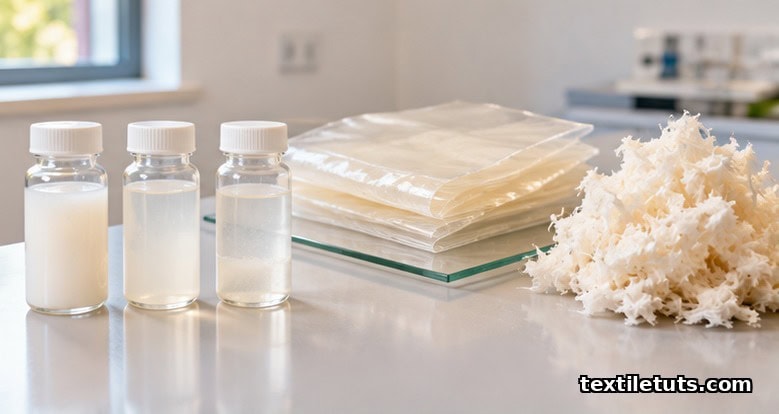
RBI’s research portfolio spans:
- Cellulose nanomaterials, including cellulose nanofibrils (CNFs) and cellulose nanocrystals (CNCs), and their composites
- Lignin valorization and biorefinery chemistry for sustainable aromatic feedstocks
- Forest-products-derived fibers and sustainable packaging substrates
- Bio-based adhesives and binders for textile and nonwoven applications
RBI regularly co-advises MSE graduate students, and its industrial members include pulp-and-paper, packaging, and consumer-products companies with active fiber programs. Students working on cellulose-based textile fibers often co-list RBI alongside their MSE advisor on publications and patents, which gives them direct exposure to industry review of their research direction.
RBI also operates an undergraduate research scholarship program that places BS students into active cellulose and bio-fiber labs during the academic year. For textile-focused undergraduates, this is one of the most reliable pathways into publishable research before graduation.
Research facilities and instrumentation
The MSE school maintains shared characterization facilities that textile-focused students use routinely. Access is typically through a per-hour recharge model after documented training, and lab managers run instrument-specific certification classes each semester.
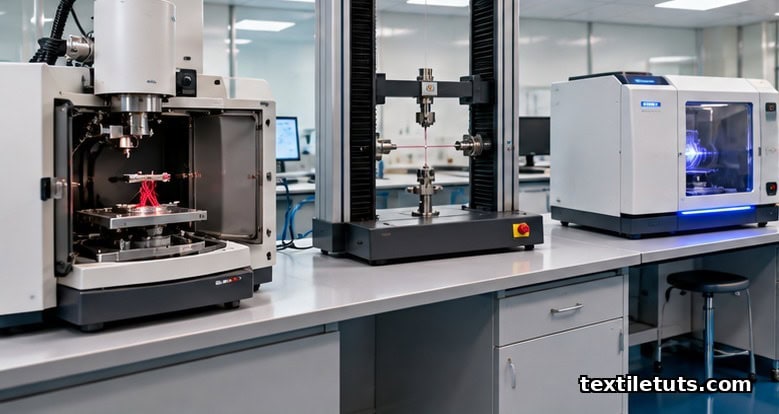
| Facility | Capabilities relevant to textile work |
|---|---|
| Electron Microscopy | SEM, TEM, and EDS for fiber surface morphology, cross-section imaging, and elemental mapping |
| X-ray diffraction lab | WAXS and SAXS for polymer fiber crystallinity, orientation, and lamellar spacing |
| Thermal Analysis | DSC, TGA, and DMA for fiber and fabric glass transition, crystallinity, and viscoelastic response |
| Mechanical Testing | Universal testing machines for tensile testing of yarns and fabrics per ASTM D2256 and ASTM D5035 |
| Rheology | Capillary and rotational rheometers for polymer melt spinning studies and fiber draw optimization |
For spinning-scale work, RBI operates a pilot facility with laboratory wet spinning, melt spinning, and film casting equipment. Pilot-scale fiber spinning equipment is rare on U.S. university campuses, and its availability at Georgia Tech is one of the practical advantages for fiber-focused MS and PhD projects that need to bridge bench chemistry with realistic process conditions.
Industry partnerships and career outcomes
Georgia Tech’s MSE graduates report strong placement in materials, aerospace, and consumer-products industries. The school publishes annual outcomes data with placement rates and median starting salaries by degree level. For textile-focused graduates specifically, employers include fiber producers, nonwoven roll-goods manufacturers, performance apparel brands, filtration companies, and national laboratories with textile or soft-matter programs.
Median starting salaries for MSE BS graduates have been published in the school’s annual outcomes reports. The figures vary year to year, but BS graduates typically start in a range comparable to other engineering disciplines at Georgia Tech, with MS and PhD graduates earning higher median compensation in research-intensive roles. Specific year-over-year numbers are available in the official annual report.
Industry partnerships matter for textile work because pilot-scale fiber spinning equipment is rare on U.S. campuses. RBI’s industrial membership model gives graduate students access to member-company mentors and, in some cases, sponsored capstone projects that translate directly to thesis chapters. Senior capstone projects sponsored by industry partners are also a regular feature of the BS PFTS thread.
How to apply to Georgia Tech MSE
Admission to the BS program is through Georgia Tech’s common application process. The MSE school does not run a separate departmental application for first-year admits. Internal transfer into MSE is possible after completing gateway courses in chemistry, physics, and calculus with the required grade thresholds, and transfer admission is competitive.
For MS and PhD admission, applicants submit official transcripts, a statement of purpose, and three letters of recommendation. The school’s GRE policy has shifted across recent cycles, and applicants should confirm the current requirement on the graduate admissions page before applying. Prospective students are encouraged to identify faculty whose research matches their textile interests and to mention that alignment in the statement of purpose. Reaching out to a potential advisor before applying often increases the chance of funded admission at the PhD level.
Application deadlines follow Georgia Tech’s graduate studies calendar, with PhD consideration typically complete by mid-December for fall admission and MS consideration rolling into the spring semester.
Frequently Asked Questions
Does Georgia Tech offer a dedicated textile engineering degree?
No. Georgia Tech does not offer a BS or MS labeled as textile engineering. The School of MSE integrates textile and fiber science inside a broader materials engineering curriculum, with the PFTS thread providing the textile-relevant elective concentration for undergraduates and polymer or soft-matter research groups supporting graduate work.
What is the PFTS thread?
PFTS stands for Polymer, Fiber, and Textile Sciences. It is one of several undergraduate research threads in the Georgia Tech MSE BS program and groups polymer physics, fiber spinning, and textile structure-property coursework into a coherent elective track.
Is the Georgia Tech MSE BS program ABET accredited?
Yes. The BS in Materials Science and Engineering is accredited by ABET under the Materials Engineering program criteria. The accreditation is verified through the ABET accreditation database and applies to the on-campus Atlanta degree.
What careers do MSE graduates with a textile focus pursue?
Common career paths include fiber process engineering at nonwoven and textile roll-goods manufacturers, R&D roles in performance apparel and filtration, technical service for dye and finish chemical suppliers, and PhD-track research positions in academia and national laboratories. Median starting compensation follows the broader Georgia Tech engineering pattern, with PhD graduates entering research-intensive roles at higher compensation than BS graduates.
Can undergraduates do textile research at Georgia Tech MSE?
Yes. The MSE undergraduate research program and the RBI undergraduate research scholarships place students in active fiber and bio-based materials labs. The Vertically Integrated Projects (VIP) program at Georgia Tech also hosts multi-year textile-related projects, and senior capstone projects in the PFTS thread are frequently sponsored by industry partners in the fiber sector.
References
- Georgia Institute of Technology, School of Materials Science and Engineering. Undergraduate Threads and Curriculum. URL: https://mse.gatech.edu/academics/undergraduate — official thread descriptions and curriculum maps.
- Georgia Institute of Technology, Renewable Bioproducts Institute. Research Areas. URL: https://rbi.gatech.edu/research — institute research portfolio in cellulose, lignin, and bio-based fibers.
- ABET, Inc. Accredited Program Search: Georgia Institute of Technology, Materials Engineering. URL: https://www.abet.org — ABET accreditation record for the MSE BS program.
- ASTM International. ASTM D2256: Standard Test Method for Tensile Properties of Yarns by the Single-Strand Method. URL: https://www.astm.org — tensile test standard for yarn mechanical characterization referenced in MSE lab work.
- ASTM International. ASTM D5035: Standard Test Method for Breaking Force and Elongation of Textile Fabrics (Strip Method). URL: https://www.astm.org — fabric tensile test standard used in MSE teaching labs.
- U.S. News & World Report. Best Graduate Schools: Materials Engineering. URL: https://www.usnews.com — graduate program rankings referenced for the MSE ranking figure.
- Springer Nature. Cellulose Nanomaterials in Textile Applications (review). URL: https://link.springer.com — peer-reviewed review on CNF and CNC applications in textiles, representative of RBI research output.
This article is the working reference for Georgia Tech Materials Science and Engineering textile-focused programs. Editorial by Iftay Khairul Alam, TextileTuts. Sources: Georgia Tech School of MSE, Renewable Bioproducts Institute, ABET, ASTM International, U.S. News, Springer as cited.


