
Tensile Strength Testing Experiment

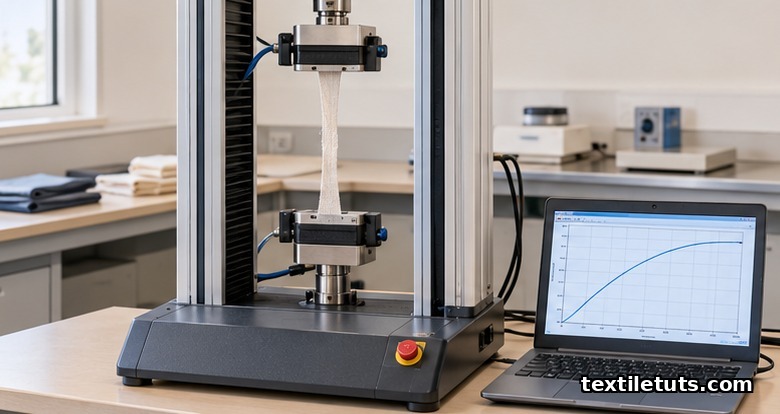
Tensile strength testing of a woven fabric follows the ISO 13934-1 strip method, in which a 50 mm wide and 300 mm long specimen is clamped in a universal tensile testing machine at a 200 mm gauge length and pulled at 100 mm/min until rupture, with the machine recording breaking force in newtons (N) and elongation at break as a percentage of the original gauge.
The result is a load-elongation curve from which the textile lab derives maximum force, elongation at maximum force, and (when sample weight is known) specific stress in N/tex, the unit preferred for comparing fibers on an equal-mass basis.
What follows is a step-by-step protocol that a textile-engineering student or QA technician can reproduce on a lab bench using a 5 kN universal testing machine, plus the calculations you will be asked to show on a thesis report or factory QC sheet.
What tensile strength testing actually measures
Tensile strength is the maximum tensile force a specimen carries before it ruptures, expressed in newtons (N) for an individual strip or in N/tex (force per linear density) when you want a fiber- or yarn-level value that does not depend on the cross-section of the sample.
The test gives three linked numbers:
- Maximum force (N) read at the peak of the load-elongation curve, also called breaking strength.
- Elongation at maximum force (%) read on the x-axis at the same instant, useful for stretch garments and parachute fabrics.
- Tenacity (N/tex) calculated as maximum force divided by the linear density of the yarns in the test width, which lets you compare cotton, polyester, and nylon on equal footing.
For routine fabric QC, most mills report force only. For fiber-level comparison (a cotton breeder comparing cultivars, or a thesis on a new blend), tenacity is the figure that matters because it strips out yarn count and fabric geometry.
Which standard applies: ISO, ASTM, or AATCC
Three families of methods cover textile tensile testing, and picking the right one depends on where the report will be read.
| Standard | Method | Specimen width | Typical use |
|---|---|---|---|
| ISO 13934-1 | Strip | 50 mm | European mills, academic research, Oeko-Tex supply chain |
| ISO 13934-2 | Grab | 25 mm gripped width | Knitted fabrics, lightweight wovens |
| ASTM D5035 | Strip | 50 mm (1.5 in) | North American apparel QC |
| ASTM D5034 | Grab | 25 mm (1.0 in) | North American woven QC |
| AATCC TM 111 | Strip, mechanical conditioning | 25 mm | Apparel end-use claims |
The grab and strip methods are not interchangeable. A strip test grips the full specimen width and forces the rupture zone to sit between the jaws. A grab test grips only the central 25 mm, which lets the edges crumple and concentrates stress at the jaw edge, so grab numbers are systematically lower than strip numbers for the same fabric. Most peer-reviewed textile-engineering papers cite ISO 13934-1 because the strip geometry is more reproducible across labs.
Equipment and consumables you need
The minimum kit to run this protocol:
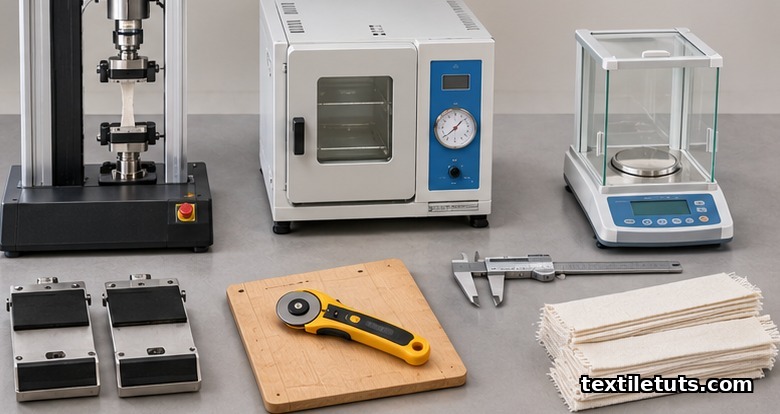
- Universal testing machine (UTM), 5 kN load cell or larger, with pneumatic or manual flat jaw grips. Entry models from Testometric, Instron 3340-class, or Tinius Olsen H5KT are adequate for fabric work.
- Flat jaw faces at least 50 mm wide × 25 mm tall, rubber-coated or with a pressure-sensitive film so the specimen does not slip or crush.
- Cutting die or template for 50 mm × 300 mm specimens (a hardwood template and a rotary cutter is the cheapest accurate option).
- Conditioning chamber at 20 ± 2 °C and 65 ± 4 % relative humidity per ISO 139, since cotton and viscose lose roughly 5 to 15 % tensile force between bone-dry and 65 % RH.
- Analytical balance reading to 0.001 g, for the linear-density back-calculation that gives tenacity.
- Personal protective equipment: safety glasses during cutting, closed shoes around the UTM.
Specimen preparation
Cut five warp-direction and five weft-direction specimens per ISO 13934-1 (the method allows a reduction to three when material is scarce, but five is the default in academic work). The standard sample size is what makes the result statistically useful: five specimens gives a coefficient of variation you can actually trust when you put it in a thesis.
- Pre-condition the fabric at 20 ± 2 °C and 65 ± 4 % RH for at least 24 hours per ISO 139.
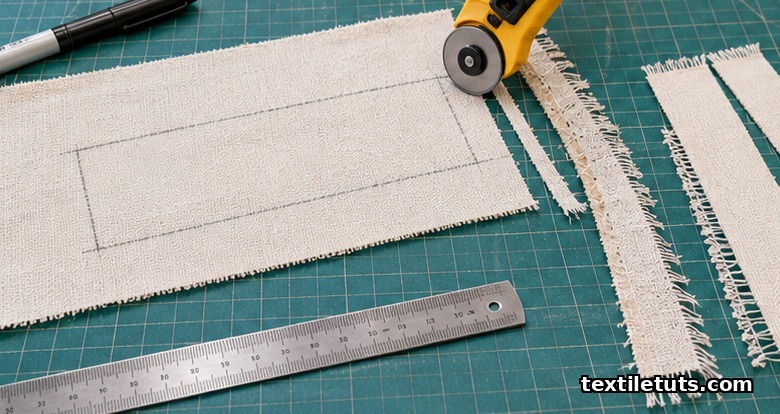
- Mark a 50 mm × 300 mm rectangle on the fabric with a permanent textile marker, keeping a 150 mm “fraying zone” beyond each end of the final test area. Cut just outside the marks.
- For woven fabrics, strip away the longitudinal yarns from each long edge of the test zone until the test width is exactly 50 mm. This fringe removal is what defines the strip method. Skipping it gives a misleadingly high force because the fringe yarns carry load after the central yarns break.
- Measure the actual stripped width with a vernier caliper at three points and average; record to 0.1 mm. A specimen whose width deviates by more than 1 mm from 50 mm is rejected.
- Condition the cut specimens for a further 4 hours in the standard atmosphere before testing.
Machine setup and test procedure
- Set the gauge length (jaw-to-jaw distance) to 200 mm. ISO 13934-1 allows 100 mm or 200 mm; 200 mm is the academic default because it gives a longer elongation signal for cotton and linen.
- Set crosshead speed to 100 mm/min for woven fabrics. For knitted fabrics and elastane blends, ISO 13934-1 drops the speed to 50 mm/min; for technical textiles like conveyor belts, ASTM D5035 lets you raise it to 300 mm/min.
- Clamp the specimen with the long axis vertical and zero the load cell. Apply just enough jaw pressure to prevent slip without crushing the yarn; 100 to 200 kPa is a starting point for flat rubber-faced jaws on cotton.
- Start the test. Record force at every 1 % strain increment or at 20 Hz, whichever is higher.
- Stop the crosshead at 10 N residual load (or when the specimen is fully separated) and return the crosshead to the start position.
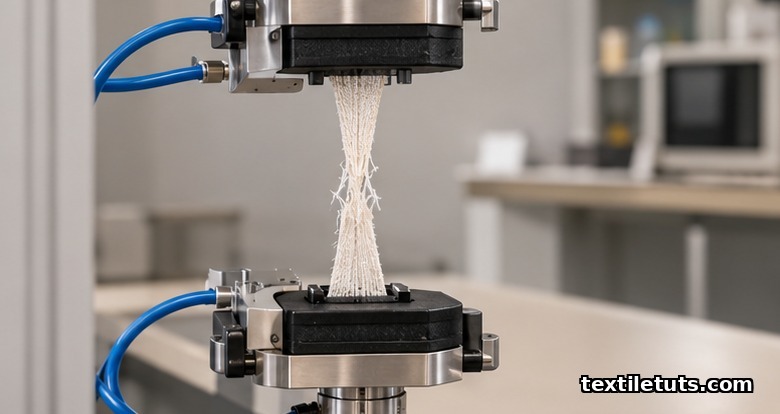
- Inspect the failure mode. A “jaw break” (failure within 5 mm of the jaw face) is invalid because the stress field there is non-uniform. Five specimens, all jaw breaks, means your grip pressure is wrong.
Reading the load-elongation curve
Three regions of the curve carry information. The initial steep region is the fiber-yarn alignment phase; the middle slope is the load-bearing phase dominated by the strongest yarn set; and the peak is the maximum force you report.
- Peak force = the breaking strength in N.
- Strain at peak (%) = (extension at peak / gauge length) × 100.
- Initial modulus (N/tex) = the slope of the steepest straight segment of the curve divided by linear density, useful for hand-feel claims about “stiff” versus “soft” fabrics.
Modern UTM software packages (Testometric winTest, Instron Bluehill, Tinius Olsen Horizon) print these values directly. For a thesis, also export the raw force-extension pairs as a CSV so you can replot in Python or Excel; the curve is part of the evidence.
Calculating tenacity in N/tex
To convert force into tenacity you need the linear density of the yarns in the test width. The back-calculation is:
Tenacity (N/tex) = Peak force (N) / [Number of yarns gripped × Yarn linear density (tex)]
For a 50 mm wide cotton plain weave with 20 ends/cm (i.e. 100 ends gripped across the 50 mm width), each yarn at 30 tex, the denominator is 100 × 30 = 3 000 tex. A peak force of 600 N gives a tenacity of 0.20 N/tex, which sits in the typical range for a 150 g/m² cotton shirting (literature range 0.15 to 0.30 N/tex warp direction for cotton, per Bhuvenesh Gohel and colleagues’ review of cotton tensile behavior).
Common errors that invalidate the result
- Skipping humidity conditioning. Cotton tested bone-dry shows tensile force values 10 to 20 % higher than at 65 % RH. Always condition first.
- Misaligned jaws. A 2 mm vertical offset between upper and lower jaws introduces a bending stress that drops measured tenacity by 15 %.
- Fringe left on the strip. Without fringe removal, warp yarns outside the jaw edge continue to carry load after the central yarns break and the reported force is too high.
- Crosshead speed too high. Above 300 mm/min on cotton, the result becomes rate-dependent because cotton is viscoelastic. Stay inside the standard speed.
- Reporting single specimens. A one-strip number is not a measurement; it is an anecdote. Always report mean and standard deviation across the five specimens.
Frequently Asked Questions
Which direction should I test: warp or weft?
Always test both warp and weft separately because they carry different yarn counts and densities, so their tensile behavior is different. A balanced weave will have similar warp and weft strengths; a typical sheeting will have the warp stronger because more ends per cm are crammed onto the loom. ISO 13934-1 requires at least five specimens in each direction.
Can I use the same protocol for knitted fabrics?
The same machine and the same 200 mm gauge length work, but switch to ISO 13934-2 (grab method) and drop the crosshead speed to 50 mm/min. Knits stretch before they break, so the strip method gives elongated strips that slip in the jaws; the grab method grips only the central 25 mm and is the method of record for jersey and interlock.
What is the anxiety question: why does my fabric break in the jaw?
Jaw breaks happen because the stress in the fabric transitions from uniaxial to a complex state over the jaw edge. The fix is to (a) reduce jaw pressure until the specimen just stops slipping, (b) use rubber-faced jaws or wrap the jaw faces with a thin card and a sheet of emery cloth, and (c) cut the specimen so the test zone extends at least 25 mm beyond the jaws on each end. If jaw breaks persist, the jaw faces are worn and need replacing.
How many specimens do I need for a publishable thesis number?
Five warp and five weft specimens per sample is the minimum for ISO 13934-1; for a thesis-level comparison of two finishes or two blends, run ten per direction and report mean, standard deviation, and a t-test or ANOVA. Anything below five gives a coefficient of variation you cannot defend in a viva.
What is the difference between tensile strength and tear strength?
Tensile strength is the force needed to pull a strip apart along its length. Tear strength is the force needed to propagate an existing cut or nick. A fabric can have very high tensile strength and very low tear strength (a thin polyethylene film) or low tensile strength and high tear strength (a loose-knit wool). For apparel QC, both matter; tear is measured separately by ISO 13937 (wing tear) or ASTM D2261 (tongue tear).
References
- International Organization for Standardization. ISO 13934-1:2013, Textiles — Tensile properties of fabrics — Part 1: Determination of maximum force and elongation at maximum force using the strip method. iso.org — defines the 50 mm specimen, 200 mm gauge, 100 mm/min crosshead speed, and the 5-specimen minimum.
- ASTM International. ASTM D5035-11(2019), Standard Test Method for Breaking Force and Elongation of Textile Fabrics (Strip Method). astm.org — North American strip-method equivalent to ISO 13934-1.
- AATCC. Test Method 111-2009, Breaking Strength of Elastic Fabrics (Grab Test). aatcc.org — mechanical-conditioning variant for stretch and elastic fabrics.
- International Organization for Standardization. ISO 139:2005, Textiles — Standard atmospheres for conditioning and testing. iso.org — defines the 20 ± 2 °C and 65 ± 4 % RH conditioning atmosphere.
- Bhuvenesh Gohel et al. Mechanical properties of cotton fabrics: a review. researchgate.net — survey of warp tenacity ranges for cotton shirting and the influence of yarn count.
- S. K. Mortuza et al. Tensile behavior of woven fabrics: effect of gauge length and crosshead speed. mdpi.com — experimental paper showing the rate-dependence of cotton tensile force and the rationale for the 100 mm/min default.
This article is the working reference for the tensile strength testing experiment in textile-engineering lab work. Editorial by Iftay Khairul Alam, TextileTuts. Sources: ISO 13934-1:2013, ISO 139:2005, ASTM D5035-11, AATCC TM 111-2009, Gohel et al. (RG), and Mortuza et al. (MDPI) as cited.


