
Tear Strength: ISO 13937 (Woven), ISO 13938 (Knit)

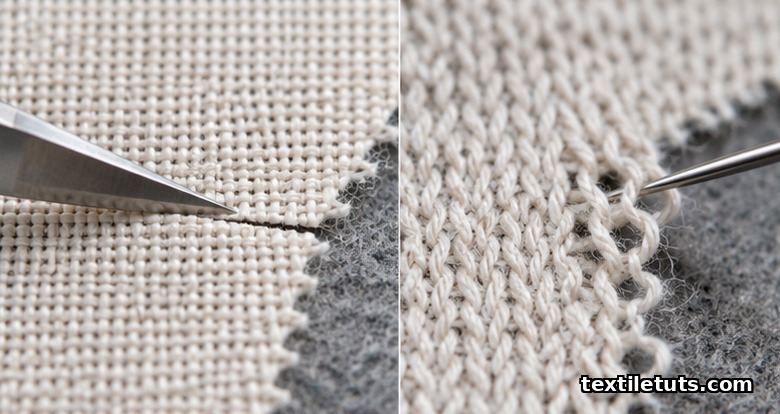
Woven fabric tear strength is measured under ISO 13937 (parts 1 to 4), which records tear force in newtons across four specimen geometries, while knit fabric strength is measured under ISO 13938 (parts 1 and 2), which records bursting pressure in kilopascals through a 50 cm² test area, because knit loops fail by yarn slippage rather than by the progressive yarn-by-yarn rupture seen in wovens.
The split exists for a structural reason. A tear in a woven fabric must break one yarn at a time, so the load curve builds in steps and the result is a force value. A tear in a weft-knit fabric unroos loops, gathers slippage, and converts a localized puncture into a large hole, so the more useful property is how much pressure the fabric can hold before it bursts. Picking the wrong method for the wrong structure gives misleading numbers, which is why laboratories separate the two ISO families.
This guide walks through what each ISO 13937 part does, how ISO 13938 covers the knit case, what specimen dimensions and loading rates the standards specify, where ASTM equivalents sit alongside them, and how engineers read the resulting numbers in mill quality reports.
Why the two ISO families are separate
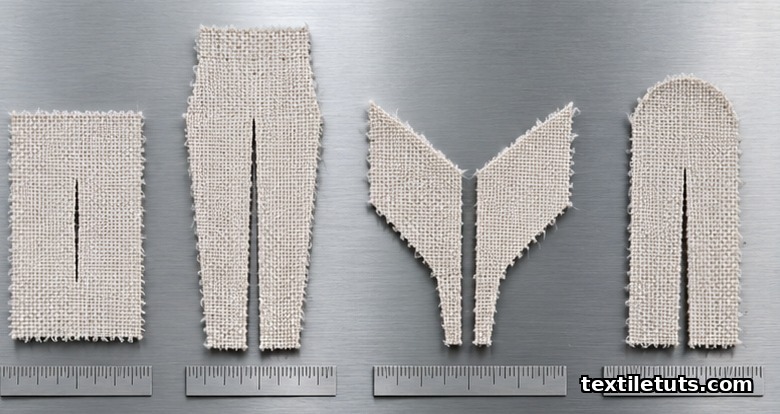
Woven and knit fabrics have different failure mechanics. In a plain weave, warp and weft yarns interlace at right angles, and once a small cut is introduced the tear propagates by breaking successive yarns in the same direction. Each broken yarn contributes a discrete load peak, and the average of those peaks defines tear strength. ISO 13937 captures this with pendulum, trouser, wing, and tongue specimens, depending on which geometry best represents the in-use stress.
In a weft knit, the yarns form interlocking loops. When a needle punches through, loops slide aside instead of breaking cleanly. The fabric does not “tear” so much as open up like a run in a stocking. That is why ISO 13938 specifies bursting pressure rather than tear force. The hydraulic or pneumatic pressure pushes a circular diaphragm against the fabric until the structure fails, and the peak pressure in kilopascals is the reported value. Using ISO 13937 on a knit gives a force number with very high variance, because the tear path keeps sliding sideways along a wale.
ISO 13937 for woven fabrics: the four parts
ISO 13937 is titled Textiles: Tear properties of fabrics, and the standard is split into four parts covering four specimen shapes and loading modes. All four report tear force in newtons. Conditioning follows ISO 139, with 65 percent relative humidity and 20 °C for at least 24 hours.
ISO 13937-1: Ballistic pendulum (Elmendorf)
Part 1 uses a ballistic pendulum tester, the same family as the older Elmendorf machine (now codified separately as ASTM D1424). A rectangular specimen, typically 100 mm long by 63 mm wide with a 20 mm pre-cut slit, is clamped on either side of the slit. A pendulum released from a fixed height swings through the specimen, tearing the fabric as it passes. The energy lost by the pendulum, read as a percentage of full scale, is converted to tear force in newtons. The pendulum capacity is usually 0 to 3200 cN or 0 to 6400 cN, and the result is calculated as the average of readings on five specimens in both warp and weft directions.
ISO 13937-2: Trouser-shaped specimen
Part 2 uses a trouser-shaped specimen, 50 mm wide by 200 mm long, with a 100 mm cut down the middle of one short end. The two legs are clamped in the upper and lower jaws of a constant-rate-of-extension (CRE) tensile tester and pulled apart at 100 mm/min. The tear force is taken as the median of the load peaks recorded across the central 80 percent of the tear path. This geometry is the most common choice for lightweight woven apparel fabrics such as shirting weight 80 to 120 g/m².
ISO 13937-3: Wing-shaped specimen
Part 3 uses a wing-shaped specimen, where two angled cuts at 55 degrees form a central tongue 25 mm wide. The wings are gripped and pulled apart at 100 mm/min. The wing geometry reduces the crosswise component of tear force and gives a cleaner single-peak response, which is useful when comparing wovens that show noisy trouser data. ISO 13937-3 is the preferred geometry for coated fabrics and for fabrics with very low yarn mobility.
ISO 13937-4: Tongue-shaped specimen (double tear)
Part 4 uses a tongue-shaped specimen, 200 mm long by 75 mm wide, with a center cut that creates a tongue. The tongue is gripped in one jaw and the two outer strips in the other, producing a double-tear action. ISO 13937-4 is the closest equivalent to ASTM D2261 (tongue tear) and is often quoted in technical data sheets for denim and heavier bottom-weight fabrics.
ISO 13938 for knit fabrics: the two parts
ISO 13938 is titled Textiles: Bursting properties of fabrics, and the test reports bursting pressure and bursting distension. Two methods are specified.
ISO 13938-1: Hydraulic method
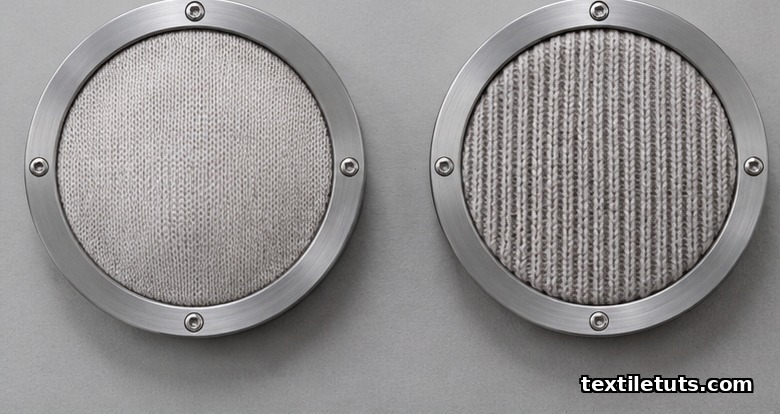
Part 1 uses a hydraulic diaphragm. The fabric is clamped over a circular test area of 50 cm² (diameter 79.8 mm), and a fluid pushes a circular rubber diaphragm against the underside of the fabric at a controlled volumetric flow rate of 100 cm³/min to 500 cm³/min. The peak pressure just before rupture is the bursting strength, reported in kilopascals, and the height the diaphragm traveled to reach that pressure is the bursting distension, reported in millimetres. The hydraulic method is preferred when the fabric must not contact a metal ring directly, for example on coated or laminated knits.
ISO 13938-2: Pneumatic method
Part 2 uses compressed air acting on a circular test area, again typically 50 cm², although a 100 cm² area is permitted for very extensible fabrics. The pressure rises at a controlled rate, usually 50 kPa/min to 500 kPa/min, until the fabric bursts. The pneumatic method is faster to set up and is widely used for routine QC of single jersey, interlock, and rib knits in knitting mills. Typical single-jersey results sit between 200 kPa and 500 kPa; rib and interlock knits usually read between 400 kPa and 900 kPa; heavy fleece can exceed 1000 kPa.
Choosing the right ISO part for the right fabric
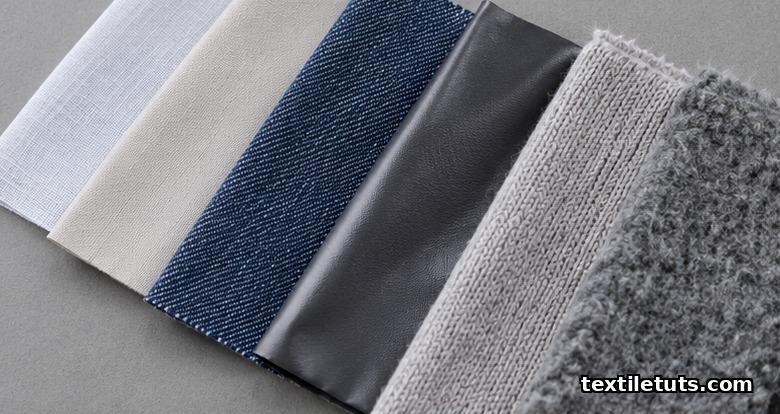
The table below maps typical fabric constructions to the part of ISO 13937 or ISO 13938 that engineers usually specify. Always defer to the buyer’s specification sheet, but this list captures the common defaults in third-party test reports.
| Fabric family | Test method | Typical specimen / area | Common unit | Typical range |
|---|---|---|---|---|
| Lightweight cotton shirting | ISO 13937-2 (trouser) | 50 mm × 200 mm | N | 8–25 N warp and weft |
| Denim, bottom weight | ISO 13937-4 (tongue) | 75 mm × 200 mm | N | 30–80 N warp, 25–60 N weft |
| Coated woven, technical textiles | ISO 13937-3 (wing) | 200 mm × 100 mm | N | 20–150 N |
| Light nonwoven interlining | ISO 13937-1 (ballistic) | 100 mm × 63 mm | N | 5–40 N |
| Single jersey cotton knit | ISO 13938-2 (pneumatic) | 50 cm² area | kPa | 200–500 kPa |
| Rib and interlock knit | ISO 13938-1 (hydraulic) | 50 cm² area | kPa | 400–900 kPa |
| Fleece and heavy knit | ISO 13938-1 (hydraulic) | 50 cm² area | kPa | 700–1200 kPa |
| Coated knit, laminated knit | ISO 13938-1 (hydraulic) | 50 cm² area | kPa | 500–1500 kPa |
How to read the test report
Most mill reports state the ISO part number, the loading rate, the number of specimens tested (almost always 5 per direction for wovens, 5 per sample for knits), the mean value, and the coefficient of variation. A coefficient of variation above 10 percent on woven tear is a flag, because tear is sensitive to yarn alignment at the cut. For knit bursting, a CV above 5 percent is usually worth investigating, since bursting tends to be more repeatable.
Two numbers engineers watch for are warp/weft balance on wovens and bursting distension on knits. A woven fabric with a warp tear of 60 N and a weft tear of 15 N is going to fray badly on the weft side, even though the warp looks strong. A knit with bursting strength of 450 kPa but a bursting distension of 30 mm is unusually stretchy, which may matter for printing or coating downstream.
ASTM equivalents and when to use them
ASTM maintains parallel methods that produce comparable but not identical numbers. ASTM D1424 is the Elmendorf pendulum test for woven tear, ASTM D2261 is the tongue tear, ASTM D5587 is the trapezoid tear, and ASTM D3786 covers bursting strength by hydraulic pressure on knit fabrics. The 2019 revision of ISO 13937-1 (ballistic pendulum) was aligned more closely with ASTM D1424, so cross-citing is now common in global supply chains.
Where ASTM and ISO differ in practice is in the specimen mounting jig and the calculation rule for averaging tear peaks. Buyers often specify the standard explicitly to remove ambiguity. If a tech pack says only “tear strength” without a part number, ask for either ISO 13937-2 / ISO 13937-4 for wovens or ISO 13938-1 / ISO 13938-2 for knits before comparing across suppliers.
Frequently Asked Questions
Why is ISO 13938 used for knit fabric instead of ISO 13937?
Knit fabrics fail by loop slippage rather than by progressive yarn rupture, so a tear test under ISO 13937 gives results with very high scatter and no clear failure peak. ISO 13938 measures bursting pressure, which is the property that actually predicts in-use failure for knits, including pilling holes, snags that turn into runs, and seam slippage near eyelets.
Can ISO 13937 and ASTM D2261 results be compared directly?
Not without noting the geometry. ISO 13937-4 (tongue) and ASTM D2261 both use a tongue-shaped specimen and a CRE tester, so the numbers are usually within 10 percent for similar fabrics. ISO 13937-2 (trouser) results run about 20 to 30 percent higher than tongue results on the same woven fabric because the load is concentrated at a single tear tip.
What specimen count is required for ISO 13937 and ISO 13938 reports?
Both standards call for 5 specimens per direction for woven tear (warp and weft counted separately) and 5 specimens for knit bursting. If the coefficient of variation exceeds 5 percent for bursting or 10 percent for tear, the standards recommend additional specimens or a check on yarn alignment and clamping pressure.
How does yarn count affect tear and bursting results?
Coarser yarns generally raise both tear and bursting because more fibre cross-section carries the load. A 20 tex weft in a plain weave usually tears 30 to 50 percent higher than a 14 tex weft in the same construction. Knit bursting is more sensitive to stitch density and loop length than to yarn count alone, so two fabrics with the same yarn but different stitch lengths can differ by 30 percent in bursting pressure.
Do fabric finishes change tear and bursting numbers?
Yes, often more than yarn count does. Softeners and lubricating finishes usually drop tear strength by 5 to 15 percent because the yarns slide more easily under the cut. Resin finishes and mercerization for cotton can raise tear strength by 10 to 25 percent because the yarns are stiffer and break rather than slide. For knits, singeing and compacting can shift bursting pressure by 5 to 10 percent in either direction.
References
- ISO 13937-1:2000, Textiles — Tear properties of fabrics — Part 1: Determination of tear force using ballistic pendulum method (Elmendorf). International Organization for Standardization, Geneva.
- ISO 13937-2:2000, Textiles — Tear properties of fabrics — Part 2: Determination of tear force of trouser-shaped test pieces (single tear method). International Organization for Standardization, Geneva.
- ISO 13937-4:2007, Textiles — Tear properties of fabrics — Part 4: Determination of tear force of tongue-shaped test pieces (double tear method). International Organization for Standardization, Geneva.
- ISO 13938-1:1999, Textiles — Bursting properties of fabrics — Part 1: Hydraulic method for determination of bursting strength and bursting distension. International Organization for Standardization, Geneva.
- ISO 13938-2:2019, Textiles — Bursting properties of fabrics — Part 2: Pneumatic method for determination of bursting strength and bursting distension. International Organization for Standardization, Geneva.
- ASTM D1424-21, Standard Test Method for Tearing Strength of Fabrics by Falling-Pendulum Type (Elmendorf) Apparatus. ASTM International, West Conshohocken, PA.
- ASTM D3786/D3786M-18, Standard Test Method for Bursting Strength of Textile Fabrics—Diaphragm Bursting Strength Tester Method. ASTM International, West Conshohocken, PA.
- Hu, J. (2008). Fabric Testing, Chapter 4: Tensile, tearing and bursting properties of fabrics. Woodhead Publishing, Cambridge.
This article is the working reference for woven tear and knit bursting testing under the ISO 13937 and ISO 13938 families. Editorial by Iftay Khairul Alam, TextileTuts. Sources: ISO 13937-1/-2/-4, ISO 13938-1/-2, ASTM D1424, ASTM D3786, and Hu (2008) as cited.


