
Temple in Weaving

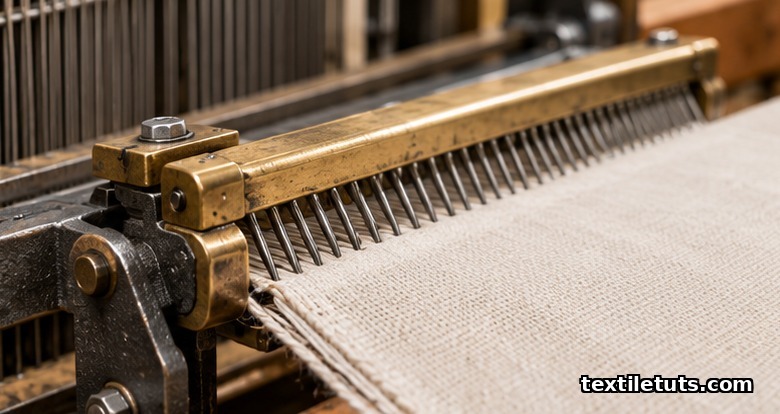
A temple is a fabric-stretching device mounted at the fell of the cloth on a weaving loom that grips the outermost warp ends near the selvedge and holds the woven fabric at its full reed width, preventing up to 8–15% width-wise contraction that would otherwise occur after beat-up and during take-up.
It performs this function continuously through every pick, transferring the inward-pulling forces on the warp ends into the cloth and relieving the selvedge yarns of the lateral tension that causes cracking, distortion, and uneven fabric width at the loom.
This guide covers what a temple is and how it is mounted on a loom, the five main temple designs used in cotton, worsted, silk, and technical weaving, the operating principle behind each, the measurable effects on cloth quality, the fabric-type rules that drive temple selection, and the maintenance practices that keep a temple serviceable across millions of picks.
What is a temple in weaving?
A temple is a mechanical fabric-stretcher fitted to the loom breast or, on modern machines, just behind the fell of the cloth. It contacts the fabric at or near the selvedge and exerts a sustained outward pull that resists the natural tendency of a freshly woven cloth to contract laterally once the weft has been beaten into place.
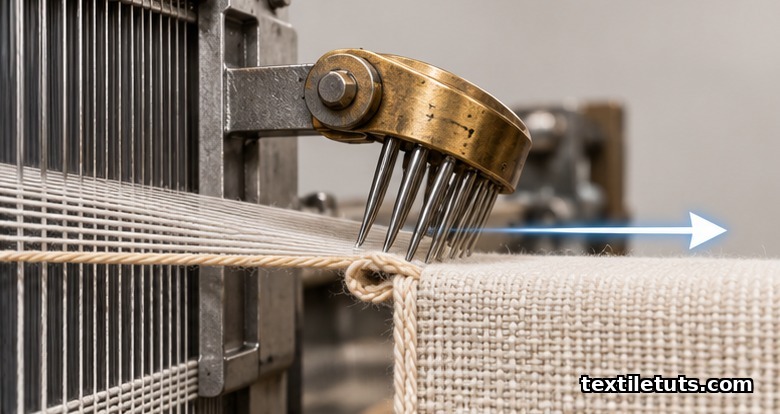
The contraction comes from two combined sources. First, the weft yarn is bent sharply around the warp ends during shed change, so each inserted pick tries to straighten into a loop, pulling the selvedges inward. Second, the take-up roller applies tension that, without counter-force at the selvedge, narrows the cloth by 8–15% on a plain cotton weave and by as much as 20% on a loosely set woolen or silk fabric.
A temple is the only standard loom component that applies outward force to the cloth. Every other element (warp tension, reed, take-up) either pulls the warp straight back toward the warp beam or pulls the cloth straight back toward the cloth roller. The temple pulls the cloth sideways toward the reed width, which is what keeps the fabric flat, true, and free of selvedge-side distortion.
Where the temple is mounted on the loom
On a conventional power loom, the temple is fixed to a swinging bracket or sliding rail attached to the breast beam or the lower loom frame. Its pin points sit just behind the fell of the cloth and slightly to the outside of the outermost warp end, so the selvedge thread passes between the pin row and the body of the fabric.
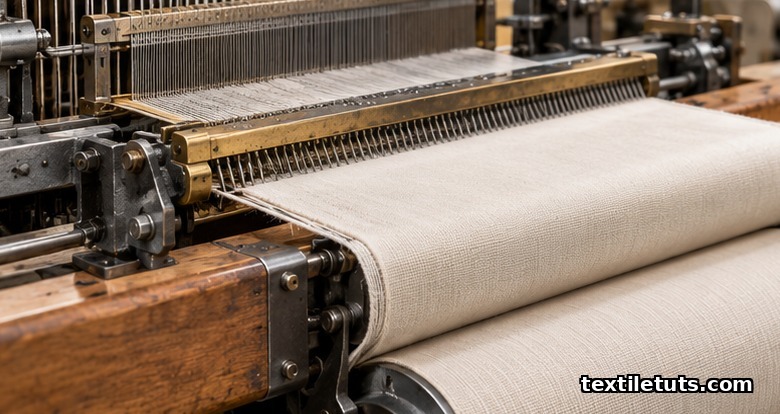
The mounting is adjustable in three directions. Vertical adjustment raises or lowers the temple so the pin tips meet the cloth at its mid-thickness rather than above or below the surface. Lateral adjustment sets the exact gripping width to match the reed width in the loom. Forward-back adjustment moves the temple closer to or further from the reed, which controls the length of cloth under the temple’s grip.
On modern projectile, rapier, and air-jet looms, the temple often travels with the sley or is mounted on a small carriage that advances toward the fell at the end of weft insertion, then returns. This active-temple design holds the cloth at full width during the entire beat-up stroke and retracts only when the shed changes.
The five main types of temples
Temples differ chiefly in how they apply the outward force to the cloth and how they release the cloth during fabric take-up.
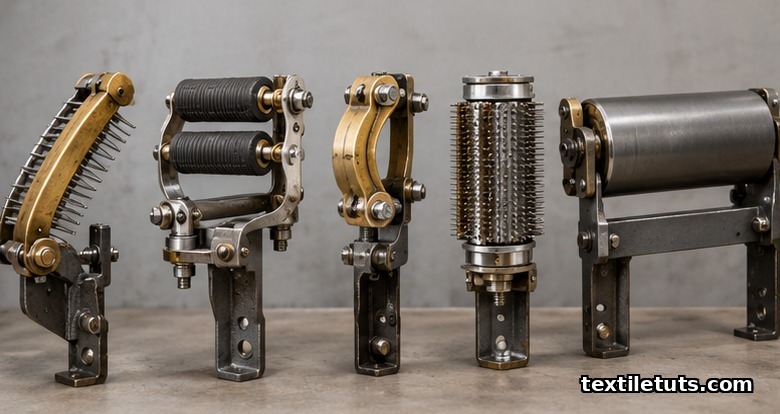
1. Copper pin temples. The most common design. Two brass or copper arms carry rows of fine steel pins arranged on a curved bar; the arms rotate inward to drive the pins into the cloth near the selvedge. The pin points grip the weft floats between the selvedge ends, anchoring the fabric without damaging the warp. Copper pin temples are standard on cotton, polyester/cotton, and light worsted looms running 60–200 picks per minute.
2. Expanding roller temples. A pair of expanding rollers covered with rubber or polyurethane, mounted on spring-loaded arms. The rollers press against the fabric and the spring force stretches it outward. Expanding roller temples are favored for delicate fabrics (fine silk, light filament polyester, fine woolen cloth) where copper pins would leave visible holes.
3. Ring temples. A split brass or steel ring clamps the selvedge; outward pressure from the split body forces the ring open and stretches the fabric. Ring temples are used on jute, hessian, polypropylene tape, and heavy industrial fabrics where pin marks are tolerable.
4. Cloth (pin) rollers. Long steel cylinders studded with fine pins that grip the cloth along the selvedge strip; the rollers rotate as the fabric advances. Cloth temples are common on jacquard and high-speed terry looms where hundreds of picks per minute leave no time for a pin-and-release mechanism.
5. Full-width (roller) temples. A single wide roller spans the full fabric width and applies uniform tension across the entire cloth, not just the selvedge. Used in technical-textile weaving for aramid, glass, and carbon fabrics where even minor width variation is rejected by the downstream lamination step.
How a temple works: the operating principle
The mechanism is simple but precise. As each pick is inserted and the reed beats it into the fell, the cloth tries to contract laterally. The temple’s pin tips or rollers are in contact with the cloth within 2–5 cm of the selvedge, so the outward force they apply acts as a counterweight to the lateral contraction.
The fabric outside the temple grip (the small section between the temple and the cloth roller) is held at full width, while the fabric between the reed and the temple is under controlled inward tension. As the cloth advances toward the take-up roller, the temple pins release automatically: the cloth simply slides over the curved pin bar as the cam rotates the arms outward at the end of each cycle.
The stretch applied by the temple is set to match the fabric’s natural shrinkage under loom tension. Weavers typically set the temple 1–2% wider than the finished cloth width to allow for relaxation shrinkage that occurs in finishing. Cotton fabrics set without a temple would finish 5–8% narrower than the reed width, while worsted and woolen fabrics without a temple would finish 10–15% narrower.
Effects of the temple on cloth quality
The temple has five measurable effects on the woven fabric, all of which show up in standard quality tests.
Width control. A temple maintains fabric width within ±2 mm of the target across the full warp run. Without a temple, width variation on a 1.5 m fabric can reach ±15 mm, which produces makedown loss in cutting for garments and rejects in technical-textile lamination.
Selvedge straightness. A straight, vertical selvedge is critical for clean shedding and for downstream processing such as printing and stentering. Without a temple, selvedges bow inward (a defect called “selvedge draw-in” or “snapped selvedge”), which jams at the print blanket or stentering frame.
Picks per cm (weft density). Because the temple holds the cloth at reed width, weft spacing on the loom matches the design set in the weave plan. Without a temple, picks crowd toward the selvedge and bunch near the center, producing density variation of 8–12% between center and edge.
Reduced selvedge cracks and reed marks. The lateral force keeps the warp ends parallel as they pass through the reed, so the reed wires do not push the warp ends into diagonal cracks. Reed-mark defects drop from 3–5 per 100 m of fabric to under 1 per 100 m on properly templed looms.
Lower warp break rate near the selvedge. The outermost 4–6 warp ends on most looms experience 30–50% higher breakage than the body warp because of lateral abrasion against the reed. A temple that distributes tension across the selvedge ends reduces this differential to under 10%.
Temple selection by fabric type
Temple choice is governed by fiber, yarn count, weave density, and end use. Weaving mills run a temple catalog that matches each fabric to a specific temple type, pin gauge, and grip width.
Cotton and polyester/cotton. A standard copper pin temple with 22–25 swg (standard wire gauge) pins on a 25 mm wide curved bar, gripping the cloth 3 mm inside the selvedge. Pin spacing of 4–6 mm and grip pressure of 0.5–1.0 N per pin.
Fine silk and filament synthetics. Expanding roller temples with 60–70 Shore A rubber covering to avoid pin holes. Operating pressure is reduced to 0.3–0.5 N per linear cm of fabric.
Worsted and woolen suiting. Copper pin temples with finer pins (25–28 swg) and reduced pressure to prevent lustrous surface marks on the finished cloth.
Terry, jacquard, and dense fabrics. Cloth (pin-roller) temples to keep pace with pick rates of 600–1200 picks per minute where a pin-arm mechanism cannot recycle fast enough.
Technical textiles (aramid, carbon, glass). Full-width roller temples to apply uniform tension across the entire fabric width.
Temple maintenance and common problems
A temple is a wear part. Pin tip wear, spring fatigue, and bracket misalignment are the three most common failure modes.
Pin wear. Pin tips blunt after roughly 6–12 months of continuous running, depending on fabric abrasiveness. Blunt pins slip on the weft floats, the cloth creeps inward, and width control degrades. Replace the pin bar as a unit rather than individual pins to maintain even grip pressure across the bar.
Spring fatigue. The springs that hold the pin arms or rollers against the cloth lose tension over time. Drop in spring force below 70% of the original setting causes fabric slippage and uneven width. Springs should be tested with a calibrated force gauge at every quarterly maintenance and replaced when below the threshold.
Bracket misalignment. The temple bracket must be square to the warp direction and centered laterally. A misalignment of more than 2 mm produces asymmetric stretch and the cloth skews toward the looser side. Re-alignment is a 10-minute task using the loom’s built-in centering marks.
Cleaning. Lint and fly from the weaving process accumulate on the pin bar and roller surface. Wipe the temple at every shift change with a soft brush; fly accumulation reduces grip and leads to cloth slippage.
Common fabric-side defects from a faulty temple. Width variation, selvedge draw-in, bowed selvedge, selvedge cracks, reed marks, and higher warp break rate at the selvedge. Any of these appearing on an inspection table should trigger a temple check before the warp is replaced.
Frequently Asked Questions
Is a temple required on every weaving loom?
Every loom that runs a plain or balanced weave with a pick density above 8 picks per cm requires a temple to maintain full warp width. Looms running very coarse jute, hessian, or polypropylene tape often omit the temple because the coarse pick spacing is forgiving and width contraction is a minor issue. Looms running sheer or open-weave silk also typically run without a temple because pin holes would damage the fabric.
What is the difference between a temple and a selvedge motion?
A temple is a passive stretching device; it grips the fabric and resists inward contraction. A selvedge motion, also called a selvedge unroller or selvage feeder, feeds separate selvedge yarns from independent yarn packages and lays them outside the main warp. The two devices solve different problems: the temple holds the cloth at width; the selvedge motion produces a finished selvedge that resists fraying in finishing and use.
How wide should a temple grip be set relative to the fabric width?
The temple should be set 1–2% wider than the finished cloth width to allow for relaxation shrinkage that occurs in scouring, bleaching, or finishing. A fabric targeted to finish at 150 cm would be templed at 151.5–153 cm on the loom. Setting the temple tighter than the target produces a fabric that finishes narrower than specified, and setting it wider produces a fabric that finishes wider and may need cropping.
Can a faulty temple cause warp breaks?
Yes. A misaligned or worn temple concentrates lateral force on a few warp ends rather than distributing it across the selvedge strip, and those ends break from abrasion against the reed wires. A temple set too far inside the warp (i.e., gripping the body warp rather than the selvedge strip) lifts and breaks the outermost ends. A qualified loom technician should verify temple position against the selvedge yarn every shift.
What is the operating temperature range for a temple?
Temples operate at ambient loom temperature, typically 20–35 °C, and have no special cooling requirement. The pins and rollers do, however, heat slightly from cloth friction at high pick rates (over 800 picks per minute), and the operating temperature on the pin surface can reach 40–50 °C. This is well below the heat tolerance of cotton, wool, or synthetic fibers, so there is no risk of fiber damage from the temple itself.
References
- International Organization for Standardization. ISO 7211-3:1984 Textiles: Woven fabrics, construction, methods of analysis, Part 3: Determination of crimp of yarn in fabric. iso.org. Defines woven-fabric dimensional analysis methods relevant to temple set-up.
- ASTM International. ASTM D3883: Standard Test Method for Yarn Crimp and Yarn Take-Up in Woven Fabrics. astm.org. Standardized method for measuring take-up that temple width-setting compensates for.
- Behera, B.K. and Hari, P.K. Woven Textile Structure: Theory and Applications. Woodhead Publishing (Elsevier), 2010. link.springer.com. Reference text on woven fabric geometry and selvedge mechanics.
- Adanur, S. Handbook of Weaving. CRC Press (Taylor & Francis), 2001. crcpress.com. Reference text on loom mechanisms including temple types and applications.
- International Organization for Standardization. ISO 3933:1976 Textiles: Woven fabrics, determination of number of threads per unit length. iso.org. Standardized method for pick-count verification under temple-tensioned conditions.
- ASTM International. ASTM D3775: Standard Test Method for End (Warp) Count and Pick (Weft) Count of Woven Fabrics. astm.org. Verification standard for fabric count under proper temple tension.
- Encyclopaedia Britannica. Weaving (textile process). britannica.com. Reference overview of loom components including temple.
This article is the working reference for the temple in weaving. Editorial by Mohammad Yousuf (Anik), TextileTuts. Sources: ISO 7211-3:1984, ISO 3933:1976, ASTM D3883, ASTM D3775, Behera & Hari (Woodhead, 2010), Adanur (CRC Press, 2001), Encyclopaedia Britannica as cited.


