
Reed and Heddle in Weaving

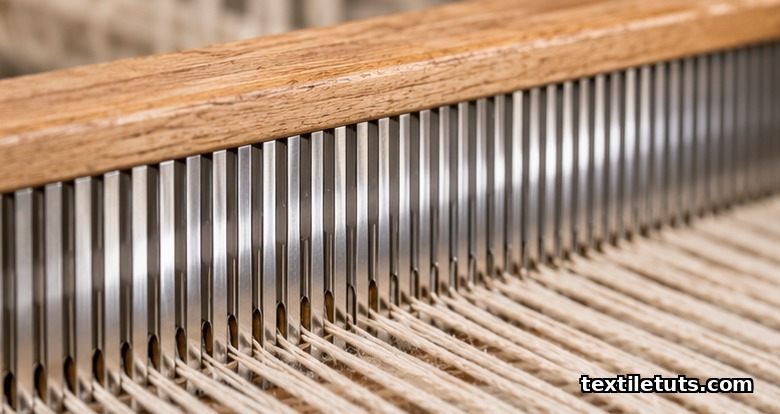
A loom reed consists of parallel steel dents spaced at 6 to 40 dents per inch (2.4 to 15.7 dents/cm), and together with the heddles it determines warp thread density, fabric width, and beat-up force on the weft.
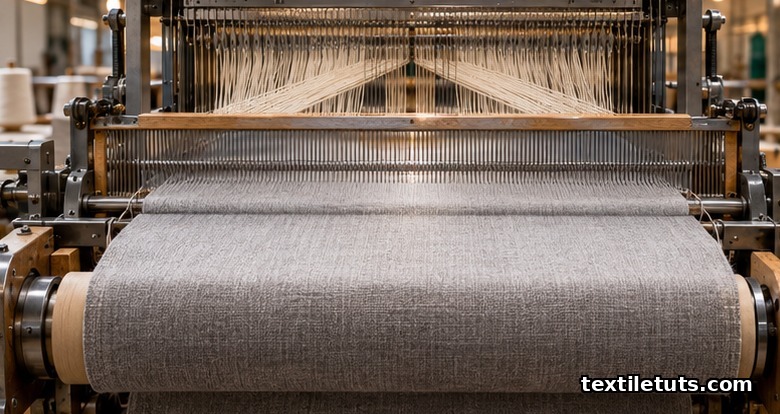
The reed beats each weft thread into the fell of the cloth while the heddles raise and lower individual warp ends to form the shed, so their geometry directly controls sett, fabric hand, and weaving efficiency on every loom from a hand frame to a 360 cm Picanol air-jet.
Below is the working reference for reed and heddle construction, selection, and maintenance, with the standard specifications used by textile engineers in cotton, worsted, filament, and technical weaving.
What Is a Reed in a Weaving Loom?
The reed is a comb-like frame mounted in the beater of a loom. It is built from flat steel strips called dents, held parallel inside a wooden or metal binder by cotton, nylon, or synthetic cord wrapping at each end. Each dent is a thin flat blade with a slot just wide enough for warp threads to pass through, typically 0.15 to 0.50 mm wide. The number of dents per unit width is the reed count, expressed as dents per inch (dpi) in the US system and dents per cm in metric practice.
Reed count is chosen before weaving, based on the warp threads per inch (epi) and the number of warp ends sharing each dent. A common convention groups warp ends into reed dents at a ratio of 1, 2, 3, or 4 ends per dent. For plain weave fabrics at 60 epi, a 15 dpi reed with 4 ends per dent is the standard pairing. For finer yarns and high-density shirting at 100 to 140 epi, weavers use 20, 24, or 30 dpi reeds with 4 to 6 ends per dent. For very dense technical fabrics above 150 epi, a 36 to 40 dpi reed with single-end-per-dent drafting gives clean shed opening.
The reed performs three jobs at once: it spaces the warp uniformly across the fabric width, it guides the shuttle or rapier during weft insertion, and it beats the freshly inserted weft thread into the fell of the cloth. Beat-up force is a function of beater swing speed, loom architecture, and the reed’s stiffness. Stiffer reeds built from heavier-gauge steel transmit more force per cycle and produce denser fabric, while lighter reeds are used for sensitive structures like woolens and low-twist filament yarns.
What Is a Heddle in a Weaving Loom?
A heddle is a looped element with an eye in its center through which a single warp thread passes. Each heddle is suspended between two heddle frames (also called shafts or harness frames), so when the frame rises or falls the heddle carries its warp end with it. The eye is the working opening through which the warp passes, and its size is matched to yarn count: a 4 to 5 mm eye suits coarse woolen yarns, while 1.5 to 2.0 mm eyes are used for fine filament warps.
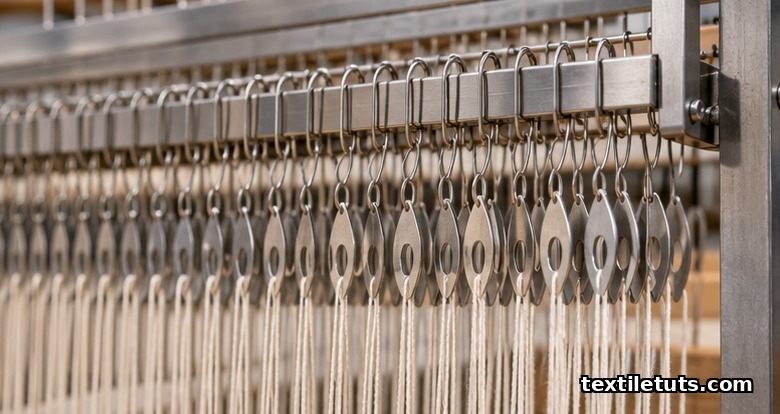
Heddle types fall into three categories. Cotton string heddles are the traditional form, made from twisted cotton cords with a hand-tied eye, and they remain common on handlooms and small workshops because they are inexpensive and gentle on delicate yarns. Flat steel heddles are precision-stamped stainless strips with a stamped central eye, widely used on power looms running medium to heavy yarns because they offer long service life and consistent tension. Wire heddles are the highest-performance type, made from stainless or galvanized steel wire formed into a flattened oval eye at the center and bent into a C-shape at each end; their open profile allows air jets from air-jet looms to pass through without disturbing the heddle, which is why wire heddles are the standard on Sulzer, Picanol, and Toyota air-jet weaving machines.
The heddle count per frame and the number of frames together control pattern complexity. Two frames give plain weave and its variations such as rib and basket. Four frames are the minimum for twill and satinette, and dobby looms commonly run 8, 12, or 16 frames. Jacquard machines eliminate the frame limitation by controlling each warp end individually, with capacities ranging from 600 to 12,000 hooks depending on the design.
How Reed and Heddle Together Set the Fabric Structure
The reed and the heddle are the two physical constraints that determine warp sett and shed geometry. The heddle decides which warp threads lift, by how much, and in what order; the reed decides how tightly those threads are packed side to side in the cloth. Warp threads per inch (epi) is calculated by dividing the reed count (dpi) by the number of warp ends per dent:
epi = dpi / ends per dent
So a 20 dpi reed with 4 ends per dent yields 80 epi, a value typical for combed-cotton shirting at roughly 31 ends per cm in metric calculation. Reed width is set to the finished fabric width plus loom waste plus shrinkage allowance. The standard shrinkage reserve for cotton is 8 to 12% of the grey width, and the loom waste is typically 10 to 30 cm depending on the loom type.
Heddle frames are spaced along the loom’s harness in a sequence that produces the desired weave structure. Plain weave uses a 2-frame configuration with heddles dressed alternately. Twill uses a 4-frame straight draw or point draw. Satins require careful frame sequence to avoid adjacent warp floats, typically running on 5 or 8 frames. Improper heddle frame spacing leads to warped sheds and uneven fabric density.
Common Reed and Heddle Specifications
| Component | Specification | Typical Values |
|---|---|---|
| Reed | Dents per inch (dpi) | 6, 8, 10, 12, 15, 20, 24, 30, 36, 40 |
| Reed | Dent slot width (mm) | 0.15 to 0.50 |
| Reed | Standard reed width (cm) | 100, 120, 140, 160, 180, 200, 220 |
| Wire heddle | Eye size (mm) | 1.5, 2.0, 2.5, 3.0, 3.5, 4.0, 4.5, 5.0 |
| Wire heddle | Wire diameter (mm) | 0.50, 0.55, 0.60, 0.70 |
| Wire heddle | Loop width (mm) | 11, 12, 13, 14, 15 |
| Flat steel heddle | Strip gauge (mm) | 1.0 to 2.5 thickness |
| Cotton string heddle | Eye size (mm) | 3 to 8 |
| Heddle frame | Heddles per frame | 400 to 1200 standard |
Choosing the Right Reed and Heddle
Reed selection is driven by warp sett. The rule is to choose a reed count so the required epi can be achieved with a sensible number of ends per dent. For plain weave with 60 to 80 epi, a 15 or 20 dpi reed with 4 ends per dent works well. For 100 to 140 epi shirting, a 25 or 30 dpi reed with 4 ends per dent gives clean shed opening. For terry towels and coarse industrial fabrics at 20 to 40 epi, a 10 or 12 dpi reed with 2 to 4 ends per dent is typical.
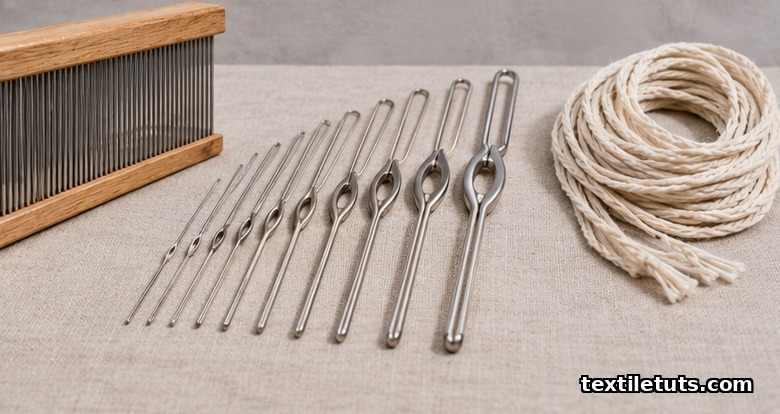
Heddle selection is driven by yarn count and fabric sensitivity. Fine cotton, silk, and filament warps run best on cotton string heddles or flat steel heddles with a small, smooth eye. Coarse woolen warps and heavy industrial yarns need a larger eye and a heavier wire gauge so the heddle does not cut the yarn during shedding. For air-jet and water-jet looms, wire heddles are mandatory because air and water must flow through the harness without disturbing the heddle frame.
Material matters for service life. Stainless steel wire heddles are rated for 1.5 to 3 million shedding cycles under normal load. Cotton string heddles wear faster and need replacement every 6 to 18 months on a production loom. The ISO 9001:2015 quality management framework, used widely in textile machinery manufacturing, sets the baseline for heddle dimensional consistency and tensile performance testing.
Maintenance and Failure Modes
Reeds and heddles wear, and the wear shows up in the fabric. A worn reed produces uneven sett, broken warp threads, and visible fabric streaks. Common failure modes include bent dents from hard beat-up against the fell of the cloth, dents clogged with size deposits that warp threads catch on, and binder cord loosening that allows dents to drift apart. ISO 9001-compliant textile machinery workshops test reed flatness and dent spacing with calibrated gauges and recommend reed replacement when deviation exceeds 0.05 mm across the reed width.
Wire heddles fail through eye elongation, loop cracking, and corrosion. Eye elongation comes from warp yarn abrasion and changes the effective yarn path, leading to uneven tension. Loop cracking is a fatigue failure and tends to start at the C-shaped bends. Corrosion is a problem with galvanized heddles in humid mills, and stainless steel is the standard upgrade. ISO and AATCC standard test methods for heddle fatigue use cyclic loading machines running 1,000 to 10,000 cycles per sample, and a wire heddle that loses 0.10 mm or more of eye width over its rated cycle count is rejected.
Heddle frame maintenance is equally important. Frames must be parallel to the reed, level across their full width, and centered on the shed opening. Out-of-level frames produce uneven shed depth, which translates directly into uneven weft pick density and visible warp streakiness in the woven cloth. The standard tolerance is less than 1 mm of vertical drift across the frame width.
Frequently Asked Questions
What is the difference between a reed and a heddle?
A reed is a comb-like frame that beats the weft into place and spaces warp threads uniformly across the fabric width. A heddle is a looped eye that carries a single warp end and lifts or lowers it to form the shed. The reed controls warp spacing and beat-up; the heddle controls shedding and weave pattern.
How do you calculate warp sett from reed count?
Warp ends per inch (epi) equals the reed dents per inch (dpi) divided by the number of warp ends passed through each dent. For a 20 dpi reed with 4 ends per dent, epi is 80. For a 15 dpi reed with 2 ends per dent, epi is 30. The reciprocal gives the finished fabric picks per inch when paired with the pick density.
Which heddle type is best for an air-jet loom?
Wire heddles are the standard for air-jet and water-jet looms because the open profile allows air and water to flow through the harness without disturbing the heddle frame. Flat steel heddles are used on rapier and projectile looms where airflow is not a factor. Cotton string heddles are limited to handlooms and slow-speed sample looms.
How often should heddles be replaced?
Stainless steel wire heddles are rated for 1.5 to 3 million shedding cycles under standard load, which on a 600 rpm loom is roughly 6 to 12 months of continuous production. Cotton string heddles wear faster and typically need replacement every 6 to 18 months depending on warp yarn and humidity. A heddle with elongated eye or cracked loop should be replaced immediately.
Why does fabric show warp streaks after the loom has run for weeks?
Warp streaks usually come from worn or bent reed dents, a dirty reed clogged with size deposits, or heddle frames that have drifted out of level. ISO 9001 maintenance protocols call for reed inspection every 2,000,000 picks and heddle inspection at every major style change. Cleaning the reed with a brass-wire brush and re-leveling the frames resolves most streak problems without full replacement.
References
- ISO. ISO 9001:2015 Quality management systems — Requirements. iso.org — quality management framework used in textile machinery manufacturing for dimensional and tensile consistency.
- ASTM International. ASTM D3775 — Standard Test Method for Warp (End) and Filling (Pick) Count of Woven Fabrics. astm.org — reference method for counting warp ends per inch in woven cloth.
- ASTM International. ASTM D5034 — Standard Test Method for Breaking Strength and Elongation of Textile Fabrics (Grab Test). astm.org — basis for fabric tensile property testing on woven samples.
- AATCC. AATCC TM135 — Dimensional Changes of Fabrics after Home Laundering. aatcc.org — reference for woven fabric dimensional stability testing relevant to reed setting decisions.
- ResearchGate. Analysis of Weaving Process Parameters on Fabric Properties. researchgate.net — peer-reviewed study covering reed count, heddle type, and beat-up force effects on finished fabric.
- ScienceDirect. Textile Research Journal — Effects of Heddle Wire Material on Yarn Tension and Heddle Fatigue. sciencedirect.com — peer-reviewed analysis of stainless vs galvanized wire heddle performance over shedding cycles.
- The Textile Institute. Textile Terms and Definitions. textileinstitute.org — canonical glossary of weaving terminology including reed, heddle, dent, and sett.
This article is the working reference for reed and heddle geometry, selection, and maintenance. Editorial by Mohammad Yousuf (Anik), TextileTuts. Sources: ISO 9001:2015, ASTM D3775, ASTM D5034, AATCC TM135, peer-reviewed research from Textile Research Journal, and The Textile Institute as cited.


