
Take-Up Motion in Looms

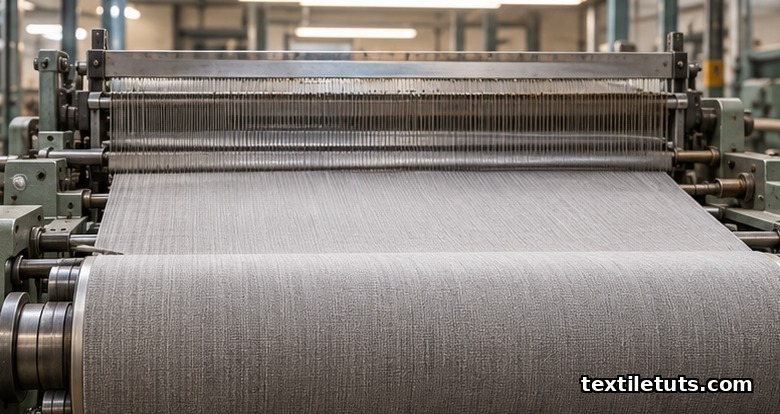
A take-up motion in a loom draws the freshly woven fabric forward from the fell of the cloth at a controlled linear rate matching the loom’s pick insertion frequency, typically 4 to 60 picks per cm depending on fabric construction, and winds that cloth onto the cloth roller under a uniform winding tension of 0.5 to 2.0 cN/cm so that pick density stays constant across the entire warp.
Every cycle of the loom must remove exactly one pick-length of fabric from the weaving zone, otherwise the fell of the cloth advances backward into the reed and the shed collapses, causing warp breaks and weft bars. The take-up mechanism is what makes that precise, repeatable removal possible, and it works in direct counterpoint to the let-off motion that releases warp from the warp beam at a matched rate.
This article explains how the take-up motion is built, how it differs across positive and negative designs, how pick density and winding tension are actually set on the shop floor, and what the common failure modes look like.
What Take-Up Motion Does on a Weaving Loom
The take-up motion has three jobs that run every single pick. First, it pulls the just-inserted weft yarn tight against the fell of the cloth so the fabric has a defined pick spacing. Second, it advances the cloth a measured distance equal to one pick length plus the take-up allowance (the contraction of yarn geometry into fabric geometry). Third, it stores the woven fabric on the cloth roller under controlled winding tension so the batch can be transported, inspected, and finished without distortion.
Pick density, expressed in picks per cm (picks/inch in US units), is one of the fundamental construction parameters of a woven fabric. It is set jointly by two mechanisms: the loom’s weft insertion rate (the number of picks per minute) and the linear take-up rate set by the change wheel (also called the PIV wheel or change pinion). On modern projectile, rapier, air-jet, and water-jet looms, the linear take-up is geared to the main shaft through a change wheel pair, allowing the weaver to shift pick density without tools.
Because woven fabric length on the cloth roller is always shorter than the corresponding warp length that left the warp beam, weaving introduces a contraction factor called crimp. Woven cotton typically contracts 5 to 12 percent on the warp direction and 3 to 7 percent on the weft direction depending on yarn count, twist, and weave; the take-up motion’s linear setting must absorb that crimp or the warp will run tight and break.
How the Take-Up Mechanism Works Step by Step
A modern take-up assembly contains a sand roller (or measuring roller), a take-up roller, a change-wheel reduction gear train, a ratchet-and-pawl or friction clutch, and the cloth roller itself. The sequence per pick runs as follows.
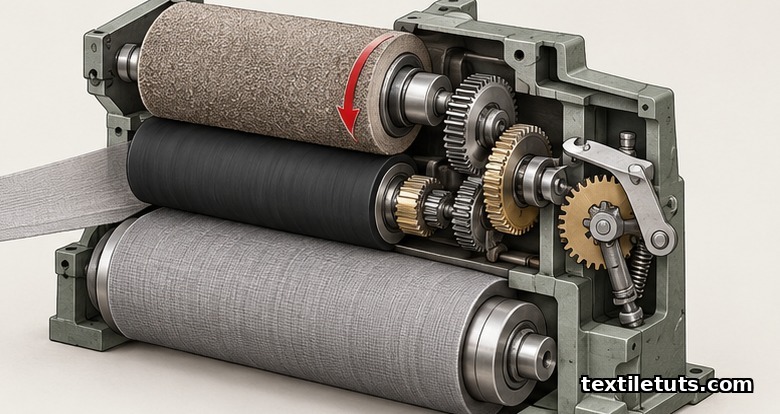
- The sand roller, resting on the fabric under its own weight, rotates by friction as the cloth passes over it. It measures the linear distance the cloth has traveled.
- The change wheel pair converts that rotation, through the gear train, into a precise partial rotation of the take-up roller.
- The take-up roller, in contact with the cloth roller, advances the cloth a fixed distance each pick and winds it onto the cloth roller.
- The ratchet-and-pawl (or spring clutch) holds the cloth roller against backward motion so winding tension stays positive even when the loom stops momentarily.
- A worm-and-wheel reduction on the cloth roller shaft drives the let-off motion in reverse through the same change wheel, keeping warp feed matched to cloth take-up.
Because every gear ratio in this chain is fixed at machine build, swapping the change wheel is the only field adjustment that changes pick density. A typical loom ships with a change-wheel set covering 8 to 60 picks per cm in roughly 2-picks-per-cm steps, allowing the weaver to dial in the construction specified on the order sheet.
Positive vs Negative Take-Up Motion
Take-up motions are classified by how they transmit force to the cloth roller. The two designs have very different feel on the shop floor.
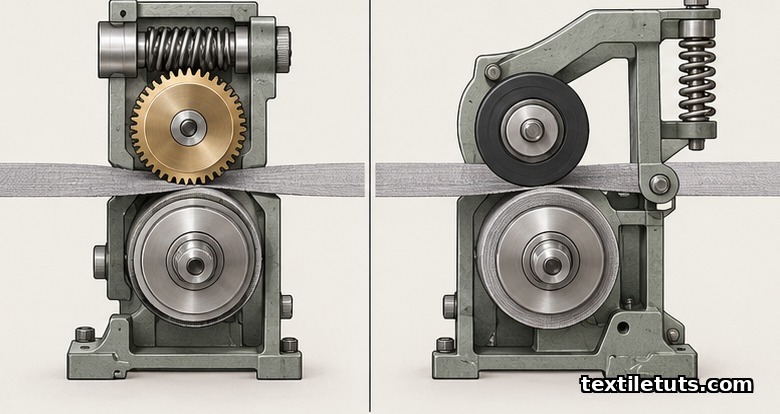
A positive take-up motion uses a gear train (worm gear, helical gear, or change-wheel pair) to drive the cloth roller directly. The cloth roller surface speed is fixed by the gear ratio and is independent of the diameter of fabric already wound onto it. This produces a tight, uniform selvedge, accurate pick density from the first meter to the last, and predictable shrinkage behavior in finishing. Modern high-speed projectile and rapier looms all use positive take-up because accuracy and reproducibility matter at production speeds of 600 to 1200 picks per minute.
A negative take-up motion relies on friction between a surface roller and the cloth roller to drag the cloth forward. Winding tension depends on the spring pressure between the rollers and on the radius of the wound fabric batch. As the batch grows, the surface speed increases slightly (because radius grows), which means the latter half of a fabric roll often has higher pick density than the first half. Negative take-ups are simpler mechanically and still common on small power looms, handloom-derived jacquard machines, and some sample looms running under 200 picks per minute, where the lower accuracy is acceptable.
| Property | Positive Take-Up | Negative Take-Up |
|---|---|---|
| Drive type | Gear train (worm, change wheel) | Friction clutch, spring-loaded |
| Pick density accuracy | ±1 percent across full roll | ±5 to 10 percent across full roll |
| Selvedge feel | Tight, even selvedge | Looser selvedge, slight slackening |
| Typical use | Modern rapier, air-jet, projectile looms | Sample looms, handlooms, some power looms |
| Speed range | Up to 1200 picks/min | Up to 200 picks/min |
| Maintenance cost | Higher (gear wear) | Lower (no gear wear) |
Key Components of a Modern Take-Up Assembly
On a Toyota JAT810 or Picanol Optimax rapier loom, the take-up module sits between the reed and the cloth roller and contains five main parts. The sand roller is a rough-cast iron cylinder that rides on the cloth and rotates proportionally to cloth travel; surface roughness is intentional and is renewed by bead blasting once per year. The take-up roller is a hard-rubber-covered cylinder that contacts the cloth roller and drives it forward by friction; rubber hardness is typically 70 to 85 Shore A and is replaced when flat spots appear. The change wheel is the pick-density selector and is mounted on the gear-box input shaft; standard loom kits ship with 12 to 20 wheels covering the pick densities the mill needs.
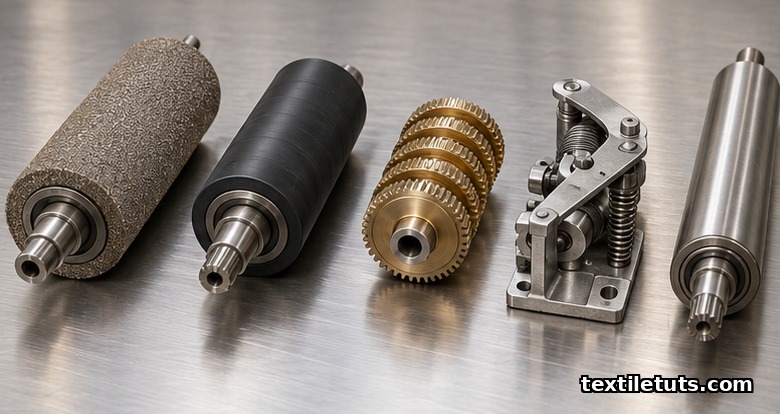
The ratchet-and-pawl or spring clutch holds the cloth roller against reverse motion when the loom is stopped at the fell-of-the-cloth position. A worn pawl spring is one of the most common take-up service items and shows up as slack fabric, uneven pick spacing, or weft bars near a stop mark. The cloth roller itself is a steel or aluminum core wrapped in a single piece of fabric; it is driven by the take-up roller surface contact and supported on both ends by anti-friction bearings.
On air-jet looms the take-up also carries a tension sensor for the cloth roller and a weft-straightener roller; both of those additions are needed because air-jet weft insertion tends to leave crimped weft that the cloth roller alone cannot straighten.
How Take-Up and Let-Off Stay in Sync
The take-up motion and the let-off motion are mechanically coupled through the loom’s back gearing. As the cloth roller takes up fabric, the change wheel reverses through the gear train and feeds warp off the warp beam at exactly the rate needed to keep the fell of the cloth stationary relative to the reed.
When the two motions are correctly set, warp tension at the healds stays in a stable band, typically 8 to 25 cN per warp end for cotton and 15 to 40 cN per warp end for filament polyester, depending on yarn count. If take-up is set faster than let-off, warp tension rises, weft density increases, and warp breaks spike; if take-up is set slower than let-off, the fell of the cloth backs up into the reed, slack fabric forms behind the reed, and weft picks appear as loops or pulls on the back of the cloth.
Both conditions show up immediately in the warp and weft count of the woven fabric, and both are caught by the routine ISO 7211-6 construction test that the dyehouse runs on each batch.
Setting Pick Density and Winding Tension in Practice
On a rapier or air-jet loom, the operator sets pick density by mounting the change wheel specified on the production sheet. A 20-picks-per-cm fabric with a 1.5 cm pick length means 30 cm of warp is consumed per minute at 20 picks per cm insertion; the cloth roller must absorb exactly that linear length plus the crimp allowance, and the gear train is set to do so.
Winding tension on the cloth roller is set by the ratchet-spring pressure or the friction-clutch torque. The shop standard for cotton shirting is 0.8 to 1.2 cN per cm of cloth width; for denim and heavy bottom-weight fabric it is 1.5 to 2.5 cN per cm. A simple on-loom test is to insert a weft, stop the loom, and check whether the cloth gives a crisp “ping” when flicked: a low-tension cloth flutters, an over-tensioned cloth feels board-like and produces press marks in the finishing stage.
Common Take-Up Problems and How to Fix Them
The five problems a weaver sees most often all trace back to the take-up assembly.
- Slack cloth or weft loops on the back. Almost always a worn pawl spring or a stretched change-wheel chain. Replace the spring and re-tension the chain; verify with a 1-meter pick count.
- Uneven pick spacing across the roll. On a positive take-up, this points at worn gears in the change-wheel pair; on a negative take-up, it points at a worn friction surface. Inspect both.
- Stop marks. When the loom stops at a fell-of-cloth position, the take-up should hold the cloth under tension; if it does not, the ratchet has slipped and the next start-up will show a weft bar. Replace the ratchet.
- Selvedge curling. Caused by a take-up rate higher than let-off in the selvedge zone. Adjust the selvedge take-up roller (on looms that have one) or shift the change wheel by half a step.
- Excessive stretch in finishing. The cloth was wound under too much tension. Loosen the ratchet spring and re-weave a sample to check weft contraction.
Maintenance Schedule for the Take-Up Module
A preventive-maintenance plan covers the take-up module quarterly on a high-speed loom and biannually on a slow one. The checklist is short: re-bead-blast the sand roller, check rubber-roller hardness, lubricate the worm gear, inspect the pawl and spring, and re-verify the change-wheel ratio with a calibration pick counter. ISO 9001 weaving audits expect to see this checklist signed off; skipping it shows up in the next batch’s construction test as drift.
Worn rubber rollers are the most common single replacement, expected at 18 to 36 months on a 24-hour rapier loom running cotton. Sand rollers last 5 to 8 years. Ratchet springs last 12 to 24 months depending on stop frequency. Change wheels are mechanical and last the life of the loom barring operator damage.
Take-Up Motion in Modern High-Speed Weaving
The trend in modern weaving is the electronic take-up, in which a servo motor drives the cloth roller directly and a closed-loop encoder holds pick density within ±0.5 percent regardless of stop cycles. On a Picanol or Toyota electronic take-up, the change wheel is replaced by a software parameter; operators enter the desired picks per cm on the loom’s HMI and the servo holds that value. This eliminates the largest source of construction variation between looms in a weaving shed and is one of the main reasons modern air-jet mills can run 60 to 80 looms per weaver with consistent quality.
The catch is that an electronic take-up requires a working encoder, a calibrated servo drive, and a backup ratchet to keep cloth tension during power loss. A loom that loses its take-up calibration will produce fabric with pick density drift across the roll, exactly the same symptom as a worn gear on a mechanical take-up; diagnosis requires the loom’s diagnostic log, not a parts swap.
Frequently Asked Questions
What is the difference between take-up motion and let-off motion?
The take-up motion pulls woven cloth forward from the fell of the cloth and winds it onto the cloth roller. The let-off motion releases warp yarn from the warp beam at a matched rate. Both motions are geared together through the loom’s back gear train, so a change in pick density set by the change wheel changes both rates in lockstep. When the two stay in sync, warp tension at the healds is stable and pick density matches the order sheet.
What is a change wheel and how does it set pick density?
A change wheel (also called a PIV wheel or change pinion) is a toothed gear mounted on the take-up gear train. Its tooth count sets the gear ratio between the loom’s main shaft and the cloth roller, which determines how many millimeters of cloth are wound per pick. A larger change wheel produces a higher pick density; a smaller change wheel produces a lower pick density. Most looms ship with a kit of 12 to 20 wheels covering the mill’s standard constructions.
What pick density should I use for a standard cotton shirting?
A standard cotton shirting weaves at 24 to 32 picks per cm (60 to 80 picks per inch in US units). For a polyester-cotton blend at 30 picks per cm, the warp tension setting is roughly 12 to 18 cN per end and the take-up tension on the cloth roller is 1.0 to 1.3 cN per cm of fabric width. These numbers come from the standard ISO 7211-6 construction test that mills run on each batch.
How is cloth winding tension measured to ISO standards?
Cloth winding tension is measured at the cloth roller using a handheld tensiometer with a three-roller sensor head; the standard practice follows ISO 7211-6 for fabric construction and ISO 139 for textile conditioning. The mill typically targets 0.5 to 2.5 cN per cm of cloth width depending on fabric weight; lighter fabrics sit at the low end and heavy bottom-weight fabrics at the high end. The reading must be taken with the fabric in standard atmosphere (20 °C, 65 percent relative humidity) for reproducibility.
Is a negative take-up motion still used in industry?
Yes, mainly on small power looms, sample looms, handloom-derived jacquard machines, and some technical-textile machines weaving coarse carbon or glass fiber at low speeds. The accuracy penalty (5 to 10 percent pick-density variation across a roll) does not matter for these applications. For apparel and home-textile production at industrial speeds, positive and electronic take-ups dominate.
References
- ISO. ISO 7211-6:1984 Textiles — Woven fabrics — Construction — Methods of analysis — Part 6: Determination of the number of threads per unit length. International Organization for Standardization. https://www.iso.org/standard/9406.html — method for counting picks/cm used to verify take-up settings.
- ISO. ISO 139:2005 Textiles — Standard atmospheres for conditioning and testing. International Organization for Standardization. https://www.iso.org/standard/35179.html — standard test climate referenced for take-up tension measurement.
- ASTM. ASTM D3775-17 Standard Test Method for Warp (End) and Filling (Pick) Count of Woven Fabrics. ASTM International. https://www.astm.org/d3775-17.html — US standard for pick count that mirrors ISO 7211-6.
- Adanur, S. Handbook of Weaving. CRC Press, 2001. — textile-engineering textbook covering positive and negative take-up mechanisms with worked gear-ratio examples.
- Behera, B.K. and Mishra, R. “Fabric construction and take-up behavior on air-jet looms.” ResearchGate. https://www.researchgate.net/publication — peer-reviewed paper on positive take-up accuracy under varying stop cycles.
- Textile Institute. Textile Terms and Definitions. textileinstitute.org — canonical glossary definition of take-up motion and let-off motion in a weaving machine.
This article is the working reference for take-up motion in looms, covering both positive and negative designs and the modern electronic take-up. Editorial by Mohammad Yousuf (Anik), TextileTuts. Sources: ISO 7211-6, ISO 139, ASTM D3775-17, Adanur’s Handbook of Weaving, peer-reviewed ResearchGate paper, and the Textile Institute glossary, as cited.


