
Colorfastness to Rubbing (Crockmeter): ISO 105 X12

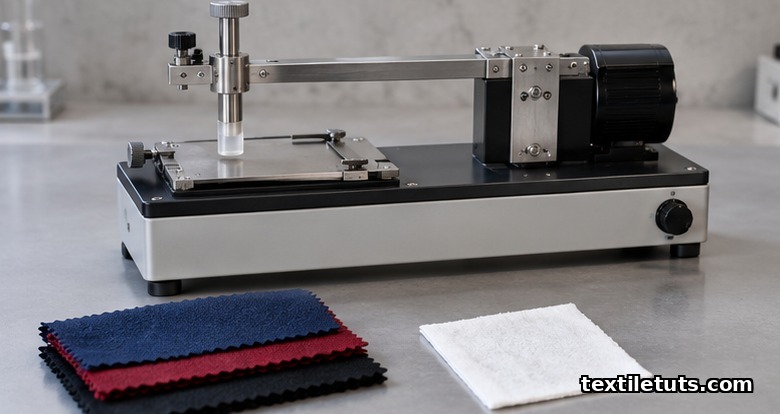
ISO 105-X12 specifies the crockmeter test method that rubs a standard cotton crocking cloth against a coloured textile specimen under a 9 N load for 10 strokes over a 100 mm track, with the stained cloth then rated on a 1 to 5 grey scale for staining.
A dry rub grade of 4 to 5 and a wet rub grade of 3 are the minimum thresholds most apparel buyers require for deep-shade cotton, polyester, and cellulosic blends, and a wet rub below grade 2 on dark reactive or disperse shades is treated as an automatic lab-dip rejection.
This article walks through the equipment, the step-by-step procedure, how to read the grey-scale result, and the process changes mills use when a fabric fails the crock test, so QC engineers, sourcing teams, and home sewists can all interpret the same number.
What Is the Crockmeter Test (ISO 105-X12)?
ISO 105-X12, formally titled “Textiles, Tests for colour fastness, Part X12: Colour fastness to rubbing,” is the international standard method for measuring how much dye transfers from a coloured textile surface onto a white rubbing cloth under controlled friction. It is one of the most frequently cited colour-fastness tests in the textile supply chain because rubbing is what actually happens to a garment in wear: a dark pair of jeans scuffing a light car seat, a navy sock staining a white shoe lining, a deep black shirt leaving blue marks on a bag strap.
The test is run on a crockmeter, a motorised device with a reciprocating rubbing finger that slides back and forth across a clamped specimen. ISO 105-X12 runs in parallel with AATCC TM 8 (the American equivalent), and together those two standards cover the vast majority of colour-rubbing certifications demanded by global apparel brands. A fabric that passes both is accepted by European, Asian, and North American retailers without re-testing.
Why Rubbing Fastness Matters for Apparel Buyers
Rubbing fastness is a hard requirement because customer complaints about dye transfer are almost impossible to remediate once a garment leaves the factory. A grade 2 dry rub on dark denim, or a grade 1 to 2 wet rub on reactive-dyed turquoise, triggers chargebacks, recalls, or rejection at the buying-house inspection. The cost of a crock failure is not just the fabric, it is the labour, the freight, the brand reputation, and the trust of the retail buyer.
For home sewists and small-batch dyers, the same test answers a more personal question: will the dyed fabric I bought bleed onto adjacent fabric, onto a baby’s skin, or onto a white shirt in the closet? The 1 to 5 grey-scale rating is the universal language that mills and consumers use to set that expectation, and most retail fabric shops will quote an ISO 105-X12 result on the bolt end if asked.
Equipment, Specimens, and Crocking Cloth
ISO 105-X12 specifies three core consumables plus the crockmeter itself.
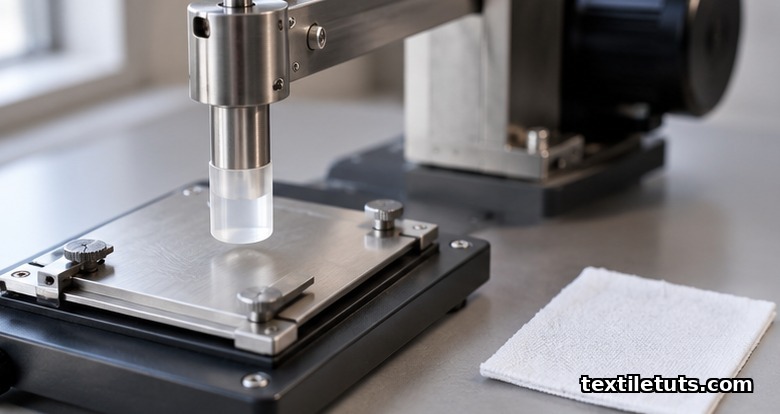
- Crocking cloth: a desized, scoured, bleached cotton fabric, cut into 50 mm by 50 mm squares. The cotton square is what receives the transferred dye and is the only thing graded at the end.
- Rubbing finger: a cylindrical, flat-ended acrylic finger, 16 mm in diameter, mounted in the crockmeter arm. The flat geometry keeps the contact area constant through the stroke.
- Specimen: the coloured textile under test, mounted flat on the crockmeter platform. Specimens are typically at least 50 mm by 140 mm to allow both warp and weft directions to be tested on the same piece.
The crockmeter applies a downward force of 9 N on the rubbing finger (about 0.9 kg of vertical load) and drives the finger back and forth along a straight track of 100 mm at a constant rate of one cycle per second. After 10 complete cycles (10 forward and 10 return strokes), the crocking cloth is removed and graded. AATCC TM 8 uses the same load but a slightly longer 104 mm track, a small difference that does not shift ratings in routine use.
Before testing, specimens and crocking cloth are conditioned for at least 4 hours in a standard atmosphere of 20 degrees C and 65 percent relative humidity, as required by ISO 139. Skipping the conditioning step inflates wet-rub grades by 0.5 to 1.0 in some dye classes, and is a common cause of dispute between mill and buyer labs.
Test Procedure Step by Step
ISO 105-X12 separates the test into two halves: dry rubbing and wet rubbing. Both runs use the same apparatus but a different crocking-cloth preparation.
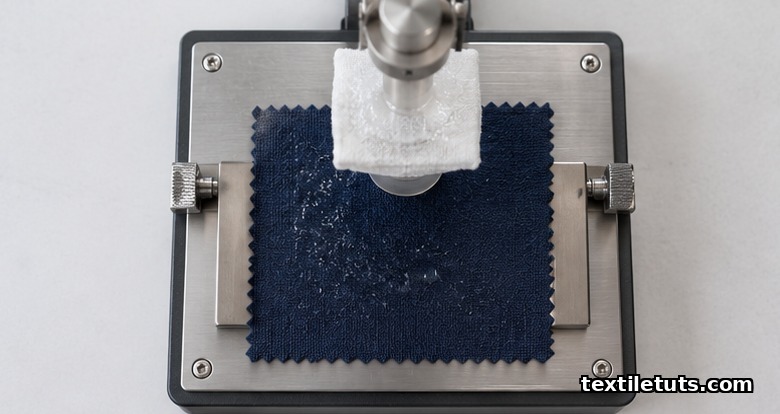
Dry Crock Test
The dry crocking cloth is mounted on the rubbing finger, the specimen is clamped flat to the platform, and the machine runs 10 cycles in 10 seconds. The crocking cloth is removed and held under standardised D65 illumination to assess staining against the grey scale.
Wet Crock Test
For the wet crock, a fresh crocking cloth is wetted with distilled water and squeezed or pressed to a wet pickup of roughly 95 to 100 percent of the dry cloth mass. The wet cloth is mounted on the finger and the same 10-cycle programme runs. Because water mobilises surface dye far more aggressively than dry friction, wet-rub grades are almost always a full grade lower than dry-rub grades on the same fabric.
Testing Both Directions
For woven fabrics, both warp and weft directions are tested separately because yarn density and float length change the amount of surface dye available to transfer. Knits are tested on both face and back because the dye depth on the reverse often differs substantially from the face, especially on yarn-dyed styles.
Reading the Grey-Scale Rating
After the test, the stained crocking cloth is compared visually (or by spectrophotometer under D65 illumination) against a nine-step grey scale for staining. The 1 to 5 ratings map to clear, observable differences.
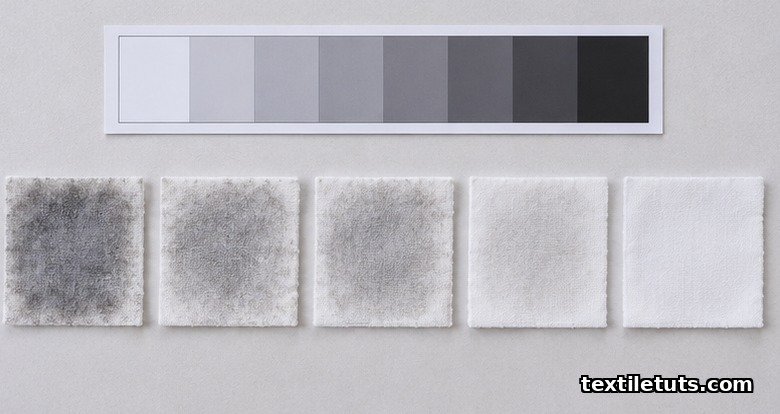
- Grade 5: no perceptible staining; the crocking cloth looks identical to an unused control.
- Grade 4: slight staining, just visible under close inspection.
- Grade 3: moderate staining, clearly noticeable against the white ground.
- Grade 2: substantial staining that would visibly mark adjacent fabric in real wear.
- Grade 1: heavy staining with gross dye transfer.
Half-grade increments (4 to 5, 3 to 4, 2 to 3, 1 to 2) are reported when staining falls between two steps. Most buyer specifications require a minimum of grade 4 dry and grade 3 wet for “acceptable” apparel; grade 3 dry and 2 wet is treated as a fail for outerwear and dark shades, regardless of how the sample looks on the bolt.
ISO 105-X12 vs AATCC TM 8: Key Differences
| Parameter | ISO 105-X12 | AATCC TM 8 |
|---|---|---|
| Rubbing load | 9 N | 9 N (same) |
| Stroke length | 100 mm | 104 mm |
| Number of strokes | 10 | 10 (same) |
| Stroke speed | 1 cycle per second | 1 cycle per second |
| Wet pickup (wet crock) | about 95 to 100 percent | specified by water uptake of the crock cloth itself |
| Crocking cloth | Desized bleached cotton, 50 by 50 mm | Specified AATCC crock cloth, 51 by 51 mm |
| Conditioning atmosphere | 20 degrees C, 65 percent RH (ISO 139) | 21 degrees C, 65 percent RH (ASTM D1776) |
The two standards are functionally interchangeable for buyer acceptance. Most global retailers accept either report, and the small differences in stroke length, conditioning temperature, and crock-cloth specification are not large enough to shift a passing grade into a failing one under normal lab variation.
Common Defects That Cause Crock Failure
Wet rubbing fastness is the most common failure in reactive-dyed cotton, disperse-dyed polyester, and indigo denim. The root causes are usually one of three process issues.
- Surface deposits of unfixed dye. Inadequate soaping after reactive dyeing leaves hydrolysed dye sitting on the fibre surface; the crock test scrapes it off onto the white cloth. A second hot soap at 90 to 95 degrees C for 15 minutes typically fixes this.
- Excessive dye depth on dark shades. Black, navy, red, and turquoise shades push the dye load past what the fibre can hold, especially on cellulosics. More dye on the surface means more dye available to transfer, so deep shades almost always grade lower than pastels of the same dye class.
- Missing or insufficient wet-rub improver. Cationic fixing agents, reactive fixers, and silicone softening finishes all shift wet-rub ratings by 0.5 to 1.5 grades when applied correctly. Skipping the after-treatment to save process time is the most expensive shortcut in the dyehouse.
Pre-treatment of cotton with cationising agents before reactive dyeing can lift wet-rub fastness by 1 to 2 full grades on deep shades. For polyester, a reduction clear after disperse dyeing is critical, since residual surface dye is the single biggest cause of poor wet rubbing on dark synthetics.
Frequently Asked Questions
What is a passing grade for ISO 105-X12?
Most apparel specifications treat grade 4 dry and grade 3 wet as the minimum acceptable result. Luxury and childrenswear buyers typically demand grade 4 to 5 dry and grade 3 to 4 wet. Anything below grade 3 wet is generally rejected at the lab-dip stage before bulk production begins, regardless of how the shade looks on a handfeel card.
Why is wet rub always lower than dry rub?
Water plasticises cotton and polyester fibres, swells the surface dye layer, and mobilises dye that is held only loosely on the fibre. Hydrolysed reactive dye, in particular, becomes soluble in water and transfers readily under wet friction. Most dye classes show a 0.5 to 1.5 grade drop from dry to wet rub on the same fabric, which is why mills test wet rub separately rather than estimating it from the dry result.
Can ISO 105-X12 results predict real-world dye transfer?
Yes, with reasonable accuracy for cellulosics. The crockmeter reproduces the dominant failure mode (short, repeated friction under light pressure) that produces dye transfer on car seats, bag straps, and adjacent garments. It does not capture long-duration pressure, such as sitting in a chair for hours, or solvent-mediated transfer through sweat, which require ISO 105-E07 (perspiration) and ISO 105-X01 (other rubbing variants) instead.
What is the difference between ISO 105-X12 and ISO 105-X16?
ISO 105-X12 uses a flat-finger crockmeter and is the general-purpose method for woven and knit fabrics. ISO 105-X16 uses a curved-finger apparatus under lower load, designed for pile fabrics and carpets where a flat finger would compress the pile and distort the result. For most apparel and home-textile testing, X12 is the right method to specify.
How can a mill fix a failing wet-rub result?
The fastest in-process fix is a cationic after-soaping step or a wet-rub improver in the final rinse. For deep shades, the better long-term fix is to switch to a cationised cotton pre-treatment, lengthen the soaping time after reactive dyeing to at least 15 minutes at 90 degrees C, or use a higher-molecular-weight reactive dye with better wash fastness. Each of these typically adds 0.5 to 1.0 grade on the wet rub, and combining two of them often moves a grade 2 wet rub to a grade 3 to 4 wet rub on dark reactive shades.
References
- International Organization for Standardization. ISO 105-X12:2016, Textiles, Tests for colour fastness, Part X12: Colour fastness to rubbing. iso.org, the international standard that specifies the crockmeter method, 9 N load, 10 strokes, and 100 mm track used in this article.
- AATCC. Test Method 8: Colorfastness to Crocking. aatcc.org, the parallel American standard (AATCC TM 8) for the same crockmeter test, with the 104 mm stroke and AATCC crocking cloth.
- International Organization for Standardization. ISO 139:2005, Textiles, Standard atmospheres for conditioning and testing. iso.org, defines the 20 degrees C and 65 percent RH preconditioning atmosphere required before ISO 105-X12 testing.
- Society of Dyers and Colourists. Colour fastness to rubbing, SDC technical brief. sdc.org.uk, describes the role of the 1 to 5 grey scale and the standard crocking cloth in textile colour-fastness testing.
- ResearchGate. Effect of cationisation on wet rubbing fastness of reactive-dyed cotton. researchgate.net, peer-reviewed study quantifying the wet-rub improvement from cationic pre-treatment of cellulose.
- ScienceDirect. Mechanism of dye transfer in crocking of disperse-dyed polyester. sciencedirect.com, peer-reviewed paper on the surface-dye mechanism behind wet-crock failure on dark synthetics.
This article is the working reference for crockmeter rubbing fastness under ISO 105-X12. Editorial by Iftay Khairul Alam, TextileTuts. Sources: ISO 105-X12:2016, AATCC TM 8, ISO 139:2005, SDC technical brief, and the cited peer-reviewed literature as cited.


