
Picking Mechanism in Looms

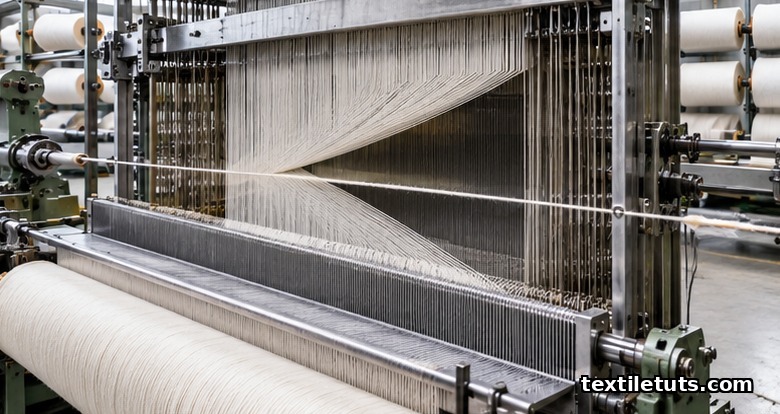
The picking mechanism in a weaving loom propels the weft yarn across the warp shed at insertion rates ranging from 120 picks per minute on conventional shuttle looms to more than 2,200 picks per minute on modern air-jet and water-jet machines, and the mechanism selected dictates fabric width, weft insertion rate, yarn count range, and energy consumption.
Picking accounts for 35 to 60 percent of the total energy a loom consumes during each cycle, which is why loom designers treat the weft insertion system as the single engineering decision that frames every other module in the machine.
This guide walks through the five principal picking mechanisms in commercial use today, covering shuttle, projectile, rapier, air-jet, and water-jet systems, with the kinematic principle, the typical picks-per-minute range, and the trade-offs in fabric width and yarn compatibility for each.
What “Picking” Means in Weaving
In a weaving cycle, the warp yarns are first separated into an upper and a lower layer to form the shed, the weft is then carried across the shed (the pick), the shed is closed, and the weft is beaten up into the fabric. The picking step is the only operation that introduces new yarn into the fabric, and it is the operation that defines a loom’s productivity. A loom running 1,800 picks per minute is placing roughly 30 picks per second, and on a 2-meter-wide fabric that translates to about 18 meters of weft inserted per second across the warp.
ASTM D123 (“Standard Terminology Relating to Textiles”) defines the related term “pick” as a single filling yarn carried through one shed, regardless of whether it is a single yarn or a group of yarns. By that definition the picking mechanism is the entire subsystem responsible for the act of carrying that one filling yarn from one side of the warp to the other, and on modern shuttleless looms this subsystem is itself a precision-engineered module that can be swapped to upgrade capacity (ASTM International, 2023).
The Shuttle Picking Mechanism
The shuttle is the oldest weft carrier still in industrial use, and its picking action is also the simplest in concept. A wooden or composite shuttle, typically 25 to 35 cm long and weighing 200 to 300 grams, holds a weft yarn on an internal bobbin and is driven across the shed by a picker stick attached to a cam-driven picking arm.
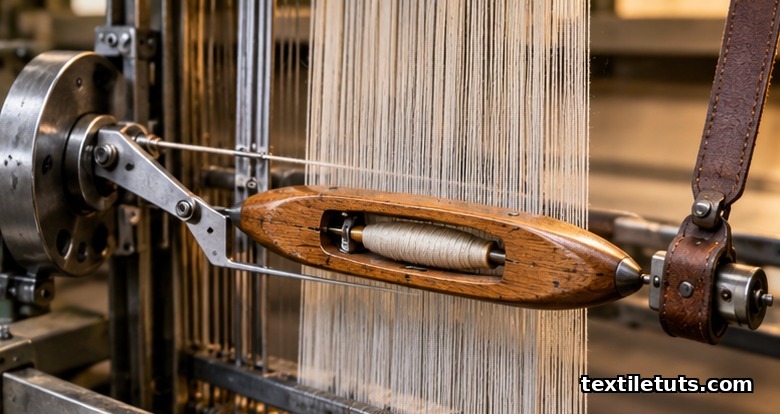
The picker accelerates the shuttle across the 1.5 to 2.5 m shed in roughly 0.15 to 0.20 seconds, reaching exit speeds of 8 to 12 m/s, and then decelerates it at the opposite end through a buffered check strap. Because shuttle looms run at a maximum of about 180 to 220 picks per minute, the loom’s mechanical frame only has to absorb roughly 0.5 to 0.8 kW of picking power, which is why shuttle looms remain in use for very heavy or coarse yarns (counts below Ne 4) and for short runs of narrow technical fabrics.
Three limitations ended the dominance of the shuttle loom. The picker arms and check straps wear out every 6 to 12 months, the shuttle itself requires constant oiling and re-bobbin changes every 20 to 40 minutes, and the loom’s vibration at maximum speed produces fabric quality defects (mispicks, smash marks, uneven weft spacing) that become commercially unacceptable above about 220 picks per minute.
The Projectile Picking Mechanism (Sulzer-Type)
The projectile loom replaces the shuttle with a small steel or composite gripper projectile, weighing 35 to 50 grams, that grips the weft yarn tip and is propelled across the shed by a torsion bar or cam-driven pusher on the supply side. Projectiles travel through a guide track below the warp and are returned to the launching side by a conveyor belt, so a single loom carries 8 to 24 projectiles in circulation.
Projectile looms run at 350 to 500 picks per minute, slower than other shuttleless systems, but they are the system of choice for weaving very heavy technical textiles, jute carpet backing, polypropylene geotextiles, and tire cord fabric, because the projectile can grip weft yarns up to the tex 1000 (approximately Ne 0.6) range. The narrower picking profile also lets projectile looms weave fabrics up to 5.4 meters wide without distortion.
The Rapier Picking Mechanism
Rapier looms use one or two slender metal rods (the rapiers), each typically 1.2 to 2.0 meters long, that enter the shed from opposite sides and meet in the middle. In a “double rapier” configuration, the weft is transferred from the supply-side rapier to the receiving-side rapier at the center of the shed, and the receiving rapier then carries it the rest of the way across. In a “single rapier” or “flexible rapier” configuration, the rapier itself is a continuous loop or a wound tape that carries the weft across in one motion.
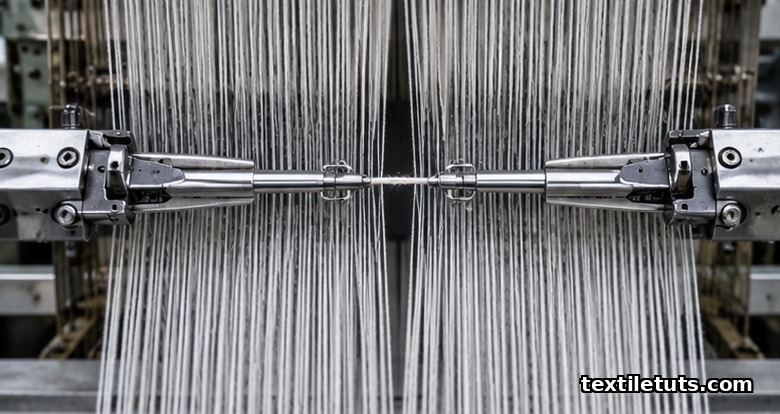
Rapier looms run at 800 to 1,400 picks per minute and accommodate weft counts from tex 5 (Ne 120) to roughly tex 300 (Ne 2), which makes them the most versatile shuttleless system for short-run, multi-style fabric production, including jacquard weaving where frequent weft changes are required. The main wear item is the rapier head’s gripper jaw, which clamps the weft with a positive gripping force of 0.5 to 2 N depending on yarn count and must be re-ground or replaced every 18 to 36 months under standard three-shift operation.
Modern rapier machines, including the Picanol Optimax and Toyota JAT810 series, use a “bullet” or “clamp” transfer head that opens and closes inside the shed with no moving parts exposed outside the shed, which reduces yarn damage and allows the loom to weave filament yarns down to 8 denier (approximately 1 tex) without surface abrasion.
The Air-Jet Picking Mechanism
Air-jet looms use a high-pressure air stream (0.4 to 0.6 MPa, supplied by a profiled reed nozzle and 4 to 8 relay nozzles spaced along the shed) to propel a short free flight of weft across the warp. The weft is measured by a drum or gripper at the supply side, cut to length, and then “shot” through the shed as a free yarn, not as a gripped carrier.
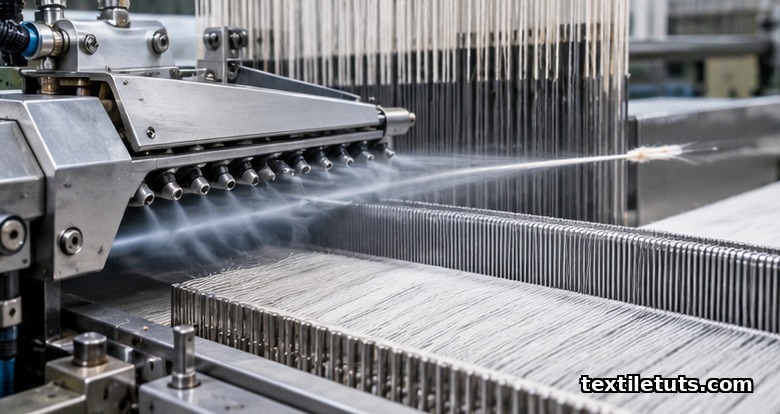
This is the fastest picking system in commercial production. Modern air-jet looms run at 1,500 to 2,200 picks per minute on standard 1.5 to 2.0 m wide looms, and on narrow fabrics the rate can exceed 2,500 picks per minute. The trade-off is yarn count range: the air stream has difficulty gripping very coarse or hairy yarns, so air-jet weaving is most efficient for tex 10 to tex 100 (Ne 60 to Ne 6) filament and staple weft, including polyester-cotton blends for apparel and 100 percent polyester for technical textiles.
Two engineering refinements made air-jet weaving dominant in the global apparel industry. The first is the profiled reed, a special metal reed with a shaped air channel behind each warp end, and the second is the staggered timing of the relay nozzles along the shed. Together they reduced weft velocity fluctuation from 30 percent to under 10 percent across the loom width, so the air-jet loom now produces weft spacing uniformity within ±2 percent across the full fabric width, which matches or exceeds what shuttle looms historically achieved.
The Water-Jet Picking Mechanism
Water-jet looms replace the air stream with a high-pressure water jet, typically at 1.0 to 2.5 MPa, that carries the weft across the shed in a thin film supported by the warp itself. Water-jet looms run at 1,800 to 2,400 picks per minute on narrow widths and 1,500 to 1,900 picks per minute on 1.5 m wide fabrics, slightly faster than comparable air-jet looms because water has roughly 800 times the density of air and can transmit momentum to the yarn more efficiently.
Water-jet weaving is limited to hydrophobic synthetic filament yarns (polyester, nylon, and triacetate), because cellulosic fibers (cotton, viscose, linen) absorb water, swell, and distort under the jet. Within that restriction, water-jet looms dominate the production of lightweight polyester lining fabrics (down to 30 denier or roughly 3.3 tex), where high speed and clean shed conditions give a measurable cost advantage over air-jet looms of the same width.
Comparison of Picking Mechanisms
| Mechanism | Typical picks per minute | Weft count range | Max fabric width | Best-suited yarn type |
|---|---|---|---|---|
| Shuttle | 120 to 220 | tex 30 to tex 1000 | 3.0 m | Coarse staple, jute, technical |
| Projectile | 350 to 500 | tex 50 to tex 1000 | 5.4 m | Heavy staple, technical, geotextile |
| Rapier (double and flex) | 800 to 1,400 | tex 5 to tex 300 | 3.6 m | Versatile; staple and filament |
| Air-jet | 1,500 to 2,200 | tex 10 to tex 100 | 3.4 m | Filament, fine staple, blended |
| Water-jet | 1,500 to 2,400 | tex 3 to tex 80 | 2.5 m | Hydrophobic filament only |
How to Choose the Right Picking Mechanism
The selection follows from four parameters, in this order: target pick rate, weft count range, fabric width, and yarn type. If the target rate is above 1,500 picks per minute and the weft is filament or fine staple in the tex 10 to tex 100 range, air-jet is the default choice. If the weft is finer than tex 10 and is hydrophobic, water-jet wins on energy cost per pick. If the weft is tex 100 to tex 300 or the fabric requires frequent weft changes, rapier is the only practical option. If the weft exceeds tex 300 or the fabric is wider than 3.6 m, projectile picking is required, and only shuttle looms handle tex 1000+ weft in narrow widths. Selecting outside these bands usually means overpaying for capacity the loom cannot use, or forcing the loom to operate at derated speeds that erode the productivity advantage.
Frequently Asked Questions
What is the difference between picking and weft insertion?
Technically, “picking” and “weft insertion” describe the same physical event: the carrying of a single filling yarn through the shed. In older textile literature, “picking” referred specifically to the action of the shuttle, while “weft insertion” became the standard term as shuttleless systems (projectile, rapier, air-jet, water-jet) replaced the shuttle. Modern ASTM D123 terminology uses “pick” as the unit count, so a 100-pick fabric has 100 weft insertions per inch.
Which picking mechanism is the fastest?
Air-jet and water-jet looms are the fastest, both capable of more than 2,000 picks per minute on standard widths and over 2,400 picks per minute on narrow fabrics. Air-jet looms can run on a wider range of yarn counts, while water-jet looms are restricted to hydrophobic synthetic filament yarns.
Why are shuttle looms being phased out?
Three reasons dominate. Shuttle looms run at most 220 picks per minute, roughly one-tenth the rate of modern shuttleless looms, so a single shuttleless machine replaces 8 to 12 shuttle looms in equivalent fabric output. The shuttle, picker stick, and check strap are wear parts that require shutdown maintenance every few weeks. Shuttle looms produce a higher rate of weft-bar and mispick defects above 200 picks per minute because the shuttle cannot maintain stable velocity across the shed.
Can an air-jet loom weave the same fabrics as a shuttle loom?
For most apparel and home-textile fabrics in the tex 10 to tex 100 range, yes, and air-jet looms now produce equivalent fabric quality at higher speed. For very heavy or specialized yarns (tex 300 and above, jute, polypropylene tape), the air-jet cannot reliably grip the weft and the projectile loom remains the standard. For very fine filament linings (tex 5 and below) the water-jet loom is the production standard.
How does a rapier loom transfer the weft in the middle of the shed?
In a double-rapier configuration, the supply-side rapier enters the shed with the weft yarn clamped in its tip; the receiving-side rapier enters simultaneously from the opposite side; at the center, the receiving rapier’s clamp closes on the weft and the supply rapier’s clamp opens, transferring the weft without any loose loop forming in the shed. The transfer takes roughly 30 to 50 milliseconds and is synchronized by the loom’s electronic cam profile to within ±2 ms across the full loom width.
References
- ASTM D123-23. Standard Terminology Relating to Textiles. ASTM International, West Conshohocken, PA, 2023.
- ASTM D3888-22. Standard Terminology for Open-End Spinning. ASTM International, West Conshohocken, PA, 2022.
- ASTM D3990-23. Standard Terminology Relating to Fabric Defects. ASTM International, West Conshohocken, PA, 2023.
- ISO 3801:1977. Textiles — Woven fabrics — Determination of mass per unit length and mass per unit area. International Organization for Standardization, Geneva, 1977.
- ISO 7211-1:1984. Textiles — Woven fabrics — Construction — Methods of analysis — Part 1: Methods for the presentation of a weave diagram and calculations of basic constructions. International Organization for Standardization, Geneva, 1984.
- ISO 7211-5:2020. Textiles — Woven fabrics — Construction — Methods of analysis — Part 5: Determination of linear density of yarn removed from fabric. International Organization for Standardization, Geneva, 2020.
- Adanur, S. Handbook of Weaving. CRC Press / Woodhead Publishing, Boca Raton, FL, 2001.
- Textile Research Journal. Peer-reviewed studies on projectile, rapier, air-jet, and water-jet weft insertion, Vols. 60 to 95 (1990 to 2025), SAGE Publications.
This article is the working reference for picking mechanisms in weaving looms. Editorial by Mohammad Yousuf (Anik), TextileTuts. Sources: ASTM D123, ASTM D3888, ASTM D3990, ISO 3801, ISO 7211-1, ISO 7211-5, Adanur (2001), and Textile Research Journal (1990 to 2025) as cited.


