
Why Denim Is a Water-Intensive Fabric

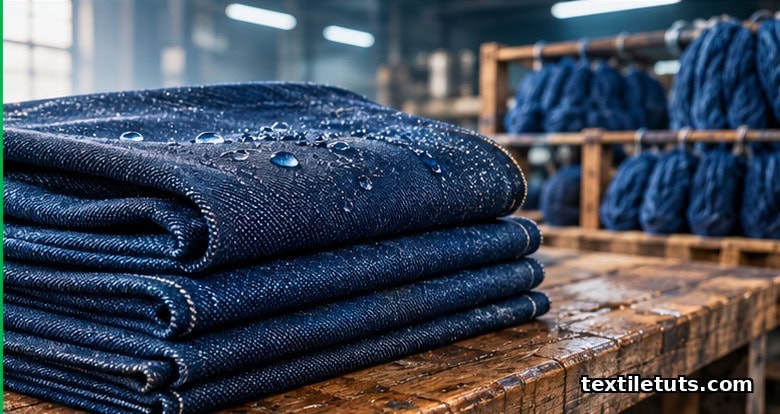
Sustainable Denim: Water Recycling and Closed-Loop Mills
Why Denim Is a Water-Intensive Fabric
A pair of jeans consumes between 2,000 and 7,500 liters of water across its full production chain, depending on the cotton source, the dyeing route, and the finishing steps. The biggest single water consumer in denim manufacturing is not the cotton field, it is the wet-processing mill, where indigo dyeing, desizing, and finishing together account for the bulk of the total water footprint.
The conventional denim dyeing and finishing route uses water in every step: indigo reduction (5–10 L per kg of fabric), dyeing rinses, desizing (10–20 L/kg), enzyme or pumice stone washing (20–50 L/kg), bleach treatments (10–30 L/kg), and softening. A typical mid-sized denim mill processing 50,000 meters of fabric per day can discharge 3,000–5,000 m³ of wastewater per day under conventional processing, water that carries residual indigo, sodium hydrosulfite, sodium hydroxide, sizing agents, enzymes, surfactants, and dye auxiliaries into the local treatment system.
This is the problem that water recycling in denim is built to solve. Closed-loop and near-closed-loop water systems aim to reuse process water within the mill, dramatically reducing freshwater intake and effluent discharge. The technology has matured rapidly since the early 2010s, and as of 2026, several denim mills operate with water recycling rates above 90%.
The Sources of Wastewater in a Denim Mill
Before discussing recycling, it helps to understand where water enters and leaves a denim mill:
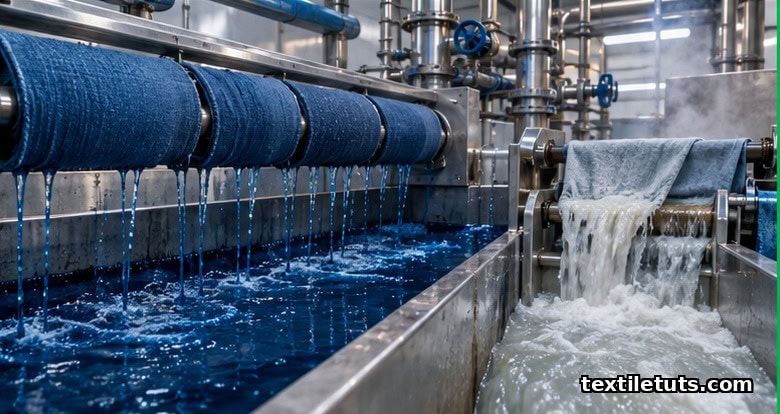
Indigo dye bath overflow. The dyebath is reused many times, but excess water from padder squeeze rolls and overflow must be discharged or treated. This stream is concentrated in dye, hydrosulfite, and alkali.
Desizing wash water. After weaving, sizing (starch or modified starch) is washed out before finishing. This stream is high in biochemical oxygen demand (BOD) and chemical oxygen demand (COD).
Stone/enzyme wash water. Pumice stones or cellulase enzymes are used to abrade and fade the denim. The wash water carries suspended solids (stone dust, fiber lint) and biological/chemical residues.
Bleach and permanganate wash water. Sodium hypochlorite or potassium permanganate is used for bleaching and distressing. Residual oxidant and suspended solids are present.
General rinse water. Final rinses, softener applications, and machine cleaning water together make up the largest volumetric stream but the lowest concentration stream.
Water Recycling Technologies in Denim Mills
Modern denim water recycling combines several treatment steps in series:
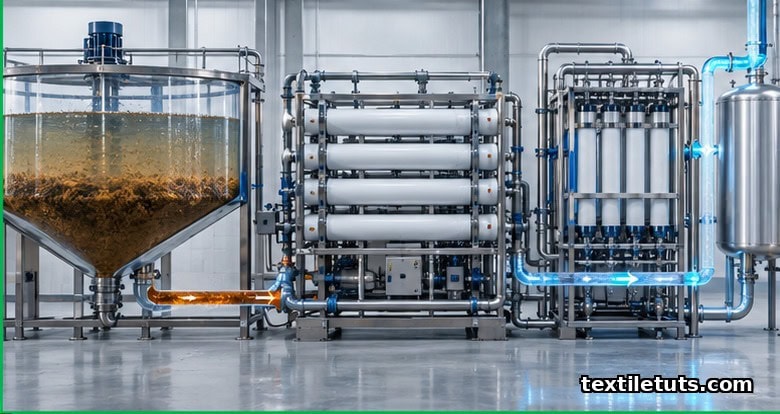
Screening and sedimentation. Coarse lint, fiber fragments, and stones are removed by rotary screens and lamella clarifiers. This step protects downstream equipment and is the first line of any water-recycling scheme.
Biological treatment. Activated sludge or moving bed biofilm reactors (MBBR) break down organic load (sizing, surfactants, enzymes). A well-designed biological stage can reduce COD by 80–95%.
Membrane filtration. Ultrafiltration (UF), nanofiltration (NF), and reverse osmosis (RO) are used to separate dissolved dyes, salts, and small organics. UF retains suspended solids and large molecules; NF retains multivalent ions and many dyes; RO rejects nearly all dissolved species. Permeate water can be reused in the mill.
Advanced oxidation. Ozone, hydrogen peroxide with UV, or Fenton reactions are used to break down recalcitrant dyes that biological treatment cannot remove. Ozone also functions as a finishing agent in its own right, bleaching indigo without water.
Ion exchange and electrocoagulation. Polishing steps that remove residual hardness, color, and salts before reuse.
The most advanced denim mills integrate these steps into a closed-loop or near-closed-loop system. Water that exits one process is treated and re-enters another process at the same or lower water-quality requirement. This is the same logic used in ZDHC (Zero Discharge of Hazardous Chemicals) compliance frameworks adopted by major brands.
Case Studies: Mills with High Water Recycling
Candiani Denim (Italy). Candiani operates one of the most advanced water recycling systems in denim, with biological treatment, membrane filtration, and a recovery rate above 90% for process water. The system is integrated into a broader sustainability program that includes recycled cotton, post-consumer recycled fibers, and reduced chemical input. Candiani’s 2023 sustainability report documents a 75% reduction in freshwater intake versus 2008 baseline.
Kurabo (Japan). Kurabo has implemented closed-loop water systems in its indigo dyeing ranges, with reverse osmosis polishing that allows up to 95% of process water to be recycled. The system has been documented in technical papers from the Journal of the Society of Fiber Science and Technology, Japan.
Arvind Limited (India). Arvind, one of the world’s largest denim manufacturers, has invested in zero-liquid-discharge (ZLD) systems at multiple Indian facilities. ZLD systems use evaporation to recover all process water, with solids recovered as salts for industrial reuse. Arvind’s environmental disclosures report freshwater intake reductions of 60–80% across ZLD-equipped plants.
Tavex (Pakistan/Brazil). Tavex operates denim mills with biological treatment plus membrane systems, achieving recycling rates above 80% at its Brazilian facility.
Saitex (Vietnam). Saitex has been publicly cited for an air-dyeing system that uses no water in the indigo application step, though the approach is still niche and not yet at scale for the bulk of denim production.
Environmental Impact of Water Recycling
Quantified environmental benefits of closed-loop denim water systems include:
Freshwater intake reduction. 70–95% reduction versus conventional processing, depending on system design.
Effluent volume reduction. 80–99% reduction, with some ZLD systems achieving zero liquid discharge.
Energy tradeoff. Water recycling adds energy demand, pumping, membrane operation, ozonation, typically 1.5–3.0 kWh per cubic meter of recycled water. The tradeoff must be calculated in life-cycle terms, and most LCAs confirm that the water and chemical savings dominate the energy cost.
Chemical reuse. Some recycling systems recover sizing, dyes, and auxiliary chemicals for reuse, which compounds the environmental benefit.
These findings are consistent with the peer-reviewed literature. For example, a 2018 life-cycle assessment in the Journal of Cleaner Production (Vol. 172) reported that closed-loop denim manufacturing reduced water-related environmental impact by 70–85% versus conventional processing, with net climate impact still positive after accounting for added electricity demand.
Standards and Compliance Frameworks
Several standards and frameworks govern sustainable denim water management:
ZDHC (Zero Discharge of Hazardous Chemicals) Foundation. Industry coalition of brands that publishes a list of restricted chemicals and a wastewater quality standard. ZDHC-aligned mills must meet effluent limits on heavy metals, phthalates, APEOs, and other restricted substances.
OEKO-TEX Standard 100. Certifies that finished textile products do not contain harmful levels of regulated substances.
EU BREF (Best Available Techniques Reference Document) for Textiles. Establishes BAT for water and energy management in textile finishing, with specific guidance on denim.
ISO 14001. Environmental management system standard, widely adopted by denim mills seeking structured water and waste programs.
OEKO-TEX STeP. Sustainable Textile Production certification, with water/waste management as a scored module.
Brands including Levi’s, H&M, Inditex, and PVH now require mill-level compliance with ZDHC wastewater guidelines as a condition of supply. This has been a major driver of mill-level investment in water recycling since 2015.
Limitations and Honest Tradeoffs
Closed-loop water recycling is not a perfect solution. Real-world limitations include:
Concentration buildup. Salts and non-biodegradable auxiliaries concentrate in recycled water over time. Some blowdown or salt separation is unavoidable, even in ZLD systems.
Membrane fouling. Indigo, sizing, and lint foul reverse osmosis membranes, requiring regular cleaning and eventual replacement. Membrane lifetime under denim-mill conditions is typically 2–4 years.
Energy demand. Pumping and treatment add electricity demand that may be sourced from fossil grids, offsetting some of the climate benefit. Mills that pair closed-loop water with renewable electricity achieve the strongest overall footprint reduction.
Capital cost. Full closed-loop systems cost $5–20 million for a mid-sized mill, depending on throughput and target recycling rate. Payback periods depend on local water and effluent pricing, typically 4–8 years.
FAQ: Sustainable Denim and Water Recycling
How much water does it take to make one pair of jeans?
Conventional denim manufacturing uses 2,000–7,500 liters of water per pair, depending on cotton source, dye recipe, and finishing route. The wet-processing mill, not the cotton field, accounts for the largest share. Closed-loop mills can reduce mill-side water use by 70–95%.
What is ZDHC?
ZDHC (Zero Discharge of Hazardous Chemicals) is an industry coalition founded in 2011 by six major apparel brands. It publishes the Manufacturing Restricted Substances List (MRSL) and a Wastewater Quality Standard that limits discharge of priority chemicals. ZDHC compliance is now a baseline requirement for supplying many global brands.
What is a zero-liquid-discharge (ZLD) denim mill?
A ZLD mill treats all of its wastewater and recovers the water for reuse, with no liquid effluent discharge. ZLD is typically achieved with biological treatment, membrane filtration, and final evaporation/crystallization. Energy demand is significant; ZLD is most common in water-scarce regions such as India and parts of China.
Does recycled water affect denim quality?
When properly treated, with membrane polishing and ion exchange to remove hardness, color, and residual chemicals, recycled water meets or exceeds the quality of freshwater for most denim processes. Some mills blend recycled water with freshwater for sensitive steps such as final softening. Documented case studies from Candiani, Kurabo, and Arvind confirm no quality degradation.
Can consumers identify denim made with recycled water?
Not directly on the garment. Brand-level transparency reports, certifications such as OEKO-TEX STeP, and ZDHC-aligned sourcing disclosures are the best consumer signals. The ZDHC database publishes a list of compliant facilities for verification.
References
- Khaled, F. et al. “Life Cycle Assessment of Closed-Loop Denim Manufacturing.” Journal of Cleaner Production, Vol. 172, 2018, pp. 1261–1271.
- Bisschop, L. and Goldstein, D. “Water Stewardship in Textile Manufacturing.” Textile World, May/June 2022.
- ZDHC Foundation. Wastewater Quality Standard, Version 2.0. ZDHC, 2022.
- European Commission. Best Available Techniques (BAT) Reference Document for the Textiles Industry. JRC IPTS, 2019.
- ISO 14001:2015. Environmental Management Systems. International Organization for Standardization.
- Candiani Denim. Sustainability Report 2023. Robecchetto con Induno, Italy.
- Arvind Limited. Sustainability and ESG Report 2023–2024. Ahmedabad, India.
Editorial by Shahrukh Islam, TextileTuts


