
Two Dye Families, Two Color Stories

Indigo vs Sulfur Dyes on Denim
Two Dye Families, Two Color Stories
Most denim is blue, and most of that blue is indigo. But not all of it. A meaningful fraction of denim on the U.S. market is dyed with sulfur dyes, often in black, gray, green, burgundy, or specialty bottom shades, and even blue denim is increasingly built as an indigo top over a sulfur bottom to deepen the color. Understanding the chemistry of indigo versus sulfur dyes explains why these two dye families behave differently on cotton, why they cost different amounts, and why they are sometimes combined.
Both dye families are applied to cellulose (cotton) and both require reduction before application. The differences lie in the chromophore, the oxidation chemistry, the fastness properties, and the color range. This article walks through the chemistry and practical implications of each family and explains when mills choose indigo, when they choose sulfur, and when they use both.
Indigo: The Vat Dye That Built Denim
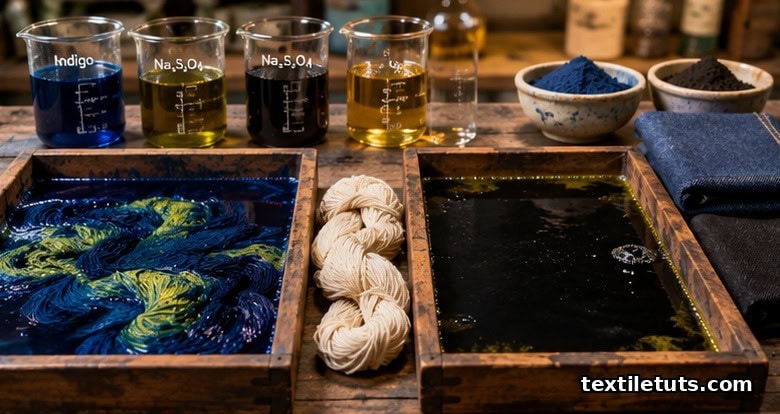
Indigo (C16H10N2O2) is a vat dye, applied as the chemically reduced leuco form, then reoxidized inside the fiber to its insoluble blue state. The chemistry was covered in detail in our indigo dyeing article. Key properties for comparison with sulfur dyes:
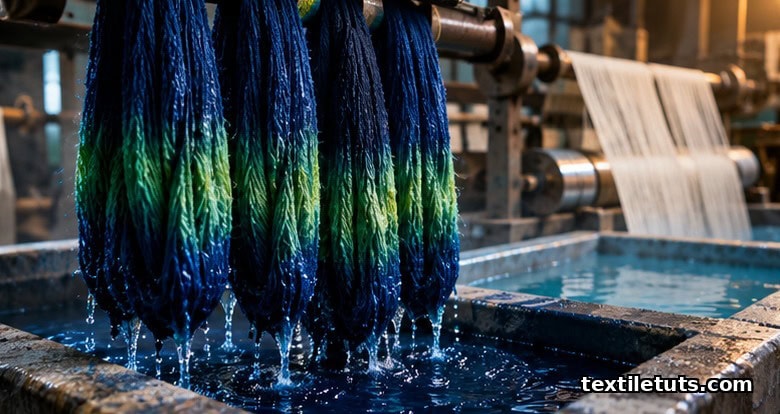
Chemical structure. Indigotin is a planar, conjugated molecule with two indolone rings linked by a central C=C double bond. The conjugation is what absorbs visible light in the orange-red region, producing the characteristic deep blue color.
Reduction. Indigo is reduced with sodium hydrosulfite (Na2S2O4) in a strongly alkaline bath (NaOH, pH > 11). The reduced form is yellow-green and soluble.
Color. Indigo produces a single dominant blue shade. Color variation comes from dye concentration, number of dips, and oxidation control, not from molecular variation.
Fastness. Indigo has good light fastness (Blue Wool 7–8 by AATCC TM-16) but limited wash fastness (typical gray-scale rating 2–4 by AATCC TM-61) and modest crocking fastness (3–4 by AATCC TM-8).
Cost. Synthetic indigo is a commodity chemical, priced at roughly $10–15 per kilogram in 2026. Indigo is the lowest-cost blue dye used at scale in textile processing.
Sulfur Dyes: The Workhorse for Black, Navy, and Specialty Shades
Sulfur dyes are a class of synthetic dyes made by heating aromatic amines or phenols with sulfur or sodium polysulfide. The resulting molecules contain sulfide linkages (–S–) and disulfide bridges (–S–S–) that give the dye class its name. Most sulfur dyes are undefined mixtures of large, polymeric molecules, the precise molecular structure is often not characterized, and they are sold as reduced, pre-pigmented powders or liquids.
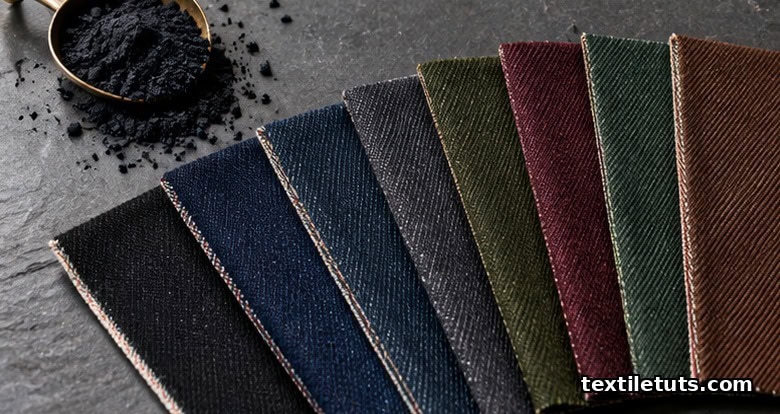
Common sulfur dye bases include C.I. Sulfur Black 1, C.I. Sulfur Blue 7 (a navy/blue base), C.I. Sulfur Red 14, and various specialty brown, green, and olive blends. Sulfur Black 1 is the world’s most-produced dye by volume because it is the cheapest black for cotton.
Reduction. Sulfur dyes are reduced with sodium sulfide (Na2S) or, in more modern recipes, with reducing sugars and sodium hydroxide. The reduced form is colorless or pale; application produces a soluble leuco form that diffuses into the cotton fiber.
Oxidation. After impregnation, sulfur dyes are reoxidized, typically with sodium perborate, hydrogen peroxide, or simply atmospheric oxygen. The reoxidized form is the insoluble colored pigment.
Color range. Sulfur dyes cover the full black-to-navy range plus browns, olives, greens, and burgundies. Sulfur black is the deepest black available for cotton at industrial scale.
Fastness. Wash fastness is excellent (gray-scale 4–5), light fastness is good (Blue Wool 5–7), and crocking fastness is moderate (3–4). Sulfur dyes do not fade as visibly as indigo because the chromophore is built differently and the dye tends to wear uniformly.
Cost. Sulfur dyes are the cheapest dye class for cotton. Sulfur Black 1 is priced at roughly $2–5 per kilogram, an order of magnitude cheaper than indigo and far cheaper than reactive dyes.
Side-by-Side: Indigo vs Sulfur on Cotton Denim
| Property | Indigo | Sulfur |
|---|---|---|
| Chemical class | Vat dye (indigotin) | Sulfide-bridged polymer |
| Reducing agent | Sodium hydrosulfite | Sodium sulfide or reducing sugars |
| Color range | Single deep blue | Black, navy, brown, olive, green, burgundy |
| Wash fastness (AATCC TM-61) | 2–4 | 4–5 |
| Light fastness (AATCC TM-16) | 7–8 | 5–7 |
| Crocking fastness (AATCC TM-8) | 3–4 | 3–4 |
| Fade behavior | High contrast, sharp | Soft, gradual, uniform |
| Approximate cost (2026) | $10–15/kg | $2–5/kg |
| Penetration | Ring dye (20–40% fiber radius) | More uniform, deeper |
| Process water use | High (multiple dips, oxidation) | Moderate |
Why Mills Combine Indigo and Sulfur
The hybrid indigo-over-sulfur route is increasingly common in the U.S. market for two reasons:
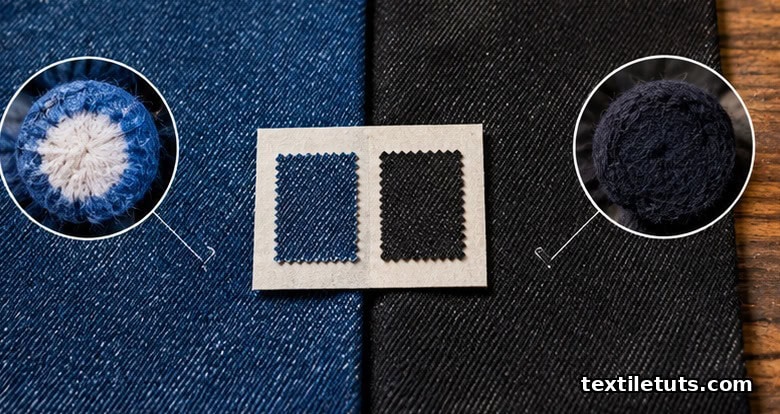
Deeper shades. Indigo alone has a saturation limit on cotton because the dye does not penetrate the fiber deeply. By laying down a sulfur bottom (often a navy or black sulfur), the mill creates a dark base, and then applies an indigo face on top. The result is a denim that looks like indigo but reads visually darker than indigo-only fabric.
Cast control. Sulfur dyes can be selected for a specific cast (redder, greener, more neutral), allowing the mill to tune the final indigo shade without changing the indigo recipe.
The trade-off is in the fade behavior. Hybrid indigo-sulfur denim does not develop the same sharp, contrasty fades as pure indigo because the sulfur dye underneath does not fade the same way. For consumers who want the heritage indigo fade, single-dye indigo remains the reference.
Specialty Indigo Alternatives
Outside the indigo–sulfur binary, denim mills sometimes use other dye classes for specialty applications:
Reactive dyes. Chemically bonded to cellulose via a covalent reaction. Reactive dyes have excellent wash fastness (gray-scale 4–5) and bright shades but cost significantly more than indigo or sulfur. They are used in women’s fashion denim where bright colors or pastels are desired.
Pigment dyes. Pigments are applied as a surface coating with a binder. They do not penetrate the fiber and produce a “worn” appearance immediately. Pigment-dyed denim is associated with fast-fashion production.
Indigo substitutes (vatted anthraquinone dyes). A small number of mills use synthetic anthraquinone-derived vat dyes that mimic indigo’s appearance but offer marginally better fastness. They are more expensive than indigo and rarely used in mainstream production.
Health, Safety, and Environmental Considerations
Indigo dyeing has been a target for environmental and occupational scrutiny because of the reducing agents used. Sodium hydrosulfite is a strong reducing agent that releases sulfur dioxide on decomposition and requires careful handling. Mill operators must manage pH, dissolved oxygen, and effluent sulfide loads.
Sulfur dyes raise different concerns. Conventional sodium sulfide reduction produces hydrogen sulfide (H2S), a toxic gas with a characteristic rotten-egg odor at low concentrations and a lethal exposure risk at high concentrations. Modern sulfur dyeing has shifted largely toward glucose-reducing or zero-sulfide systems, but legacy mills still use Na2S in some regions.
Both dye classes are subject to ZDHC and OEKO-TEX standards. Restricted substance lists include residual sulfide, heavy metals (some historical sulfur dyes contained trace chromium), and unreacted aromatic amines.
Choosing Indigo or Sulfur
For a denim mill, the choice between indigo and sulfur depends on the target shade, the target fastness, the desired fade behavior, and the cost ceiling:
Use indigo when the goal is the heritage blue jean, sharp fades, and a recognized consumer identity. Indigo is the only choice when the mill wants the denim to age with high-contrast whiskers, honeycombs, and stacks.
Use sulfur black when the goal is deep black denim at the lowest possible cost with strong wash fastness. Sulfur black does not develop the indigo-style high-contrast fade; it ages by gradual softening.
Use sulfur navy or specialty colors when the goal is a denim look in a non-blue color (black, gray, olive, burgundy) at commodity cost.
Use indigo over sulfur when the goal is a darker indigo that still reads as indigo on the surface but has the depth that indigo alone cannot deliver.
FAQ: Indigo vs Sulfur Dyes on Denim
Are indigo and sulfur dyes used on the same denim?
Yes. Hybrid constructions are common, a sulfur bottom (often navy or black) is applied first, then an indigo top is layered over it. The result looks like indigo but is visually darker and has different aging behavior than pure indigo denim.
Which dye has better wash fastness on cotton?
Sulfur dyes have better wash fastness (gray-scale 4–5 by AATCC TM-61) than indigo (2–4 on the same scale). This is because sulfur dye molecules are larger and more polymeric, and the post-oxidation form is more permanently trapped inside the fiber.
Which dye has better light fastness?
Indigo. Indigotin rates Blue Wool 7–8 under AATCC TM-16, while sulfur dyes rate 5–7. This is why vintage indigo denim still shows visible blue decades later, while sulfur-dyed denim of similar age may show more visible yellowing or color shift.
Why is indigo denim more expensive than black denim?
Indigo costs roughly $10–15/kg in 2026, while Sulfur Black 1 costs $2–5/kg. The dye cost gap, combined with the more complex multi-dip indigo range, makes indigo denim inherently more expensive to produce than sulfur-black denim at the same fabric weight.
Can sulfur dyes produce the same blue as indigo?
No. Sulfur blue dyes produce a navy or dull blue that does not match indigo’s characteristic bright deep blue. For denim that reads visually as indigo, only indigo (or indigo over a sulfur bottom) produces the right shade.
References
- Venkataraman, K. The Chemistry of Synthetic Dyes, Vols. 1–2. Academic Press, 1952.
- AATCC Technical Manual, Test Methods 8, 16, 61. American Association of Textile Chemists and Colorists, 2023.
- ISO 105 series. Textiles, Tests for Colour Fastness. International Organization for Standardization.
- Chakraborty, J.N. Fundamentals and Practices in Colouration of Textiles. Woodhead Publishing India, 2014.
- Shore, J. “Chemistry of Vat and Sulfur Dyes.” In: The Chemistry of Synthetic Dyes, ed. K. Venkataraman. Academic Press, 1970.
- ZDHC Foundation. Manufacturing Restricted Substances List (MRSL), Version 3.0. ZDHC, 2023.
- Paul, R. (ed.). Denim: Manufacture, Finishing and Applications. Woodhead Publishing, 2015.
Editorial by Shahrukh Islam, TextileTuts


