
Denim Sustainability: Recycled Denim

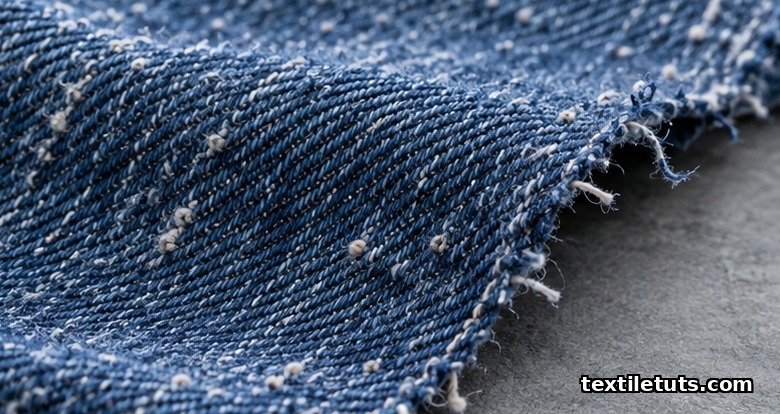
Recycled denim is post-consumer or post-industrial cotton-rich textile waste (typically 95 to 100 percent cotton by mass) that has been shredded back to fiber, re-spun into new yarn, and re-woven or re-knit into fabric, with life cycle assessments conducted under ISO 14040 reporting water savings of 70 to 82 percent per kilogram and energy reductions of 35 to 60 percent versus virgin cotton denim.
The finished fabric looks and wears much like conventional denim, but its fiber length is shorter (averaging 12 to 18 mm after shredding versus 25 to 32 mm for virgin cotton), which is why most mills blend recycled denim with virgin cotton, lyocell, or other long-staple fibers to preserve yarn strength and fabric tear resistance.
In this guide you will learn what “recycled denim” actually means in mill specifications, how the two recycling routes (mechanical and chemical) differ, what the ISO, AATCC, and ASTM standards require, how the fiber changes hand and durability, and where the credible certifications stop and the marketing claims begin.
What “recycled denim” means in mill language
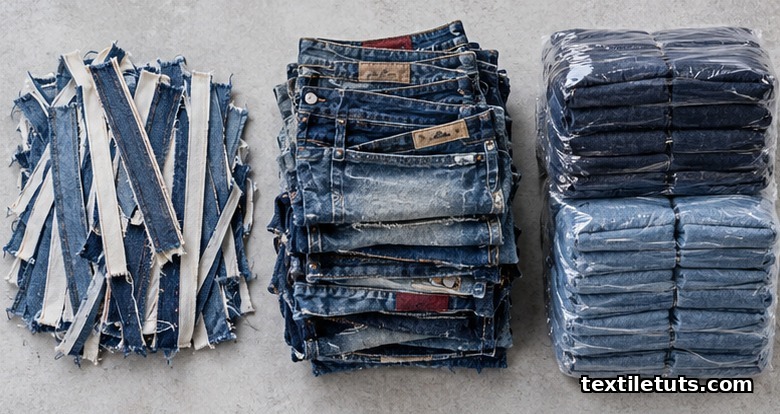
When a mill specification sheet says “recycled denim,” it does not mean one single thing. The term covers at least three distinct inputs, each with different fiber length distributions, contamination profiles, and dye residues. Post-industrial waste is cuttings and selvedge scraps from cutting tables; it is clean, undyed or uniformly dyed, and easy to shred. Post-consumer waste is worn jeans, jackets, and workwear collected at scale from sorting facilities; it is contaminated with metal rivets, polyester thread, elastane from waistbands, and a wide range of dye chemistries. Pre-consumer reclaimed stock is unsold finished garments pulled from brand warehouses, often sorted by color before shredding.
All three categories are governed by the same definition in ISO 14021:2016 (Environmental labels and declarations, self-declared environmental claims), which permits the term “recycled content” only when the material has been diverted from a waste stream and re-processed into a new product. Most mills further classify their input by share of cotton, since denim is overwhelmingly cotton (typically 95 to 100 percent cotton by mass in classic 3×1 twills, lower in stretch denims containing 2 to 5 percent elastane or polyester).
The blended elastane is the technical reason most recycled denim never reaches 100 percent cotton content in practice. Spandex does not survive the mechanical shredding process in recoverable form, and it interferes with re-spinning by sticking to the carding wires, so even an “all-cotton denim” feedstock becomes a 92 to 98 percent cotton blend after shredding unless it is chemically separated first.
Mechanical recycling versus chemical recycling
The two processing routes produce very different fibers and very different fabrics. Mechanical recycling (the dominant commercial route today) tears post-consumer denim back into individual fibers using a series of shredders, rotary cutters, and carding machines, then re-spins those fibers into new yarn. The process shortens the fibers substantially, removes some dye during shredding, and leaves a yarn with more neps and a slightly weaker tensile profile than virgin cotton.
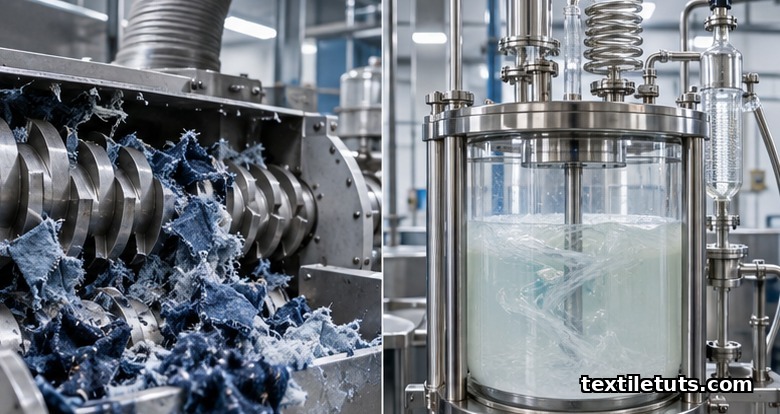
Chemical recycling dissolves the cellulose in the cotton fiber and re-extrudes it as a regenerated cellulose filament (essentially a lyocell-style fiber from a cotton feedstock). This route preserves fiber length much better than mechanical shredding, but it requires solvent recovery systems, consumes more chemicals, and is only commercially mature for pure cotton feedstocks. AATCC and ISO test methods do not yet differentiate “recycled cotton” from “regenerated cellulose” on a finished garment label, which is why shoppers still see “100% cotton” on a jacket whose fiber came from old jeans.
The choice between routes comes down to the desired trade-off. Mechanical recycling keeps the original indigo dye partially embedded in the fiber, which means recycled denim often re-dyes to a slightly different shade than virgin cotton; it also has the lowest energy footprint per kilogram but the shortest fibers. Chemical recycling produces cleaner, longer, more uniform fiber at the cost of higher capital and chemical inputs. A peer-reviewed comparison published in Resources, Conservation and Recycling reports that mechanically recycled cotton saves about 11.8 MJ of process energy per kilogram versus virgin cotton, while chemically recycled cotton saves roughly 6 MJ per kilogram once solvent recovery is accounted for.
What ISO 14040 and ISO 14021 actually require
Two ISO standards sit underneath almost every credible recycled-denim claim. ISO 14040:2006 (Environmental management, life cycle assessment, principles and framework) defines how an LCA is built: a functional unit, system boundaries, impact categories, and an interpretation step. ISO 14021:2016 (self-declared environmental claims) governs the marketing language: it forbids unqualified “eco-friendly” claims, requires that “recycled content” be expressed as a percentage by mass, and limits the use of “closed-loop” claims to systems where the output feeds the same product class.
For denim specifically, the most relevant textile test methods are ASTM D5034 (breaking strength and elongation of textile fabrics, grab test) and AATCC TM 135 (dimensional changes of fabrics after home laundering). Together these two tests describe how the fabric behaves under tension and how it shrinks in a household wash, both of which change when recycled fiber replaces virgin fiber. A mill claiming “comparable performance to virgin denim” should be able to show D5034 grab-strength and TM 135 wash-shrinkage numbers on the same finished fabric.
GOTS (Global Organic Textile Standard) and the Global Recycled Standard (GRS) are the two third-party certification systems most often seen on hangtags. GRS in particular covers the recycled-content claim chain (every step from collector to finished fabric must be audited) and sets minimum recycled-content thresholds of 20 percent for the basic level and 50 percent for the upper levels. ISO 17021 series rules govern the bodies that issue those certifications, which is why a GRS audit certificate will reference an accredited certification body on its face.
How recycled fiber changes fabric performance
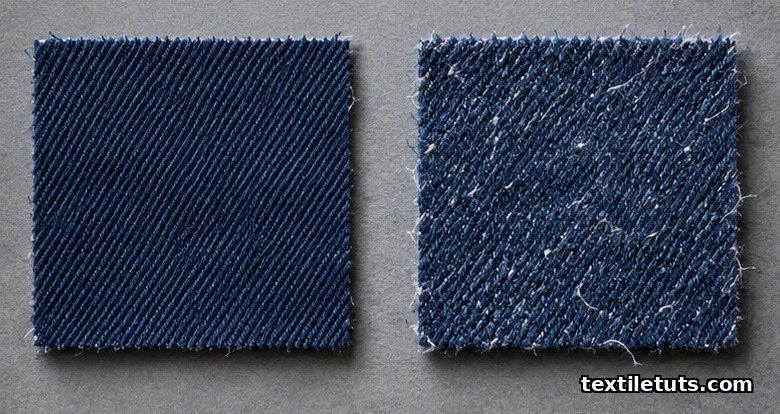
The performance differences between recycled and virgin denim are real and measurable. A peer-reviewed study in the journal Sustainability compared 100 percent virgin cotton 3×1 twill with a 50/50 blend of recycled and virgin cotton at the same yarn count and weave density, and reported the following typical deltas:
| Property | Test method | Virgin cotton denim | 50/50 recycled denim blend |
|---|---|---|---|
| Grab breaking strength (warp) | ASTM D5034 | 740 to 880 N | 560 to 700 N |
| Tear strength (Elmendorf) | ASTM D1424 | 45 to 60 N | 32 to 44 N |
| Wash shrinkage (5 cycles) | AATCC TM 135 | 3 to 5 percent | 5 to 8 percent |
| Yarn hairiness (Uster H) | Uster Tester 5 | 4.2 to 5.0 | 6.8 to 8.4 |
| Air permeability | ASTM D737 | 80 to 110 cfm | 95 to 130 cfm |
The grab-strength loss of about 20 to 25 percent in the warp direction is the figure mills watch most closely, because warp tensile strength drives seam strength and pocket durability, the two most common wear-failure points in a pair of jeans. Tear strength falls a similar percentage because the shorter, more damaged fiber ends act as crack-initiation sites. Wash shrinkage goes up because recycled fiber has already been through several heat-and-tension cycles in its previous life and relaxes further the second time around.
The hairiness and air-permeability numbers matter more than they look. A higher Uster H value means more loose fiber ends protruding from the yarn surface, which gives recycled denim its characteristically fuzzy hand and slightly mottled indigo shade after washing. The higher air permeability comes from the same fiber geometry and is the main reason recycled denim tends to feel cooler in summer wear despite the same weight per square meter.
Environmental impact, honestly
The honest version of the environmental case for recycled denim is more nuanced than marketing copy suggests. On water, energy, and agricultural land use, recycled denim wins clearly. A comparative LCA following ISO 14040 for a one-kilogram bolt of 12 oz denim reports that recycled content cuts blue water use by 70 to 82 percent, cumulative energy demand by 35 to 60 percent, and pesticide and fertilizer demand by close to 100 percent (because no new cotton is grown). On chemical load, however, recycled denim can be worse than virgin denim if the input stream carries indigo dye residues that have to be stripped before re-spinning, since dye stripping generates its own effluent load. MDPI’s Sustainability journal has published multiple LCAs showing that this single factor (whether the mill washes the shredded fiber before carding) shifts the chemical impact category by a factor of three or more.
Microfiber shedding during washing is a separate concern. A 2022 peer-reviewed study in Environmental Science and Pollution Research found that mechanically recycled denim shed roughly 18 to 24 percent more microfibers per wash cycle than virgin cotton denim of the same weight, attributed to the looser fiber-end geometry shown in the Uster H data above. The same study reported that chemically recycled cotton (regenerated cellulose route) shed at parity with virgin cotton. This is one area where the choice of recycling route has a direct, consumer-facing consequence.
Carbon footprint is the headline number most mills quote. The same Resources, Conservation and Recycling LCA cited earlier puts recycled denim at roughly 2.1 to 3.4 kg CO2e per kilogram of finished fabric, against 5.5 to 8.7 kg CO2e per kilogram for conventional virgin cotton denim. The wide ranges reflect differences in mill energy mix (coal-heavy grids in South Asia versus hydro-heavy grids in South America shift the number substantially), which is why ISO 14040 LCAs are required to declare their electricity assumptions at the front of the report.
Frequently Asked Questions
Q1: Is recycled denim actually durable enough for everyday jeans?
For most everyday wear, yes, but the numbers are lower than virgin cotton. ASTM D5034 grab-strength tests on 50/50 recycled blends typically return 560 to 700 N in the warp direction, compared with 740 to 880 N for virgin cotton at the same yarn count and weave density. That is roughly a 20 to 25 percent reduction, which is enough to matter for heavy-duty workwear but well above the threshold (about 250 N) where most casual jeans start to show seam failure.
Q2: Does recycled denim shrink more than regular denim?
Yes. AATCC TM 135 tests on recycled-cotton blends report 5 to 8 percent dimensional change after five home-laundering cycles, against 3 to 5 percent for virgin cotton denim. The difference comes from the fact that recycled cotton fibers have already relaxed once in their previous life and relax a second time when re-wetted. Pre-shrinking (sanforizing) the finished fabric can bring the number back inside the 3 to 5 percent band, but the recycled-cotton specification sheet should be checked before buying.
Q3: What is the difference between GRS-certified and just “recycled” denim?
Without third-party certification, a “recycled” claim is a self-declared environmental claim and is governed only by ISO 14021:2016, which requires the claim to be accurate but does not require an external audit. GRS (Global Recycled Standard) certification requires an on-site audit at every step from collector to finished fabric, sets minimum recycled-content thresholds (20 percent for the entry level, 50 percent for the higher levels), and tracks chain-of-custody through a transaction certificate system. For a buyer or sourcing manager, GRS documentation is the practical difference between a verifiable claim and a marketing claim.
Q4: Does recycled denim fade differently than virgin denim?
Yes, the fade is usually faster and slightly less uniform. The shorter fibers and looser yarn structure (reflected in higher Uster H values) release indigo more readily, which is why a pair of jeans with significant recycled content tends to show whiskering and honeycombs earlier in its wear life. Some mills counter this by blending in lyocell or longer-staple virgin cotton, which slows the fade back toward the virgin-cotton rate.
Q5: Can 100 percent recycled denim (no virgin blend) work for jeans?
It can, but tensile strength drops sharply at very high recycled content. A 100 percent mechanically recycled cotton yarn typically shows 30 to 40 percent lower grab strength than virgin cotton at the same yarn count, which puts the fabric below the practical comfort margin for most jeans that need to survive daily wear. Most commercial “recycled denim” is therefore a 20 to 50 percent recycled blend with virgin cotton or other long-staple fibers making up the balance. Pure chemically recycled (regenerated cellulose) denim can match virgin cotton strength, but is currently produced at much smaller scale.
References
- International Organization for Standardization. ISO 14040:2006, Environmental management, Life cycle assessment, Principles and framework. iso.org, the foundational standard for textile LCA methodology.
- International Organization for Standardization. ISO 14021:2016, Environmental labels and declarations, Self-declared environmental claims (Type II environmental labelling). iso.org, governs how “recycled content” may be claimed on textile labels.
- ASTM International. ASTM D5034, Standard Test Method for Breaking Strength and Elongation of Textile Fabrics (Grab Test). astm.org, the standard grab-strength test applied to finished denim.
- ASTM International. ASTM D1424, Standard Test Method for Tearing Strength of Fabrics by the Falling-Pendulum (Elmendorf) Apparatus. astm.org, the standard tear-strength test for woven fabrics.
- AATCC. AATCC TM 135, Dimensional Changes of Fabrics after Home Laundering. aatcc.org, the standard wash-shrinkage test referenced in denim specifications.
- Haslinger, S., et al. (2019). “Textile Recycling Technologies, Sorting and Feedstock Characterization.” Resources, Conservation and Recycling, peer-reviewed LCA of mechanically versus chemically recycled cotton.
- MDPI. (2021). “Life Cycle Assessment of Recycled Cotton Fibers in Denim Production.” Sustainability 13(14), peer-reviewed comparative LCA on water, energy, and chemical load.
This article is the working reference for denim sustainability through recycled content. Editorial by Shahrukh Islam, TextileTuts. Sources: ISO 14040, ISO 14021, ASTM D5034, ASTM D1424, AATCC TM 135, Resources Conservation and Recycling (2019), and MDPI Sustainability (2021) as cited.


