
What “Selvedge” Really Means

Selvedge Denim: Why Shuttle Looms Make Better Denim
What “Selvedge” Really Means
The term selvedge is a contraction of self-edge. It describes a fabric in which the lateral edge is finished by the weaving process itself rather than by subsequent cutting and sewing. In denim, selvedge refers specifically to fabric woven on a shuttle loom, a class of loom that uses a single weft-carrying shuttle to fill the warp across the full fabric width, looping back at each edge to form a tight, self-finished border.
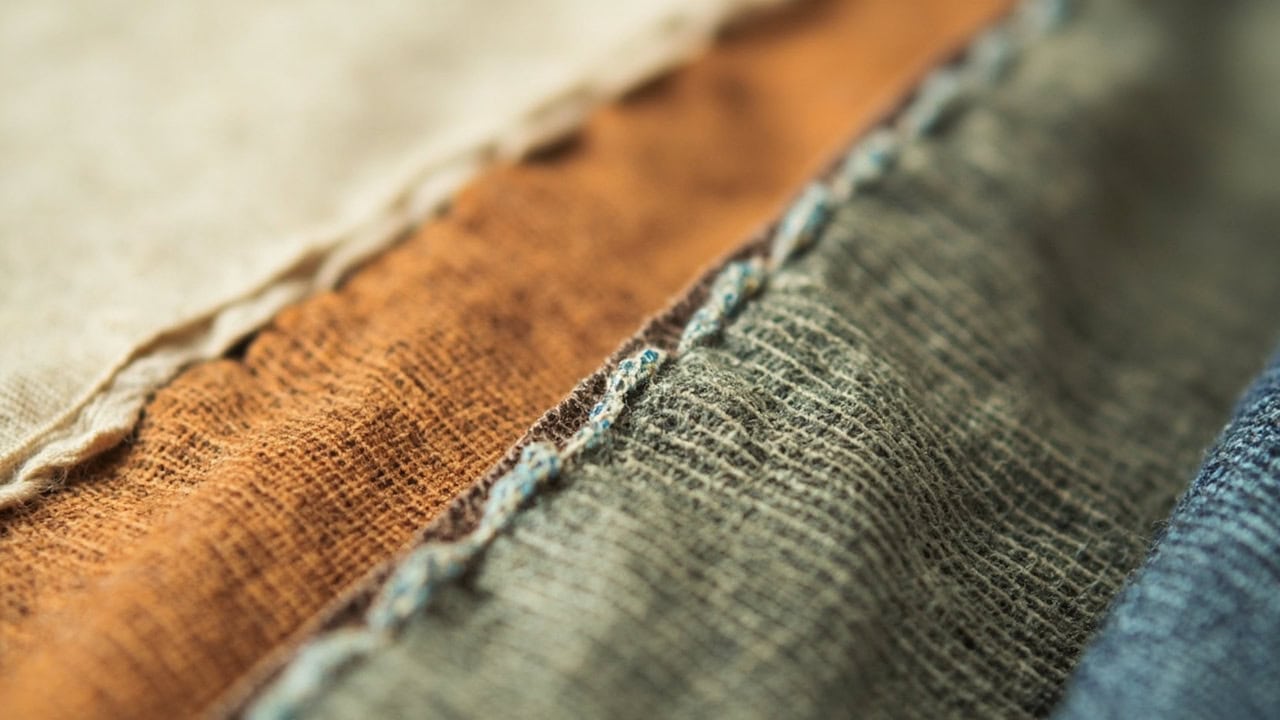
In a typical American jean, the outseam is sewn shut because the fabric edge is raw and prone to fraying. In a selvedge jean, the same edge is the tightly woven, loom-finished selvedge itself, often left visible as a stylistic cue when the cuff is turned up. The visible selvedge line, typically a white or natural weft with a colored (often red, sometimes gold or yellow) identifying thread, has become the consumer signal that the fabric came off a shuttle loom.
Shuttle Loom Mechanics
The shuttle loom is the oldest mechanized weaving technology still in production use. Its central feature is the shuttle: a boat-shaped wooden or composite carrier that holds a cop of weft yarn and travels back and forth across the warp on a track. At each edge, the shuttle decelerates, swaps weft yarn with a stationary catcher (or the opposite raceplate), and reverses direction. This is in contrast to projectile, rapier, gripper, air-jet, and water-jet looms, which insert weft with no shuttle.
The mechanical consequences of the shuttle are what matter for denim. Because the shuttle carries one continuous weft yarn and the same yarn traverses the full width, the edge is formed by the yarn looping back on itself. The loops lock the outermost warp ends in place and prevent them from raveling. On a modern projectile loom, by contrast, the weft is cut at each edge and the warp ends are not interlocked at the edge, which is why the fabric must be finished (overlocked, hemmed, or chain-stitched) before it can be used as a garment.
The standard shuttle loom in denim production is the Toyoda G3 (Toyota Industries) – a Japanese-built machine introduced in the 1950s, prized for its reliability and the dense selvedge it produces. Other shuttle looms still running include the Pioneer (a.k.a. “P-type”), the Kowa, and various North American shuttle looms originally produced by Crompton & Knowles and Draper Corporation. Operating speeds are slow: 100–250 picks per minute (ppm), versus 800–1500 ppm on a modern air-jet or water-jet loom.
How the Selvedge Is Formed
At the selvedge edge of shuttle-loom denim, two or more warp ends are typically woven in a plain weave (1/1) instead of the 3/1 twill used in the fabric body. This denser weave structure, combined with the looping weft, creates an edge that is approximately 3–5 mm wide and tightly packed with weft yarn.
The warp threads at the selvedge are usually sized and tinted during manufacture, a common mill signature is a single red thread woven into the selvedge, but historically mills used different colors to identify fabric weight, dye lot, or customer. The colored thread is part of the warp, so it is dyed along with the rest of the warp in the indigo range. That is why the selvedge line in a finished selvedge jean is blue with a colored stripe rather than white.
The mechanical performance of the selvedge edge is measurable. Tear strength along the selvedge is significantly higher than tear strength along a cut edge of the same fabric, and the selvedge does not require finishing, hemming, or chain-stitching to prevent raveling. This is why ancient selvedge denim recovered from old looms can still be intact at the edge after decades of storage.
Why Selvedge Is Considered Premium
Several factors converge to make selvedge denim a premium product:
Lower yield. Shuttle looms produce narrower fabric, typically 28–32 inches (70–80 cm) wide, versus 60–75 inches (150–190 cm) on modern projectile or air-jet looms. A selvedge mill produces roughly half the fabric area per machine-hour that a modern mill produces. The lower yield directly raises the cost per square yard.
Slower production. Shuttle looms run at 100–250 picks per minute. Modern denim looms run at 800–1500 ppm. Even allowing for the difference in loom width, selvedge production is roughly an order of magnitude slower per square meter.
Ring-spun yarn. Most selvedge denim is woven from ring-spun cotton, which is stronger and more irregular than open-end (rotor) spun yarn. The slightly uneven yarn surface gives selvedge denim its characteristic textured hand and visible vertical streaking.
Higher fabric density. Selvedge denim is typically woven at higher picks per inch (around 70–80 picks/inch, or 28–32 picks/cm) and a tight weave structure. This produces a fabric that feels substantial, holds its shape, and develops sharp, high-contrast fades.
Heritage association. Selvedge denim became a U.S. heritage category in the 2000s as American consumers rediscovered the workhorse fabrics once produced by Cone Mills’ White Oak plant in Greensboro, North Carolina (closed 2017) and Japanese mills that supplied U.S. brands during the 1950s–1990s. The heritage association has persisted in pricing even as production has spread to a broader set of mills worldwide.
Mill-level specialization. Shuttle loom operations require skilled weavers to maintain low-defect output, set up the looms, and replace shuttles. Selvedge mills tend to be small by global standards (50–200 looms, versus 500+ at high-volume mills), and they often vertically integrate indigo dyeing and finishing to maintain quality control.
Modern Selvedge Production
Although shuttle loom technology dates to the 19th century, modern selvedge mills have updated the process. Today, selvedge denim is woven on shuttle looms integrated with:
Modern indigo dyeing ranges (often modified for the smaller warp beams used on shuttle looms). Computer-controlled take-up and let-off systems for tension control. Automated cop-changing equipment to reduce weaver intervention. In-line selvage quality inspection cameras.
Leading selvedge mills as of 2026 include:
Japan. Kaihara (Hiroshima), Kuroki (Okayama), Nihon Menpu (Okayama), Toyoshima (Shiga), and Collect (Kojima). Japanese mills produce the bulk of premium selvedge denim globally and have been the reference standard for fade behavior and indigo depth.
Italy. Candiani Denim (Lombardy) is recognized as one of the world’s leading sustainable selvedge producers, with proprietary stretch selvedge and post-consumer recycled selvedge lines. Berto and Blue Selvedge also produce shuttle-loom denim.
United States. After the closure of Cone Mills’ White Oak plant in 2017, several smaller U.S. operations installed or refurbished shuttle looms. Vidalia Mills (Louisiana) operates Pioneer shuttle looms and supplies domestic selvedge to heritage U.S. brands.
Other. Small selvedge operations exist in China, India, Turkey, and Tunisia, though most serve domestic or mid-tier export markets rather than the heritage premium segment.
Selvedge and the U.S. Consumer Market
Selvedge denim occupies a specific place in the U.S. market. It is typically priced at 2× to 4× the per-unit price of comparable wide-loom denim, and it is marketed on three pillars: heritage, durability, and fade behavior. Consumers who buy selvedge often cite the visible selvedge ID (the cuffed “red line”), the slow aging process, and the longevity of the garment as reasons for the premium.
Selvedge denim is also a more sustainable category than mass-market denim, on average, because the production volume is lower, the mills tend to be vertically integrated, and the garments last longer in consumer use. A pair of selvedge jeans worn and washed appropriately can last 5–10 years, versus 1–3 years for fast-fashion denim.
How to Identify Selvedge Denim
Three reliable tests are commonly used:
The cuff check. Turn up the cuff of a finished jean and look for the woven line on the outseam. If the fabric edge is a clean, woven, self-finished border with a colored thread (usually red, sometimes gold, white, or yellow), the fabric is selvedge. If the cuff exposes a cut edge with overlock or chain stitching, the fabric is wide-loom.
The fabric width. Selvedge denim is typically 28–32 inches wide; wide-loom is 58–75 inches. In finished jeans, this affects pattern efficiency but is not visible to the consumer.
The selvedge weight. Most selvedge denim is 13–17 oz. Lighter selvedge (11–12 oz) exists but is less common.
Counterfeit selvedge, fabric with a printed or sewn-on “selvedge” line but no actual shuttle-loom construction, is a recurring problem in the U.S. market, particularly on third-party marketplaces. The cuff check is the most reliable consumer test.
FAQ: Selvedge Denim
Are all shuttle loom denims selvedge?
Yes. The shuttle-loom weaving mechanism is what produces the self-finished edge. Any shuttle-loom denim will have a selvedge by definition, although some shuttle-loom denims are cut at the selvedge and used as ordinary fabric in garments that do not display the cuff.
Why is selvedge denim more expensive than regular denim?
Three reasons: shuttle looms produce narrower fabric at lower speeds, so per-square-yard cost is higher; selvedge mills tend to use ring-spun yarn; and the heritage association of selvedge denim with Japanese and Italian mills supports a price premium in the U.S. market. The typical retail premium is 2× to 4× over comparable wide-loom jeans.
What does the colored thread in selvedge mean?
The colored thread is a mill signature. Red was used by Cone Mills’ White Oak plant to identify its fabric; many Japanese mills use white, gold, or yellow. The thread is part of the warp and is dyed along with the rest of the indigo warp, which is why the visible selvedge on a finished jean shows the colored stripe against a blue background.
Can you make stretch selvedge denim?
Yes. Stretch selvedge is woven on shuttle looms using core-spun yarns with an elastane core. Candiani, Kuroki, and Collect all produce stretch selvedge denims that retain the shuttle-loom selvedge while providing 1–2% elastane stretch. Stretch selvedge does not age in the same way as rigid 100% cotton selvedge, but it offers the same loom-finished edge.
Is selvedge denim stronger than wide-loom denim?
The selvedge edge itself is significantly stronger than a cut edge because the warp ends are interlocked. The body of selvedge denim is also typically woven at a higher density (more picks per inch) with ring-spun yarn, which yields higher tensile and tear strength than wide-loom denim of the same weight. ASTM D5034 (grab tensile) and ASTM D1424 (Elmendorf tear) confirm this in mill-side testing.
References
- Wells, K. “Selvedge Denim: A Technical and Cultural History.” Textile History, Vol. 44, No. 2, 2013.
- Paul, R. (ed.). Denim: Manufacture, Finishing and Applications. Woodhead Publishing, 2015.
- ASTM D5034, D1424, D3776, D3107. ASTM International, West Conshohocken, PA.
- ISO 3801, ISO 7211-5. International Organization for Standardization.
- Harada, T. The Denim Manual: From Field to Fashion. Toyo Publishing, 2014.
- Inoue, K. “Shuttle Loom Technologies and Modern Selvedge Production.” Journal of the Textile Institute, Vol. 109, No. 8, 2018.
- Saito, M. Denim: From Workwear to Streetwear. V&A Publishing, 2020.
Editorial by Shahrukh Islam, TextileTuts


