
Sustainability in Spinning: Recycled Yarns

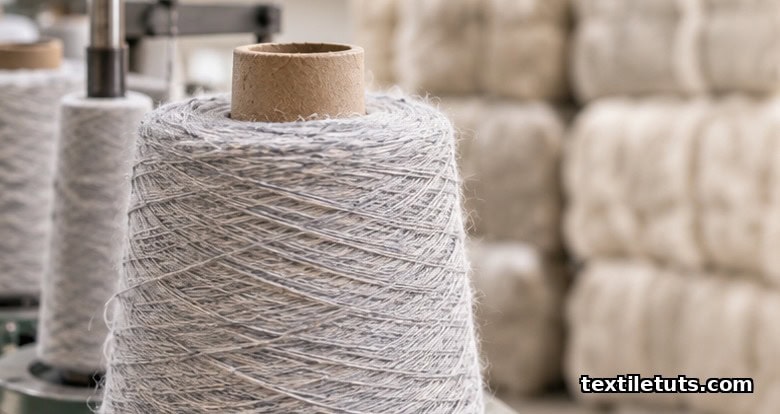
Recycled yarns use 30 to 60 percent less energy and cut water consumption by up to 80 percent compared with yarns spun from virgin fiber, with mechanically recycled cotton reducing CO2 emissions by approximately 1.5 kg per kilogram of yarn produced.
Those savings come with a measurable trade-off in fiber length and tensile strength that determines how recycled stock is reintroduced into the spinning line.
What follows is a working reference on how recycled fibers reach yarn form, what the standards require, and which properties spinners and brand teams need to verify before claim or scale.
What Counts as a Recycled Yarn
ISO 14021:2016 defines “recycled material” as material that has been reprocessed from recovered (reused or waste) material by means of a manufacturing process and made into a final product or a component for incorporation into a product. In yarn terms, the recycled input is fiber recovered from pre-consumer waste (manufacturing scrap, fabric cuttings, selvedge) or post-consumer waste (used garments, household textiles, carpets) that is then opened, cleaned, and respun.
The distinction matters because the two streams behave differently on the spinning line. Pre-consumer scrap is cleaner, more uniform, and contains known fiber chemistry. Post-consumer feedstock arrives blended, dyed, and contaminated with finishes, trims, and elastane, which is why most commercial recycled cotton is blended with virgin cotton or polyester at 20 to 50 percent inclusion before it can be spun on ring or rotor frames.
Pre-Consumer vs Post-Consumer Feedstock
Pre-consumer waste originates inside the textile and garment supply chain. Cutting table selvedge, weaving loom waste, knit seconds, and yarn remnant cones fall in this stream. Because the fiber history is known and dye chemistry is usually restricted to one recipe, mechanical recycling yields a longer, cleaner fiber (typically 18 to 22 mm) that can be carded and spun on standard cotton systems with only minor adjustments.
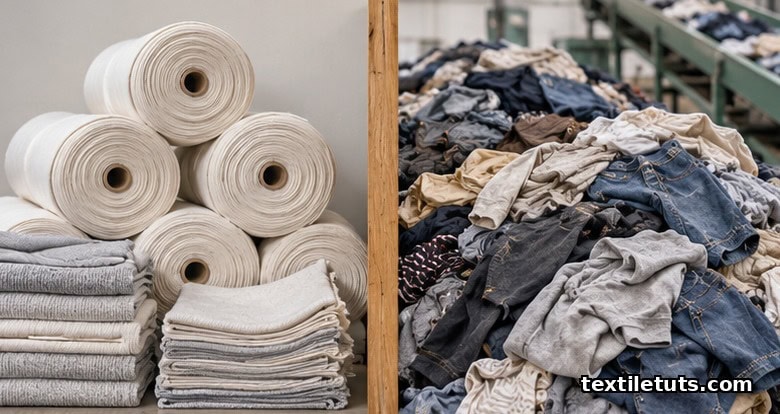
Post-consumer waste originates from garments and household textiles that have completed their consumer use phase. Sorting is required before recycling. Near-infrared (NIR) sorters separate fiber types, and manual or optical sorting removes buttons, zippers, and trim. After sorting, garments are shredded, color-sorted, and either mechanically opened into fiber or chemically depolymerized back to monomer for polyester and nylon. The resulting fiber is shorter (typically 8 to 16 mm), more variable in diameter, and carries dye residues that influence the recycled yarn shade. Most mills blend this fiber at 30 to 50 percent with virgin to recover spinnability.
Fiber Preparation: Shredding, Carding, Garnetting
Mechanical recycling follows a fixed sequence: cutting, tearing, fiberizing, cleaning, and carding. Cutting reduces fabric to 5 to 10 mm pieces. Tearing (also called garnetting) pulls pieces apart with pinned rollers to separate fibers without excessive cutting, recovering a fiber web at 60 to 80 percent efficiency depending on fabric construction.
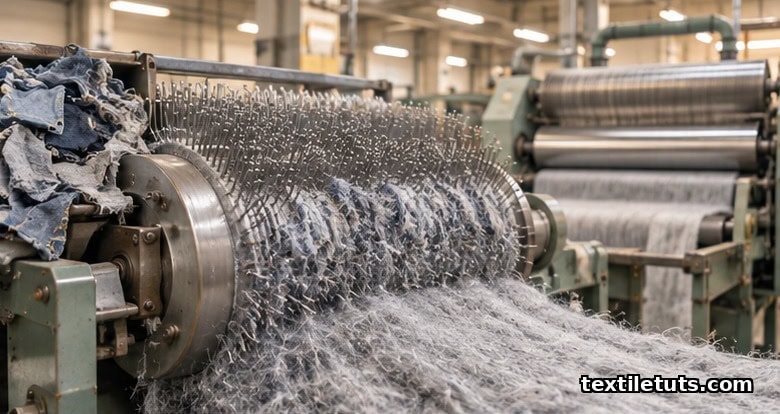
Garnetted fiber is then passed through a card, the same machine used in virgin cotton processing. Because recycled fiber is shorter and contains more neps and trash, card wire density and worker-stripper settings are tightened, and multiple carding passes may be used. Production rates drop by 20 to 35 percent versus virgin carding to keep neps and short-fiber content within spinning limits. Web evenness improves with a second passage, but at the cost of additional fiber length loss (about 1 to 2 mm per pass).
Spinning Systems for Recycled Stock
The choice of spinning frame depends on recycled fiber length and the target yarn count.
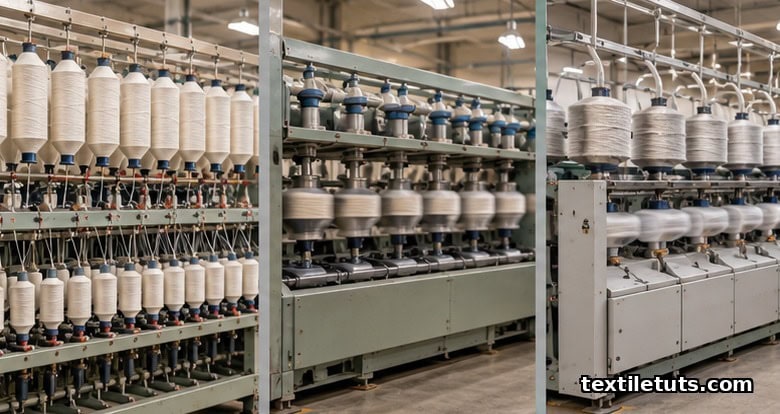
- Ring spinning suits longer recycled fibers (above 18 mm) and finer counts (Ne 30 to Ne 60). It produces the strongest yarn, but is sensitive to short fiber and trash content. Most pre-consumer recycled cotton is spun on ring frames.
- Rotor (open-end) spinning tolerates shorter, more variable fiber (12 to 18 mm). Production speed is 4 to 6 times higher than ring, and yarn is more even but slightly weaker in tenacity. Rotor frames dominate the post-consumer recycled cotton market.
- Air-jet (Vortex) spinning uses air to wrap fibers around a core. It tolerates short fiber at 6 to 12 mm, runs at 200 to 400 m/min, and produces yarn with low hairiness and good pilling resistance. Vortex is now the standard frame for recycled PET and cotton blends in knit applications.
Quality Drop: Tensile Loss, Short Fiber, Neps
Each mechanical recycling cycle damages the fiber. Cotton loses roughly 20 to 40 percent of its staple length per cycle, and tenacity drops by 15 to 25 percent. Polyester, when mechanically recycled, loses molecular weight through thermomechanical degradation, dropping tenacity by 10 to 30 percent and raising the melt-flow index.
This quality drop is the reason most recycled yarns are blended. A 30/70 recycled-to-virgin cotton blend recovers tenacity to within 5 percent of virgin yarn while still meeting brand sustainability targets. Below 30 percent recycled content, yarn performance is statistically indistinguishable from virgin on standard test frames. Above 70 percent, endbreak rate on ring frames rises sharply, and yarn evenness CV percent exceeds 18, the upper limit most knitters tolerate.
| Property | Virgin cotton yarn | 100% pre-consumer recycled | 50/50 recycled / virgin blend |
|---|---|---|---|
| Yarn count (Ne) | 30 | 30 | 30 |
| Tenacity (cN/tex) | 18 to 22 | 14 to 17 | 16 to 20 |
| Elongation (%) | 6 to 8 | 5 to 7 | 6 to 8 |
| Evenness CV% | 12 to 14 | 16 to 20 | 13 to 16 |
| Short fiber content (%) | 8 to 10 | 18 to 25 | 12 to 16 |
Hairiness is another recycled-specific defect. Recycled yarn shows 20 to 40 percent more protruding fibers than virgin at the same count, which translates to higher pilling in knit fabrics. Sizing and waxing at the winding stage reduce but do not eliminate the gap.
Environmental Impact and Verified Savings
Energy and water savings come from skipping the cultivation or polymerization step. Recycled cotton avoids irrigation, which uses roughly 7,000 to 10,000 liters of water per kilogram of cotton fiber, a range reported in peer-reviewed life cycle assessments of cotton farming. Recycled polyester avoids the crude-to-monomer polymerization step, saving 30 to 50 percent of process energy.
These claims depend on a verified life cycle assessment (LCA) following the ISO 14040 series and verified chain-of-custody following ISO 14021 self-declared claims or third-party certification. A common pitfall is reporting virgin-fiber-equivalent savings without specifying system boundaries (cradle-to-gate vs cradle-to-grave) or allocation method. Spinners and brand teams should request the underlying LCA report and check whether transport, sorting, and depolymerization energy have been included.
Standards and Certifications Spinners Should Know
Three standards and certification frameworks govern recycled yarn claims today.
- ISO 14021:2016 covers self-declared environmental claims. It specifies the rules for terms such as “recycled content” and prohibits unqualified “eco-friendly” or “green” labels.
- ASTM D7811 provides a guide for testing recycled or reused textile materials, covering sampling, fiber identification, and reporting of mechanical properties.
- ISO 17088:2021 specifies compostability requirements for plastics, including PLA fibers used in some recycled-blend yarns. It is the standard most often cited when biodegradable claims are made.
Third-party chain-of-custody certifications (GRS, RCS) verify recycled content percentage through documented supply chain audits. Both reference ISO 14021 for the underlying definitions but add traceability and social criteria. Buyers specifying recycled yarn should request the certification scope, the certification body, and the audit issue date.
Frequently Asked Questions
What is the maximum recycled content a yarn can hold before it stops spinning?
On rotor frames handling post-consumer cotton, the practical ceiling is 70 to 80 percent recycled content. Above that level, endbreak rate, CV percent, and neps push the yarn outside knit and weave tolerances. Ring spinning tolerates lower inclusions (40 to 60 percent) because its drafting requires longer, more uniform fiber. Vortex frames can run 80 to 100 percent recycled blends when paired with proper finish application.
Does recycled yarn shrink more than virgin yarn?
Yes, by 1 to 3 percentage points in standard AATCC 135 wash testing for cotton-rich recycled blends. The cause is residual manufacturing stress in the shorter recycled fibers, which relax more aggressively in the first wash cycle. Pre-shrinking with a compactor at the fabric stage usually brings total shrinkage back inside the 3 percent tolerance required for knit apparel.
Can recycled polyester be spun to the same fineness as virgin polyester?
Mechanically recycled PET is limited to 1.2 to 1.5 denier per filament because of higher molecular weight distribution. Virgin PET runs down to 0.5 DPF. Chemically recycled PET (depolymerized to monomer and re-polymerized) recovers virgin-equivalent fineness but at higher cost and with a 5 to 10 percent yield loss during depolymerization.
How is recycled content verified at the yarn stage?
Through chain-of-custody audits, mass balance calculations, and periodic third-party testing of the input fiber using ASTM D7811 or supplier-specific test plans. Fiber-level NIR or burn testing confirms the recycled feedstock matches the declared composition. Yarn suppliers should be able to produce a transaction certificate for every lot.
Is recycled yarn always lower-carbon than virgin yarn?
For mechanically recycled cotton and PET, yes, with cradle-to-gate savings of 30 to 60 percent. For chemically recycled fiber, the energy balance depends on the depolymerization route. Glycolysis and methanolysis processes are net-positive on carbon in most published LCAs, but enzymatic depolymerization is still at pilot scale and not yet broadly verified. Brand claims should always cite a peer-reviewed LCA, not a marketing summary.
References
- International Organization for Standardization. ISO 14021:2016, Environmental labels and declarations: Self-declared environmental claims. iso.org. Defines “recycled material” and “recycled content,” and the rules for self-declared eco claims on textile products.
- ASTM International. ASTM D7811, Standard Guide for Testing of Recycled or Reused Materials (Textiles). astm.org. Sampling, identification, and mechanical testing protocols for recycled textile feedstock.
- International Organization for Standardization. ISO 17088:2021, Plastics: Compostable Plastics Specifications. iso.org. Specifies compostability requirements used for PLA and biodegradable fiber claims in recycled-blend yarns.
- MDPI Sustainability. Recycled Cotton Fibers for Use in the Textile Industry. mdpi.com. Covers tensile, evenness, and short-fiber data for recycled cotton at varying inclusion rates.
- MDPI Polymers. Mechanical Recycling of PET Fibers: A Review. mdpi.com. Covers energy savings, molecular weight loss, and processing routes for recycled polyester.
- European Environment Agency. Textiles and the environment in a circular economy. europa.eu. Aggregates water and CO2 footprints for virgin and recycled fiber at European scale.
This article is the working reference for sustainability in recycled-yarn spinning. Editorial by Shahrukh Islam, TextileTuts. Sources: ISO 14021:2016, ASTM D7811, ISO 17088:2021, MDPI Sustainability (recycled cotton), MDPI Polymers (recycled PET review), European Environment Agency as cited.


