
Recycled Polyester Spinning (rPET)

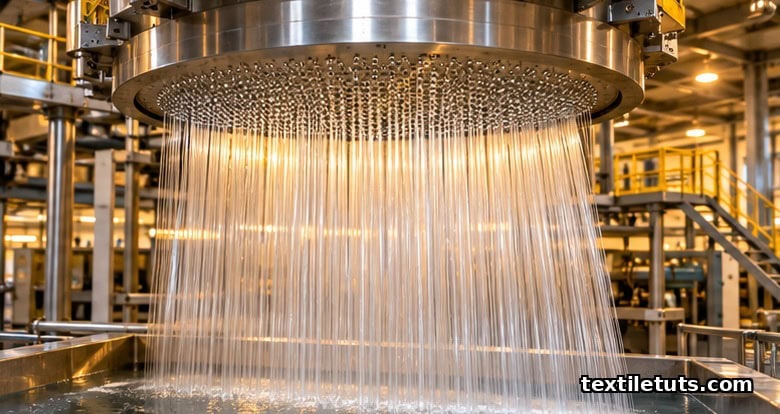
Recycled polyester (rPET) staple fiber is produced by extruding post-consumer PET flakes through spinneret holes of 0.20 to 0.40 mm diameter at a melt temperature of 270 to 285 °C, then drawing the filaments at a draw ratio of 2.5 to 4.5× to reach a tenacity of 4.5 to 6.5 cN/dtex and an elongation at break of 20 to 40%.
That single set of process windows sets the floor and ceiling for every rPET staple line in operation today, whether the feedstock is clear bottle flake, mixed-color flake, or pre-consumer textile scrap.
Below is what those numbers look like on a working melt-spinning line, why recycled flake behaves differently from virgin chip, and how spinning engineers control intrinsic viscosity, dye uptake, and tenacity to hit the same end-use specifications as virgin polyester.
What rPET is and where the feedstock comes from
rPET is polyester fiber spun from recovered polyethylene terephthalate rather than from virgin paraxylene and monoethylene glycol. ISO 14021:2016 on self-declared environmental claims is the standard that defines how a material can be labelled “recycled” once the feedstock has been reprocessed into a manufactured product, and that, in textile applications, means melt extrusion and fiber formation.
The three industrial feedstocks for rPET staple are:
- Post-consumer bottle flake: the largest single source by volume, sorted by color, washed, and ground to 4 to 8 mm chips with a bulk density of 250 to 400 kg/m³.
- Pre-consumer textile scrap: selvedge, off-cut, and pilot-run waste from weaving, knitting, and garment factories. Intrinsic viscosity often lands higher than bottle flake, at 0.70 to 0.85 dL/g versus 0.55 to 0.70 dL/g for bottles.
- Post-consumer textile waste: mechanically recovered garments, often blended with cotton, which must undergo near-infrared sorting or chemical separation before PET-rich fractions can be re-extruded.
For staple fiber spinning, the intrinsic viscosity (IV) of the incoming flake is the most important number because it sets the molecular weight, which in turn sets the maximum draw ratio a line can hold and the final fiber tenacity.
The rPET spinning line, step by step
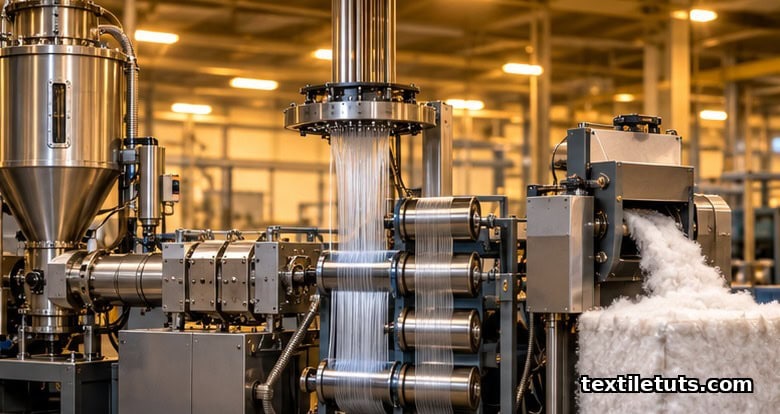
A modern rPET staple line runs five discrete stages. Each stage has a measurable target a quality engineer can write down and a process operator can hit.
Stage 1: Drying
PET is hygroscopic enough that wet flake in the extruder causes hydrolysis, which drops IV and produces bubbles that break filaments. Industrial drying targets a residual moisture of ≤50 ppm before melt, achieved in a desiccant hopper dryer running at 160 to 180 °C with a dew point of -40 °C for 4 to 6 hours of residence time.
Stage 2: Extrusion
The dried flake is fed into a single- or twin-screw extruder. Barrel temperatures step from 260 °C at the feed zone to 285 °C at the metering zone. Melt filters of 40 to 60 µm are standard for textile-grade fiber, finer than the 200 to 300 µm filters used for strapping or sheet applications, because any single gel particle larger than 30 µm breaks filaments during drawing.
Stage 3: Spinneret and quench
The melt is pumped through a spinneret with 1,000 to 30,000 holes, each 0.20 to 0.40 mm in diameter, at a throughput of 0.5 to 1.5 g/min per hole. Quench air at 18 to 25 °C crosses the filament bundle at 0.4 to 0.8 m/s. Quench temperature control is tighter for rPET than for virgin PET because recycled flake carries a wider molecular-weight distribution, which makes filament solidification less predictable.
Stage 4: Drawing
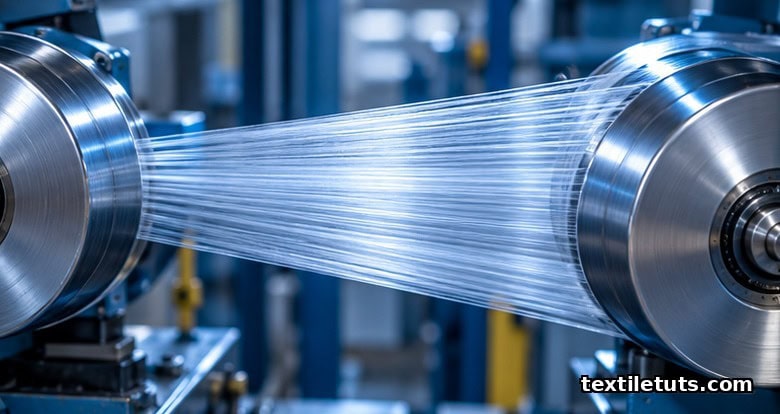
Filaments pass over godets running at progressively higher speeds. A three-stage draw with ratios of 1.0, 2.5, and 4.5× is typical for a 1.5 denier staple target. Higher draw raises tenacity and lowers elongation, lower draw raises elongation and lowers tenacity, and the process operator tunes the ratio to hit a target linear density.
Stage 5: Crimping, cutting, and baling
After drawing, tow is crimped at 8 to 12 crimps per cm, cut to a 32 to 51 mm staple length, and baled at 200 to 400 kg per bale. Bale density and moisture are checked before shipment. Bales above 8% moisture are rejected because moisture in transit leads to mildew on cotton blends.
Why rPET needs different process settings from virgin PET
Three physico-chemical differences between recycled flake and virgin chip force the spinner to change settings.
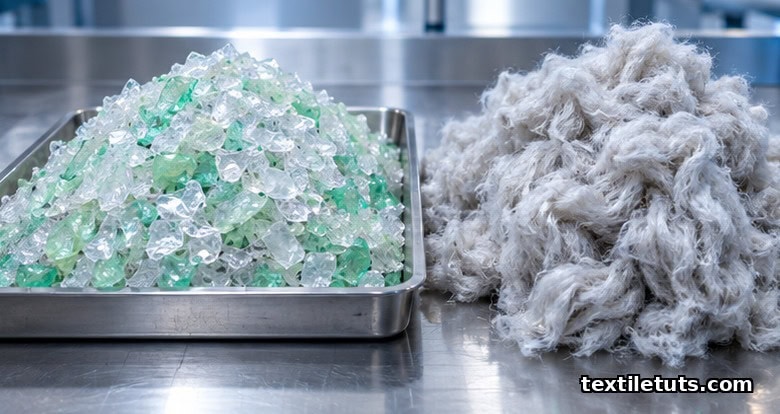
First, IV variation. Bottle flake commonly arrives at 0.55 to 0.70 dL/g, well below the 0.90 to 1.05 dL/g of textile-grade virgin chip. Two responses are used in industry: solid-state polycondensation (SSP) in a nitrogen-purged reactor at 200 to 230 °C for 8 to 16 hours to push IV back up; or chain extension with a tetrafunctional epoxide or dianhydride additive at 0.3 to 1.0 wt% during extrusion. Most rPET lines run a short SSP tower before the extruder because SSP alone raises tenacity by 15 to 25% versus un-SSP’d flake at the same draw ratio.
Second, contamination. Even after sorting and washing, post-consumer flake carries 50 to 200 ppm of PVC, polyolefin, and adhesive residue. These show up as gels and broken filaments. Industrial practice is to oversize the melt filter to 40 to 60 µm instead of the 80 µm used for virgin chip, and to accept a higher filter pressure differential, which translates to a 5 to 10% drop in throughput.
Third, color. Mixed-color bottle flake yields a grey fiber that needs to be dark-dyed for apparel end-uses, while clear flake can be spun white. Per ASTM D3822 on tensile properties of single textile fibers, color does not affect tensile performance once draw is held constant, so dark-dye rPET commands a 10 to 25% price discount versus white-spun rPET of the same IV.
Process parameters that decide fiber quality
For a 1.5 denier × 38 mm staple target on a clear-bottle line, the working process window is roughly:
| Parameter | Typical range | What happens at the edge |
|---|---|---|
| Melt temperature | 270 to 285 °C | Above 290 °C: IV drops 0.02 dL/g per 10 °C |
| Spinneret hole size | 0.20 to 0.40 mm | Larger hole → coarser denier, lower tenacity |
| Throughput per hole | 0.5 to 1.5 g/min | Over 1.6 → quench air cannot solidify uniformly |
| Draw ratio | 2.5 to 4.5× | Above 5.0× → filament breaks during draw |
| Quench air temperature | 18 to 25 °C | Above 30 °C → wider denier variability |
| SSP temperature | 200 to 230 °C | Below 195 °C → IV rise too slow |
| Crimps per cm | 8 to 12 | Below 6 → poor carding cohesion |
| Staple length | 32 to 51 mm | Outside window → unsuitable for cotton or woolen systems |
Each row is a single decision the spinning shift has to make in real time. Most mills hold these targets through statistical process control on at least the draw ratio, melt temperature, and throughput per hole, and they run a tensile check at the start of every shift against AATCC TM 20 (fiber identification) and ASTM D3822 (single-fiber tensile).
Quality tests rPET has to pass
End-buyers specify a small hand of tests on incoming bale. The minimum set on most purchase orders is:
- Tenacity and elongation: ASTM D3822 or ISO 5079, on 20 fibers per sample, target 4.5 to 6.5 cN/dtex and 20 to 40% elongation.
- Linear density (denier): ASTM D1577 by weighing a known length, target ±5% of nominal.
- Crimp stability: percent crimp retention after a 5-minute boil, measured in-house because no single AATCC or ISO method is universally accepted.
- Color and whiteness: measured on a HunterLab or spectrophotometer, target Yellowness Index ≤10 for white-spun.
- Recycled content verification: chain-of-custody audit against ISO 14021 and the Global Recycled Standard (GRS).
The recycled-content verification is the one buyers push hardest on. Brands selling into the EU under the Green Claims Directive have to substantiate any “recycled” label with third-party certification, and unverified rPET carries a 20 to 30% price penalty versus GRS-certified bale.
How rPET compares with virgin polyester
| Property | rPET (clear bottle, SSP’d) | Virgin PET (textile-grade chip) |
|---|---|---|
| Intrinsic viscosity (dL/g) | 0.62 to 0.75 | 0.90 to 1.05 |
| Tenacity (cN/dtex) | 4.5 to 6.0 | 5.5 to 7.5 |
| Elongation at break (%) | 25 to 40 | 15 to 30 |
| Boiling-water shrinkage (%) | 1.0 to 3.0 | 0.5 to 1.5 |
| Dye uptake (disperse) | +10 to +20% versus virgin | Baseline |
| CO₂e footprint (kg CO₂e / kg fiber) | 1.0 to 1.5 | 2.5 to 3.5 |
| Price (USD / kg, indicative) | 1.10 to 1.60 | 1.30 to 1.90 |
The lower tenacity and higher elongation of rPET come from the lower average molecular weight, which SSP only partially restores. The higher dye uptake is the more useful trait for yarn-dyed and piece-dyed apparel because mills can use 10 to 20% less disperse dye to hit the same shade depth, a saving that partly offsets the bale-price premium of certified rPET.
Frequently Asked Questions
Does recycled polyester perform as well as virgin polyester?
rPET spun with solid-state polycondensation reaches 85 to 95% of virgin tenacity and matches virgin elongation after the draw stage. In wear tests published on rPET-cotton woven fabric, tensile loss after 25 wash cycles is within 10% of virgin polyester-cotton controls, so for staple end-uses such as T-shirts, fleece, and workwear, the performance gap is small enough that brand spec sheets no longer distinguish the two.
Can rPET be spun into filament yarn as well as staple?
Yes. Partially oriented yarn (POY) lines run the same extruder and spinneret setup, then wind at 3,000 to 3,500 m/min instead of feeding tow to a draw line. Draw-textured yarn (DTY) for knitwear is the largest filament end-use. The process window is narrower for POY because higher winding speeds amplify IV drift in the melt.
Is rPET safe from the chemicals used in bottle recycling?
Yes, if the line is operated correctly. Industrial wash at 70 to 90 °C with caustic soda (NaOH 1 to 2 wt%) removes label adhesive and surface contaminants, and the subsequent melt stage at 270 to 285 °C destroys any residual volatile organic compounds. Finished fiber routinely passes OEKO-TEX Standard 100 Class II for skin contact, and migration tests on food-contact-grade rPET sheet are below the 10 mg/dm² overall migration limit set in EU Regulation 1935/2004, though food-contact fiber is a different grade than apparel.
Why does rPET need solid-state polycondensation?
Because post-consumer bottle flake arrives at the line with an intrinsic viscosity of 0.55 to 0.70 dL/g, lower than the 0.90 to 1.05 dL/g needed for a tenacity above 5.0 cN/dtex. SSP is a heated, nitrogen-purged reactor that rebuilds molecular weight without re-melting the polymer, raising IV by 0.05 to 0.15 dL/g per cycle, and pulling tenacity back up into the same band as virgin chip.
What is the largest defect class on an rPET line?
Broken filaments during drawing, almost always caused by melt-borne gels from PVC or polyolefin contamination in the feedstock. Filter pressure differential rising faster than planned, draw tension spikes, and filaments wrapping the godet are the three signs that the upstream flake wash is failing, and the standard response is to swap the melt filter and back-flush the spinneret pack.
References
- International Organization for Standardization. ISO 14021:2016, Environmental labels and declarations – Self-declared environmental claims (Type II environmental labelling). iso.org – the standard that defines how “recycled content” can be claimed on a textile label.
- ASTM International. ASTM D3822 / D3822M-14, Standard Test Method for Tensile Properties of Single Textile Fibers. astm.org – the tensile test method applied to rPET filament.
- ASTM International. ASTM D1577-07(2018), Standard Test Methods for Linear Density of Textile Fibers. astm.org – the gravimetric method for denier measurement on rPET staple.
- AATCC. AATCC Test Method 20-2021, Fiber Analysis: Qualitative. aatcc.org – the burn-test and microscopic method used to confirm a fiber is PET.
- International Organization for Standardization. ISO 5079:2020, Textiles – Fibres – Determination of breaking force and elongation at break of individual fibres. iso.org – the ISO counterpart to ASTM D3822 used in EU mills.
- Welle, F. Twenty years of PET bottle to bottle recycling: a review. Resources, Conservation and Recycling, Elsevier (2011) – the most cited review of PET bottle-to-bottle recycling, including fiber applications.
- Pawlak, A., Pluta, M., and Galeski, A. Mechanical recycling of PET: the effect of processing on molecular weight and rheological properties. ScienceDirect / Polymer Degradation and Stability (2000) – reference study on IV loss during extrusion of recycled PET.
This article is the working reference for recycled polyester spinning. Editorial by Iftay Khairul Alam, TextileTuts. Sources: ISO 14021:2016, ASTM D3822, ASTM D1577, AATCC TM 20, ISO 5079:2020, Resources, Conservation and Recycling (Elsevier), Polymer Degradation and Stability (Elsevier) as cited.


