
Surgical Sutures: Absorbable vs Non-Absorbable

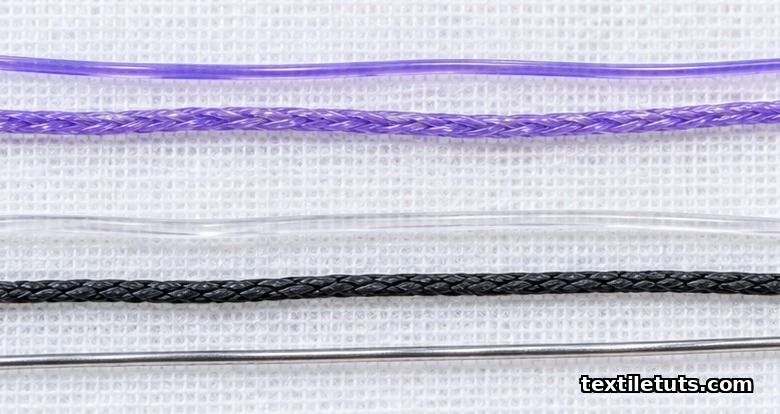
Absorbable sutures made from polyglycolide, polyglactin 910, polydioxanone, and surgical gut lose 50 percent of their tensile strength within 14 to 28 days and are fully resorbed by tissue enzymes or hydrolysis in 42 to 210 days, whereas non-absorbable sutures such as polypropylene, polyester, nylon, silk, and stainless steel keep their breaking strength indefinitely and must be physically removed once the wound has healed. The choice between these two classes shapes every wound-closure decision a surgeon makes, because picking the wrong material can trigger dehiscence, chronic inflammation, or long-term foreign-body reactions.
This guide breaks down the polymer chemistry, absorption kinetics, tensile behavior, and clinical indications that separate absorbable from non-absorbable sutures, using cited data from the United States Pharmacopeia, ISO 10321, ASTM F2454, and peer-reviewed surgical journals.
What Counts as a Surgical Suture and Why the Material Matters
A surgical suture is a sterile, medical-grade thread used to ligate vessels or approximate tissue after injury or operation. Every suture is governed by a single standard of measurement: the United States Pharmacopeia, in Chapter 881 on Tensile Strength and Chapter 871 on Suture Diameter, defines how suture breaking strength, knot-pull strength, and diameter must be tested before any product reaches an operating room. The same pharmacopeia recognizes only two material classes, absorbable and non-absorbable, and sets the absorption and tensile-retention benchmarks that surgeons rely on.
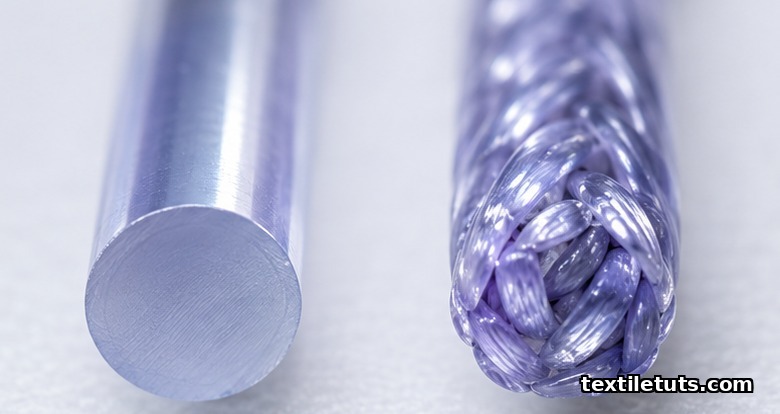
Sutures are textile structures before they are medical devices. They can be monofilament (a single extruded fiber) or multifilament (several filaments twisted or braided together, sometimes coated with silicone, polybutilate, or wax to reduce tissue drag). Both material and construction influence handling, knot security, capillary action (wicking of bacteria into the wound), and the body’s inflammatory response. These textile variables explain why a polyester suture feels and behaves differently from a silk one, even when both are rated as non-absorbable 3-0.
How Absorbable Sutures Work
Absorbable sutures are designed to be broken down by the body and to disappear once the wound has regained enough intrinsic strength to hold itself together. Two chemical routes do the work.
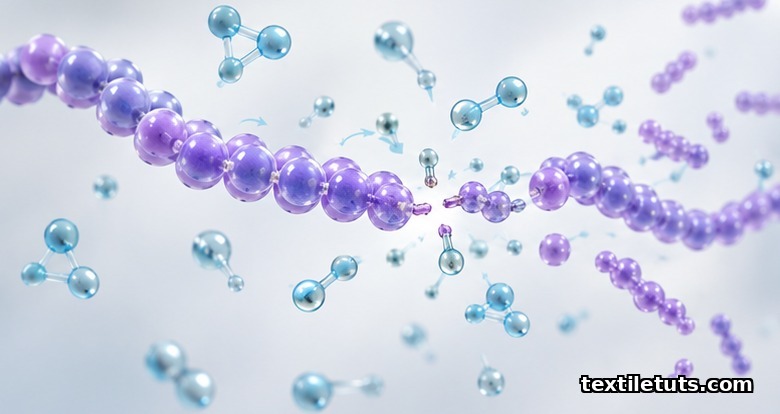
Proteolytic absorption applies only to natural sutures made from purified collagen (surgical gut, sold as plain catgut or chromic catgut). Enzymes such as collagenase and lysosomal proteases chop the collagen chain into peptides and amino acids. Plain catgut retains roughly 50 percent of its tensile strength at 3 to 5 days and is fully absorbed within about 70 days. Chromic catgut, treated with chromium salts to slow the enzyme attack, holds 50 percent of its strength at 7 to 10 days and is absorbed in roughly 90 days.
Hydrolytic absorption covers every modern synthetic absorbable suture. Water attacks the ester or ether bonds in the polymer backbone, breaking long chains into shorter fragments that phagocytes can clear. The rate is governed by chemistry, not by patient enzymes, so absorption is more predictable from patient to patient than with catgut. Examples:
- Polyglycolic acid (PGA, sold as Dexon): retains 50 percent strength at 21 days, complete absorption in 60 to 90 days.
- Polyglactin 910 (Vicryl): 90/10 copolymer of glycolide and lactide; 50 percent strength at 21 days, full absorption in 56 to 70 days.
- Polydioxanone (PDS II): 50 percent strength at 28 days, 25 percent at 42 days, full absorption in 180 to 210 days.
- Polyglyconate (Maxon): 50 percent strength at 28 days, complete absorption in 180 to 210 days.
- Poliglecaprone 25 (Monocryl): 50 to 60 percent strength at 7 days, 20 to 30 percent at 14 days, complete absorption in 90 to 120 days.
Non-Absorbable Sutures: Permanent Mechanical Support
Non-absorbable sutures are designed to stay. Their polymers resist enzymatic and hydrolytic attack, so they remain at the implantation site for the life of the patient unless a clinician removes them. They are chosen where tissue support must outlive the natural healing window, or where the material must not biodegrade at all.
The five main families, each a textile with distinct handling:
- Silk: braided from natural Bombyx mori fibroin; soft handling and excellent knot security. Gradual loss of tensile strength, roughly 20 percent per year in vivo, but technically classed as non-absorbable because complete resorption is not expected within the standard test window.
- Polyester (PET, sold as Ethibond or Ti-Cron): braided polyethylene terephthalate, often coated with polybutilate or silicone to reduce tissue drag. Indefinite tensile retention.
- Polypropylene (Prolene, Surgipro): an isotactic monofilament olefin. Indefinite tensile retention and the lowest tissue reactivity of the non-absorbable class, which is why it is favored for vascular anastomoses and skin closure.
- Nylon (polyamide, sold as Ethilon or Nurolon): loses about 15 to 20 percent of its tensile strength per year through slow hydrolysis, yet is still classified as non-absorbable because no clinically significant absorption occurs inside the testing window.
- Stainless steel: monofilament or twisted multifilament of 300 or 316L alloy. Highest tensile strength of any suture, indefinite retention, used in orthopedic and thoracic closures.
Tensile Strength and Absorption Profile at a Glance
| Material | Class | 50% tensile strength retained | Complete absorption |
|---|---|---|---|
| Plain catgut | Absorbable (proteolytic) | 3 to 5 days | ~70 days |
| Chromic catgut | Absorbable (proteolytic) | 7 to 10 days | ~90 days |
| Polyglycolic acid (PGA) | Absorbable (hydrolytic) | ~21 days | 60 to 90 days |
| Polyglactin 910 (Vicryl) | Absorbable (hydrolytic) | ~21 days | 56 to 70 days |
| Poliglecaprone 25 (Monocryl) | Absorbable (hydrolytic) | 7 to 14 days | 90 to 120 days |
| Polydioxanone (PDS II) | Absorbable (hydrolytic) | ~28 days | 180 to 210 days |
| Polyglyconate (Maxon) | Absorbable (hydrolytic) | ~28 days | 180 to 210 days |
| Silk | Non-absorbable | ~1 year (~20% loss/yr) | Gradual degradation |
| Nylon | Non-absorbable | ~1 year (~15-20% loss/yr) | Years, but classed permanent |
| Polyester (PET) | Non-absorbable | Indefinite | Not absorbed |
| Polypropylene | Non-absorbable | Indefinite | Not absorbed |
| Stainless steel | Non-absorbable | Indefinite | Not absorbed |
Numbers are aggregated from USP Chapter 881 reporting on the major commercial sutures and from manufacturer product monographs; the time points match the same benchmarks ISO 10321:2016 uses to grade tensile behavior in textile-form sutures.
Tissue-Specific Application Guidelines
The fastest-healing tissues pair with the fastest-absorbing sutures; the slowest-healing or load-bearing tissues pair with permanent ones.
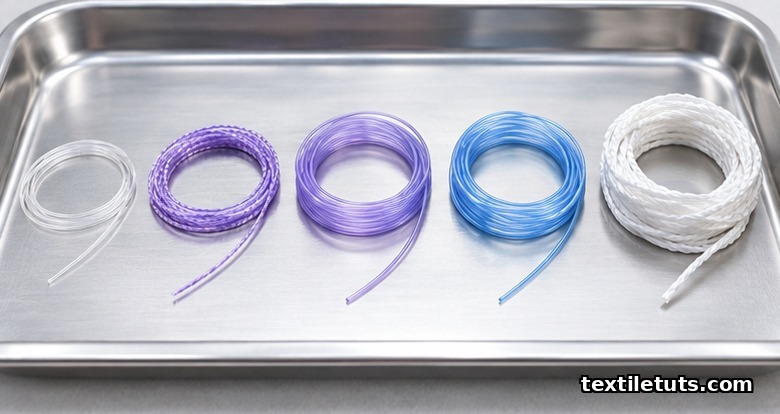
Skin and subcutaneous tissue: for facial closures where removal of stitches would scar, fast-absorbing monofilaments such as poliglecaprone 25 (Monocryl) or polyglactin 910 (Vicryl Rapide) are common. For back, extremity, or scalp skin where removal is straightforward, non-absorbable polypropylene or nylon is standard because it provokes less tissue reaction and gives a cleaner puncture scar.
Subcutaneous and soft-tissue layers: polyglactin 910 (Vicryl) and poliglecaprone 25 (Monocryl) dominate because they hold during the critical 2 to 4 week remodeling phase, then disappear without a return visit.
Fascia and muscle: polydioxanone (PDS II) or polyglyconate (Maxon) are chosen because their 180 to 210 day absorption window covers the slow return of fascial tensile strength, which can take 6 months.
Vascular anastomosis: permanent monofilament polypropylene is the consensus choice; its low thrombogenicity and indefinite strength match a vessel wall that never regains full native strength after suturing.
GI tract, bladder, and hollow viscera: synthetic absorbables that absorb quickly are preferred because they minimize the long-term risk of stone formation (suture lithiasis) or calculus at anastomotic sites.
Orthopedic tendon and ligament repair: high-strength permanent sutures, often braided polyester or ultra-high-molecular-weight polyethylene blends, plus stainless steel in older bone-anchor techniques, are used because the repaired structure will never regain full native strength.
Frequently Asked Questions
Which suture is best for closing skin?
For most clean skin closures, surgeons choose non-absorbable monofilament nylon or polypropylene (USP 4-0 to 6-0) because the monofilament structure has no interfilament capillary channels for bacteria to wick into the wound, and the sutures are removed in 5 to 14 days. For pediatric or facial closures where a return visit is impractical, fast-absorbing poliglecaprone 25 (Monocryl) or polyglactin 910 (Vicryl Rapide) gives 50 percent tensile retention at 7 days and complete absorption in 42 to 90 days, eliminating the need for removal.
Do absorbable sutures really dissolve completely?
Synthetic absorbables do. Polyglycolide, polyglactin 910, polydioxanone, polyglyconate, and poliglecaprone 25 are all broken down by hydrolysis into small fragments that are phagocytosed and metabolized, with the manufacturer-reported complete-absorption windows above. Surgical gut is also absorbed, but the absorption is driven by host enzymes and is therefore more variable from patient to patient. With any absorbable suture, a small percentage of patients can show a sterile abscess or “spitting suture” reaction when the surface fragment is extruded before deeper absorption finishes.
How long does Vicryl take to dissolve?
Polyglactin 910 (Vicryl) holds about 50 percent of its original tensile strength at 21 days and is fully absorbed in 56 to 70 days when used as a buried suture. Vicryl Rapide, a lower-molecular-weight variant, holds roughly 50 percent strength at 5 days and absorbs in about 42 days, which is why it is reserved for superficial closures where only short-term support is needed.
Can absorbable sutures cause allergic reactions?
The polymer backbone of synthetic absorbables (PGA, polyglactin 910, polydioxanone, polyglyconate, poliglecaprone 25) is generally regarded as non-antigenic because it lacks the protein epitopes that drive IgE-mediated allergy. Real allergic reactions to these sutures are rare and most often trace to the coating or to a dye such as D&C Violet No. 2 used to improve visibility. Natural gut sutures carry a higher (though still uncommon) risk because residual bovine or ovine protein can trigger reactions in patients with a known collagen allergy.
Are non-absorbable sutures always removed?
Not always. Non-absorbable sutures are removed when they are accessible (skin, mucosa) and no longer needed for support, which is standard practice for skin closures at 5 to 14 days. Non-absorbable sutures that are buried inside the body, for example polyester in a vascular graft or polypropylene in a heart valve ring, are intentionally left in place for life because removing them would require a second, more dangerous operation. The two situations are decided by anatomy, not by the suture material alone.
References
- United States Pharmacopeia. Chapter 881: Tensile Strength, Sutures. USP 43-NF 38. United States Pharmacopeial Convention, Rockville, MD. The pharmacopeial method for measuring suture breaking strength and knot-pull strength.
- United States Pharmacopeia. Chapter 871: Sutures — Diameter. USP 43-NF 38. United States Pharmacopeial Convention, Rockville, MD. Defines the USP size metric (numeric suffix that inversely relates to diameter) for every suture class.
- International Organization for Standardization. ISO 10321:2016 — Textiles — Tensile properties of sutures. International Organization for Standardization, Geneva. ISO method for tensile testing of suture textile structures.
- ASTM International. ASTM F2454-05(2014) Standard Guide for Wrinkle Recovery and Load-Strain Characterization of Sutures. ASTM International, West Conshohocken, PA. Wrinkle-recovery and load-strain guidance for medical-grade suture fibers.
- Edlich, R. F., et al. Physical and chemical configuration of sutures in the development of surgical wound infection. Journal of Long-Term Effects of Medical Implants, 1993; 3(4): 311-332. Peer-reviewed analysis of how suture textile construction (monofilament vs. braided) affects infection risk.
- Dart, A. J., and Dart, C. M. Sutures and ligatures: a practical review. In: Equine Surgery (4th ed.). Elsevier, 2012, Chapter 20. Textbook chapter detailing absorption kinetics, tensile profiles, and clinical indications by material class.
- Chu, C. C. Wound closure biomaterials and devices. CRC Press, Boca Raton, 2018. Reference textbook covering the polymer chemistry and biomedical performance of absorbable and non-absorbable sutures.
Editorial by Md. Asad Ullah (Meem), TextileTuts. Sources: United States Pharmacopeia Chapters 871 and 881; ISO 10321:2016; ASTM F2454-05; peer-reviewed surgical and biomaterials references as cited.


