
Surgical Mesh: Hernia Repair

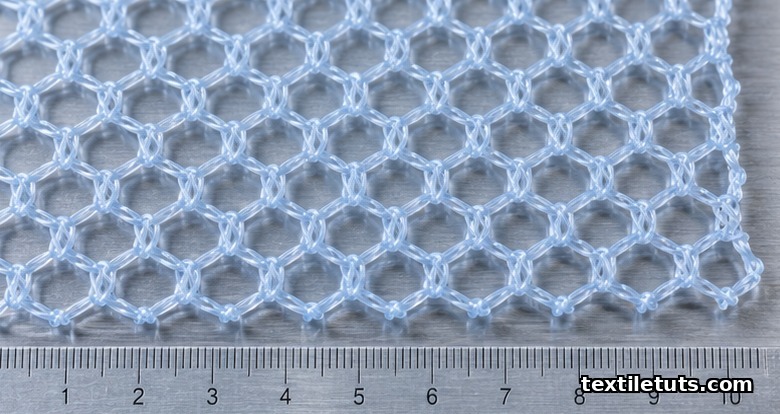
Polypropylene surgical mesh, used in roughly 90% of the more than 20 million inguinal hernia repairs performed worldwide each year, lowers long-term recurrence to 1–3% (compared with 10–15% for primary tissue repair without mesh) by acting as a porous textile scaffold that the body infiltrates with collagen-rich connective tissue over 6–12 months.
The textile engineering behind a hernia mesh matters as much as the surgery itself: polymer chemistry, filament construction, pore geometry, and areal density together decide how the body accepts the implant and how long the repair holds.
This guide walks through what surgical mesh is made from, how it is knitted or woven, which ASTM and ISO standards govern its mechanical testing, and how lightweight and heavyweight constructions compare in clinical outcome.
What Surgical Mesh Does in a Hernia Repair
A hernia forms when an internal organ or preperitoneal fat pushes through a weak spot in the abdominal wall fascia. Surgical repair restores the defect, either by stitching the tissue edges together directly (a primary tissue repair, such as Shouldice or Bassini) or by implanting a textile patch that bridges and reinforces the gap. The patch-based approach is called hernioplasty, and the textile patch is the surgical mesh.
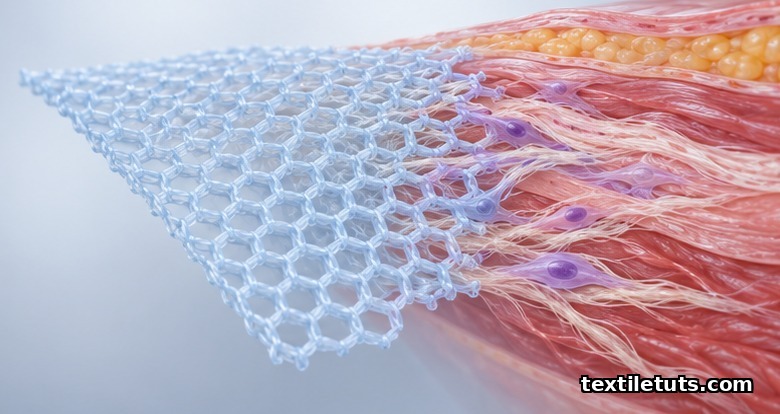
The EU Hernia Trialists Collaboration, a meta-analysis of more than 7,000 patients across randomised controlled trials, showed that mesh-based techniques reduce long-term recurrence by 50–75% compared with tissue-only repair. That single statistic explains why mesh has been the standard of care for inguinal hernia since the early 1990s and now accounts for roughly 95% of inguinal repairs in the United States and Europe, with adoption climbing across Asia and Latin America as laparoscopic and robotic techniques spread.
The mesh is not meant to be a permanent load-bearing plate. It is a scaffold that host fibroblasts, blood vessels, and immune cells gradually infiltrate through the pores, depositing collagen and gradually transferring mechanical load to the patient’s own tissue. After 6–12 months the repair is largely biological, even though the synthetic filaments remain.
Common Materials: Polypropylene, Polyester, and ePTFE
Three polymer families dominate hernia mesh manufacturing, each with a distinct mechanical and biological profile.
Polypropylene (PP). Polypropylene monofilament mesh accounts for the majority of implants placed worldwide. It is hydrophobic, chemically stable in tissue, and inexpensive to manufacture, with a Young’s modulus of roughly 3–4 GPa in the drawn filament. Stiffness is usually well tolerated in the abdominal wall but contributes to higher rates of chronic foreign-body sensation and post-operative pain when the mesh sits near sensory nerves. Baylón and colleagues, in a 2017 review in Advanced Healthcare Materials, identify polypropylene as the benchmark material because two decades of clinical follow-up confirm its long-term in-vivo stability.
Polyethylene terephthalate (PET, polyester). PET mesh, marketed under trade names such as Mersilene, was common in first-generation products and is still used in some pelvic floor repairs. Polyester can hydrolyse in the wet, warm, low-pH environment of infected tissue, reducing long-term tensile strength, and is therefore rarely chosen for modern inguinal hernia products. It is still common in pelvic organ prolapse surgery.
Expanded polytetrafluoroethylene (ePTFE). ePTFE is a microporous fluoropolymer film with a node-and-fibril microstructure rather than a true textile. Pore size is small (typically 1–25 µm), which limits tissue ingrowth and instead produces a fibrous encapsulation around the implant. Surgeons choose ePTFE when a barrier is required, such as ventral hernia repair where the bowel must not adhere to the patch. ePTFE is more expensive and can delaminate under sustained intra-abdominal pressure.
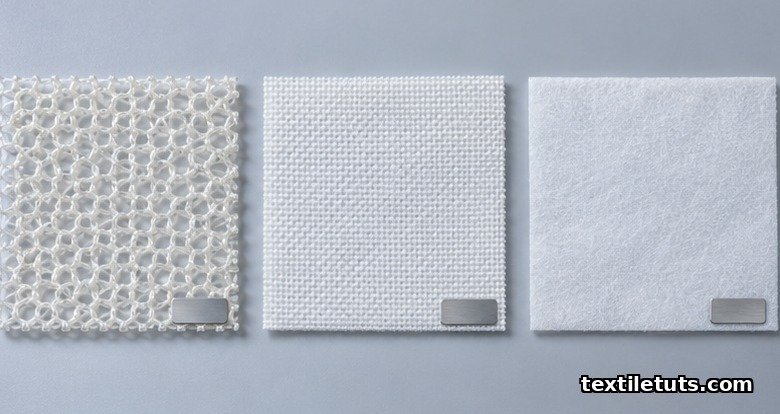
Mesh Construction: Knitted, Woven, and Nonwoven Structures
Most hernia mesh is warp-knitted, not woven. The choice is deliberate: warp knitting on a Raschel machine creates an open, porous structure with high elasticity and reliable suture retention, while using less polymer and therefore reducing the foreign-body burden.
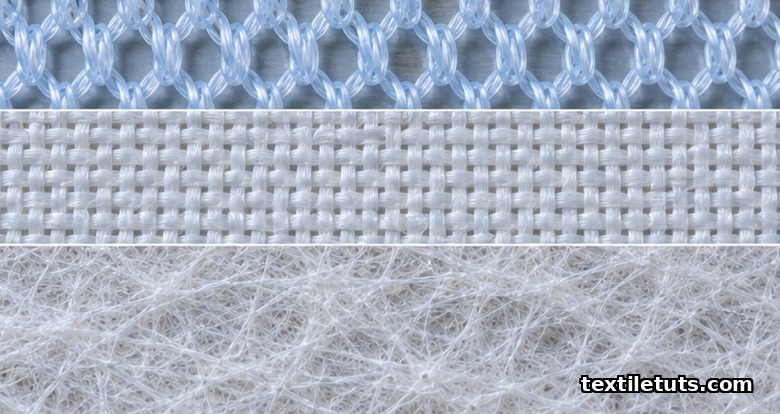
Woven mesh. Woven constructions are dimensionally very stable (low elongation under load) and have high burst strength, but the tightly packed yarns produce small effective pores that resist fibroblast infiltration. Woven PET mesh is occasionally selected for high-tension abdominal wall reconstruction.
Knitted mesh. Warp-knitted polypropylene is the workhorse. Heavyweight designs weigh 80–100 g/m²; lightweight designs 27–35 g/m². Knitted pores range from 0.5–5 mm in modern macroporous products, and the structure stretches in both directions, which lowers perceived mesh stiffness in vivo. The Amid classification groups surgical meshes by pore size: microporous (<10 µm), microporous with submicron filaments, and macroporous (>75 µm); macroporous meshes give the best tissue ingrowth and the lowest infection rates.
Nonwoven and composite mesh. Nonwoven structures (spunbonded or meltblown) appear in composite products where a barrier layer is laminated onto a macroporous textile, for example a polyester or polypropylene mesh with a collagen or omega-3 coating. These composites combine ingrowth on the visceral side and anti-adhesion on the peritoneal side.
Testing Standards and Mechanical Requirements
Surgical mesh is a Class II medical device in most regulatory systems and is governed by standards that specify how mechanical and biological performance is measured before the product reaches the market.
ASTM F2459 is the standard test method for determining the force required to pull a suture through medical mesh. A typical hernia repair mesh must retain at least 20 N per suture under this test, ensuring the patch does not tear at the fixation points during recovery or sudden abdominal strain.
ASTM F2819 sets the protocol for in-vitro determination of antibacterial activity on medical mesh, used for products coated with antimicrobial agents such as triclosan or chlorhexidine.
ISO 10993 (parts 1–22) governs biocompatibility testing, including cytotoxicity, sensitisation, irritation, and systemic toxicity. Every hernia mesh on the market is tested to ISO 10993 before clinical use.
Beyond suture retention, surgeons and textile engineers evaluate tensile strength, ball burst strength, and tear resistance. A common design target is a tensile strength of 16–32 N/cm in the weakest direction, mirroring the native abdominal wall’s tensile strength of about 16 N/cm at rest and up to 32 N/cm under Valsalva strain. Matching the mechanical profile of the host tissue is the central design goal.
Lightweight vs Heavyweight Mesh: A Comparison Table
| Property | Lightweight PP mesh | Heavyweight PP mesh |
|---|---|---|
| Areal density (g/m²) | 27–35 | 80–100 |
| Pore size | > 1 mm (macroporous) | 0.5–1 mm (small macroporous) |
| Elongation at break (%) | 20–35 | 10–15 |
| Foreign-body burden | Lower | Higher |
| Reported chronic pain rate | 3–8% | 10–15% |
| Typical applications | Lichtenstein inguinal, laparoscopic TEP/TAPP | Large ventral hernias, contaminated fields (selected cases) |
The shift toward lightweight designs followed randomised trials and meta-analyses showing that reducing polymer load at the implant site lowers post-operative pain and foreign-body sensation without raising recurrence. Heavyweight mesh is still preferred for large ventral hernia repairs where the highest burst strength is required and a small loss of compliance is acceptable.
Frequently Asked Questions
What is the success rate of mesh hernia repair?
Mesh inguinal hernia repair has a recurrence rate of 1–3% at five years, compared with 10–15% for primary tissue repair (Shouldice or Bassini). For ventral and incisional hernia the recurrence with mesh is roughly 10–15% versus 25–40% without mesh, according to the EU Hernia Trialists Collaboration and subsequent meta-analyses.
Can hernia mesh cause long-term pain?
About 3–8% of patients with lightweight mesh and 10–15% with heavyweight mesh report chronic post-herniorrhaphy pain lasting more than three months, usually related to nerve entrapment, fixation tacks, or mesh stiffness. Most cases resolve with physiotherapy or a nerve block; surgical mesh removal is needed in 1–2% of patients overall.
How long does surgical mesh last in the body?
Polypropylene mesh is designed as a permanent implant. It does not dissolve, but its mechanical load is gradually transferred to host collagen as tissue ingrowth matures (around 6–12 months post-op). Polypropylene filaments have been recovered intact at autopsy more than 20 years after implantation, with strength retention above 70%.
What is the difference between synthetic and biological mesh?
Synthetic mesh (polypropylene, polyester, ePTFE) is permanent; biological mesh is made from decellularised human or animal tissue (porcine dermis, bovine pericardium, small intestinal submucosa) and is gradually remodelled by the body. Biological mesh is chosen in contaminated or infected fields where synthetic material carries higher infection risk, but it is more expensive and has higher recurrence rates than synthetic mesh in clean repairs.
When does hernia mesh need to be removed?
Mesh removal is uncommon. The main indications are chronic infection that does not resolve with antibiotics, mesh erosion into an adjacent organ (bowel, bladder, or vagina), severe chronic pain unresponsive to conservative treatment, and mesh migration. Removal is technically demanding because of tissue integration and is performed by specialist abdominal wall reconstruction surgeons.
References
- ASTM F2459-22. Standard Test Method for Determining the Force Required to Pull a Suture Through Medical Mesh. ASTM International. — Suture pull-out strength test for surgical mesh.
- ASTM F2819-22. Standard Test Methods for In Vitro Determination of Antibacterial Activity on Medical Mesh. ASTM International. — Antibacterial coating evaluation protocol.
- ISO 10993-5:2009. Biological evaluation of medical devices — Part 5: Tests for in vitro cytotoxicity. International Organization for Standardization. — Biocompatibility standard for medical textiles.
- Baylón K, Rodríguez-Camarillo P, et al. (2017). Past, Present and Future of Surgical Meshes. Advanced Healthcare Materials, 6(11), 1601107. Wiley. — Comprehensive review of mesh materials, structure, and clinical performance.
- Brown CN, Finch JG (2010). Which mesh for hernia repair? Annals of the Royal College of Surgeons of England, 92(4), 272–278. — Comparison of mesh types and clinical outcomes (PMC3093778).
- Cobb WS, Kercher KW, Heniford BT (2006). The Argument for Lightweight Polypropylene Mesh in Hernia Repair. Surgical Technology International, 15, 121–127. — Evidence base for lightweight versus heavyweight mesh.
- EU Hernia Trialists Collaboration (2000). Mesh compared with non-mesh methods of open groin hernia repair: systematic review of randomized controlled trials. Cochrane review. — Recurrence and complication meta-analysis across 7,000+ patients.
This article is the working reference for surgical mesh in hernia repair. Editorial by Md. Asad Ullah (Meem), TextileTuts. Sources: ASTM F2459, ASTM F2819, ISO 10993-5, Baylón et al. 2017, Brown and Finch 2010, Cobb et al. 2006, EU Hernia Trialists Collaboration 2000 as cited.


