
Surgical Mask Construction

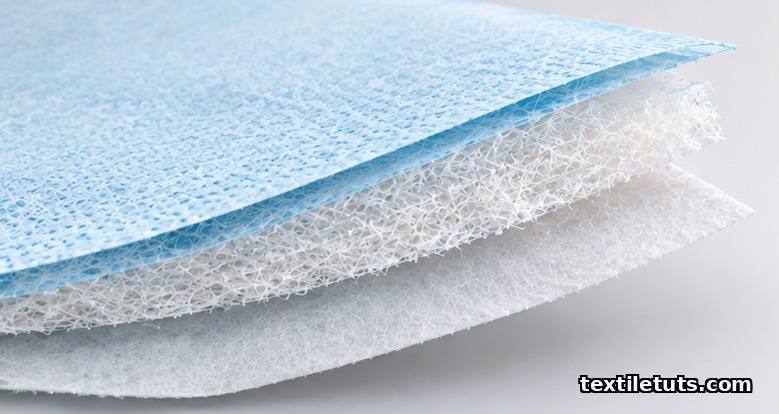
A surgical mask is a three-layer nonwoven laminate, typically combining spunbond polypropylene outer and inner layers with a meltblown polypropylene middle filter, that must achieve ≥95% bacterial filtration efficiency (BFE) at 3 µm under EN 14683:2019+AC:2019 Type I or ≥98% BFE under Type II while keeping differential pressure below 40 Pa/cm² to remain breathable.
The middle meltblown layer carries an electret (electrostatic) charge that captures particles far smaller than its physical pore size, which is why a mask weighing only 2.5-3.5 g can block droplets and aerosols that mechanical filtration alone would miss.
This article walks through the layer architecture, fiber chemistry, filtration physics, regulatory test methods, and assembly line steps behind every disposable surgical mask, with reference to EN 14683, ASTM F2100, and ISO 13485 quality standards.
The three-layer nonwoven architecture
A disposable surgical mask is not a fabric in the woven sense. It is a laminated nonwoven web, produced by bonding continuous filaments without spinning or interlacing. The standard construction stacks three layers, sold and supplied as a single SMS (spunbond-meltblown-spunbond) roll:
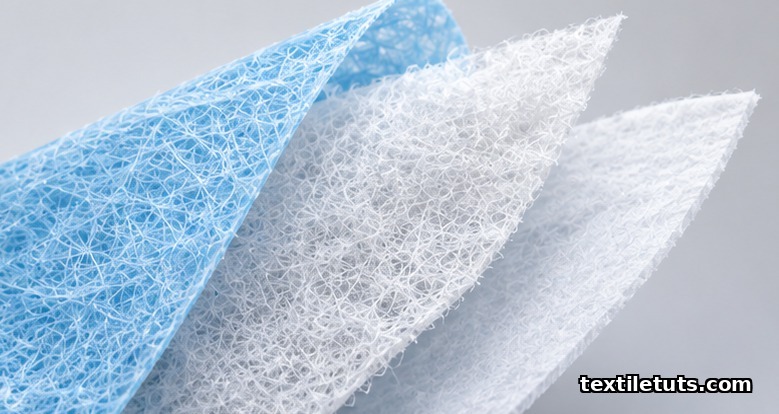
- Outer (face-out) layer: spunbond polypropylene (PP), typically 20-25 g/m² basis weight, often treated with a hydrophobic finish to resist splash and droplet penetration.
- Middle (filter) layer: meltblown polypropylene, typically 25 g/m², with fiber diameters of 1-5 µm. This is the electret-charged filtration layer.
- Inner (face-in) layer: spunbond polypropylene, typically 20-25 g/m², soft against the skin and designed to absorb exhaled moisture.
The combined laminate basis weight is 65-80 g/m². The flat mask blank is roughly 175 mm wide × 95 mm tall before pleating; once pleated (typically three pleats), it expands vertically by 30-50% so it conforms to face curvature from nasal bridge to chin without gapping at the sides.
Spunbond vs meltblown: two nonwoven processes, one laminate
Both layers are polypropylene, but they are made by very different processes, and that difference drives filtration performance.

Spunbond (outer and inner layers): Polypropylene pellets (melt flow rate 25-35 g/10 min) are melted at 200-230 °C, extruded through a spinneret with thousands of fine holes (0.3-0.5 mm diameter), and the continuous filaments are attenuated by air jets and laid on a moving belt. The resulting filament diameter is 15-35 µm. The web is then thermally point-bonded between calender rolls with a patterned engraved roll and a smooth roll at 140-160 °C, producing a soft but dimensionally stable sheet. Tensile strength of a typical 25 g/m² spunbond PP is 20-30 N/5 cm in the machine direction.
Meltblown (filter layer): Polypropylene pellets are melted and extruded through a die with hundreds of small nozzles, then attenuated by high-velocity hot air (typical air-to-polymer mass ratio 20:1) to produce very fine fibers of 1-5 µm diameter. The fibers self-bond at residual heat and are collected as a fine web with random fiber orientation. The resulting structure has high surface area per gram and small pore size, but low mechanical strength on its own, which is why it is sandwiched between two spunbond layers rather than used alone.
After web formation, the meltblown is passed through a charging field (corona discharge or hydro-charging) that injects an electret charge into the PP fibers. This charge is what allows a 25 g/m² layer to filter 95%+ of 0.1 µm particles.
How the middle layer filters: mechanical capture plus electrostatic attraction
Filtration of sub-micron particles in a meltblown nonwoven operates through four mechanisms acting simultaneously:
- Interception: a particle following a streamline passes within one particle radius of a fiber and sticks.
- Inertial impaction: a particle with enough inertia leaves the airflow and collides with a fiber.
- Diffusion (Brownian): sub-0.1 µm particles wander across streamlines and contact fibers.
- Electrostatic attraction: the electret charge on meltblown PP draws charged or polarized particles toward fibers regardless of streamline position.
The most penetrating particle size (MPPS) for an uncharged meltblown web is around 0.3 µm. Charging the web with an electret field drops that penetrating fraction by 5-10×, which is why a single 25 g/m² meltblown PP layer can filter 95-98% of 0.1 µm particles without a prohibitively high basis weight. The downside: electret charge decays with humidity, alcohol exposure, and accumulated wear, which is why a surgical mask loses filtration after 4-8 hours of continuous use.
EN 14683 and ASTM F2100: the two performance standards
Globally, two standards govern surgical mask performance. Europe uses EN 14683 (current revision EN 14683:2019+AC:2019); the United States uses ASTM F2100-19. Both specify bacterial filtration efficiency (BFE), differential pressure (ΔP, the breathability metric), and splash resistance; ASTM also specifies particle filtration efficiency (PFE) at 0.1 µm.
| Property | EN 14683 Type I | EN 14683 Type II | EN 14683 Type IIR | ASTM F2100 Level 1 | ASTM F2100 Level 2 | ASTM F2100 Level 3 |
|---|---|---|---|---|---|---|
| BFE (%) | ≥95 | ≥98 | ≥98 | ≥95 | ≥98 | ≥98 |
| PFE at 0.1 µm (%) | not required | not required | not required | ≥95 | ≥98 | ≥98 |
| ΔP, differential pressure (Pa/cm²) | <40 | <40 | <60 | <50 | <60 | <60 |
| Splash resistance (kPa) | not required | not required | ≥16 | ≥10.6 | ≥16 | ≥21.3 |
| Cleanliness (CFU/g) | ≤30 | ≤30 | ≤30 | not required | not required | not required |
BFE is tested with Staphylococcus aureus aerosol at a mean particle size of 3.0 ± 0.3 µm per EN 14683 Annex B. PFE uses latex sphere aerosols at 0.1 µm. Differential pressure is measured by pushing air through the mask material at 8 L/min and recording pressure drop across the test area. Splash resistance is measured by delivering a 2 mL jet of synthetic blood at controlled pressure and inspecting for penetration.
Mask components beyond the filter layers
The nonwoven laminate handles filtration, but a finished mask needs four more parts:
- Nose wire (nose clip): a 90-100 mm strip of malleable aluminum or plastic (often polyethylene with embedded wire) sewn or ultrasonically welded inside the top edge. It shapes the mask to the nasal bridge to cut leakage, which dominates real-world filtration performance.
- Ear loops: flat or round knitted/braided bands of polyester, nylon, or polyamide-spandex blend. Typical elongation at break is 100-200%, recovery after 50% stretch is ≥80%. Loops are joined to the mask edge by ultrasonic welding or stitching.
- Inner and outer binding strips: additional spunbond sections at the edges to prevent pleat unraveling and to reinforce loop attachment points.
- Pleat folds: the three-pleat accordion fold is created during ultrasonic die-cutting and folding; it allows the flat mask to expand vertically by 30-50% to cover chin and nose.
The combined mass of these components is roughly 2.5-3.5 g per mask, of which 75-85% by mass is the three-layer nonwoven laminate.
Manufacturing process: from polymer pellets to a packed mask
Production of a Type IIR surgical mask runs on a fully automated line at 30-60 masks per minute per machine. The sequence is:

- Nonwoven laminate supply: three rolls of SMS web are unwound under tension control and fed into an accumulator.
- Nose wire insertion: an aluminum or plastic strip is fed into the upper edge and ultrasonically welded or stitched in place.
- Ear loop welding: ultrasonic welding dies bond pre-cut loop sections to the side edges of the moving web. Ultrasonic welding uses 20-40 kHz vibration under pressure to locally melt PP fibers, joining layers without thread or solvent adhesive.
- Pleating: the flat web is fed into a pleating die that folds it into three accordion pleats (typical pleat depth 10-14 mm).
- Die cutting and stacking: a press die cuts individual masks and stacks them, often 50 pcs per dispenser box.
- EO sterilization (optional, for surgical-grade IIR labeled sterile): finished masks are exposed to ethylene oxide gas and aerated to remove residuals. EN 14683 Type IIR masks labeled sterile typically follow ISO 11135 validation.
ISO 13485 quality management governs the entire production environment for surgical masks sold as medical devices, requiring lot traceability, validated sterilization, and post-market surveillance. Production environments for sterile masks typically meet ISO 14644-1 Class 8 cleanroom particulate limits.
Frequently Asked Questions
What materials are surgical masks made of?
Surgical masks are made of three layers of polypropylene nonwoven fabric: spunbond polypropylene on the outer and inner faces and meltblown polypropylene in the middle. The middle meltblown layer is electret-charged to enhance filtration. Additional components include a malleable aluminum or plastic nose wire and polyester or nylon-spandex ear loops joined by ultrasonic welding. None of these materials are woven or knitted in the traditional textile sense; they are all nonwoven.
How does a surgical mask filter bacteria?
Filtration in a surgical mask combines mechanical capture (interception, inertial impaction, and Brownian diffusion) with electrostatic attraction from the electret charge on the meltblown polypropylene. The electret charge captures particles smaller than the physical pore size, which is why a 25 g/m² meltblown layer can stop 95-98% of 3 µm bacteria and 95-98% of 0.1 µm particles without unacceptable airflow resistance.
What is the difference between Type I, Type II, and Type IIR surgical masks?
EN 14683 Type I requires bacterial filtration efficiency of ≥95%, Type II requires ≥98%, and Type IIR requires ≥98% plus splash resistance of ≥16 kPa. Type IIR is the surgical-grade variant used in operating rooms where blood and fluid splashes are expected, while Type II is sufficient for general ward and outpatient use where splash protection is not required.
How long does a surgical mask remain effective?
Most regulatory bodies and manufacturers recommend replacing a surgical mask every 4 hours, or sooner if it becomes wet, soiled, or damaged. The electret charge on the meltblown layer decays with humidity, alcohol exposure, and prolonged wear, so a mask used beyond 8 hours typically loses 10-30% of its original filtration efficiency, dropping BFE toward 70-80%.
Are surgical masks reusable or washable?
Standard disposable surgical masks are not designed for reuse or washing. Washing with water, soap, or alcohol destroys the electret charge on the meltblown layer and collapses pore structure, reducing BFE from 95-98% to under 50%. Reusable cloth masks are a separate product category, typically using woven cotton or spunbond polyester, and follow different filtration standards such as AFNOR S76-001 in France or the community-fabric guidance issued by the World Health Organization.
References
- European Committee for Standardization (CEN). EN 14683:2019+AC:2019 — Medical face masks — Requirements and test methods. Brussels: CEN. Defines Type I, Type II, and Type IIR performance criteria including BFE, ΔP, splash resistance, and microbial cleanliness.
- ASTM International. ASTM F2100-19 — Standard Specification for Performance of Materials Used in Medical Face Masks. West Conshohocken, PA. Defines Level 1, 2, and 3 BFE, PFE, ΔP, and splash resistance criteria for surgical masks.
- International Organization for Standardization. ISO 11135:2014 — Sterilization of health-care products — Ethylene oxide — Requirements for the development, validation and routine control of a sterilization process for medical devices. Geneva: ISO. Sterilization validation for surgical masks labeled sterile.
- International Organization for Standardization. ISO 13485:2016 — Medical devices — Quality management systems — Requirements for regulatory purposes. Geneva: ISO. QMS requirements for medical mask production, traceability, and post-market surveillance.
- Konda, A.; Prakash, A.; Moss, G. A.; Schmoldt, M.; Grant, G. D.; Guha, S. (2020). Aerosol filtration efficiency of common fabrics used in cloth masks. ACS Nano, 14(5), 6339-6347. Peer-reviewed filtration physics across fabric types including meltblown polypropylene and the role of electrostatic effects.
- International Organization for Standardization. ISO 14644-1:2015 — Cleanrooms and associated controlled environments — Part 1: Classification of air cleanliness by particle concentration. Geneva: ISO. Reference for cleanroom particulate limits relevant to mask production environments.
This article is the working reference for surgical mask construction. Editorial by Md. Asad Ullah (Meem), TextileTuts. Sources: EN 14683:2019+AC:2019, ASTM F2100-19, ISO 11135:2014, ISO 13485:2016, ISO 14644-1:2015, Konda et al. 2020 as cited.


