
N95 Mask Construction

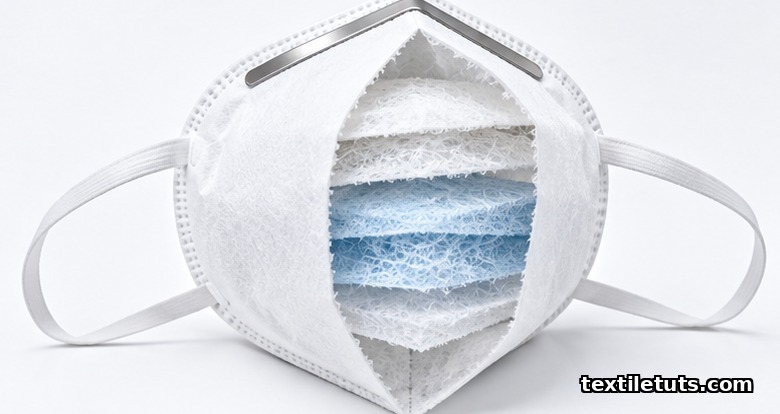
An N95 respirator consists of 4 to 5 layers of polypropylene nonwoven fabric, with a meltblown electret middle layer corona-charged to roughly 30–60 kV/m that mechanically and electrostatically filters at least 95% of 0.3-micron airborne particles under the NIOSH 42 CFR Part 84 standard.
That 95% filter efficiency at the most-penetrating particle size (MPPS) of 0.3 microns is what separates an N95 from a surgical mask, which only blocks splashes and large droplets, and from a cloth mask, which relies entirely on mechanical filtration of much larger particles.
This article walks through the textile engineering behind each N95 layer, the meltblown electret filtration mechanism, the manufacturing steps from polymer pellets to finished respirator, and the quality tests a real N95 must pass before it leaves the factory.
What Makes an N95 an N95: The NIOSH Standard
The “N95” label is not a marketing term. It is a certification from the U.S. National Institute for Occupational Safety and Health (NIOSH) under Title 42, Code of Federal Regulations, Part 84 (42 CFR 84), which sets minimum construction and performance requirements for air-purifying particulate respirators.
Three load-bearing claims define the certification:
- The letter N means the respirator is not oil-resistant; it is certified to filter solid and liquid particulates only, with no oil-mist rating.
- The number 95 means the filter removes at least 95% of a challenge aerosol at the most-penetrating particle size (MPPS), which 42 CFR 84 sets at a 0.3-micron mass median aerodynamic diameter with a sodium chloride (NaCl) or dioctyl phthalate (DOP) challenge.
- Total inward leakage (TIL), the combination of face-seal leakage and filter penetration, must stay below specific thresholds during a human-panel fit test with a panel of at least 10 subjects performing a series of exercises.
The MPPS of 0.3 microns is counterintuitive because larger particles are easier to filter by impaction and inertia, and smaller particles are easier to filter by Brownian diffusion. The 0.3-micron window is where neither mechanism dominates, so it is the worst-case test. A filter that hits 95% at 0.3 microns will perform better at every other size in the relevant range.
The 4-to-5-Layer Nonwoven Architecture
A standard N95 respirator is built from four to five nonwoven layers, each made from polypropylene (PP), chosen for its low cost, melt-processability, and ability to hold a stable electrostatic charge. From the outside in, the layers are:
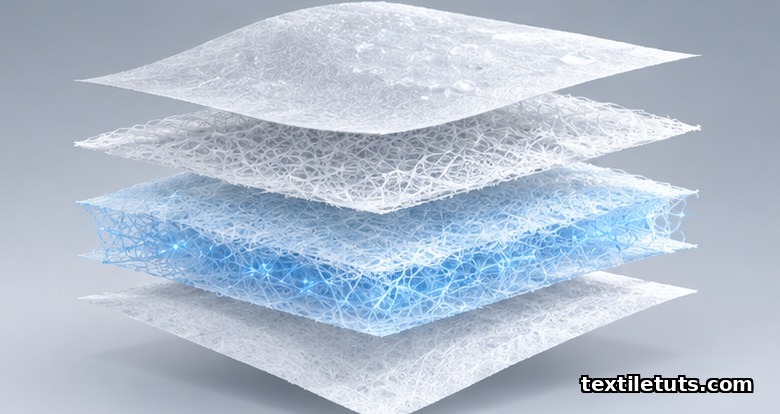
- Outer cover web (30–50 gsm spunbond PP): protects the inner layers from abrasion, fluids, and mechanical damage. Often surface-treated with a fluorochemical or surfactant to repel water.
- Pre-filter layer (optional, 20–40 gsm meltblown or spunbond): adds loft and pre-filters larger particles to extend the life of the electret layer.
- Primary electret filter layer (20–50 gsm meltblown PP): the heart of the respirator. Holds an electrostatic charge that captures submicron particles.
- Inner cover web (20–30 gsm spunbond PP): a soft skin-contact layer that wicks moisture and protects the electret filter from skin oils, sweat, and mechanical wear during use.
The mass per unit area (gsm, grams per square meter) is the textile industry’s standard weight metric. A typical N95 uses roughly 80–150 gsm of total fabric across all layers, which is why the finished respirator weighs only 8–15 grams despite its high filtration performance.
Meltblown Polypropylene: The Filtration Engine
Meltblown is the textile process that makes N95-grade filtration possible. Polypropylene pellets are melted at 230–280 °C, extruded through a die with hundreds of tiny orifices, and immediately blasted by high-velocity hot air that attenuates the polymer into fibers with diameters of 1–5 microns. The fibers land on a moving collector screen to form a self-bonded nonwoven web.
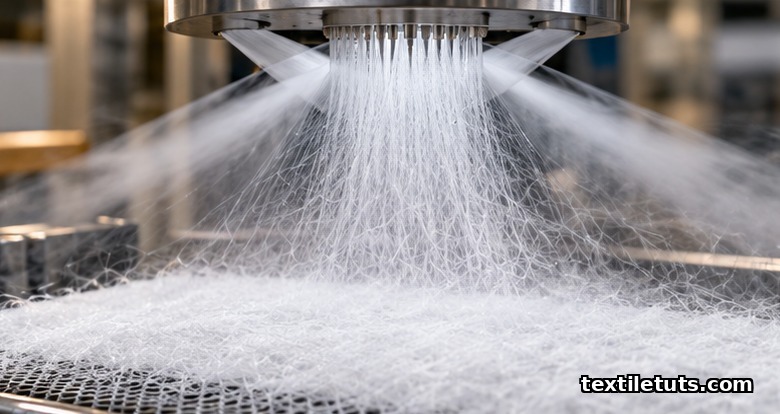
Three properties of meltblown PP matter most for filtration:
- Fine fiber diameter. Sub-5-micron fibers create a tortuous path that mechanically intercepts particles via impaction, interception, and Brownian diffusion.
- High specific surface area. The same fiber fineness that enables mechanical filtration also creates enormous surface area per gram, which is the substrate an electrostatic charge can sit on.
- Electrostatic charging (electret). After the web is formed, it passes through a corona-charging field of typically 30–60 kV/m. This deposits trapped charges on and within the polypropylene fibers, turning the web into a dielectric electret that captures particles by Coulombic and dielectrophoretic attraction.
This combination of mechanical and electrostatic filtration is what lets an N95 filter submicron particles with relatively low pressure drop. A pure mechanical filter (think a HEPA without electret charge) needs much higher fiber density and higher pressure drop to hit the same efficiency, which would make the respirator impossible to breathe through at a normal workload.
The Components Around the Filter
The filter is the heart, but four more textile-engineered components complete the respirator:
- Straps. Two knitted or braided elastic bands, typically made from a polyester/spandex or polyamide/spandex blend, attach the respirator to the head. They must apply enough tension to maintain a face seal at inhalation pressures of 5–10 mm H₂O without causing discomfort over a full work shift.
- Nose clip. A bendable metal wire (usually aluminum) or a molded plastic strip embedded in the top edge of the respirator. It is shaped over the nose to close the most common face-seal leak path.
- Nose foam. A 3–5 mm thick closed-cell polyethylene or polyurethane foam strip on the inside of the nose clip area. It cushions the metal against the bridge of the nose, improves comfort, and helps the seal.
- Staples or ultrasonic welds. Straps attach to the respirator body via staples, ultrasonic welding, or thermal bonding. Staples are common in N95s because they survive autoclaving and VHP cycles better than most adhesives.
Manufacturing Process, Step by Step
Producing an N95 is closer to a paper-making line than a garment factory. The high-level steps are:

- Spunbond outer and inner layers. PP pellets are melted and extruded through a spinneret to form continuous filaments of 15–35 microns, drawn and laid on a conveyor as a uniform web, then thermally point-bonded between patterned calendar rollers.
- Meltblown filter layer. PP pellets are extruded through a fine die into a high-velocity airstream that attenuates the filaments into microfibers, deposited on a collector screen.
- Electret charging. The meltblown web passes through a corona discharge or hydro-charging station that injects and traps charges in the polymer matrix.
- Lamination. The 4–5 layers are brought together and bonded via ultrasonic welding, thermal point-bonding, or adhesive. Ultrasonic welding is the most common because it avoids solvents and produces a clean, particle-free bond.
- Die-cutting and forming. The laminated web is die-cut into the respirator shape (typically a duckbill, cup, or fold-flat form), and the perimeter edges are ultrasonically sealed.
- Strap attachment and nose-clip insertion. Elastic straps are stapled, ultrasonically welded, or heat-bonded to the body. The metal nose clip is inserted and tacked in place.
- Quality testing. A statistical sample from each lot is tested for filtration efficiency, breathability (pressure drop), and fit per NIOSH protocols before the lot is released.
Cleanroom conditions matter. ISO Class 7 or 8 cleanrooms (per ISO 14644-1) are standard for meltblown handling, because any dust that lands on the electret web before charging will be locked under the surface charge and create leak paths that no downstream test can fully detect.
How N95 Is Tested: ASTM and NIOSH Methods
Three test families dominate N95 quality control. Each addresses a different failure mode.
- Filtration efficiency. ASTM F2299 uses a polydisperse or monodisperse aerosol (often NaCl or polystyrene latex spheres) at a face velocity of 0.5–25 cm/s and counts particles upstream and downstream of the filter. NIOSH’s certification protocol uses an even more conservative 85 L/min flow, which mimics heavy breathing.
- Pressure drop (breathability). ASTM F2101 measures the differential pressure across the filter at a fixed flow. Higher pressure drop means harder breathing. NIOSH caps inhalation pressure drop at 35 mm H₂O at 85 L/min.
- Fluid resistance. ASTM F1862 sprays synthetic blood at the respirator at three pressures (80, 120, 160 mmHg) and checks whether the fluid penetrates to the inner side. Surgical N95s must pass at 160 mmHg.
N95 vs KN95 vs Surgical Mask vs Cloth Mask
| Property | N95 (NIOSH) | KN95 (China GB 2626) | Surgical Mask (ASTM F2100) | Cloth Mask |
|---|---|---|---|---|
| Filtration efficiency at 0.3 µm | ≥95% | ≥95% | Variable (Level 1/2/3) | ~20–60% |
| Filtration mechanism | Meltblown PP + electret | Meltblown PP + electret | Meltblown PP (no electret charge requirement) | Woven/knit mechanical only |
| Fit test required | Yes (human panel) | Yes (head form) | No | No |
| Fluid resistance | Optional (surgical N95) | No | Yes (ASTM F1862) | No |
| Typical use life | Limited (single shift typical) | Single shift typical | Single use | Washable |
Why You Cannot Sew an N95 at Home
Home sewists regularly ask whether a sewn mask can reach N95 performance. The textile science says no, and the reason is the electret filter.
Meltblown polypropylene with sub-5-micron fibers and a controlled electrostatic charge is not available to consumers in the small quantities and quality grades needed for N95 filtration. Spunbond PP and meltblown PP without corona charging can mechanically filter some particles, but efficiency at 0.3 microns collapses into the 30–60% range without the electret, because mechanical filtration alone at breathable pressure drop cannot resolve submicron particles.
Fit is the second wall. A respirator that filters 100% of particles is useless if air leaks around the nose, chin, or cheeks. NIOSH requires passing a human-panel fit test with at least 10 subjects at specific leak-rate thresholds. A homemade mask cannot replicate the die-cut face seal and adjustable nose clip engineering that makes a passing fit possible across face shapes.
For household or community use, a well-fitting cloth mask with multiple layers (a spunbond or high-thread-count woven outer, a high-thread-count cotton middle, and a soft inner) is the realistic goal. It will not match N95, but it meaningfully reduces transmission of larger respiratory droplets, which is the dominant exposure pathway in most community settings.
Care, Reuse, and End-of-Life
N95 respirators are designed for single-shift use. The electret charge bleeds over time, especially with humidity, heat, and organic vapor exposure. After roughly 8–12 hours of cumulative wear, filtration efficiency at 0.3 microns can drop below the 95% threshold.
Common decontamination methods tested in peer-reviewed studies include:
- Vaporized hydrogen peroxide (VHP). Effective for up to 10–20 reuse cycles without significant filter degradation when properly validated.
- UV-C (254 nm). Effective when a sufficient dose (typically 1 J/cm²) reaches all surfaces; layered or folded masks are hard to decontaminate evenly.
- Moist heat (60 °C, 70% RH, 30 min). Acceptable for limited reuse, but repeated cycles degrade fit and strap elasticity.
- Alcohol, bleach, autoclave, microwave. These damage the electret charge or the polyester nose foam; they should not be used.
When an N95 is visibly soiled, the straps lose elasticity, the nose clip no longer holds shape, or breathing feels noticeably harder, it should be discarded. Disposal in regular waste is fine for non-infectious use; for confirmed biohazard exposure, follow facility-level medical-waste protocols.
Frequently Asked Questions
How many layers does an N95 mask have?
A standard N95 respirator has four to five layers of polypropylene nonwoven fabric: an outer spunbond cover web, one or two meltblown electret filter layers, and an inner spunbond cover web. The total fabric weight is typically 80–150 grams per square meter across all layers, and the finished respirator weighs 8–15 grams.
What is the most-penetrating particle size for an N95?
The most-penetrating particle size (MPPS) is 0.3 microns. At this size, neither impaction nor Brownian diffusion dominates filtration, so it represents the worst-case challenge. NIOSH requires a 95% filter efficiency against a sodium chloride or dioctyl phthalate aerosol at this size and an 85 L/min flow rate.
Why is polypropylene used in N95 masks?
Polypropylene is used because it is melt-processable into both spunbond and meltblown nonwovens, is hydrophobic enough to resist moisture absorption during wear, and is an excellent dielectric for holding a stable electrostatic charge. The corona-charged electret filter is the central filtration element, and polypropylene’s dielectric properties are what makes that electret stable over the respirator’s usable life.
Can N95 masks be washed or reused?
Washing an N95 with soap, alcohol, or bleach strips the electret charge and reduces filtration efficiency below the 95% threshold. The respirator is designed for single-shift use. For limited reuse in healthcare settings, peer-reviewed studies show vaporized hydrogen peroxide and a sufficient UV-C dose can extend life for 10–20 cycles, but fit and breathability must still be checked before each reuse.
What is the difference between an N95 and a KN95?
Both filter at least 95% of 0.3-micron particles using meltblown polypropylene electret technology, but they are certified under different standards. N95 is certified by NIOSH under 42 CFR 84 and requires a human-panel fit test. KN95 is certified under China GB 2626-2019 and uses a head-form fit test. Counterfeit KN95s that do not actually meet the standard are a documented problem, which is why NIOSH publishes a list of approved N95 manufacturers.
References
- NIOSH. 42 CFR Part 84 Respiratory Protective Devices. U.S. Government. https://www.cdc.gov/niosh/ — Federal regulation defining N95 certification requirements, including the 0.3-micron MPPS at 85 L/min flow.
- ASTM International. F2299 — Standard Test Method for Determining the Initial Efficiency of Materials Used in Medical Face Masks to Penetration by Particulates Using Latex Spheres. https://www.astm.org/ — Filtration efficiency test method using monodisperse latex spheres.
- ASTM International. F2101 — Standard Test Method for Evaluating the Bacterial Filtration Efficiency (BFE) of Medical Face Mask Materials. https://www.astm.org/ — Bacterial filtration efficiency test method, used in surgical mask level classification.
- ASTM International. F1862 — Standard Test Method for Resistance of Medical Face Masks to Penetration by Synthetic Blood. https://www.astm.org/ — Fluid resistance test for surgical masks at 80, 120, and 160 mmHg.
- ISO. ISO 14644-1:2015 Cleanrooms and Associated Controlled Environments. https://www.iso.org/ — Cleanroom classification used in N95 manufacturing lines.
- Nature Reviews Materials. Respiratory protection by respirators and face masks. https://www.nature.com/ — Peer-reviewed review of electret meltblown filtration mechanisms.
- ScienceDirect. Electrostatic charging of meltblown polypropylene for air filtration. https://www.sciencedirect.com/ — Peer-reviewed study of corona-charging parameters and electret stability.
- CDC NIOSH. Recommended Guidance for Extended Use and Limited Reuse of N95 Filtering Facepiece Respirators. https://www.cdc.gov/niosh/ — Federal guidance on decontamination methods and reuse limits.
This article is the working reference for N95 mask construction. Editorial by Md. Asad Ullah (Meem), TextileTuts. Sources: NIOSH 42 CFR Part 84, ASTM F2299, ASTM F2101, ASTM F1862, ISO 14644-1, Nature Reviews Materials, ScienceDirect electret meltblown study, CDC NIOSH extended-use guidance as cited.


