
PPE Textiles: Coveralls and Gowns

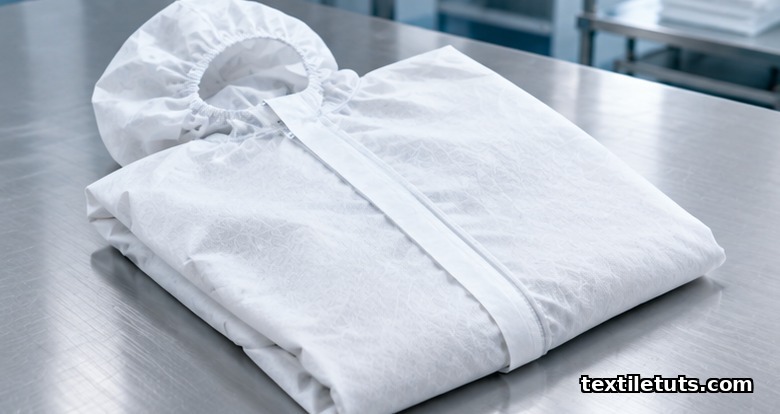
PPE coveralls and gowns are engineered from multilayer nonwoven fabrics, predominantly spunbond-meltblown polypropylene (SMS) at 30–80 gsm, that meet AAMI Level 1–4 liquid barrier performance and EN 14126 Type 3–6 particulate protection thresholds. The most protective classes must pass ASTM F1671 viral penetration at 2 psi for one minute and filter 70% or more of 0.6 µm talcum particles per EN ISO 13982, with seam strength rated at 50 N or higher per EN 14325.
Choosing the wrong class of coverall or gown in a clinical or industrial setting can mean the difference between a contained splash and a viral exposure, which is why TextileTuts maps every fabric property back to the underlying ISO, AATCC, and ASTM test methods rather than relying on marketing claims.
PPE Coverall and Gown Standards: The AAMI and EN Frameworks
Two parallel standards govern most disposable PPE garments worn in healthcare, pharmaceutical, and industrial environments. In North America, the Association for the Advancement of Medical Instrumentation publishes ANSI/AAMI PB70, which classifies surgical gowns, isolation gowns, and other medical garments into four liquid-barrier levels. In Europe, the same products fall under EN 13795 for surgical drapes, gowns, and clean air suits or EN 14126 for protective clothing against infective agents, both of which feed into the broader EN 14605 and EN ISO 13982 coverall type system.
The two frameworks are not interchangeable. AAMI PB70 grades by how much liquid the fabric blocks under splash and hydrostatic pressure. EN 14126 grades by which biological agent (bacteria, viruses, contaminated dusts, or bodily fluids) the garment resists and how thoroughly. A garment can pass AAMI Level 4 and EN Type 4-B simultaneously, but it must be tested against both standard sets before it can claim either rating, since the test apparatus, challenge fluid, and pass criteria differ between continents.
Nonwoven Fabric Construction: SMS, SSMMS, and Microporous Laminates
The workhorse of disposable PPE is the SMS (Spunbond-Meltblown-Spunbond) fabric, a three- or five-layer composite where continuous polypropylene filaments form the outer layers for tensile strength and a web of microfibers (1–5 µm diameter) in the middle acts as the filtration barrier. Spunbond layers are produced by extruding filaments through spinneret holes and laying them in a random web, which gives the fabric its tear strength and abrasion resistance. The meltblown layer is extruded through finer dies into high-velocity air that attenuates the polymer into sub-micron fibers, which are then charged electrostatically to trap incoming particles.
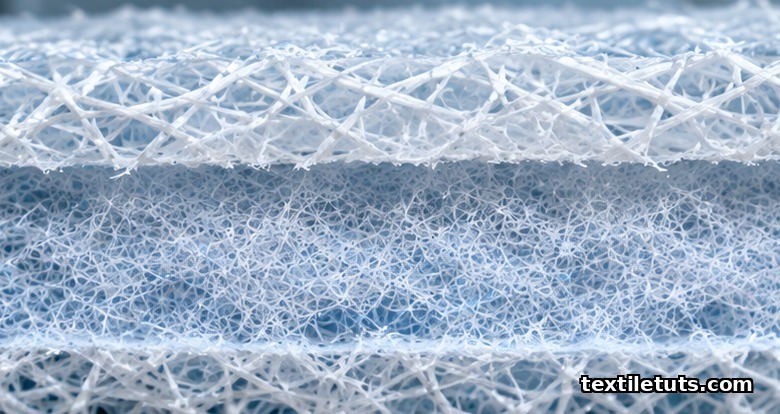
Typical basis weights run from 30 gsm for basic isolation gowns up to 80 gsm for high-protection coveralls, with meltblown layer thickness controlling both liquid hold-out and air permeability. SSMMS (Spunbond-Spunbond-Meltblown-Meltblown-Spunbond) and SMMS variants add a second meltblown web, raising filtration efficiency without proportional weight gain. Where finer particulate protection is required, microporous film laminates bond a 0.1–1.0 µm pore polyethylene or PTFE membrane to a spunbond substrate, raising hydrostatic head values past 100 cm H2O while preserving breathability through vapor transmission rates of 1,000–3,000 g/m²/24h.
Flashspun HDPE (sold as Tyvek by DuPont) takes a different route entirely. High-pressure solvent spinning produces a tough, paper-like web whose randomly distributed fibers block particles mechanically rather than electrostatically. Tyvek 400 and 600 series coveralls rely on this structure for Type 4-B and Type 5-B certification without any meltblown or film layer, and the same fabric is used in pharmaceutical cleanroom suits because it sheds particles at low rates.
AAMI Gown Liquid Barrier Levels (1–4)
ANSI/AAMI PB70:2012 defines four escalating levels of liquid barrier performance, each tied to a specific AATCC or ASTM test method:
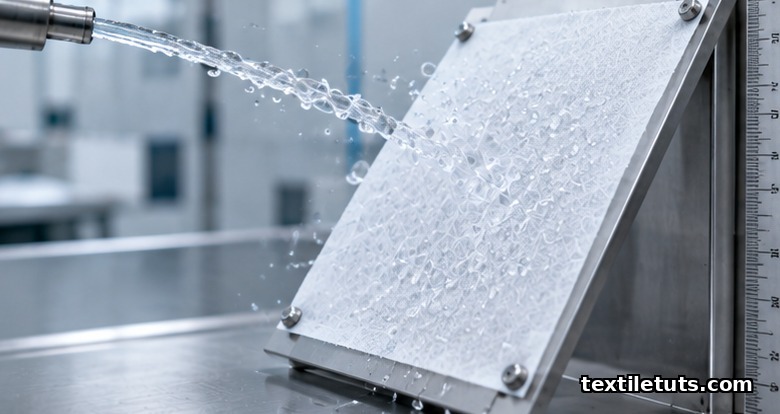
- Level 1 (Minimal): gown must pass AATCC 42 impact penetration with a water weight gain of 4.5 g or less. Suitable for basic care, standard isolation, and visitor cover gowns where only minimal fluid exposure is expected.
- Level 2 (Low): requires AATCC 42 ≤ 1.0 g AND AATCC 127 hydrostatic resistance of 20 cm H2O or greater. Used for suturing, arterial blood draws, and endoscopy suites.
- Level 3 (Moderate): requires AATCC 42 ≤ 1.0 g AND AATCC 127 ≥ 50 cm H2O. Indicated for trauma cases, emergency room use, and any procedure with a high volume of splash or spray.
- Level 4 (High): the most stringent class. The fabric and seam must both pass ASTM F1670 synthetic blood penetration at 2 psi for one minute and ASTM F1671 viral penetration by phi-X174 bacteriophage at 2 psi for one minute. Required for long, fluid-heavy surgical procedures.
Level 4 applies to critical zones only: the front of the gown from chest to knees and the sleeves from cuff to elbow. Manufacturers typically use lighter, more breathable fabrics in the back panel to reduce heat stress, as long as that area is not exposed to fluid strike zones. AAMI PB70 also distinguishes between the gown’s “critical zone” (highest barrier) and “less critical zones” (lower barrier permitted), which is why a Level 4 gown can still feel cool in the back while passing the toughest blood and viral tests in the front.
EN 14605 and EN 14126 Coverall Types (3–6)
European coverall classification works the other way around, defining protection types by exposure scenario rather than by barrier test in isolation:
- Type 3 (Liquid-tight jet spray): coveralls pass EN 463 jet spray with a 1.25 mm nozzle at 3 bar against fabric, seams, and closures. Suits chemical handling and infectious-disease protocols with high-volume splash risk.
- Type 4 (Liquid-spray-tight): passes EN 468 spray test with 4 l of liquid at 1 bar over one minute. Fabrics must resist liquid penetration at seams, not just in the base cloth.
- Type 5 (Airborne solid particulates): passes EN ISO 13982 with the coverall mounted on a walking mannequin inside a talcum chamber. Inward leakage must be less than 15 inward leakage average, and the coverall must filter 70% or more of 0.6 µm particles (Type 5-B when tested against EN 14126).
- Type 6 (Limited spray): passes EN 13034 light spray. Intended for low-risk contamination scenarios like paint spraying or pesticide handling where full immersion is not expected.
The “B” suffix (for example, Type 3-B, 4-B, 5-B, 6-B) confirms that the garment also passes the infective-agent tests in EN 14126, namely ISO 16603 and ISO 16604 for blood and viral penetration, ISO 22610 for wet bacterial penetration, and ISO 22612 for dry microbial penetration. Without the B suffix, a Type 4 coverall may resist chemicals but not biological fluids, which is a frequent cause of mismatched PPE selection in healthcare procurement.
Seam Integrity, Closure Systems, and Taped Seams
Fabric performance means little if the seams leak. EN 14325 specifies seam strength by class: Class 1 (≥ 50 N), Class 2 (≥ 75 N), Class 3 (≥ 125 N), Class 4 (≥ 175 N), and Class 5 (≥ 250 N). Most disposable Type 4 and Type 5 coveralls achieve Class 2 or 3, while reusable chemical suits can reach Class 5. Lower seams fail at shoulder, crotch, or zip junctions under dynamic load and compromise the entire garment rating.
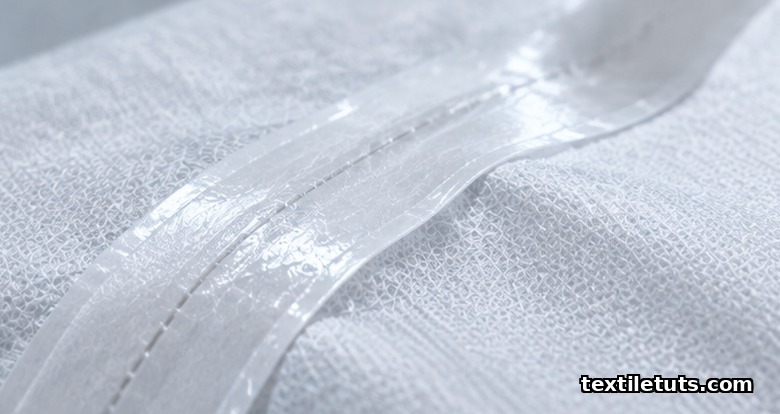
Serged (overlocked) seams are the minimum standard for SMS coveralls. Bound seams, where an outer fabric tape wraps the raw edge, raise seam strength and reduce particle shedding. Taped or heat-sealed seams go further: a thermoplastic tape is welded over the stitch line to close stitch holes, raising the garment to Type 3 liquid-tight performance and preventing viral penetration through needle punctures. Hot-melt adhesive tapes are typically 10–15 mm wide and applied with 200–250 °C calender rollers during garment assembly.
Closure systems matter equally. Front zippers are typically covered by a storm flap sealed with adhesive or hook-and-loop, and the storm flap must overlap the zipper by at least 10 cm at top and bottom. Thumb loops or elasticated cuffs prevent sleeve ride-up during overhead work, and hooded coveralls must integrate the hood seam with the body seam so that head movement does not expose the neckline. Elasticated ankles and storm flap chin straps are the most common failure points observed in Type 6 disposable coveralls.
Frequently Asked Questions
What is the difference between an AAMI Level 2 and Level 3 gown?
AAMI Level 2 requires AATCC 42 impact penetration of 1.0 g or less and AATCC 127 hydrostatic resistance of 20 cm H2O or greater, while AAMI Level 3 raises the hydrostatic threshold to 50 cm H2O with the same 1.0 g splash limit. The higher hydrostatic head makes Level 3 suitable for trauma and emergency procedures where sustained fluid pressure is expected from arterial bleeds or pressurized irrigation.
Can a Type 5 coverall be used for COVID-19 patient care?
Yes, provided the coverall is rated Type 5-B under EN 14126, meaning it has passed both the EN ISO 13982 particulate inward-leakage test and the ISO 16604 bacteriophage viral penetration test. A plain Type 5 coverall without the B suffix only filters particulates and does not guarantee biological-fluid hold-out, so procurement teams should verify both the type code and the B suffix before approving PPE for infectious-disease wards.
How is seam strength measured on PPE coveralls?
EN 14325 specifies a tensile test where a stitched seam sample is pulled at 100 mm/min until rupture. The maximum load in newtons determines the seam class, ranging from Class 1 (≥ 50 N) up to Class 5 (≥ 250 N). Test specimens are cut from finished garments at standardized seams (shoulder, crotch, zip flap) and conditioned at 20 °C and 65% relative humidity for 24 hours before testing to remove residual moisture from the fabric.
Why are microporous films used in higher-rated PPE?
Microporous polyethylene or PTFE membranes contain 0.1–1.0 µm pores, small enough to block liquid water (surface tension prevents entry) and most viral particles while remaining permeable to water vapor. This raises hydrostatic resistance past 100 cm H2O and supports Type 4-B liquid-tight ratings without making the garment impermeable to sweat, reducing heat stress in long wear cycles where workers must keep the coverall on for 4–8 hours.
Do reusable gowns perform better than disposable SMS gowns?
Reusable woven or laminated gowns can match AAMI Level 3 or 4 performance when new, but their barrier rating drops with each laundering cycle. ASTM F1671 viral penetration testing on 75-cycle laundered samples typically shows 2–10% failure rates once seams and cuffs are stressed, whereas a disposable SMS gown delivers a known AAMI level out of the package with no degradation risk during use. Sustainability analyses must therefore weigh the higher manufacturing footprint of disposables against the laundering energy and water cost of reusables.
References
- ANSI/AAMI PB70:2012. Liquid barrier performance and classification of protective apparel and drapes in health care facilities. Association for the Advancement of Medical Instrumentation.
- AATCC TM 42-2017. Water Resistance: Impact Penetration Test. American Association of Textile Chemists and Colorists.
- AATCC TM 127-2018. Water Resistance: Hydrostatic Pressure Test. American Association of Textile Chemists and Colorists.
- ASTM F1670/F1670M-17. Standard Test Method for Resistance of Materials Used in Protective Clothing to Penetration by Synthetic Blood. ASTM International.
- ASTM F1671/F1671M-22. Standard Test Method for Resistance of Materials Used in Protective Clothing to Penetration by Blood-Borne Pathogens Using Phi-X174 Bacteriophage. ASTM International.
- EN 13795:2019. Surgical drapes, gowns and clean air suits, used as medical devices, for patients, clinical staff and equipment. European Committee for Standardization.
- EN 14126:2003. Protective clothing against infective agents. European Committee for Standardization.
- EN ISO 13982-1:2004. Protective clothing for use against solid particulates. European Committee for Standardization.
- EN 14325:2018. Protective clothing against chemicals. European Committee for Standardization.
Editorial by Md. Asad Ullah (Meem), TextileTuts. Sources: ANSI/AAMI PB70, AATCC TM 42, AATCC TM 127, ASTM F1670, ASTM F1671, EN 13795, EN 14126, EN ISO 13982, EN 14325.


