
Surgical Gowns and Drapes

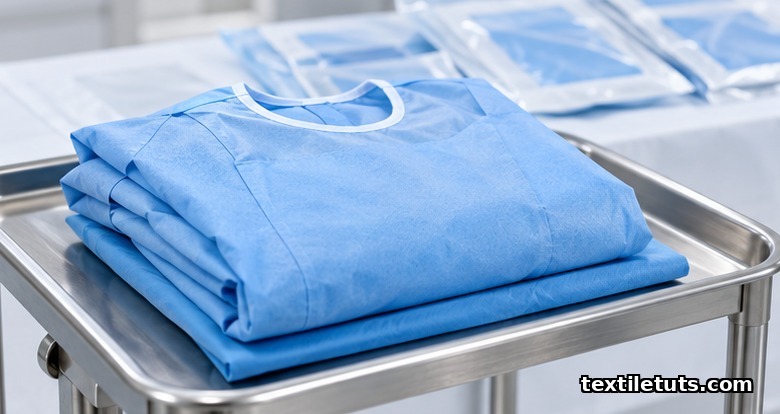
Surgical gowns and drapes are classified by ANSI/AAMI PB70:2012 into four liquid-barrier performance levels (1 through 4), where Level 4 fabric must block Phi-X174 bacteriophage penetration at 2 psi (13.8 kPa) hydrostatic pressure with a 99.9% passage reduction under ASTM F1671 viral penetration testing. Level 4 surgical gowns are mandatory for procedures involving long-duration fluid exposure, high viral load, or surgical smoke, while Level 1 and Level 2 products are appropriate for minimal-risk settings such as simple wound dressings, minor outpatient work, and bedside examination where fluid splash is brief.
This article covers how surgical gown and drape performance is measured, what the four AAMI barrier levels mean in test numbers, the material constructions that meet each level, and the seams and critical zones where barrier failure most often begins. The aim is a working reference grounded in the published standards.
How Barrier Performance Is Classified: AAMI PB70 Levels
ANSI/AAMI PB70:2012, Liquid barrier performance and classification of protective apparel and drapes intended for use in health care facilities, is the dominant classification system used by US hospitals and CMS-regulated ambulatory surgical centers. The standard defines four ascending levels of liquid-barrier protection and assigns specific test methods to each.
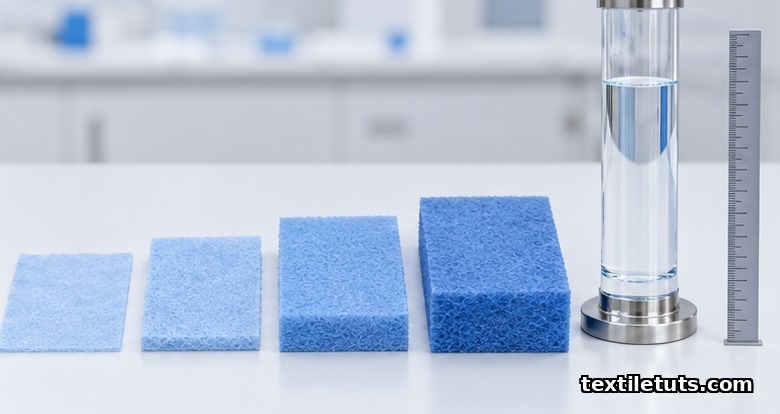
Each level is defined by passing two test methods: a spray impact test (AATCC 42) that simulates a low-pressure splash, and a hydrostatic head test (AATCC 127) that simulates sustained pressure from a soaked surface. Higher levels additionally require passing ASTM F1670 (synthetic blood penetration) and ASTM F1671 (viral penetration), which use live challenge fluids under pressure applied for set durations.
- Level 1 (minimal risk): AATCC 42 ≤ 4.5 g water pickup. Used for basic care, simple wound dressings, and short procedures with no fluid splash expected.
- Level 2 (low risk): AATCC 42 ≤ 1.0 g and AATCC 127 ≥ 20 cm hydrostatic head. Suited for endoscopy, phlebotomy, and minor procedures with limited splash.
- Level 3 (moderate risk): AATCC 42 ≤ 1.0 g and AATCC 127 ≥ 50 cm hydrostatic head. Required for arterial punctures, IV line insertion, and minor surgical procedures.
- Level 4 (high risk): Passes AATCC 42 and AATCC 127 at Level 3 thresholds, plus ASTM F1670 (synthetic blood) and ASTM F1671 (viral penetration) at 2 psi for 1 minute. Required for long, fluid-heavy surgeries, orthopedics, trauma, and any procedure where the surgical team is exposed to blood-borne pathogens.
The European equivalent, EN 13795:2019, uses a two-zone approach (critical zone versus less-critical zone) and distinguishes between standard and high-performance products. EN 13795 additionally specifies microbial penetration (ISO 22612), particle release, bursting strength, and tensile strength, which gives a fuller physical-property profile than AAMI PB70 alone.
Critical Zones and the Geometry of Barrier Failure
A surgical gown is not a uniform barrier. ANSI/AAMI PB70 divides the gown into regions and requires Level 4 performance only in the critical zones, defined as the areas most likely to be exposed to fluid strike-through. For a surgical gown, the critical zones are the front of the gown from chest to knees and the sleeves from the elbow to the cuff. The back of the gown and the upper chest above the sterile field are considered less-critical and may use lower-level fabric.
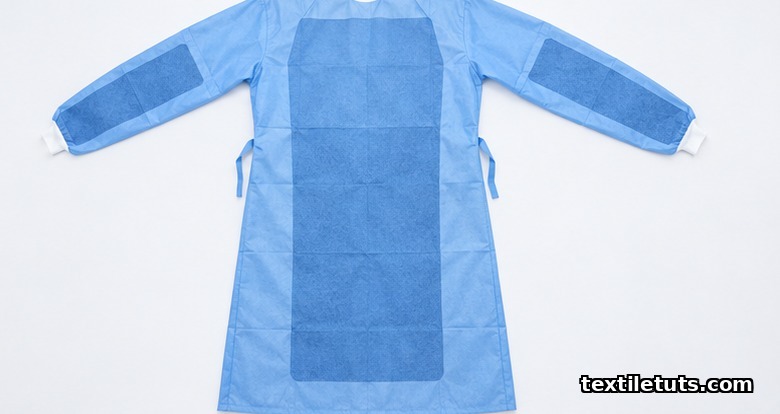
This zoning matters because it allows manufacturers to use a less expensive fabric on the back panel while concentrating the high-barrier material where fluid actually strikes. Hospitals buying gowns should verify that the supplier has clearly marked the critical zones on the gown (most do with darker fabric panels or color change) and that AQL inspection records for the critical zones are within the limits specified by the standard (typically AQL 1.5 for Level 4 fabric pinholes, AQL 4.0 for Level 3).
Seams are the other failure geometry. A gown can pass all fabric-level tests and still fail in the operating room if seam holes, stitch holes, or ultrasonic bond weaknesses allow liquid wicking. AAMI PB70 requires the same barrier test pass on the seams as on the fabric, and ASTM F1671 specifically tests seam regions when called out in the sampling plan.
Material Constructions Used in Surgical Gowns and Drapes
The barrier levels are met by a small set of engineered nonwoven and woven constructions. Each construction has a characteristic weight range, drape, and barrier profile.
| Construction | Typical weight | Typical barrier level | Notes |
|---|---|---|---|
| Spunbond polypropylene (SS) | 20–30 gsm | Level 1 | Low cost, breathable, single use |
| SMS (spunbond-meltblown-spunbond polypropylene) | 35–50 gsm | Level 2–3 | Meltblown middle layer carries the barrier; standard for most drapes |
| SMMS or SSMMS | 45–65 gsm | Level 3–4 | Two meltblown layers raise hydrostatic head to 50+ cm |
| Spunlace (polyester / wood pulp) | 50–70 gsm | Level 2–4 | Hydroentangled, soft hand, often used in reinforced gowns |
| Polyester microfiber with fluorocarbon finish | 110–180 gsm | Level 3–4 reusable | Used in high-cycle reusable gown programs (50–75 wash cycles) |
| Laminates (PE film / nonwoven, breathable film / nonwoven) | 60–90 gsm | Level 4 reinforced areas | Often used in sleeve reinforcement and chest panel |
| Polypropylene laminate with impervious film | 80+ gsm | Level 4 (full gown) | Used for trauma and orthopedics where total imperviousness is required |
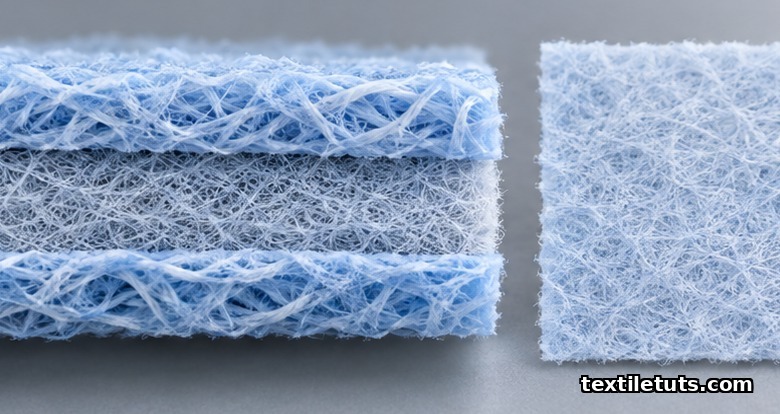
SMS is the workhorse construction of disposable surgical drapes and standard gowns. The two spunbond outer layers give tensile strength and abrasion resistance, and the meltblown middle layer, made of sub-micron polypropylene fibers with typical pore sizes of 10–30 µm, provides the hydrostatic resistance. By adding a second meltblown layer (SMMS or SSMMS), the pore structure becomes tortuous enough to pass ASTM F1671 viral challenge.
Spunlace, also called hydroentangled nonwoven, uses high-pressure water jets to entangle polyester fibers with wood pulp. The result is a fabric with a cloth-like hand that drapes well, making it the preferred choice for surgeons who complain that pure SMS feels paper-like. Spunlace is also widely used in reinforced areas, where a second fabric layer is ultrasonically or thermally bonded on top of the base layer.
Physical Properties Beyond Barrier
Barrier is necessary but not sufficient. A surgical gown or drape must also pass a set of mechanical tests that predict in-use failure under stress, abrasion, and laundering. These include tensile strength (ISO 9073-3 for nonwovens), bursting strength (ISO 13938-1) typically required to exceed 40 kPa for chest and sleeve panels, mean flow pore size of the meltblown layer (ASTM F316), and air permeability (ISO 9237). Excessive stiffness, measured by ISO 9073-9, reduces surgeon comfort and dexterity, so most Level 3 SMS gowns are tuned to a balance of hydrostatic head and drape.
Flammability and Surgical Smoke Considerations
Surgical gowns and drapes must meet Class I flammability per 16 CFR Part 1610 (US), the same flammability standard that applies to general apparel. Most polypropylene nonwovens pass easily because they shrink away from small ignition sources, but reusable polyester gowns with fluorocarbon finishes must be tested for any after-flame time the finish might create.
For procedures involving electrosurgery or lasers, surgical drapes used in the immediate field may need to comply with ISO 11810:2015 for laser resistance. This is a separate evaluation because laser ignition sources are far hotter than open flames. Drapes rated for laser use have a wet-strength barrier or a foil-treated edge that prevents ignition at the surgical site.
Reusable Versus Disposable: The Trade-Off
The reusable gown question is a trade-off between barrier stability over wash cycles and total environmental load. Reusable polyester gowns, typically 110–180 gsm with a durable fluorocarbon finish, are designed for 50–75 wash-and-sterilize cycles. Each cycle strips a fraction of the finish, and after roughly 50 cycles the hydrostatic head can drop from the Level 4 range (≥ 50 cm) into the Level 2 range (20–30 cm). Hospitals running reusable programs must track cycle count per gown and remove them at the published retirement cycle. Disposable gowns deliver guaranteed barrier performance for a single use but contribute to medical waste streams, typically 50–65 g and 0.5 L of landfill volume per Level 4 SMS gown.
Disposal Pathways and End-of-Life
Used gowns and drapes visibly contaminated with blood or other potentially infectious materials are regulated as medical waste under the OSHA Bloodborne Pathogens Standard (29 CFR 1910.1030), with states adding rules for incineration versus autoclave. Single-polymer polypropylene gowns are technically recyclable but normally go to medical waste incineration or autoclave-and-landfill because hospitals lack dedicated collection pathways. Spunlace gowns cannot be economically separated and follow the same path, while reusable polyester gowns return to the operating room through industrial laundry.
Frequently Asked Questions
What is the difference between Level 1, 2, 3, and 4 surgical gowns?
The four AAMI PB70 levels correspond to increasing thresholds on AATCC 42 (water spray), AATCC 127 (hydrostatic head), and, for Level 4 only, ASTM F1670 (synthetic blood) and ASTM F1671 (viral penetration). Level 4 requires no viral passage at 2 psi for one minute. Levels 1 and 2 pass only the spray and hydrostatic tests at progressively stricter thresholds.
What does ASTM F1671 actually test?
ASTM F1671 is a viral penetration test that uses Phi-X174 bacteriophage as a surrogate for blood-borne viruses such as HIV and hepatitis B. The fabric or seam is exposed to the challenge fluid at 2 psi (13.8 kPa) for one minute, and any viral passage through to the collection side is detected by plaque assay. Pass criterion is no detectable viral passage.
How are surgical drapes different from surgical gowns?
Surgical drapes cover the patient and the surrounding sterile field, while surgical gowns cover the surgical team. Both must meet AAMI PB70 barrier levels, but drapes are usually evaluated as a single fabric rather than with critical-zone zoning, and commonly carry additional requirements for tear resistance, drapeability, and laser resistance under ISO 11810.
Are reusable surgical gowns better than disposable ones?
Neither construction is universally better. Reusable polyester gowns can match Level 4 barrier performance for roughly 50 wash cycles and have lower cumulative energy demand after about 10–15 cycles, but they require strict cycle tracking. Disposable SMS gowns deliver guaranteed barrier performance for one procedure but contribute more to solid waste per use.
What is SMS fabric and why is it used?
SMS stands for spunbond-meltblown-spunbond. It is a three-layer polypropylene nonwoven in which two outer spunbond layers provide strength and abrasion resistance, and an inner meltblown layer of sub-micron fibers provides the liquid barrier. SMS is the dominant disposable drape and gown fabric because it balances barrier, strength, and cost effectively for Levels 2 and 3.
References
- Association for the Advancement of Medical Instrumentation. ANSI/AAMI PB70:2012, Liquid barrier performance and classification of protective apparel and drapes intended for use in health care facilities. AAMI, 2012. Defines the four barrier levels, critical zones, and seam testing requirements.
- AATCC. AATCC Test Method 42, Water resistance: impact penetration test. American Association of Textile Chemists and Colorists. Splash test used to qualify AAMI Level 1–4 fabrics.
- AATCC. AATCC Test Method 127, Water resistance: hydrostatic pressure test. American Association of Textile Chemists and Colorists. Hydrostatic head method that defines Level 2–4 thresholds.
- ASTM International. ASTM F1671 / F1671M, Standard test method for resistance of materials used in protective clothing to penetration by blood-borne pathogens using Phi-X174 bacteriophage penetration as a test system. ASTM. Defines the viral challenge applied to Level 4 fabric and seam specimens.
- ASTM International. ASTM F1670 / F1670M, Standard test method for resistance of materials used in protective clothing to penetration by synthetic blood. ASTM. Synthetic blood challenge used together with F1671.
- European Committee for Standardization. EN 13795:2019, Surgical drapes, gowns and clean air suits, used as medical devices for patients, clinical staff and equipment. CEN. Two-zone European standard covering barrier, mechanical, and microbial properties.
- International Organization for Standardization. ISO 11810:2015, Lasers and laser-related equipment: Test method for the laser-resistance of surgical drapes and/or patient protective covers. ISO. Test method for laser ignition resistance in surgical drapes.
- International Organization for Standardization. ISO 9073-3:2023, Nonwovens: Determination of tensile strength and elongation. ISO. Mechanical test method applied to nonwoven gown and drape fabric.
This article is the working reference for surgical gown and drape barrier classification, material construction, and test methods. Editorial by Md. Asad Ullah (Meem), TextileTuts. Sources: ANSI/AAMI PB70:2012, AATCC 42, AATCC 127, ASTM F1671, ASTM F1670, EN 13795:2019, ISO 11810:2015, ISO 9073-3:2023 as cited.


