
Hospital Linens: Antimicrobial

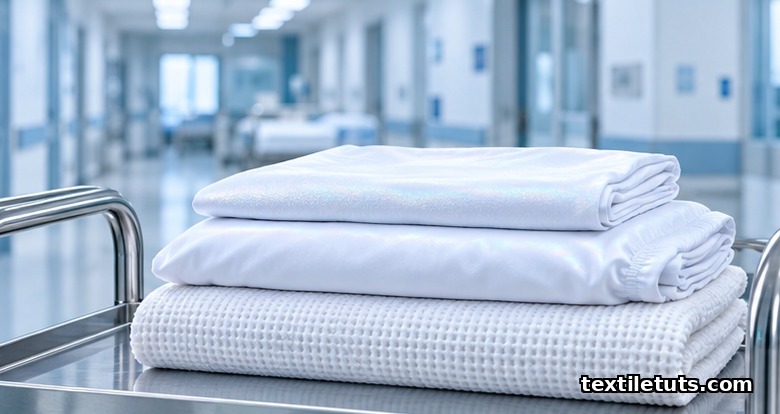
Antimicrobial hospital linens treated with silver-ion or silane-bound quaternary ammonium finishes achieve ≥99.9% (≥3-log) bacterial reduction against Staphylococcus aureus and Escherichia coli within 24 hours under ISO 20743:2013, and the active finish typically retains efficacy through 50 to 75 industrial laundry cycles at 71 to 85 °C before dropping below the 95% (2-log) threshold most hospital procurement specifications require.
The same finishes also suppress odor-causing bacteria and the regrowth that survives standard thermal disinfection, which matters because healthcare-associated infections (HAIs) affect an estimated 1 in 31 hospitalized patients on any given day in U.S. acute-care hospitals, according to the Centers for Disease Control and Prevention (CDC).
This article explains the chemistry behind the most common antimicrobial finishes used on hospital sheets, blankets, pillowcases, gowns, and cubicle curtains, the test methods that qualify a textile for clinical infection-control claims, and the durability trade-offs that determine whether a finish survives the realities of a hospital laundry.
Why Hospital Linens Need Antimicrobial Finishes
Healthcare-associated infections remain the most frequent complication of inpatient care. The CDC’s 2022 HAI progress report documented more than 50,000 device-associated infections in U.S. intensive care units in a single year, and contaminated textiles contribute to pathogen transmission during the chain that runs between soiled-linen collection, sorting, washing, drying, folding, transport, and bedside use. Any step in that chain can recontaminate fabric that came out of the wash clean.
Conventional thermal disinfection at 71 °C for at least 3 minutes, the U.S. healthcare laundry benchmark set by the Healthcare Laundry Accreditation Council (HLAC), delivers a 5-log reduction on most vegetative bacteria but does not reliably eliminate spore-formers such as Clostridioides difficile, and it does not prevent regrowth during the hours that pass between finishing and the next patient contact. An antimicrobial finish acts as a second line of defense on the textile surface after thermal disinfection has done its primary work.
The economic case is straightforward. The CDC has estimated the annual direct cost of U.S. HAIs at $28 to $33 billion. Any intervention that reduces textile-borne bacterial load at the ward level, even by 90%, can shift the contamination baseline that clinicians work against every shift.
How Antimicrobial Finishes Work on Hospital Textiles
An antimicrobial finish is a chemical treatment applied to the fiber or fabric that either kills microorganisms on contact (bactericidal) or prevents them from multiplying (bacteriostatic). On hospital linens, the finish is almost always applied at the finishing mill, either as a pad-dry-cure treatment where the fabric passes through a chemical bath and is then dried and cured, an exhaust process similar to a dye cycle, or a sol-gel coating when the active is a metal or metal-oxide nanoparticle.
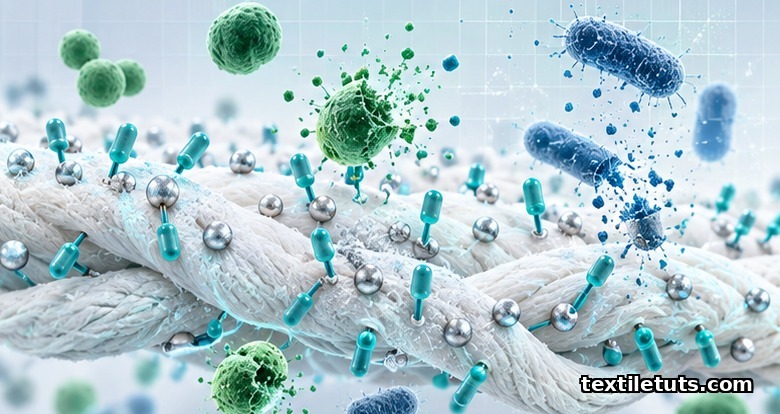
The mechanism varies by chemistry. Silver ions (Ag+) and silver nanoparticles, typically in the 10 to 50 nm range, denature bacterial cell-wall proteins and interfere with DNA replication. Quaternary ammonium compounds (QACs) insert their positively charged nitrogen into the negatively charged bacterial membrane and cause the contents of the cell to leak out. PHMB, or polyhexamethylene biguanide, binds to the bacterial membrane and condenses the cytoplasm. Chitosan, a biopolymer derived from chitin, disrupts the outer membrane of gram-negative bacteria. Copper ions act through a mix of membrane and oxidative damage similar to silver.
The earliest commercial antimicrobial finishes were “leaching” agents, where the active diffused to the surface over time and was consumed in the process. The more durable finishes used in modern hospital linens are “bound” or “regenerable”: the antimicrobial is covalently attached to the fiber surface or held in a carrier such as a zeolite or glass ceramic, and the surface activity is restored during routine laundering when the fiber is rinsed with a metal salt or a built-in recharge bath.
Common Antimicrobial Agents Used on Hospital Linens
Silver-based finishes dominate the medical-textile market. Silver ions and silver nanoparticles in a zeolite or glass-ceramic carrier deliver 99.9% reduction against S. aureus, E. coli, and Pseudomonas aeruginosa within 24 hours under AATCC TM 100, and the carrier system controls the release rate so the finish is not exhausted in the first few laundry cycles.
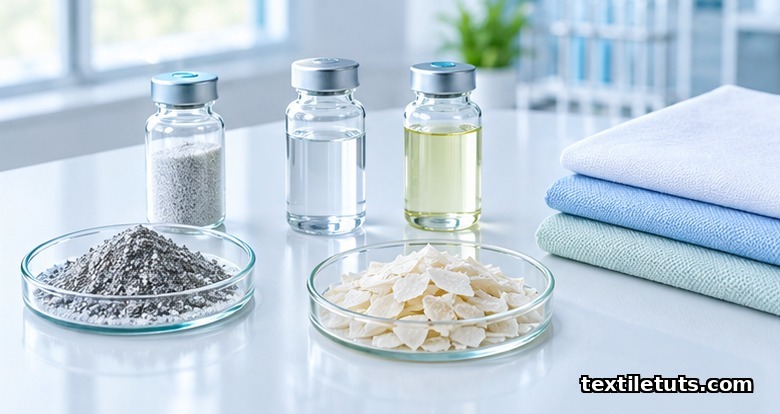
Quaternary ammonium compounds, usually silane-modified so that they bond covalently to cellulose, are the second major class. Tested cotton finished with a silane-QAC reports 99.0 to 99.9% reduction against S. aureus and Klebsiella pneumoniae under AATCC TM 100, and the finish remains active past 75 home or industrial wash cycles. QACs are more tolerant of chlorine bleach than silver, which is one reason they are common in U.S. hospital procurement specifications.
PHMB is widely used in European hospital textiles for its broad-spectrum activity and low skin irritation. Triclosan and triclocarban, which were common in earlier-generation hospital linens, have largely been phased out since the U.S. FDA restricted them in 2016 over endocrine-disruption concerns and microbial-resistance risk. Chitosan and zinc pyrithione appear mainly in niche or blended finishes where biodegradability or antifungal performance is required.
Test Methods and Performance Standards
Three test methods account for most antimicrobial claims on hospital linens, and a buyer who reads a mill datasheet should be able to match the claim to the method that produced it.
ISO 20743:2013 is the international reference method. It is quantitative, uses either an absorption or transfer inoculation protocol, and reports a log reduction or a bacteriostatic activity value at 0 hours and at 18 to 24 hours. ISO 20743 also requires a negative control so the result is comparable across laboratories and across test organisms.
AATCC TM 100 is the workhorse quantitative method in North America. A test sample is inoculated with a known bacterial concentration, typically 10⁵ colony-forming units per milliliter, incubated for 18 to 24 hours, and the surviving bacteria are counted. AATCC bands results into qualitative ranges: 95% reduction is considered “good,” 99% is “excellent,” and 99.9% or higher is “outstanding.” AATCC TM 147, the parallel streak method, is a qualitative agar-diffusion screen that produces a zone-of-inhibition image and is best for confirming whether an agent is leaching from the textile.
ASTM E2149 is the dynamic-contact shake-flask method, designed for non-leaching finishes since it does not require the active agent to diffuse into agar. JIS L 1902, the Japanese Industrial Standard method, is functionally similar to ISO 20743 and is accepted in most Asian markets. Cross-reading results between ISO 20743, AATCC TM 100, and JIS L 1902 requires the conversion tables in ISO 20743 Annex C.
Durability and Laundry Cycle Performance
An antimicrobial finish that loses its activity after ten wash cycles is not useful in a hospital. HLAC recommends a minimum service life of 50 industrial laundry cycles for reusable healthcare textiles, and most modern silver or QAC finishes are tested to 50, 75, or 100 cycles under conditions that simulate a hospital laundry: 71 to 85 °C, alkaline detergent, and chlorine or peroxide bleach depending on color and fiber.
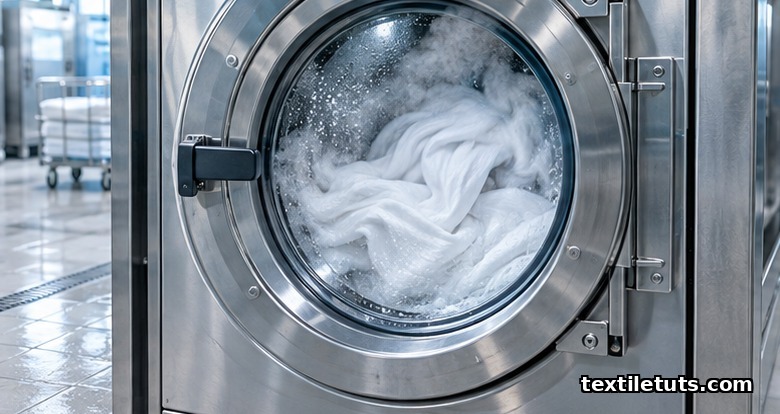
Activity loss follows a roughly linear pattern under repeated washing, so a finish that starts at 99.9% reduction typically drops to 99% after 50 cycles and to 95%, the borderline acceptance level in most procurement specifications, after 75 to 100 cycles depending on the carrier system. Chlorine bleach accelerates silver-ion loss because chloride ions form insoluble silver chloride. Regenerative finishes, where the surface chemistry is restored by a metal-salt rinse step, can extend service life past 100 cycles without the activity dropping below 95%.
The interaction with the laundry’s actual chemistry is the single most important durability variable a hospital laundry manager should track, since chlorine bleach is standard for the color-safe whitening of cotton hospital linens, and the wrong bleach-finish pairing can halve the warranted cycle count of an otherwise good finish.
Comparison of Antimicrobial Agents for Hospital Linens
| Agent | Mechanism | Typical Log Reduction (AATCC TM 100, 24 h) | Wash Durability (industrial cycles) | Practical Notes |
|---|---|---|---|---|
| Silver ion / Ag nanoparticles (zeolite-bound) | Membrane and DNA disruption | ≥3-log (99.9%) | 50 to 100 | Most common on cotton and poly-cotton; bleach-sensitive |
| Silane-bound quaternary ammonium | Membrane lysis | 2 to 3-log (99 to 99.9%) | 75+ | Bleach-tolerant; can yellow at very high cure temperature |
| PHMB | Membrane binding and cytoplasm condensation | 2 to 3-log (99 to 99.9%) | 50 to 75 | Low skin irritation; preferred in EU hospital specifications |
| Chitosan (biopolymer) | Outer-membrane disruption, gram-negative bias | 1 to 2-log (90 to 99%) | 20 to 30 | Biodegradable; weaker durability under alkaline wash |
| Copper oxide / copper-ion blend | Membrane damage and oxidative stress | 2-log (99%) | 50+ | Often blended with silver; color is a constraint on whites |
Frequently Asked Questions
Do antimicrobial hospital linens actually reduce infection rates?
Antimicrobial finishes reduce bacterial load on the textile surface by 90 to 99.9% under standard test conditions such as ISO 20743 and AATCC TM 100, and several peer-reviewed studies link their use to reduced environmental contamination at the bedside. Direct causation between any single textile finish and lower HAI rates is harder to prove in clinical trials, since infection control depends on hand hygiene, surface disinfection, and antibiotic stewardship working together. Antimicrobial linens should be treated as one layer of a multi-layer program, not a stand-alone solution.
Are antimicrobial hospital linens safe for patient skin?
Yes, when the finish is applied and tested to ISO 10993 or an equivalent biocompatibility standard. Silver-ion and QAC finishes on certified hospital textiles have a long clinical history with low reported skin irritation. PHMB at textile-use concentrations has been reviewed favorably by the European Chemicals Agency (ECHA) for use on articles intended for repeated skin contact.
How many wash cycles does an antimicrobial finish actually last?
Most silver and QAC finishes are warrantied for 50 to 75 industrial cycles at 71 to 85 °C, with tested data showing ≥95% (2-log) reduction through that range. Chlorine bleach shortens service life, while regenerative finishes can extend it past 100 cycles. Always check the mill’s test data matched to your laundry’s chemistry, water hardness, and bleach use, not the headline cycle number on the datasheet.
What is the difference between AATCC TM 100 and ISO 20743?
AATCC TM 100 is a quantitative absorption method widely used in North America, with results reported as percent reduction after 18 to 24 hours of contact. ISO 20743 is the international equivalent, offering both absorption and transfer protocols and reporting results as a log reduction or an activity value. Both methods are valid. Cross-reading their results requires the activity-value conversion in ISO 20743 Annex C, since the two methods use slightly different inoculum sizes and incubation conditions.
Is triclosan still used in hospital linens?
Triclosan and triclocarban were widely used in hospital textiles before 2016. The U.S. FDA removed them from over-the-counter antiseptic products and several textile registrations were withdrawn over the following years. Current hospital procurement specifications ban triclosan in favor of silver, QAC, PHMB, or chitosan-based finishes, all of which have clearer safety profiles and lower microbial-resistance risk.
References
- ISO. (2013). ISO 20743:2013 Textiles — Determination of antibacterial activity of textile products. International Organization for Standardization.
- AATCC. (2019). AATCC Test Method 100: Antibacterial Finishes on Textile Materials. American Association of Textile Chemists and Colorists.
- AATCC. (2019). AATCC Test Method 147: Parallel Streak Method. American Association of Textile Chemists and Colorists.
- ASTM. (2020). ASTM E2149-20: Standard Test Method for Determining the Antimicrobial Activity of Antimicrobial Agents Under Dynamic Contact Conditions. ASTM International.
- JIS. (2008). JIS L 1902:2008 Testing method for antibacterial activity of textiles. Japanese Industrial Standards.
- Dastjerdi, R., & Montazer, M. (2010). A review on the application of inorganic nano-structured materials in the modification of textiles. Colloids and Surfaces B: Biointerfaces, 79(1), 5-18.
- Simoncic, B., & Tomsic, B. (2010). Structures of novel antimicrobial agents for textiles. Textile Research Journal, 80(16), 1721-1737.
- Windler, L., Height, M., & Nowack, B. (2013). Comparative evaluation of antimicrobials for textile applications. Environment International, 53, 62-73.
- Centers for Disease Control and Prevention. (2022). Healthcare-Associated Infections (HAI) Progress Report. U.S. Department of Health and Human Services.
- Healthcare Laundry Accreditation Council. (2019). HLAC Accreditation Standards for the Processing of Reusable Textiles for Healthcare.
This article is the working reference for antimicrobial hospital linens. Editorial by Md. Asad Ullah (Meem), TextileTuts. Sources: ISO 20743:2013, AATCC TM 100, AATCC TM 147, ASTM E2149-20, JIS L 1902:2008, Dastjerdi and Montazer (2010), Simoncic and Tomsic (2010), Windler, Height, and Nowack (2013), the CDC HAI Progress Report (2022), and HLAC Accreditation Standards (2019), as cited.


