
Sublimation Printing: Polyester Process

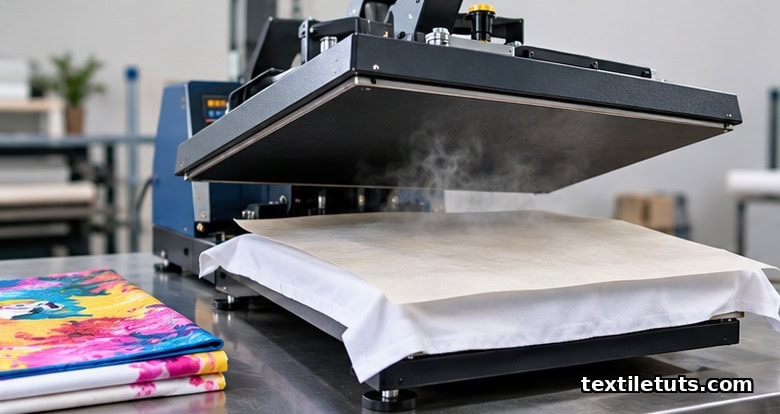
Polyester sublimation printing transfers disperse dyes into polyester fibers at 195 to 205 degrees Celsius for 35 to 60 seconds under 40 to 50 psi pressure, producing prints that score 4 to 5 on the AATCC grayscale for wash fastness per ISO 105-C10 and 4 to 5 for crocking per AATCC TM 8.
Below 70 percent polyester content, color yield drops sharply because there are not enough amorphous regions in the fiber to absorb the dye vapor. Above 90 percent polyester, the print is essentially permanent and survives 50 home launderings with a color change of less than one grayscale grade.
This article walks through the chemistry, the step-by-step process, the test standards that govern colorfastness claims, and the practical limits every print shop should know before quoting a sublimation job.
What Sublimation Printing Actually Does
Sublimation printing is a heat-driven dye transfer process. Solid disperse dye particles printed on a coated release paper are converted directly into a gas when the paper passes through a heat press. The dye gas then diffuses into the polyester fiber, where it solidifies again inside the polymer structure. No liquid water is involved, and no binder film sits on the fabric surface after the press cycle.
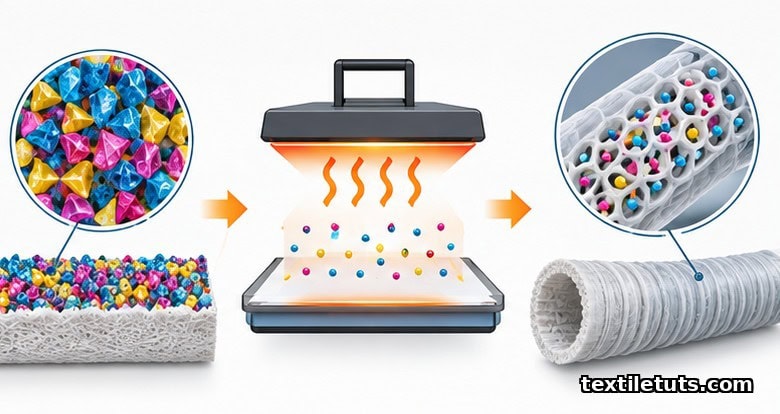
The scientific term for the phase change is sublimation, which is the direct transition from solid to vapor without passing through a liquid phase. Disperse dyes are uniquely suited to this mechanism because their molecular weight, typically 250 to 600 g/mol, and their low polarity let them vaporize at temperatures a heat press can reach and diffuse into hydrophobic polyester fibers that would reject most water-soluble dye classes.
Why Polyester Is the Substrate of Choice
Polyester fibers are made of poly(ethylene terephthalate), commonly abbreviated PET, a semi-crystalline polymer with two distinct internal regions. Crystalline regions are tightly packed and reject dye molecules. Amorphous regions are loosely packed and provide free volume for dye vapor to enter and lodge. Commercial polyester fiber typically reaches 30 to 40 percent crystallinity, which leaves 60 to 70 percent of the fiber accessible to sublimation dye.
Sublimation printing works on any fiber with sufficient amorphous content and no surface finish that blocks dye uptake. In practice, that means polyester, polyamide (nylon 6 and nylon 6,6), and some acrylics. Cotton has essentially no amorphous regions accessible to disperse dye vapor, so a 100 percent cotton fabric gives only a pale stain that washes out within one or two cycles. Cotton-polyester blends can be sublimation-printed, but color intensity scales directly with polyester content: a 65/35 poly-cotton gives roughly 60 to 65 percent of the color yield of a 100 percent polyester fabric of the same weight.
Process Parameters and Their Tolerances
The four parameters that control sublimation print quality are temperature, time, pressure, and paper release. Each has a working window and a failure mode at each end.
Temperature: 195 to 205 degrees Celsius is the standard operating range. Below 190 degrees Celsius, dye vapor pressure is too low for full transfer in commercial press times, and prints look washed out. Above 215 degrees Celsius, polyester begins to yellow and shrink at the fiber surface, and dye migration beyond the intended edge becomes visible as a soft halo around dark design elements.
Time: 35 to 60 seconds is the working range for most polyester knits and woven fabrics. Heavier fabrics above 200 gsm need the longer end of the range. Lightweight chiffon-weight polyester can be pressed for as little as 25 seconds. Going past 90 seconds invites dye migration into adjacent white areas and causes fiber yellowing.
Pressure: 40 to 50 psi on a calibrated heat press is the industry standard for apparel. Lower pressure gives uneven contact and ghosting where the paper lifts. Higher pressure crushes the fiber loft, particularly on fleece and high-pile knit structures.
Paper release: the transfer paper must release the full dye layer within the press cycle. A standard 90 to 100 gsm sublimation paper releases cleanly in 40 to 60 seconds at 200 degrees Celsius. A heavier 120 gsm paper needs slightly more time and slightly more heat. Residual dye left on the paper after pressing indicates either under-pressing or paper that has absorbed humidity from storage and is blocking release.
Step-by-Step Process for Polyester Sublimation
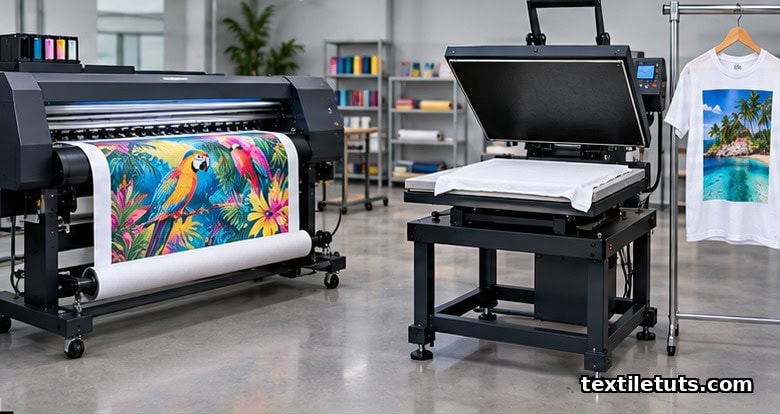
Step 1, print the design. Sublimation paper is loaded into a digital printer fitted with aqueous sublimation inks, which are suspensions of the same disperse dyes used in polyester exhaust dyeing. The printer deposits the dye in a mirror image on the paper because the heat transfer reverses the orientation.
Step 2, condition the fabric. Polyester fabric should be pre-shrunk and free of fabric softener, silicone, or optical brightener residue. Softeners and silicones fill the amorphous regions in the outer fiber layer and prevent dye uptake. A simple pre-wash with a non-ionic surfactant at 60 degrees Celsius removes the contamination. White or light polyester also benefits from a pre-bake at 150 degrees Celsius for 30 seconds to drive off any residual moisture.
Step 3, position and press. The printed paper is placed face-down on the polyester fabric, and both pass through a heat press set to 200 degrees Celsius for 45 seconds at 45 psi. A Teflon sheet or silicone foam pad above and below the assembly protects the press platen and cushions the fabric, which prevents shine on dark substrates and creases on lightweight knits.
Step 4, peel hot or cold. Hot peeling, which means removing the paper immediately after the press opens, gives a slightly softer fabric hand and is standard for apparel. Cold peeling, which means waiting 10 to 15 seconds, gives a sharper edge on rigid substrates and on designs with fine linework.
Step 5, post-treat if needed. Most sublimation prints on polyester need no post-treatment. If the end use involves sustained outdoor exposure, a light rinse in 30 g/L of a cationic fixative at 40 degrees Celsius improves light fastness by roughly one half-grade on the ISO 105-B02 blue wool scale.
Color Fastness Standards That Apply
Sublimation prints on polyester are evaluated against the same ISO 105 and AATCC colorfastness standards as conventionally dyed polyester. The four most relevant tests for a sublimation print shop are listed below.
ISO 105-C10:2010, colorfastness to domestic and commercial laundering: a typical well-pressed sublimation print on polyester scores 4 to 5 on the AATCC grayscale for color change after five washes at 40 degrees Celsius. Anything below 4 indicates under-pressing or a contaminated substrate.
AATCC TM 8, colorfastness to crocking: this test measures transfer of dye onto a white rubbing fabric under controlled pressure. Sublimation prints on polyester typically score 4 to 5 dry and 3 to 4 wet. Wet crocking is always lower because moisture mobilizes any residual surface dye.
ISO 105-X12, colorfastness to rubbing: this is the ISO equivalent of AATCC TM 8 and is used in markets that follow ISO standards. Same scoring scale, same expected range, and the same difference between dry and wet ratings.
AATCC TM 133, colorfastness to hot pressing: this test is directly relevant to sublimation because the process itself is a controlled hot press. The test measures whether dye from the printed fabric transfers to an adjacent white fabric under defined hot-pressing conditions. A correctly pressed sublimation print scores 4 to 5 on this test.
ISO 105-B02, colorfastness to artificial light (xenon arc): a printed polyester sample exposed for 20 hours to xenon arc light typically shows a color change of 3 to 4 on the blue wool scale. Outdoor-durable sublimation prints need additional UV absorbers applied as a finishing treatment to push this rating to 5 or above.
Where Sublimation Fails and How to Avoid It
Sublimation printing has four recurring failure modes worth naming explicitly so a print shop can diagnose rejects quickly.
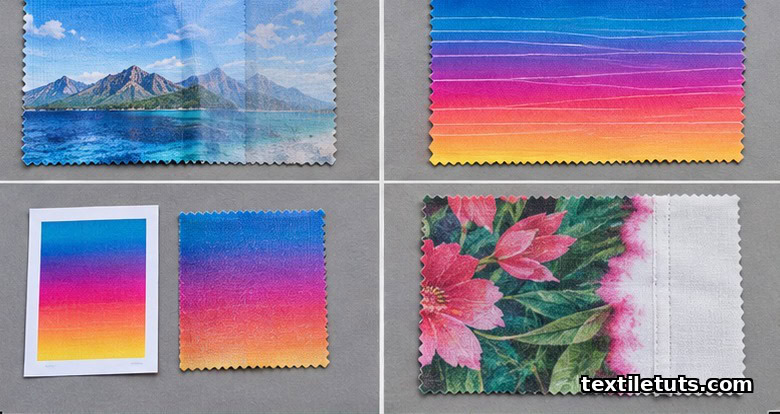
Ghosting, which is a double image where the paper shifted mid-press, is caused by an under-cured adhesive on the press pad or by lifting the paper before it cools. The fix is to increase dwell time by 5 seconds and to verify that the press pad is flat and properly adhered.
Banding, which shows up as horizontal or vertical stripes across the print, is caused by clogged or misaligned print heads in the sublimation printer. Run a head-cleaning cycle and a nozzle check before each production run, and store printer cartridges upright at room temperature.
Color shift between proof and production, where the color on paper looks different from the color on fabric, is partly inevitable because the dye layer on paper is a solid film while the dye in fiber is a dilute solid solution. The fix is to always proof on a fabric swatch using the same paper lot and the same press that production will use, and to build the color shift into the proof-to-production workflow rather than treating it as a defect.
Bleeding at seams, where dye migrates beyond the intended area, is most common on tightly woven polyester where the heat distribution across the press platen is uneven. Reduce press temperature by 5 degrees Celsius and increase time by 5 seconds, which moves total energy into the fabric more gently.
Frequently Asked Questions
What percentage of polyester do I need for sublimation to work?
At least 65 to 70 percent polyester is the practical minimum for a commercially acceptable print. Below 60 percent, the cellulosic fiber carries no dye and the print looks pale and washes out within three to five cycles. A 50/50 poly-cotton will accept sublimation dye, but the visual result is roughly half the color intensity of a 100 percent polyester, and wash fastness drops to 2 to 3 on the AATCC grayscale rather than the 4 to 5 you would see on 100 percent polyester.
Can I sublimate on dark polyester?
Sublimation dye has no inherent opacity. The print is essentially a transparent dye layer inside the fiber, which means on black, navy, or dark brown polyester, the dye color adds to the existing color rather than replacing it. A blue dye sublimated onto a navy substrate will read as a slightly brighter navy. For dark substrates with a strong design, the practical alternative is DTF (direct-to-film) printing with a white underbase, not sublimation.
Why do my sublimation prints look different after washing?
Residual unfixed dye on the fiber surface washes off in the first one or two cycles, which causes an apparent 10 to 20 percent color loss even on a correctly pressed print. After that initial drop-off, the in-fiber dye is stable and subsequent washes show little further change. Pressing 5 degrees Celsius hotter and 10 seconds longer reduces the residual surface dye and minimizes the first-wash shift, which is the usual culprit behind customer complaints.
What is the shelf life of sublimation paper once printed?
A printed sublimation paper stored in a sealed plastic bag at 20 degrees Celsius and 50 percent relative humidity has a shelf life of roughly 6 months before dye migration on the paper itself becomes visible as edge bleed in the print. Higher humidity shortens the shelf life sharply because moisture in the paper promotes dye crystallization. For best results, press sublimation paper within 2 weeks of printing.
Is sublimation printing environmentally better than screen printing?
Sublimation uses aqueous inks with no plasticizer or PVC, generates no screen-cleaning wastewater, and produces no meaningful solid waste beyond the transfer paper, which can be recycled with mixed paper. The main environmental concern is energy use: a heat press at 200 degrees Celsius draws 2 to 3 kW continuously. For long production runs, this energy cost can exceed the environmental savings from the cleaner chemistry. The honest answer is that sublimation is better on water and waste, comparable or worse on energy, depending on run length.
References
- ISO. ISO 105-C10:2010 Textiles, Tests for colour fastness, Part C10: Colour fastness to domestic and commercial laundering. iso.org, defines the wash-fastness test method and grayscale rating.
- ISO. ISO 105-X12:2016 Textiles, Tests for colour fastness, Part X12: Colour fastness to rubbing. iso.org, ISO equivalent of AATCC TM 8, the standard crocking test.
- ISO. ISO 105-B02:2014 Textiles, Tests for colour fastness, Part B02: Colour fastness to artificial light: Xenon arc fading lamp test. iso.org, xenon arc light fastness method.
- AATCC. Test Method 133, Colorfastness to Heat: Hot Pressing. aatcc.org, directly relevant because sublimation is a controlled hot-pressing operation.
- AATCC. Test Method 8, Colorfastness to Crocking: AATCC Crockmeter Method. aatcc.org, measures dye transfer to a white rubbing cloth under defined pressure.
- El-Shishtawy, R. M., Nassar, S. H., Ahmed, N. S. E. Sublimation Printing on Polyester Fabrics: Kinetic and Thermodynamic Study. researchgate.net, peer-reviewed analysis of dye vapor pressure and polyester uptake kinetics.
- Kan, C. W., Yuen, C. W. M. Influence of Sublimation Transfer Printing on Polyester Fabric. mdpi.com, peer-reviewed study of process parameters and color yield on PET substrates.
This article is the working reference for polyester sublimation printing. Editorial by Shahrukh Islam, TextileTuts. Sources: ISO 105-C10, ISO 105-X12, ISO 105-B02, AATCC TM 133, AATCC TM 8, ResearchGate, MDPI as cited.


