
Screen Printing: Flat Bed vs Rotary

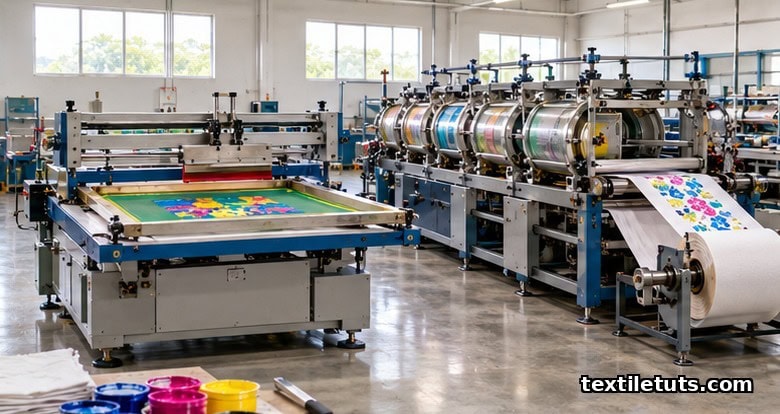
Rotary screen printing runs continuous fabric at 30 to 80 m/min on rolls up to 3.2 m wide, while flat bed screen printing prints piece goods at 12 to 40 cycles/min on pre-cut panels, a speed gap that splits the textile printing industry between the two machines.
The two presses answer different production problems. Most fabric mills run rotary because yardage is continuous. Most apparel print shops run flat bed because each panel or garment is a discrete unit that benefits from quick design changeover. Calling one better than the other misses the point.
This guide covers how each press deposits ink, where the per-meter cost curve flips between them, and how ISO 105 and AATCC TM standards grade colorfastness on both machines when dye selection and curing are correct.
How Flat Bed Screen Printing Works
A flat bed press clamps a rectangular mesh screen, typically polyester monofilament in the 60 to 200 mesh range, over a stationary substrate. A polyurethane squeegee (60 to 80 Shore A) presses ink through the open mesh onto the fabric below, then lifts. The screen raises, the substrate indexes to the next color station, and the next color prints. A full cycle of a 6-color garment press takes 1.5 to 3 seconds, giving 20 to 40 cycles per minute in steady state.
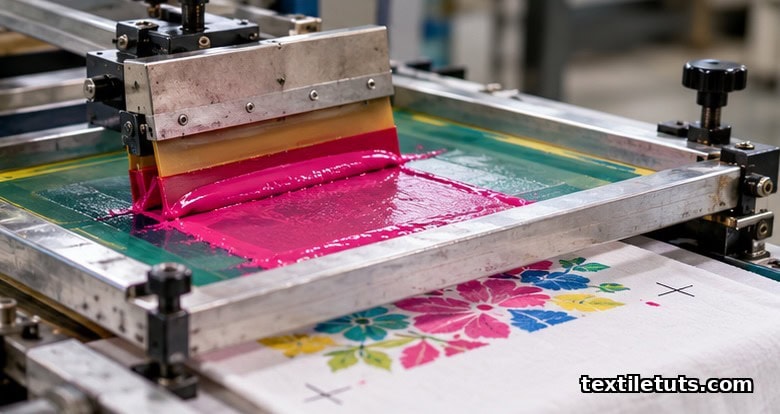
Flat bed presses fall into three families:
- Manual: the operator loads and unloads each piece by hand. Common in sampling studios where runs are under 100 pieces per design and design variety matters more than throughput.
- Semi-automatic: the substrate indexes from a conveyor or pallet loader, but the operator still places each blank. Standard for 100 to 5,000 piece runs in contract shops.
- Automatic: a robotic arm loads pallets, the press cycles at full speed, and a flash-cure station sits between colors for wet-on-wet printing. Used for runs above 1,000 pieces where labor cost dominates.
Because each screen is rectangular and the press is open on three sides, changeover is fast. Operators swap frames in 5 to 15 minutes, register colors using pin systems or laser alignment, and resume printing. This short setup makes flat bed the standard for sample yardage, custom apparel, and short runs where design variety outweighs raw throughput.
How Rotary Screen Printing Works
A rotary press replaces each flat screen with a cylindrical nickel screen, fabricated by electroforming the design as fine perforations in the cylinder wall. A stationary squeegee inside each cylinder presses ink through the perforations as the cylinder rotates against the fabric moving below at constant tension. The fabric travels through the machine in one continuous pass, prints each color in registration, then passes through a dryer (typically 150 to 180 °C hot air, 1 to 3 minutes residence time for pigment prints) before batching on a take-up roll.
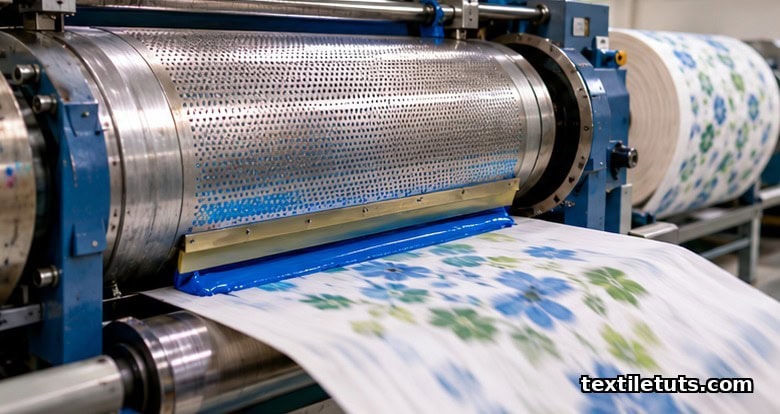
Modern rotary lines reach 80 to 100 m/min on lightweight cotton. The 30 to 80 m/min envelope is the more common production range once fabric construction, design coverage, and dryer capacity are factored in. A common repeat of 640 mm (the historic Stork standard, still dominant) and a design that fits inside it avoids re-engraving and seam loss.
Rotary presses also carry more color stations in line. A 12- or 16-color rotary is standard in fashion-fabric printing; flat bed presses top out around 8 to 12 colors before registration drift becomes visible.
Throughput, Setup, and the Break-Even Point
The economic gap between flat bed and rotary is what makes the choice for you, not the image on the cloth.
| Variable | Flat Bed | Rotary |
|---|---|---|
| Fabric throughput | 5 to 15 m/min | 30 to 80 m/min (up to 100 m/min on lightweight cotton) |
| Garment throughput | 12 to 40 cycles/min | Not used for piece goods |
| Setup time per design | 5 to 15 minutes | 2 to 6 hours (engraving + registration) |
| Setup cost per design | $50 to $200 | $1,500 to $6,000 per screen |
| Best run length (fabric) | Under 1,000 m | Above 5,000 m |
| Best run length (garments) | 50 to 50,000 pieces | n/a |
| Operator count | 1 to 3 | 2 to 5 plus a dryer operator |
| Maximum fabric width | Up to 3 m (carpet presses wider) | Up to 3.2 m standard, 5 m industrial |
The break-even on a rotary line, given engraving cost, dryer energy, and labor, sits around 3,000 to 5,000 m for a single design. Below that, flat bed is cheaper per meter. Above 10,000 m, rotary wins on labor cost per meter by a factor of 3 to 5×. The break-even drops if the design uses 6 or fewer colors and fits the common repeat without re-engraving.
Color Registration and Design Complexity
Flat bed presses register each color independently. The operator dials in horizontal and vertical offset at each station using micro-adjust knobs, usually to within ±0.1 mm. This setup makes fine linework, tight multi-color registration, and photographic detail easier on flat bed, especially on dark grounds where the white underbase needs precise placement.
Rotary presses register by gear pitch. Each cylinder rides on a synchronized gear train that holds registration within ±0.05 mm under steady tension, tighter than flat bed in theory. Any fabric distortion from uneven tension or over-drying shows as misregistration across the repeat, and chasing that on a 50 m/min line costs more downtime than on a flat bed press. Patterns with smooth color blends and large geometric repeats favor rotary; patterns with fine linework or photographic halftones favor flat bed.
For halftone prints, the practical limit on rotary is around 40 to 60 lines/cm before dot gain from the cylindrical screen geometry degrades the image. Flat bed holds 60 to 80 lines/cm more consistently because the screen lays flat against the substrate during the squeegee pass.
Colorfastness: The Standards Stay the Same
Colorfastness is set by dye chemistry, fabric preparation, and curing, not by press geometry. A print that passes ISO 105-X12 on a flat bed press will pass it on rotary when dye, concentration, and curing recipe match. The variables that matter:
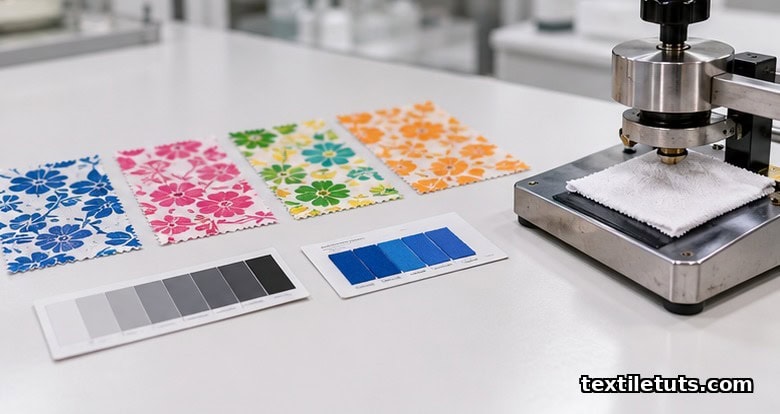
- Reactive prints on cotton: 102 °C steam fixation for 8 to 15 minutes, then wash-off at 95 °C until no unfixed dye bleeds. ISO 105-C06 specifies the wash test for verification.
- Pigment prints: 150 to 160 °C dry cure for 3 to 5 minutes. Cure below 140 °C reliably fails the ISO 105-X12 crocking test on dark grounds.
- Disperse prints on polyester: 180 to 200 °C thermofixation for 60 to 90 seconds. ISO 105-X12 dry-rub values typically grade 4 to 5 when cure is complete.
AATCC TM 8 (crocking) and AATCC TM 16.3 (lightfastness, xenon arc) are the parallel US test methods used in mills selling into North American brand programs. Either press produces grade 4 to 5 colorfastness when process control is tight. Curing inconsistency, not press type, is the most common cause of field failures.
Cost of Capital and Floor Space
A new 8-color rotary line with dryer and steamer runs $1.5 to $3.5 million installed, occupies 35 to 60 m of floor length, and draws 100 to 250 kW for the dryer alone. A 6-color automatic flat bed press with pallet loader runs $80,000 to $250,000 and fits in 8 to 12 m of floor space on a standard 200 A service.
This capital gap is why most small print shops never buy rotary. A half-million-dollar dryer alone won’t pay back on runs under 200,000 m per year, and the minimum economic run length for rotary exceeds most custom printers’ customer base. Conversely, a yardage mill printing 5 to 10 million m per year cannot meet volume with flat bed because labor cost per meter is too high. The press choice follows the order book.
Which One Should You Use, or Buy?
For a contract printer doing custom apparel, sample yardage, and short runs under 1,000 m of fabric or 5,000 pieces, flat bed is the correct choice. Setup cost is low, changeover is fast, and capital recovery is shorter. For a vertical mill printing its own fabric lines in long runs, rotary is the correct choice. Setup cost is amortized over the run and throughput is 3 to 5× higher per labor hour.
Hybrid shops run both: rotary for the bulk production of core designs, flat bed for the long tail of customer-specific designs, samples, and one-offs. Most large apparel brands operate this way, with the rotary line at the mill and flat bed presses at the design studio for sampling. The two machines complement each other when work is sorted correctly.
Frequently Asked Questions
Is rotary screen printing higher quality than flat bed?
Not inherently. Rotary presses hold tighter mechanical registration (±0.05 mm) and lay a more uniform ink film because the cylindrical screen spins at constant speed against the substrate. Flat bed presses lay down slightly heavier ink and hold fine linework above 60 lines/cm more reliably. For most apparel and home-textile end uses, the two are visually indistinguishable when process control is tight.
What is the typical fabric width on a rotary screen press?
Standard rotary printing machines run fabric up to 3.2 m wide, with 1.6 m, 1.8 m, and 2.4 m the most common widths in cotton and polyester mills. Industrial carpet and technical-textile rotaries go to 5 m or wider, using heavier-gauge cylinders and modified dryer sections.
How does mesh count change ink deposit on each press?
Mesh count and ink deposit follow the same physics on both presses. A 60 to 80 mesh screen deposits 30 to 50 g/m² of print paste and suits bold graphics. A 120 to 150 mesh screen deposits 12 to 25 g/m² and suits fine linework. A 200+ mesh screen deposits under 10 g/m² and is reserved for detailed halftones. The press type changes contact geometry, not the calibration curve.
What is the minimum run length for rotary to make sense?
Below 3,000 m of a single design, flat bed is usually cheaper per meter because rotary engraving and registration setup (typically 2 to 6 hours) dominate the run. Above 5,000 m, rotary is cheaper per meter. Between 3,000 and 5,000 m, the answer depends on color count and on whether the design fits the common 640 mm repeat without extra engraving.
Does screen printing still compete with digital ink-jet printing?
Yes, on cost per meter above roughly 200 m. Digital pigment and reactive ink-jet has closed the speed gap for short runs and the resolution gap entirely, but ink cost per square meter is still 3 to 8× higher than screen printing paste. Screen printing remains the lowest-cost-per-meter option above 500 m for most apparel fabric.
References
- ISO. (2016). ISO 105-X12:2016 Textiles, Tests for color fastness, Part X12: Color fastness to rubbing. International Organization for Standardization. https://www.iso.org/standard/65241.html. Crockmeter method for dry and wet rubbing fastness on both rotary and flat bed prints.
- ISO. (2010). ISO 105-C06:2010 Textiles, Tests for color fastness, Part C06: Color fastness to domestic and commercial laundering. https://www.iso.org/standard/51021.html. 40 °C wash cycle with steel balls for grading wash fastness of reactive and pigment prints.
- AATCC. (2016). AATCC Test Method 8-2016 Colorfastness to Crocking: AATCC Crockmeter Method. https://www.aatcc.org/testing/test-methods/. US-side rubbing fastness test, parallel to ISO 105-X12.
- AATCC. (2014). AATCC Test Method 16.3-2014 Colorfastness to Light: Xenon-Arc. https://www.aatcc.org/testing/test-methods/. Xenon arc protocol for verifying lightfastness on printed textiles.
- ASTM. (2015). ASTM D629-15 Standard Test Methods for Quantitative Analysis of Textiles. https://www.astm.org/d0629-15.html. Fiber blend quantification used to confirm substrate composition before printing.
- Ujiie, H. (Ed.). (2006). Digital Printing of Textiles. Woodhead Publishing (now Elsevier). https://www.sciencedirect.com/book/9781845691585. Reference textbook on flat bed and rotary screen parameters, ink rheology, and run-length economics.
- Kan, C. W., & Yuen, C. W. M. (2012). Digital printing of textiles. Textile Progress (Taylor & Francis). https://www.tandfonline.com/toc/ttpr20/44/1. Peer-reviewed review of rotary, flat bed, and digital printing economics.
This article is the working reference for choosing between flat bed and rotary screen printing. Editorial by Shahrukh Islam, TextileTuts. Sources: ISO 105-X12, ISO 105-C06, AATCC TM 8, AATCC TM 16.3, ASTM D629, and peer-reviewed textile printing literature as cited.


