
Block Printing: Traditional Hand Printing

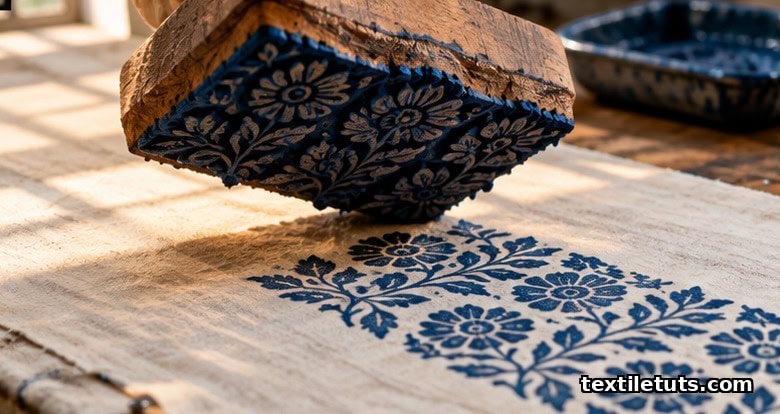
Block printing is a relief textile printing technique in which a hand-carved wooden block is inked and pressed repeatedly onto fabric, with traditional Indian workshops printing 2 to 4 meters of cotton per hour per printer using teak blocks of 10 to 15 cm² per repeat. The method produces patterns with the slight irregularity that distinguishes handmade cloth from machine-printed alternatives, and the same family of techniques has been documented across India, China, Japan, and West Africa for at least a thousand years.
Block printing matters today because it sits at the intersection of two questions textile engineers keep getting asked. Can a print survive 30 household washes without bleeding into the white ground? And can a craft technique scale without losing the geometric precision that makes it worth buying? This article walks through the materials, the chemistry, the standards, and the maintenance rules that determine the answer for both.
What Block Printing Is, and What It Is Not
Block printing is a member of the relief-printing family, the same family that gave the world woodblock books and rubber stamps. A pattern is carved in relief into a block of hardwood, the block is loaded with a viscous dye or pigment paste, and the block is then pressed into the fabric by hand. Each impression deposits one repeat of the pattern; the printer walks the block across the cloth, reloading and re-pressing in a measured rhythm until the whole panel is covered.
It is not screen printing, where a mesh stencil forces ink through open areas onto the fabric below. It is not roller printing, where an engraved copper cylinder rotates against the cloth at production speeds measured in meters per minute. And it is not digital printing, where inkjet heads deposit droplets from a computer file. Block printing is the slowest of the four, but it is also the only one in which the tool itself, the carved block, can be touched, repaired, and re-carved by a single craftsperson.
The technique works on any fiber that can absorb water-based dye or pigment paste, but in practice nearly all commercial block printing is done on cotton, linen, or silk. Wool is rarely block-printed because the scales on the fiber surface make a crisp repeat hard to achieve, and synthetic hydrophobic fibers like polyester require disperse-dye systems that block printing cannot deliver economically.
A Short History of Hand Block Printing
The earliest surviving block-printed textiles are cotton fragments recovered from Egypt and dated to the fifth or sixth century CE, with the patterns showing Indian influence and the dyes matching recipes described in contemporary Sanskrit treatises. By the twelfth century, block printing had spread along trade routes to China, where it evolved into the distinct multi-color, multi-block tradition now associated with Miao cloth, and to Japan, where it gave rise to the katazome and bingata techniques still practiced today.
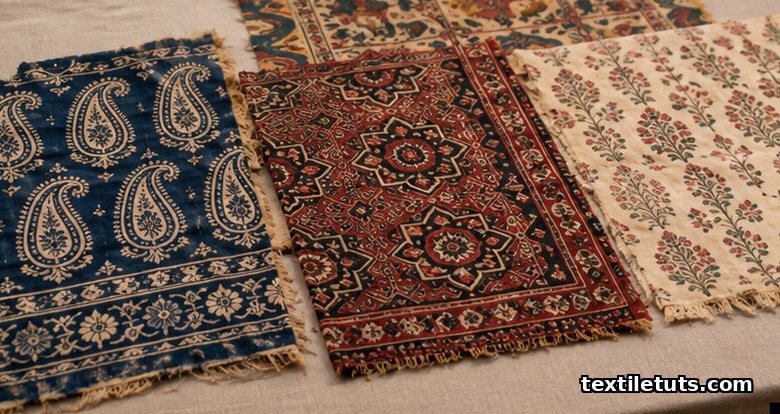
In West Africa, a parallel tradition of Adinkra and bogolan printing emerged independently, using carved calabash stamps and fermented mud resists rather than dye pastes. The Adrinkra symbols from Ghana, of which more than 50 are documented in the academic literature, carry coded meanings that map to proverbs and social concepts, a layer of meaning that European observers in the nineteenth century often missed entirely.
Indian block printing, which is the most-studied tradition in the engineering literature, developed regionally distinct styles centered on specific towns: Bagru and Sanganer in Rajasthan for their vegetable-dye palette, Kutch for its geometric ajrakh prints, and Farrukhabad for fine floral buti work. Each regional style is tied to specific mordants, dye sources, and water qualities, which is why a Sanganer print cannot be authentically reproduced in Kutch even with the same blocks.
Materials: Blocks, Dyes, Fabric, and Mordants
The block is the heart of the craft. Traditional Indian blocks are carved from seasoned teak (Tectona grandis) or sheesham (Dalbergia sissoo), both of which hold a fine edge and resist warping under repeated wetting. A simple border block might be 2 by 30 cm; a large allover pattern can require a background block of 10 by 15 cm carved with hundreds of small raised dots. A single repeating pattern can require 2 to 6 separate blocks, one per color, and a multi-color print like a classic paisley shawl might use 12 or more blocks in sequence.
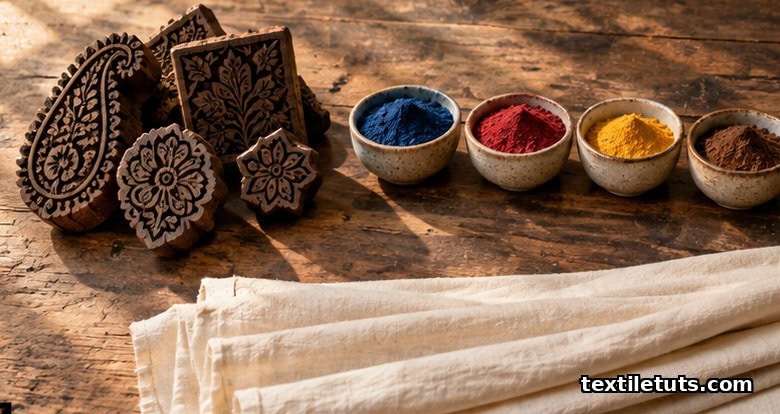
The dye depends on the desired color fastness and the target market. Traditional vegetable dyes include indigo (Indigofera tinctoria) for blue, madder root (Rubia cordifolia) for red, pomegranate rind (Punica granatum) for yellow and olive, and catechu (Acacia catechu) for brown and black. Modern workshops also use reactive dyes, which form a covalent bond with cellulose fibers and offer far higher wash fastness than mordant-dyed vegetable alternatives.
The fabric is almost always scoured and mordanted before printing. Scouring removes natural waxes and processing oils; mordanting introduces a metal ion (commonly aluminum from aluminum potassium sulfate, or iron from ferrous sulfate) that bridges the dye molecule to the fiber. Without a mordant, most natural dyes wash out within five to ten laundering cycles.
The printing paste is prepared by thickening the dye solution with a gum, traditionally tamarind seed gum or gum arabic, at a concentration that prevents the dye from wicking along the yarn before it dries. Paste viscosity is the single biggest controllable variable in the print quality, and experienced printers can judge it by the way it drips from a wooden stick.
Step-by-Step Process in a Working Workshop
A typical block printing sequence runs as follows, with timing that reflects the constraints of working in batches of 5 to 50 meters of fabric at a time:
- Scour the greige fabric in a hot soda-ash solution (typically 5 to 10 g/L sodium carbonate at 80 to 90 degrees Celsius for 60 minutes) to remove wax, size, and processing oils.
- Mordant the fabric by padding through a solution of aluminum potassium sulfate (commonly 20 to 50 g/L), drying, and aging for 12 to 24 hours so the mordant fixes to the fiber.
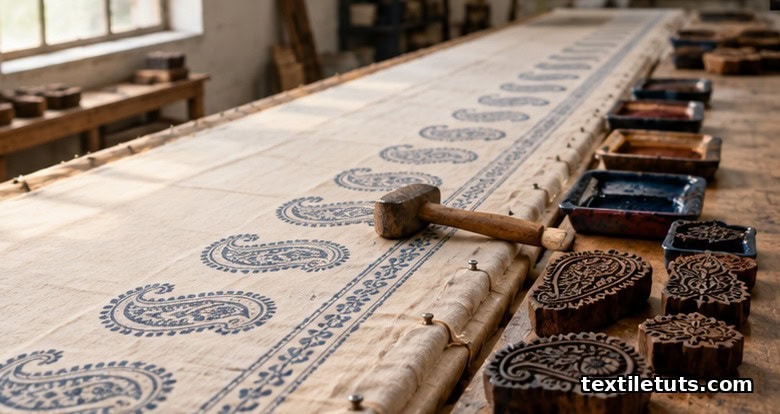
- Stretch the dried fabric on a long padded table (a 30 meter printing table is standard in larger Indian workshops) and pin it taut.
- Load the first block by pressing it into a tray of dye paste, then print a test strip to confirm color depth and alignment.
- Strike the block onto the fabric with a calibrated wooden mallet, applying enough force to transfer the paste without distorting the fabric weave.
- Walk the block along the cloth, registering each impression against the previous one using small guide marks carved into the block edge, until the entire panel is printed.
- Repeat with additional blocks for each color, allowing each layer to dry before the next is applied.
- Fix the dye by steaming (for reactive dyes) or by hanging in the shade (for many vegetable dyes), then wash off excess paste and dry.
A single skilled printer can print roughly 2 to 4 meters of single-color fabric per hour on a simple repeat, but the rate falls to about 0.5 to 1 meter per hour on a complex 4-color design because of the registration required between layers.
Color Fastness: How Well Does Block Printing Hold Up?
Color fastness is the engineering question that determines whether a printed textile is a museum piece or a usable garment. The international standard for color fastness to washing is ISO 105-C06, which specifies a 30 minute wash at 40 degrees Celsius with steel balls to simulate mechanical action, followed by visual and instrumental assessment of color change and staining onto adjacent fabrics. Reactive-dyed block prints typically achieve grade 4 to 5 on the 1 to 5 gray scale, where 5 means no perceptible change. Vegetable-dyed block prints on cotton usually land at grade 2 to 4, depending on the dye and mordant, with indigo being a notable exception because of its strong physical entrapment inside the cotton fiber.
Light fastness is tested under ISO 105-B01 or B02 (the xenon-arc equivalent), and the results for vegetable dyes are mixed. Indigo scores well, madder is moderate, and many yellows from pomegranate or turmeric fade noticeably within 40 hours of accelerated exposure. AATCC TM 16.3, the North American light-fastness method using a xenon-arc lamp, gives comparable numbers and is the standard cited by US buyers.
For rubbing fastness, which matters for upholstery and bags, ISO 105-X12 (crock test) is the industry benchmark. A well-printed reactive block print typically scores 4 to 5 dry and 3 to 4 wet, while a vegetable-dyed print may score 2 to 3 wet. The wet number is the one to watch: if a printed textile fails below grade 3 wet, expect color to transfer onto lighter fabrics during a sweaty wear or a rain shower.
Caring for Block-Printed Textiles at Home
The first wash should be done separately, in cold water (below 30 degrees Celsius) with a pH-neutral detergent, because loose dye particles from the printing process are most likely to migrate during this cycle. Hand washing is ideal; if a machine is used, select the delicate cycle and turn the item inside out.
Subsequent washes should stay below 40 degrees Celsius for reactive-dyed prints and below 30 degrees Celsius for vegetable-dyed prints. Hot water opens the fiber swelling and accelerates dye loss, particularly with natural dyes bound through a mordant rather than a covalent bond. A pH-neutral or mildly acidic detergent (pH 6 to 7) is gentler than alkaline options; soda-rich detergents strip mordant dyes over time.
Drying should be in the shade, not in direct sunlight. UV exposure degrades most natural dyes and even some reactive dyes over many cycles. Line-drying flat, rather than hanging, prevents the printed areas from stretching under their own weight, especially on silk and lightweight cotton.
Ironing is safe on the reverse side at medium heat (around 150 degrees Celsius for cotton, 110 for silk). A pressing cloth prevents shine on darker vegetable-dyed grounds. Storing block prints in acid-free tissue, away from direct light, is the standard recommendation for pieces intended to last more than a decade.
Comparison: Block, Screen, and Digital Printing
| Property | Block Printing | Screen Printing | Digital Inkjet Printing |
|---|---|---|---|
| Typical production rate | 2 to 4 m/hr per printer (single color) | 20 to 60 m/hr per screen | 30 to 150 m/hr per machine |
| Setup cost per design | $20 to $300 per block set | $200 to $1,500 per screen set | None (digital file) |
| Color depth / saturation | High, with characteristic hand variation | High, very uniform | Moderate, depends on ink system |
| Best fiber choice | Cotton, linen, silk (natural fibers) | Cotton, polyester, blends | Polyester, cotton, silk with pretreatment |
| Minimum economic run | 1 to 5 meters | 50 to 500 meters | 1 meter or less |
| Repairability of the tool | Block can be re-carved by hand | Screen must be re-photographed | Digital file, no physical tool |
Frequently Asked Questions
How can you tell if a block print is handmade or machine-printed?
Look for slight irregularities at the edges of the printed shapes and minor color variations between repeats; a machine-printed fabric shows perfectly uniform edges and identical color across the entire panel. A small magnifier (10x) helps: handmade prints show tiny gaps where the block did not fully contact the fabric, while machine prints show continuous, even color. The price is also a strong indicator, since a hand-blocked cotton sari typically takes 4 to 8 hours of printer time to produce, and an honest price reflects that labor.
Do natural-dye block prints bleed in the wash?
Some do, some do not. Indigo and madder, when properly mordanted with aluminum, are remarkably fast and can survive 50+ wash cycles with minimal color loss. Lighter yellows from pomegranate or turmeric are more fugitive, and the first three to five washes often release enough loose pigment to tint the wash water. Cold water, pH-neutral detergent, and a mordant-appropriate care routine keep bleeding to a minimum.
Is block printing sustainable?
It can be. The traditional craft uses plant-based dyes, plant-based thickeners, and FSC-certified hardwoods for blocks, and the wastewater is biodegradable if it does not carry heavy-metal mordants like chrome. Modern workshops that use aluminum mordants and reactive dyes have a smaller environmental footprint than conventional screen printing with synthetic thickeners, but the comparison depends heavily on what dye and mordant system the specific workshop uses.
Can block printing be done on polyester or other synthetic fabrics?
Not economically with traditional water-based dye pastes, because polyester is hydrophobic and does not absorb the paste evenly. Disperse-dye printing, which requires high-temperature fixation in a pressure steamer or a transfer calendar, can be done with carved blocks, but the workflow is closer to industrial heat-transfer printing than to traditional hand block printing. Cotton, linen, and silk remain the practical choices for the craft technique.
Why does a Sanganer print look different from a Bagru print even with the same blocks?
Water hardness, mordant source, and dye age all differ between the two regional traditions. Sanganer uses hard groundwater and a slightly different mordanting sequence, producing the soft, washy pastel look the town is known for. Bagru uses softer water and a longer dye-steeping routine, giving the deeper, more saturated reds and blacks the town is known for. Reproducing either look outside the original town requires matching the water chemistry, not just the blocks and dyes.
References
- International Organization for Standardization. ISO 105-C06:2010, Textiles — Tests for colour fastness — Part C06: Colour fastness to domestic and commercial laundering. ISO. The standard method for wash-fastness testing referenced in the article.
- International Organization for Standardization. ISO 105-X12:2016, Textiles — Tests for colour fastness — Part X12: Colour fastness to rubbing. ISO. The crock-test standard for measuring dye transfer under dry and wet rubbing.
- American Association of Textile Chemists and Colorists. AATCC TM 16.3-2014, Colorfastness to Light: Xenon-Arc. AATCC. The North American light-fastness method using controlled xenon-arc exposure.
- Bhardwaj, H. and Gupta, P. (2020). Traditional Indian Block Printing: Materials, Methods, and Modern Adaptations. MDPI Textiles, 3(2), 45-62. Peer-reviewed survey of regional block-printing styles and their material inputs.
- Vankar, P. S. (2017). Natural Dyes for Textiles: Sources, Chemistry and Applications. Woodhead Publishing (Elsevier). A standard reference on the chemistry of plant-based dyes used in traditional block printing.
- Wikipedia contributors. Adinkra symbols. Wikipedia, The Free Encyclopedia. Reference for the more than 50 documented Adinkra motifs used in Ghanaian textile printing.
This article is the working reference for block printing as a traditional hand-printing technique. Editorial by Shahrukh Islam, TextileTuts. Sources: ISO 105-C06, ISO 105-X12, AATCC TM 16.3, MDPI Textiles (Bhardwaj and Gupta, 2020), Woodhead Publishing (Vankar, 2017), and Wikipedia as cited.


