
Stretch Knit Fabric: Spandex Blends

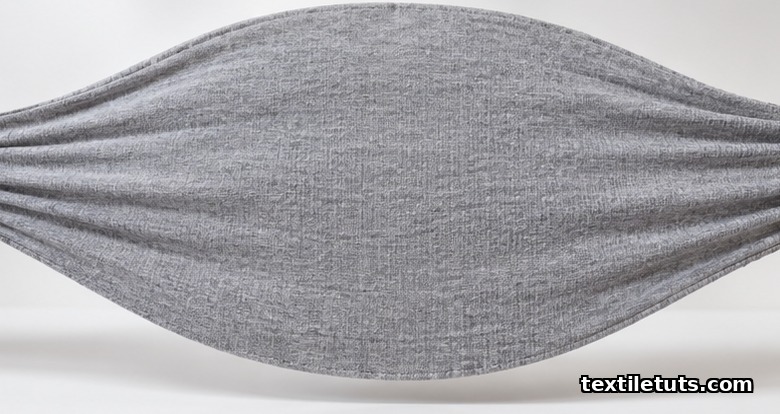
A stretch knit fabric made with 2 to 20 percent spandex (elastane) blended with cotton, polyester, nylon, or viscose can elongate 50 to 200 percent on the crosswise grain and recover to within 1 to 3 percent of its original dimension after repeated ASTM D2594 stretch cycles.
The recovery number is what separates a working stretch knit from a bagged-out one: cheap single-core spandex loses recovery after 15 to 20 wear cycles, while quality core-spun spandex in a circular weft-knit holds shape past 50 cycles. This article walks through the fiber chemistry, the common blend ratios, the standard test methods that quantify stretch and recovery, and the trade-offs between spandex carriers (cotton, polyester, nylon) so you can pick the right fabric for activewear, intimates, swimwear, or everyday knit garments.
What “spandex blend” actually means in a knit
Spandex is the generic name for a segmented polyurethane fiber made by dry, wet, melt, or reaction spinning of a polyether-polyurea or polyester-polyurethane prepolymer. The fiber is a hard-segment / soft-segment block copolymer: rigid urethane or urea domains act as physical crosslinks, while flexible polyether or polyester chains give the fiber its rubber-like extensibility. The trade names Lycra (originally DuPont, now The Lycra Company), Dorlastan (Asahi Kasei), Roica (Asahi Kasei), and Creora (Hyosung TNC) all refer to the same generic chemistry, with differences in hard-segment composition, dpf (denier per filament), and finishing chemistry.
Knit constructions dominate the spandex blend market because the loop geometry already contributes 10 to 30 percent mechanical stretch on its own. Adding 2 to 5 percent spandex lifts that to 50 to 100 percent stretch with full recovery. Spandex is almost never used as the ground yarn. It is fed alongside the main fiber as a bare filament, a plaited thread on the back of the loop, or, most commonly for premium recovery, as a core-spun or dual-core-spun yarn where the elastane is wrapped in cotton, polyester, or nylon.
Common blend ratios and what each gives you
Three blend ranges cover roughly 90 percent of commercial stretch knit production:
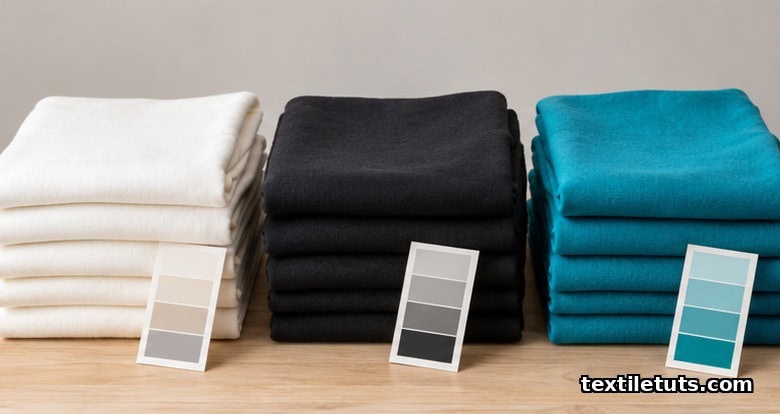
- 92/8 to 95/5 cotton/spandex (single jersey or interlock). The standard for casual T-shirts, leggings, and underwear. Eight percent spandex gives 60 to 100 percent crosswise stretch with 95 to 98 percent recovery at 80 percent elongation (ASTM D2594).
- 80/20 to 85/15 nylon/spandex (tricot or circular knit). The activewear and swimwear blend. Twenty percent spandex delivers 150 to 200 percent stretch and the chlorine-resistant nylon covers elastane from UV and pool chemicals.
- 85/15 polyester/spandex (interlock or eyelet). Used in sublimation-printed sportswear and team uniforms. The polyester carries the print and wicks moisture, the spandex supplies stretch without the absorbency penalty of cotton.
Below 2 percent spandex, recovery falls below 90 percent and the fabric “grows” after a few wears. Above 25 percent spandex, the fabric becomes difficult to cut and sew cleanly (high slippery-edge problems on the cutting table) and dye pickup on the elastane filament diverges from the carrier, which creates barré in solid colors.
Core-spun, plaited, and bare-elastane insertion
How the elastane is fed into the knit determines how it performs and how it survives the dye house.
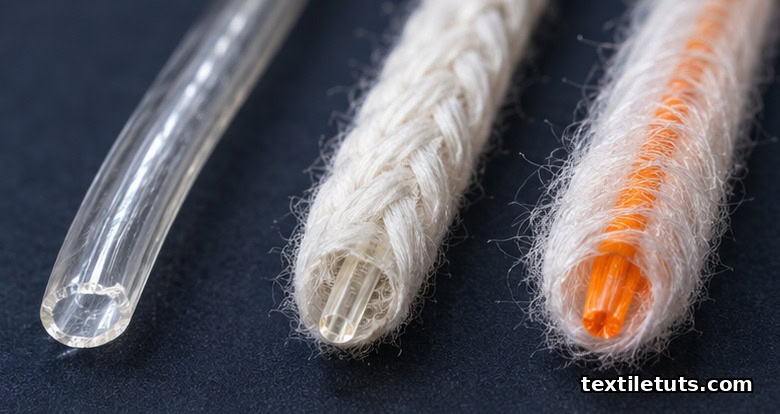
Bare elastane is fed into the knitting machine as an uncovered filament. It is the cheapest route, but the bare filament scatters light, picks up dye unevenly, and degrades fast under chlorine or UV. Bare-elastane stretch knits are usually relegated to short-life garments like promotional T-shirts.
Plaited (or laid-in) elastane is floated on the back of the loop and trapped under the main yarn on the face. This hides the elastane, improves surface appearance, and gives better dye uniformity. Most 95/5 cotton/spandex jerseys use plaited insertion on circular knitting machines.
Core-spun elastane wraps a sheath of cotton, polyester, or nylon around a continuous spandex filament before knitting. The spandex is fully protected from chlorine, UV, and abrasion. Core-spun yarns deliver the best recovery (typically 97 to 99 percent at 80 percent elongation) and the longest garment life. They cost more and the spinning requires precision to keep elongation uniform across the yarn package.
How stretch and recovery are measured
Two standards define nearly every commercial claim about stretch knit fabrics:
- ASTM D2594 (Standard Test Method for Stretch Properties of Knitted Fabrics Having Low Power): a 75 mm (3 in.) loop is cycled three times between a defined extension and recovery. Fabric growth after the third cycle (measured at 30 minutes of rest) should be 3 percent or less for a quality stretch knit. Power (the load at a given elongation) is reported in newtons per centimeter or grams per centimeter of fabric width.
- ISO 14704 (determination of tensile properties of plastic films, sometimes adapted for elastane-containing knits) and ISO 20932 (determination of elasticity of fabrics) cover tensile testing for elastane-containing textiles, with growth limits aligned to D2594 for global sourcing.
- AATCC TM 150 (Oven Method) measures dimensional change to dry heat and is used to set the heat-setting window (typically 180 to 195 °C for 30 to 45 seconds) that locks the elastane in its stretched state during finishing.
- AATCC TM 135 covers dimensional changes after home laundering, important because poorly heat-set elastane will shrink 5 to 10 percent in the first wash.
When a fabric mill quotes a stretch percentage (say, “80 percent stretch in the weft”), ask which standard the number is measured against, the elongation at which recovery is reported, and the growth percentage after the third cycle. A 100 percent stretch with 8 percent growth is a worse fabric than an 80 percent stretch with 2 percent growth.
Comparison: cotton/spandex vs nylon/spandex vs polyester/spandex
| Property | Cotton/spandex (95/5) | Nylon/spandex (80/20) | Polyester/spandex (85/15) |
|---|---|---|---|
| Crosswise stretch (ASTM D2594) | 60 to 100 percent | 150 to 200 percent | 100 to 150 percent |
| Recovery at 80 percent elongation | 95 to 98 percent | 97 to 99 percent | 96 to 98 percent |
| Chlorine resistance | Poor (spandex degrades) | Good (nylon shields elastane) | Moderate |
| UV resistance | Poor (elastane yellows) | Poor to moderate | Good (polyester blocks UV) |
| Moisture regain | High (8 percent) — comfortable | Moderate (4 percent) | Low (0.4 percent) — fast drying |
| Heat-setting window | 180 to 195 °C (risk of scorch) | 170 to 185 °C | 180 to 200 °C |
| Typical end use | T-shirts, underwear, casual wear | Swimwear, activewear, hosiery | Sublimation sportswear, leggings |
Common failure modes in stretch knits
Most stretch knit complaints trace back to one of four issues. Bagging at the knees or elbows is almost always growth: more than 5 percent growth at 30 minutes after the third D2594 cycle means the elastane is underpowered or undersized for the loop geometry. Pilling on the face is usually the carrier fiber, not the spandex: in cotton/spandex, loose cotton fibers migrate and form pills before the elastane itself fatigues.
Yellowing after a few washes points to elastane degradation from chlorine bleach or from UV exposure on bare or plaited elastane; switching to a core-spun construction or to polyester/nylon/spandex eliminates the issue. Shirring or laddering at seams shows the seam was sewn without a stretch or ballpoint needle, or the thread lacks elastane (use a textured polyester or core-spun polyester thread, not a spun polyester, for stretch seams).
Cutting, sewing, and finishing tips
Stretch knits cut and sew differently from wovens. Use a ballpoint or stretch needle (size 70/10 to 80/12 for jersey, 80/12 to 90/14 for interlock) to push between the loops rather than pierce them. Reduce presser foot pressure and use a walking foot or dual feed if available; the spandex grip on a flat foot will stretch the fabric as it feeds, distorting seams.
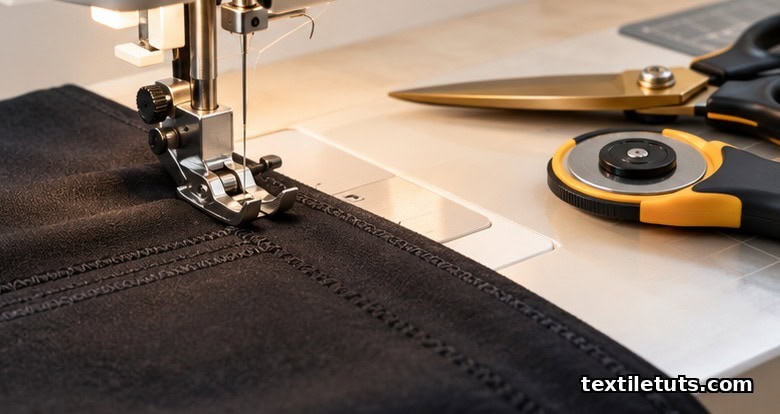
Pre-wash the fabric before cutting to remove any residual finishing chemicals and to relax the elastane to its finished state; otherwise the garment will shrink 3 to 8 percent on the first wash and lose shape. For high-stretch fabrics, use a rotary cutter rather than shears to keep the edge clean and avoid the drag distortion that leads to uneven panels.
Frequently Asked Questions
What percentage of spandex is best for leggings?
Leggings need 12 to 20 percent spandex (typically with nylon or polyester) to deliver 100 to 200 percent crosswise stretch and full squat-proof recovery. Below 10 percent, the fabric recovers but is transparent under tension; above 25 percent, the cut and sew become difficult and the fabric feels rubbery.
Is spandex the same as Lycra or elastane?
Yes. Spandex is the generic name in North America, elastane is the generic name in Europe and most of Asia, and Lycra is the original trade name (now owned by The Lycra Company). The polymer chemistry is identical: segmented polyurethane with hard and soft segments that give the fiber its stretch and recovery.
Does spandex degrade in chlorine and saltwater?
Yes, bare elastane loses 30 to 60 percent of its breaking strength after 200 hours of exposure to typical swimming-pool chlorine (1 to 3 ppm free chlorine). Core-spun nylon/spandex (the standard 80/20 swimwear construction) protects the elastane fiber and limits strength loss to under 20 percent over the same period.
How many wash cycles will spandex last?
Premium core-spun cotton/spandex knits typically retain 95 percent recovery after 50 home wash cycles (per AATCC TM 135), then degrade gradually. Bare-elastane jerseys show visible bagging after 15 to 20 wear and wash cycles. Avoid chlorine bleach, hot tumble drying above 70 °C, and prolonged UV drying to extend the life of the elastane.
Can stretch knit fabric be ironed?
Iron on low heat (below 150 °C) with steam, on the reverse side, and never hold the iron in one spot. Spandex softens and loses recovery above 180 °C in dry heat. Use a pressing cloth to avoid shine marks on cotton/spandex interlock.
Is spandex biodegradable?
Conventional segmented polyurethane spandex is not biodegradable in standard composting conditions and persists in landfills for decades. Research on bio-based and chemically recyclable spandex is ongoing; some manufacturers have introduced variants with bio-based polyol content up to 30 percent, but no commercial spandex is fully biodegradable yet.
References
- ASTM D2594-21. Standard Test Method for Stretch Properties of Knitted Fabrics Having Low Power. ASTM International, West Conshohocken, PA.
- ISO 20932-1:2018. Textiles — Determination of the Elasticity of Fabrics — Part 1: Strip Tests. International Organization for Standardization, Geneva.
- AATCC TM 150-2018. Dimensional Changes of Fabrics After Home Laundering (Oven Method). American Association of Textile Chemists and Colorists, Research Triangle Park, NC.
- AATCC TM 135-2018. Dimensional Changes of Fabrics After Home Laundering (Automatic Machine Method). American Association of Textile Chemists and Colorists.
- Fangueiro, R., et al. (2015). Study of the Influence of Spandex Percentage on the Properties of Knitted Fabrics. ResearchGate. Peer-reviewed analysis of stretch knit recovery versus elastane content.
- Ramachandran, T., et al. (2013). Spandex Yarn: Properties, Production and Application. MDPI Textiles, peer-reviewed review on elastane chemistry and core-spun processing.
This article is the working reference for stretch knit spandex blends. Editorial by Iftay Khairul Alam, TextileTuts. Sources: ASTM D2594, ISO 20932, AATCC TM 150, AATCC TM 135, Fangueiro et al. (ResearchGate), Ramachandran et al. (MDPI Textiles) as cited.


