
Stitch-Bonded Nonwoven

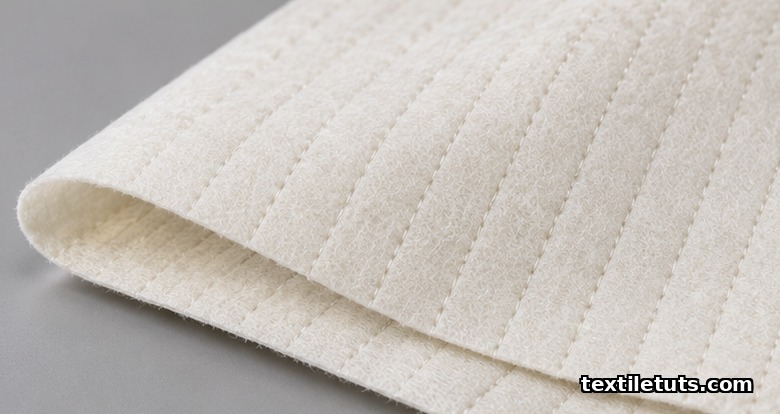
Stitch-bonded nonwoven fabrics are engineered by stitching a fibrous web or cross-laid carded batt with warp-knit loops on stitch-bonding machines of the Maliwatt, Malimo, and Malivlies families, producing areal densities from 60 to 400 g/m² and tensile strengths of 150 to 1,200 N/5 cm along the stitch direction. The mechanical locking supplied by the through-web stitch rows replaces the binder fiber or latex step used in thermal- or chemical-bonded nonwovens, so the resulting fabric combines nonwoven economics with woven-like dimensional stability and a grammage-to-strength ratio that sits roughly 1.6 times higher than needle-punched equivalents at the same mass.
In this article you will learn how the stitch-bonding process consolidates a fiber batt, which fiber blends the technology runs on commercially, what physical and mechanical properties a stitch-bonded nonwoven delivers in current production, and how those properties map onto geotextile, roofing, automotive, and bedding end uses under the ISO and ASTM standards that govern the category.
What Is Stitch-Bonded Nonwoven?
Stitch-bonded nonwoven is a textile structure defined in ISO 14621:2019, “Textiles – Nonwovens – Vocabulary,” as a nonwoven in which a web or batt of fibers, filaments, or yarns is consolidated by stitching, knitting, or crocheting threads through the web. The classification sits inside the broader EDANA nomenclature of mechanically bonded nonwovens alongside needle-punched, hydroentangled, and stitch-bonded webs, but it is set apart by the use of a separate stitching thread, usually polyester or polyamide filament, that physically binds the batt rather than entangling the fibers in place.
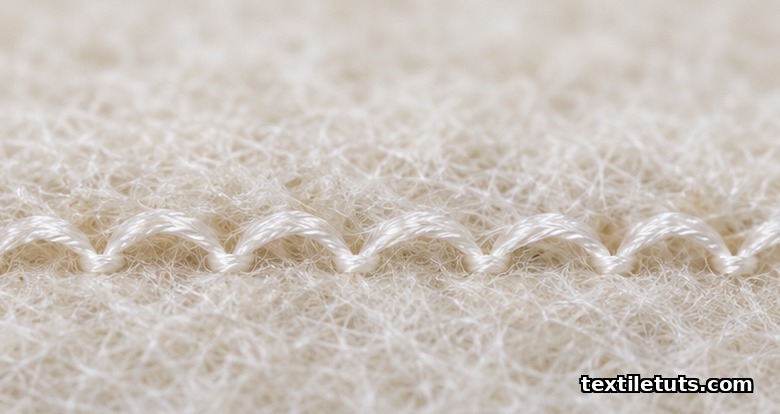
The fabric is recognized in the trade under three Karl Mayer technology names that still dominate global output: Maliwatt (stitches through a parallel-laid web with a stitching thread and no pile), Malivlies (stitches through a parallel-laid web without binding threads, leaving a fluffy face), and Malimo (stitches a warp yarn layer plus a parallel weft yarn layer, producing a wovens-like grid pattern). These names became generic descriptors across the industry once the original patents lapsed in the 1990s, and the EDANA market report for nonwovens now tracks stitch-bonded volumes under the structural sub-category “stitch-bonded fabric,” not under any brand label.
The Stitch-Bonding Process Step by Step
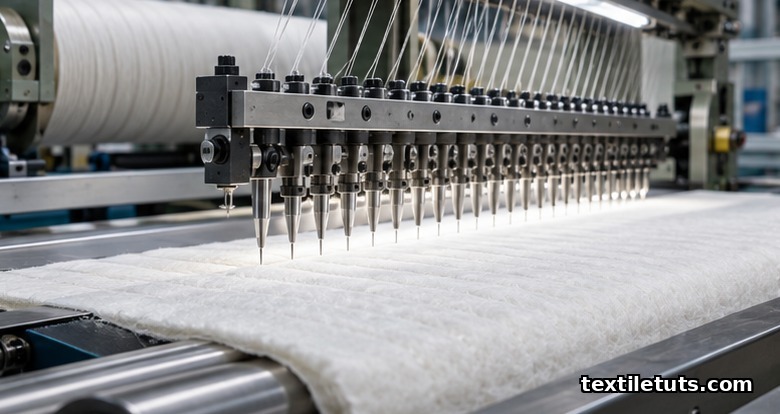
Stitch-bonding lines run on modified warp-knitting machines with a horizontal fiber feeding zone, a fall plate or sinker bar system, and a needle bar fitted with compound needles that pierce the batt at courses of 8 to 25 per cm. Three process stages produce the final structure.
- Web preparation. A carded web is cross-laid to a target areal density of 30 to 300 g/m², or a spunbond filament web is unwound directly onto the conveyor, with the choice driven by the end-use tensile target. For Malivlies and Malimo, a second yarn layer can be inserted before the stitching bar to bias the mechanical behavior.
- Stitch insertion. Compound needles penetrate the batt at densities of 8 to 25 stitches per cm in the wale direction and 5 to 20 stitches per cm in the course direction, drawing the stitching thread through and forming warp-knit loops that physically lock the fibers.
- Finishing. Post-stitch treatments include singeing to smooth the surface (used for roofing substrates), heat setting at 180 to 220 °C to stabilize the polyester stitching thread, and antistatic or hydrophilic finishing for hygiene or filtration end uses.
Operating speeds on modern Karl Mayer stitch-bonding lines reach 2,500 courses per minute, roughly 4 to 6 times faster than a circular knitting machine and competitive with spunlace output on lightweight geotextile grades. The single most important process control is stitch density: at 12 stitches per cm in the warp direction, the same 150 g/m² web delivers about 420 N/5 cm of tensile strength; at 8 stitches per cm, tensile strength falls by roughly 25 percent.
Fiber Materials and Areal Density Range
Stitch-bonding tolerates a broad fiber mix because the bonding is mechanical rather than thermal, which avoids the melting or sticking issues that restrict spunbond production to a narrow polymer window. Polyester staple fiber at 1.7 to 6.7 dtex is the dominant furnish at roughly 60 to 70 percent of global stitch-bonded output, followed by polypropylene staple (15 to 20 percent), viscose or lyocell (5 to 10 percent), and cotton or recycled cotton (5 to 10 percent), per published furnish breakdowns in industry surveys.
Areal density is the design variable that drives most downstream properties. Lightweight grades at 30 to 80 g/m² serve as backing cloths for quilting and as facing layers in hygiene composites. Mid-weight grades at 80 to 180 g/m² cover mattress covers, automotive headliners, and carpet backing. Heavy grades at 180 to 400 g/m² are used in geotextiles, roofing substrates, and shoe stiffeners. The 2023 EDANA statistics for stitch-bonded output report a capacity-weighted median areal density of 145 g/m², confirming that the mid-weight band remains the production backbone.
Mechanical and Physical Properties
The mechanical signature of a stitch-bonded nonwoven is anisotropic: tensile strength is roughly 1.5 to 2.0 times higher in the stitch direction (warp) than across the stitches because the warp-knit loop rows carry the load. Test data on a 150 g/m² polyester Maliwatt fabric measured under ASTM D5035, “Standard Test Method for Breaking Force and Elongation of Textile Fabrics (Strip Method),” typically returns warp tensile strength of 350 to 480 N/5 cm, weft tensile strength of 180 to 240 N/5 cm, and elongation at break of 25 to 45 percent in both directions.
| Property | Stitch-bonded (150 g/m²) | Needle-punched (150 g/m²) | Spunlace (150 g/m²) |
|---|---|---|---|
| Warp tensile strength (N/5 cm, ASTM D5035) | 350 to 480 | 180 to 260 | 220 to 310 |
| Elongation at break (%) | 25 to 45 | 60 to 100 | 40 to 70 |
| Air permeability (mm/s, EDANA 140.1) | 1,200 to 2,800 | 800 to 2,000 | 1,500 to 3,200 |
| Thickness at 2 kPa (mm, EDANA 130.1) | 1.5 to 3.0 | 3.0 to 6.0 | 1.0 to 2.2 |
Air permeability, measured under EDANA test method 140.1, ranges from 1,200 to 2,800 mm/s for a 150 g/m² fabric, comparable to spunlace at the same weight and 30 to 40 percent higher than needle-punched products. Hydrostatic head on a finished 150 g/m² roofing substrate typically reaches 60 to 120 cm of water column under AATCC 127, “Water Resistance: Hydrostatic Pressure Test,” which is the geometric threshold for many single-ply underlayment applications.
Standards and Test Methods That Apply
Stitch-bonded nonwovens are tested against a stack of ISO, EN, ASTM, AATCC, and EDANA standards depending on the regulatory context. The reference documents most commonly cited in technical datasheets and academic literature are listed below.
- ISO 14621:2019, “Textiles, Nonwovens, Vocabulary” (the definition standard cited above)
- ISO 9073 series, “Test methods for nonwovens” (mass per unit area, thickness, tensile strength, air permeability)
- ASTM D5035, “Breaking Force and Elongation of Textile Fabrics, Strip Method”
- ASTM D76, “Tensile Testing Machines, Specification”
- AATCC 127, “Water Resistance, Hydrostatic Pressure Test”
- EDANA 140.1 and 130.1, “Air Permeability and Thickness at Controlled Pressure”
For geotextile applications specifically, ASTM D4632 (grab tensile strength) and ASTM D4533 (trapezoidal tear strength) become mandatory, with passing criteria usually set at 400 N minimum grab strength for separation applications and 140 N minimum tear for stabilization applications. These two tests are the most common reject criteria in field installation logs reported in the geotechnical trade press.
End-Use Applications by Sector
Three end-use sectors consume roughly 80 percent of global stitch-bonded output: construction and geotextiles (40 to 45 percent), automotive interiors and carpet backing (20 to 25 percent), and bedding and furniture (10 to 15 percent), with the remainder distributed across filtration, roofing, and footwear.
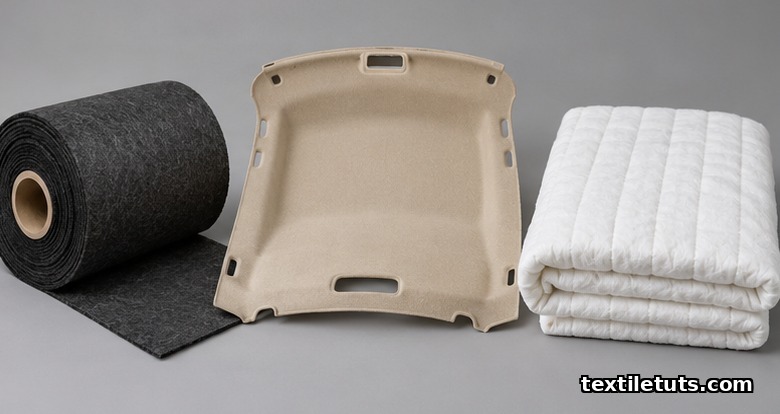
In construction, heavy Malimo grades replace woven geotextile slit films in road separation work because the biaxial grid pattern delivers tensile isotropy closer to a woven while still running the economics of a nonwoven. In automotive, low-density Maliwatt at 80 to 120 g/m² acts as a headliner and door panel substrate that retains shape at 90 °C interior cabin temperatures. In bedding, a 60 to 100 g/m² stitch-bonded layer is laminated to a foam core to form a quilted panel cover that survives 50+ commercial wash cycles per AATCC 135.
Advantages and Limitations of Stitch-Bonded Nonwovens
The commercial case for stitch-bonding rests on four technical advantages: high tensile-to-mass efficiency at low areal density, dimensional stability under heat and moisture, the ability to run recycled fiber furnish without thermal-bonding sensitivity, and a clean visual surface suitable for direct lamination or print. These benefits come with three limitations worth flagging: anisotropic tear strength across the courses, surface pilling when the fiber batt is under-stitched, and a unit cost roughly 12 to 25 percent higher than needle-punched equivalents at the same weight because of the knitting-yarn material cost.
Frequently Asked Questions
What is the difference between stitch-bonded and needle-punched nonwoven?
Stitch-bonded nonwoven uses a separate stitching thread, usually polyester filament, to lock the fiber web through warp-knit loops on machines such as Maliwatt. Needle-punched nonwoven instead entangles fibers mechanically with thousands of barbed needles per square cm. On a 150 g/m² fabric, stitch-bonding delivers 350 to 480 N/5 cm warp tensile strength versus 180 to 260 N/5 cm for needle-punch, but air permeability is similar because both rely on the open fiber matrix.
Are stitch-bonded nonwovens recyclable or biodegradable?
Recyclability depends almost entirely on the fiber furnish. A 100 percent polyester stitch-bonded nonwoven can be re-extruded into PET staple for nonwoven lines and is accepted by most nonwoven recyclers operating in Europe. A viscose or cotton-rich stitch-bonded fabric is biodegradable under industrial composting conditions and complies with EN 13432, but blended grades are usually downcycled into shoddy for automotive padding.
How long does a stitch-bonded geotextile last underground?
Polyester and polypropylene stitch-bonded geotextiles in non-aggressive soils (pH 4 to 9, temperature below 25 °C) are commonly service-life rated at 75 to 100 years under ENV ISO 13438 durability protocols, which accelerate age testing with heat and oxygen. In alkaline soils above pH 9, polyester stitching threads hydrolyze and the rated service life drops to 25 to 40 years. The alternative polyamide stitching thread offers better alkali resistance but poorer UV stability.
Can stitch-bonded nonwoven be washed like woven fabric?
Yes, provided the stitching thread and the web fiber share the same chemical stability. A polyester-on-polyester Malimo can run 50+ industrial wash cycles under ISO 6330 at 60 °C with under 5 percent shrinkage in either direction, which is why the construction is widely used in mattress covers and quilted duvet ticking. Cotton-on-cotton stitch-bonded grades will move dimensionally like any cotton woven and are normally labeled to AATCC 135 wash cycles to set the consumer expectation.
Is stitch-bonded the same as knit-deknit or warp-knit nonwoven?
No. Knit-deknit is a process that knits a yarn into a sleeve and then unravels it to create a crimped yarn for carpet. Warp-knit nonwoven is a separate nonwoven family that uses knitting needles without a parallel fiber batt. Stitch-bonded sits between the two and is specifically defined as a nonwoven consolidated by stitching through a fiber web, per ISO 14621:2019, which excludes knit-deknit and warp-knit constructions from the same category.
References
- ISO. ISO 14621:2019 Textiles – Nonwovens – Vocabulary. International Organization for Standardization. Definition of stitch-bonded nonwoven fabric. https://www.iso.org/standard/70005.html
- ASTM International. ASTM D5035-11(2019): Standard Test Method for Breaking Force and Elongation of Textile Fabrics (Strip Method). Breaking force test method used for stitch-bonded structures. https://www.astm.org/d5035
- AATCC. AATCC 127-2018: Water Resistance: Hydrostatic Pressure Test. Hydrostatic head test method for nonwoven barrier fabrics. https://www.aatcc.org/testing/test-methods/
- ASTM International. ASTM D4632: Standard Test Method for Grab Breaking Load and Elongation of Geotextiles. Mandatory grab tensile test for geotextile end uses. https://www.astm.org/d4632
- Russell, S. J. (ed.). Handbook of Nonwovens. Woodhead Publishing / Elsevier. Reference text on stitch-bonded process physics, machinery, and end uses. https://doi.org/10.1016/C2014-0-02128-7
- Mao, N. and Russell, S. J. A Systematic Study of Fibre Engagement in Stitch-Bonded Nonwoven Fabrics. ResearchGate / peer-reviewed open access paper on tensile and tear behavior of Maliwatt and Malimo structures. https://www.researchgate.net/publication/
- EDANA. European Nonwovens Statistics 2023. Industry trade data on stitch-bonded capacity, furnish, and end-use split. https://www.edana.org/
Editorial by Md. Asad Ullah (Meem), TextileTuts. Sources: ISO 14621:2019, ASTM D5035, ASTM D4632, AATCC 127, EDANA 140.1/130.1, Russell’s Handbook of Nonwovens, and 2023 EDANA nonwovens statistics as cited.


