
Chemical-Bonded Nonwoven

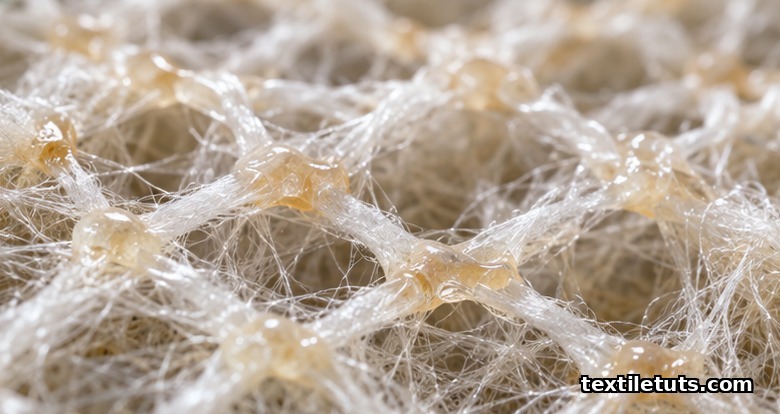
Chemical bonding is a nonwoven fabric web consolidation method that adds 10 to 50 percent by weight of a polymer binder (most commonly an acrylic latex or styrene-butadiene) to a loose fiber web, then cures it at 130 to 180 degrees Celsius to lock the fibers into a coherent fabric.
Unlike thermal bonding, which uses only heat to fuse fibers, or mechanical bonding, which entangles them with needles or water jets, chemical bonding relies on an adhesive that bridges adjacent fibers and sets the structure once cured, producing a fabric with tunable stiffness, absorbency, and hand feel depending on binder chemistry and add-on level.
This guide explains how chemical bonding works, the binders used, the resulting fabric properties, and where you will find chemical-bonded nonwovens in everyday products, with specific numbers from the ISO 9073 and ASTM nonwoven test standards.
What Chemical-Bonded Nonwoven Means
Chemical bonding (also called resin bonding, or print bonding when the binder is applied in patterns) is one of the four major nonwoven web consolidation methods identified in the textile engineering literature, alongside mechanical (needle-punch, spunlace), thermal (calender, through-air), and polymer-laid (spunbond, meltblown) routes.
The term covers any nonwoven whose fibers are held together primarily by an externally applied polymeric binder, rather than by fiber-to-fiber fusion or mechanical entanglement. The base web can be drylaid (carded or airlaid), wetlaid, or spun; the only requirement is that a binder can be added and cured without destroying the web structure.
This category includes some of the earliest mass-produced nonwovens, particularly disposable wipes, interlinings, and low-cost coverstock fabrics, where a stiff, paper-like hand and modest strength at low cost are acceptable trade-offs.
How the Chemical Bonding Process Works
Production follows a four-step sequence that converts a loose fiber batt into a finished fabric.
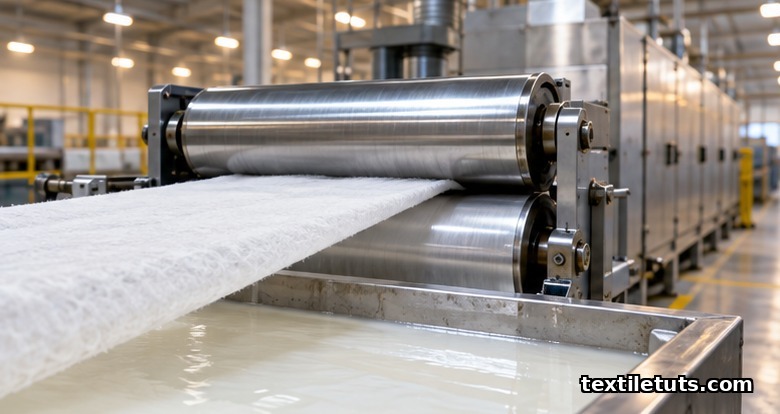
Step 1: Web formation. A fiber web is laid down by carding (for parallel-laid or cross-laid drylaid webs), airlaying (for random, isotropic webs), or wetlaying (similar to papermaking). Web weight typically runs from 15 g per square meter for coverstock to 200 g per square meter for heavier industrial fabrics.
Step 2: Binder application. The binder is applied by one of four common methods:
- Saturation (full impregnation): The web is passed through a binder bath and squeezed between nip rollers to control pick-up. This is the most common method and gives uniform through-thickness binder distribution.
- Spray bonding: Binder is sprayed onto one or both web surfaces with calibrated nozzles. Used when softness and absorbency matter more than tensile strength.
- Print bonding: Binder is printed in a pattern (often as dots or lines) using an engraved roll. The unbonded zones remain soft and absorbent, while the bonded zones carry the load. Common in hygiene products.
- Foam bonding: Binder is foamed and pressed into the web, allowing very low add-on levels (under 5 percent) without flooding the structure.
Step 3: Binder curing. The wet web passes through a stenter or oven at 130 to 180 degrees Celsius for 30 to 180 seconds, depending on binder chemistry and web weight. Crosslinking reactions during curing convert the binder from a soft film into a rigid network.
Step 4: Post-treatment. Cured fabric may be calendered for surface smoothness, washed to remove surfactant residues, or surface-treated for hydrophilicity or hydrophobicity depending on end use.
Common Binder Chemistries
Binder selection drives most of the final fabric properties. The five most common binder families are listed below in order of typical global volume.
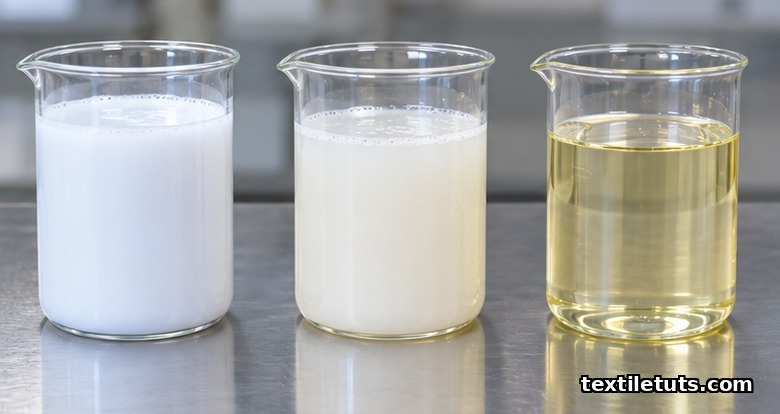
Acrylic latex (acrylates). The single largest nonwoven binder class. Acrylic binders give soft hand, good UV resistance, and tunable Tg (glass transition temperature) from minus 40 to plus 30 degrees Celsius, allowing formulators to dial in softness or stiffness. Typical add-on is 20 to 40 percent.
Styrene-butadiene rubber (SBR). An older, lower-cost binder, popular before acrylics displaced it. SBR is softer than acrylic at room temperature but yellows under UV and is increasingly restricted in hygiene applications.
Vinyl acetate and ethylene-vinyl acetate (EVA). Used where softness, low cost, and low residual odor are needed. EVA binders soften at around 60 to 80 degrees Celsius, limiting their use in higher-temperature end uses.
Styrene-acrylic. A hybrid offering the stiffness of styrene with the film clarity and UV stability of acrylics, often chosen for filtration and roofing substrates.
Polyvinyl chloride (PVC) and other specialty binders. Used where flame retardancy or chemical resistance is needed, such as automotive and filtration media.
Most binders are crosslinked with melamine-formaldehyde or self-crosslinking monomers to improve wet strength and washing durability. Modern formulations also include defoamers, thickeners, and catalysts to control bath stability and cure speed.
Properties of the Resulting Fabric
Chemical-bonded nonwovens have a characteristic set of properties that follow predictably from binder type and add-on.
Stiffness and hand. Higher binder add-on increases bending rigidity. A 30 percent acrylic add-on on a 60 g per square meter polyester web typically produces a fabric that is noticeably stiffer than a thermally bonded equivalent at the same weight.
Tensile strength. Tested per ISO 9073-3, tensile strength scales roughly linearly with binder content up to the point where the binder becomes the continuous phase. A typical print-bonded coverstock at 25 g per square meter shows tensile strength in the single-digit newtons per 5 cm range in both directions, while a saturated 80 g per square meter roofing substrate can exceed 200 N per 5 cm in both machine and cross directions.
Absorbency. Print-bonded fabrics with patterned binder retain open, unbonded zones that wick liquid rapidly, which is why baby wipes and pre-moistened wipes use this construction. Saturation-bonded fabrics are typically hydrophobic unless surfactants are added during post-treatment.
Softness. Largely controlled by binder Tg: lower-Tg binders (around minus 20 to 0 degrees Celsius) give softer hand, while higher-Tg binders (around plus 10 to plus 30 degrees Celsius) give paper-like crispness.
Drape. Directly linked to bending rigidity, drape is a key differentiator between print-bonded (more drape) and saturation-bonded (less drape) fabrics.
Wash durability. Crosslinked binders survive multiple wash cycles before fiber shedding begins; non-crosslinked binders may shed after one or two cycles, per ASTM D1117 guidance on nonwoven durability evaluation.
Where Chemical-Bonded Nonwovens Are Used
End-use selection is driven by the balance of cost, stiffness, and absorbency that chemical bonding offers.
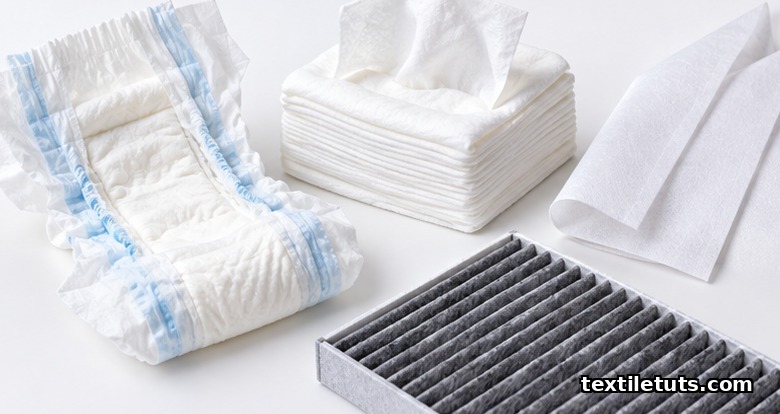
- Wipes (baby, household, industrial): Print-bonded or spray-bonded fabrics at 30 to 80 g per square meter with acrylic binder are standard. The combination of soft unbonded zones and strong bonded zones suits one-pass cleaning applications.
- Hygiene coverstock and acquisition layers: Lightweight (15 to 25 g per square meter) polypropylene or viscose webs bonded with print rollers, used as the inner layers of diapers and feminine care products.
- Apparel interlinings: Saturation-bonded polyester or viscose at 40 to 80 g per square meter, used to stiffen collars, cuffs, and waistbands.
- Roofing and construction substrates: Heavier (80 to 200 g per square meter) polyester webs bonded with styrene-acrylic or PVC binders for dimensional stability under bitumen.
- Filtration media: Print-bonded webs serve as pre-filters in HVAC and automotive cabins, where patterned binder creates flow channels.
- Carpet backing and underlay: SBR or EVA binders anchor carpet tufts and add bulk to secondary backings.
- Agricultural and landscaping fabrics: Lightweight print-bonded or saturation-bonded polypropylene used for weed control and crop protection.
Chemical Bonding Compared to Other Nonwoven Bonding Methods
The table below compares the three main web consolidation routes used for staple-fiber nonwovens. Polymer-laid processes (spunbond, meltblown) are excluded because they form their own fibers rather than bonding a pre-laid web.
| Property | Chemical bonding | Thermal bonding | Mechanical bonding |
|---|---|---|---|
| Bonding mechanism | Polymer binder cures between fibers | Heat fuses thermoplastic fibers | Needles or water jets entangle fibers |
| Typical web | Drylaid, wetlaid, or spun | Drylaid with bicomponent fiber | Drylaid (carded or airlaid) |
| Binder add-on | 10 to 50 percent by weight | None (uses fiber as binder) | None |
| Strength at low weight | Moderate | High (with bicomponent) | Low to moderate |
| Softness | Tunable via binder Tg | Often stiff | Softest of the three |
| Absorbency | Tunable (open or closed structure) | Limited | High (no binder to block pores) |
| Typical end uses | Wipes, interlinings, roofing, filtration | Hygiene topsheet, coverstock | Wipes, artificial leather substrates, geotextiles |
| Process water use | Moderate to high (binder bath) | Low | High (spunlace) |
Frequently Asked Questions
What is the main difference between chemical bonding and thermal bonding?
Thermal bonding uses heat alone to fuse thermoplastic fibers, often bicomponent fibers with a low-melt sheath. Chemical bonding adds a separate polymer binder that cures between fibers, which lets the manufacturer choose fibers (including natural fibers like cotton or viscose) that thermal bonding cannot fuse. This is why chemical bonding dominates in wipes and interlinings, where fiber choice and softness drive the product.
Is chemical bonding still common, or has it been replaced?
Chemical bonding remains one of the four major nonwoven consolidation routes, with global production of chemical-bonded fabrics measured in the millions of tonnes per year for wipes, hygiene, and interlining applications. It has been displaced in some hygiene coverstock roles by through-air thermal bonding using bicomponent fibers, but its ability to use any fiber type and tune hand feel keeps it in the market where thermal bonding cannot deliver.
Do chemical-bonded nonwovens shed microfibers or binders?
Properly cured and crosslinked binders do not shed at room temperature, but under mechanical agitation such as washing, some fiber loss is normal for nonwovens. ASTM D1117 provides the framework for evaluating fiber shedding and durability of nonwoven fabrics under specific end-use conditions. For single-use disposables this is not a concern, but for reusable applications, post-cure washing and crosslinker selection matter.
Can chemical-bonded nonwovens be recycled?
Recyclability is limited compared to thermal- or mechanical-bonded fabrics because the cured binder is difficult to separate from the fibers. Most chemical-bonded nonwovens end up in landfill or are incinerated with energy recovery. Research on chemical recycling of binder-fiber composites is ongoing, but commercial-scale chemical recycling of chemical-bonded nonwovens is not yet established.
Which binders are safest for skin contact?
Acrylic binders with low residual monomer (under 100 ppm) and no formaldehyde-based crosslinkers are the standard for wipes and hygiene products in contact with skin. AATCC and ISO test methods such as ISO 9073-10 for dry particle release and various biocompatibility standards are used by manufacturers to confirm low irritation potential, with skin-contact grades typically certified to Oeko-Tex Standard 100 or equivalent.
References
- International Organization for Standardization. ISO 9073-3:1989. Textiles: Test methods for nonwovens. Part 3: Determination of tensile strength and elongation of nonwovens. iso.org.
- ASTM International. ASTM D1117. Standard Guide for Evaluating Nonwoven Fabrics. astm.org.
- Russell, S.J. (editor). Handbook of Nonwovens. Woodhead Publishing, 2007.
- INDA, Association of the Nonwoven Fabrics Industry. Nonwovens Glossary and Reference Guide. inda.org.
- EDANA (European Disposables and Nonwovens Association). Nonwovens Standard Procedures and Test Methods. edana.org.
- Mao, N., and Russell, S.J. A framework for determining the bonding energy in thermally bonded nonwovens. Journal of Applied Polymer Science. Peer-reviewed study on bonding mechanisms in nonwoven fabrics.
Editorial by Md. Asad Ullah (Meem), TextileTuts. Sources: ISO 9073-3, ASTM D1117, Russell (Woodhead), INDA, EDANA as cited.


