
Stain Resistant Finishes

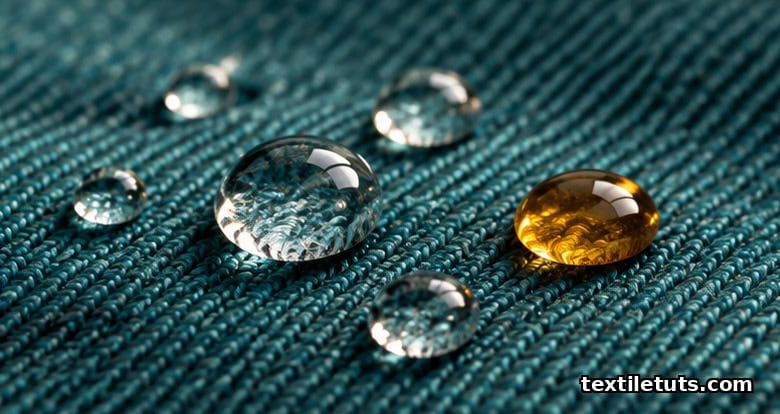
Stain-resistant finishes on textiles rely on fluorocarbon, silicone, or nanoparticle chemistries that lower a fabric’s surface energy to roughly 10 to 25 mN/m, allowing water- and oil-based liquids to bead up and roll off instead of wetting the fiber.
Performance is graded against AATCC Test Methods 118, 22, 130, and 193 (and their ISO equivalents, ISO 14419 and ISO 23232), with a C6 fluorocarbon finish typically scoring grade 6 or higher on the AATCC TM 118 oil-repellency scale, the threshold most mills treat as “commercial grade” for contract upholstery, workwear, and outdoor apparel.
Below is how the chemistry works on the fiber, what each test method actually measures, how durable the finishes are through repeated laundering, and where the industry has shifted as older C8 fluorocarbons were phased out due to concerns about PFOA and broader PFAS persistence.
How Stain-Resistant Finishes Work: Surface Energy and Contact Angle
Wetting happens when a liquid’s surface tension pulls it into the spaces between fibers. An untreated cotton fiber has a surface energy near 40 to 44 mN/m, which is why water (72 mN/m) and especially cooking oils and motor oils (20 to 30 mN/m) spread and absorb readily. A stain-resistant finish reverses this by depositing a thin film of fluorinated or silicone chains on the fiber surface, exposing CF3 or methyl groups whose surface energy sits well below that of common staining liquids. Contact angles rise above 90 degrees for water and 60 degrees for mineral oil, and droplets bead up rather than soak in.
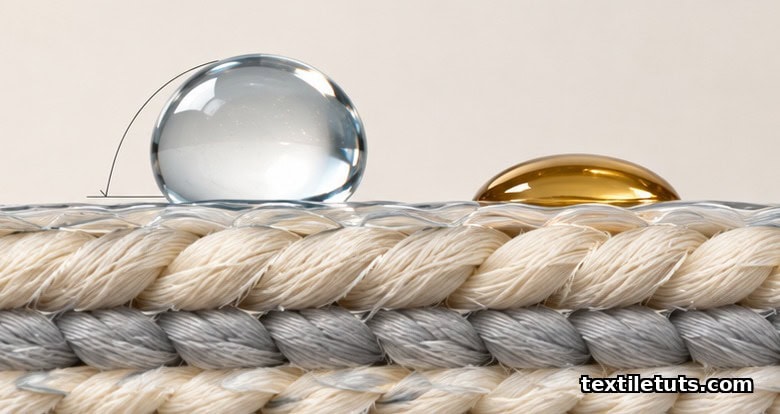
The stain does not actually disappear. It sits on top until blotted, wiped, or laundered away, which is why reputable manufacturers market these finishes as “stain resistant” or “stain release” rather than “stain proof.” This is also the same physics behind self-cleaning lotus leaves, where waxy micro-bumps reduce contact area with water droplets. On fabric, the finish is applied uniformly across the fiber surface rather than as bumps, but the mechanism, a low-surface-energy film that prevents wetting, is identical.
The Main Chemistry Families
Four chemistry families dominate the commercial market. Each behaves differently in the lab, in the wash, and after multiple wear cycles, which is why mills specify performance against more than one AATCC or ISO method.
Fluorocarbon finishes (C8, C6, and PFAS-free)
Fluorocarbon finishes have been the workhorse of stain resistance since 3M introduced Scotchgard in the 1950s. The original “C8” chemistry used a perfluorooctane chain (eight perfluorinated carbons) that gave exceptional oil and water repellency. After the U.S. EPA PFOA Stewardship Program (2006 to 2015) drove the voluntary phase-out of long-chain perfluorinated compounds, the industry shifted to “C6” perfluorohexane chemistry, which still contains fluorine but degrades more readily in the environment. C6 chemistry is now the standard for most outdoor apparel, performance fabrics, and contract upholstery. Recent regulation in the EU and several U.S. states is now pushing the market further toward PFAS-free alternatives built on hydrocarbons, silicones, waxes, or dendrimer structures.
Silicone (polysiloxane) finishes
Polydimethylsiloxane (PDMS) emulsions are the dominant silicone finish, prized for soft hand and high water repellency. They are widely used on synthetic fibers, synthetic-blend suedes, and rainwear. Silicones deliver excellent spray-test scores (AATCC TM 22 ratings of 90 to 100 are typical) but poor oil repellency, so they are usually paired with a fluorocarbon or sold as “water repellent only.” Their main advantages are lower cost, lower fluorine content, and a noticeably softer fabric hand.
Nanoparticle and sol-gel finishes
Research published since 2010 has focused on nanoparticle films of SiO2, TiO2, ZnO, and silver that create rough, low-energy surfaces inspired by lotus and rice leaf morphologies. Peer-reviewed reviews report water contact angles above 150 degrees (the “superhydrophobic” threshold) on cotton and polyester treated with SiO2/silane composites. Commercial use is still limited to technical research and a few niche performance lines as of 2025, because wash durability and large-scale coating uniformity remain challenging.
Conventional (non-fluorinated) finishes
Before fluorocarbons, water repellency came from wax emulsions, paraffin-aluminum salts, pyridinium-type softeners, and melamine-formaldehyde resins. These chemistries are still used in industrial workwear, awnings, and some military textiles because they are inexpensive and meet the spray-test specifications of many institutional buyers. They give modest oil repellency and tend to soften or wash off faster than fluorocarbons, with useful life of 10 to 30 launderings compared to 50 or more for a properly cured C6 finish.
Test Methods and Performance Grades
Stain-resistant performance is not a single number. It is a family of standardized tests run by the American Association of Textile Chemists and Colorists (AATCC), the International Organization for Standardization (ISO), and ASTM.
| Standard | What it measures | Scale and outcome |
|---|---|---|
| AATCC TM 22 | Water repellency (spray test) | 0 to 100 rating; 90+ is “excellent” |
| AATCC TM 118 | Oil repellency (hydrocarbon resistance) | 0 to 8 grade; grade 6+ resists motor oil |
| AATCC TM 130 | Soil release after laundering | 1 to 5 grade; 5 is complete release |
| AATCC TM 193 | Aqueous liquid repellency (water + alcohol) | 0 to 8 grade; 8 is most repellent |
| ISO 14419 | Resistance to surface wetting (oil + aqueous) | Comparable to TM 118 and TM 193 |
| ISO 23232 | Stain resistance determination | Visual rating after controlled staining |
AATCC Test Method 118 uses eight hydrocarbon liquids of decreasing surface tension. The fabric passes the highest-numbered liquid it can resist for 30 seconds without darkening at the droplet boundary. Grade 6 (n-hexadecane, surface tension about 27.3 mN/m) is the industry benchmark for contract upholstery; grades 7 and 8 indicate performance suitable for rainwear and high-end outerwear. AATCC Test Method 130 goes further and measures how well the same oily stain is removed by a standard home laundering cycle, which is a closer match to real-world soiling.
Durability, Wash Cycles, and Care
Factory finishes are cured at 150 to 180 degrees Celsius for 1 to 3 minutes to bond the fluorocarbon chains to the fiber surface. After this cure, a C6 fluorocarbon finish typically retains an AATCC TM 118 grade of 5 or higher through 30 to 50 home launderings and grade 3 or higher through 100. Consumer spray-on aftermarket products, by contrast, wash out in 1 to 5 launderings because they lack the crosslinking and high-temperature curing step used in mill finishing.
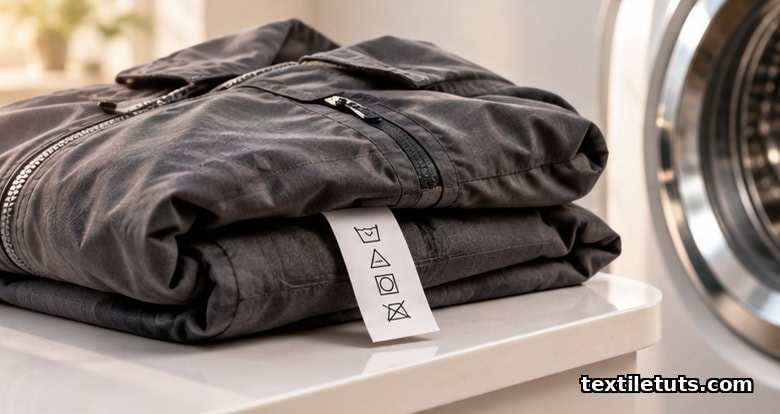
Heat is the enemy of any stain-resistant finish. Tumble drying at temperatures above 70 degrees Celsius, ironing without a pressing cloth, and dry cleaning with harsh solvents strip the fluorinated film faster than ordinary wear. Manufacturers recommend washing in cool water (30 degrees Celsius maximum), avoiding fabric softeners (which coat the fluorocarbon film and reduce repellency), and tumble drying on low heat or line drying. Reactivating the finish by tumble drying on medium heat for 10 minutes after air-drying is a recognized refresh step on many outerwear care labels.
Applications and Limitations
Stain-resistant finishes are not universal. They work best on smooth, tightly woven fabrics (poplin, twill, microfiber) and worst on deeply textured surfaces (terry cloth, fleece, berber carpet) where mechanical abrasion quickly removes the film. They also cannot stop dye-based stains such as wine, coffee, or ballpoint ink, because those penetrate the fiber by solution chemistry rather than by surface wetting. A drop of red wine on a grade-6 fluorocarbon-finished tablecloth will still bead up initially but will leave a colored ring if not blotted within minutes.
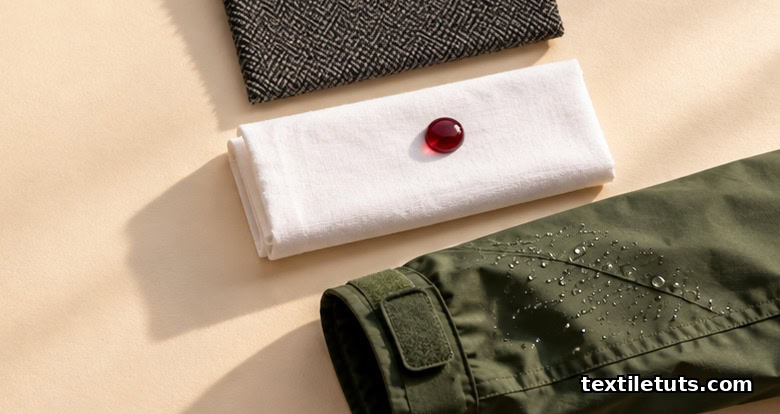
The biggest market segments are contract and residential upholstery (where stain resistance is increasingly specified by architects and furniture buyers), hospitality table linens, healthcare uniforms, industrial workwear, and outdoor apparel. Carpet tile backing, automotive interior fabrics, and filtration media also use heavy fluorocarbon treatments. Since 2023, the U.S. EPA has required disclosure of PFAS in carpets, rugs, and aftermarket treatments under TSCA reporting rule 40 CFR Part 705, which is accelerating the move toward PFAS-free chemistries across all of these segments.
Frequently Asked Questions
Do stain-resistant finishes wash out?
Factory-applied C6 fluorocarbon finishes typically retain an AATCC TM 118 oil-repellency grade of 5 or higher through 30 to 50 home launderings at 30 degrees Celsius. They are not permanent; they are durable water repellent (DWR) finishes that lose performance gradually. Spray-on aftermarket products wash out in 1 to 5 cycles because they lack the high-temperature curing step used in manufacturing.
Are stain-resistant finishes safe?
C6 fluorocarbons contain no measurable PFOA or PFOS and are considered safer than the legacy C8 chemistries they replaced. However, “PFAS-free” is now the trend because all fluorocarbons belong to the broader PFAS family that regulators are scrutinizing for environmental persistence. For household use, finishes certified under OEKO-TEX Standard 100 or bluesign meet established thresholds for skin contact and residual content.
What is the difference between water-repellent and stain-resistant?
Water-repellent finishes (often silicone or short-chain fluorocarbon) shed water but offer little protection against oily stains. Stain-resistant finishes must repel both water-based and oil-based liquids, which is why they are graded against the AATCC TM 118 oil series in addition to the spray test. A fabric can pass AATCC TM 22 at 100 and still fail AATCC TM 118 at grade 2.
Can I apply a stain-resistant finish at home?
Yes. Consumer products based on C6 fluorocarbon emulsions or silicone sprays can be applied to washable garments and home textiles. Performance is noticeably lower than factory finishes because home application cannot reach the 150 to 180 degrees Celsius cure temperatures used in mill finishing, and durability is typically 1 to 5 wash cycles.
How long do factory-applied stain-resistant finishes last?
Under normal household use and care (cool wash, low-heat dry, no fabric softener), a quality C6 fluorocarbon finish maintains commercial-grade repellency for 3 to 5 years on upholstery and 2 to 3 years on frequently laundered garments. Outdoor gear stored dirty or subjected to repeated high-heat drying may lose noticeable repellency within a single season.
References
- AATCC. Test Method 118: Oil Repellency: Hydrocarbon Resistance Test. AATCC Technical Manual. — Defines the eight-grade oil-repellency scale (grade 6 plus is commercial grade).
- AATCC. Test Method 22: Water Repellency: Spray Test. AATCC Technical Manual. — Specifies the 0 to 100 spray rating for water-repellent fabrics.
- AATCC. Test Method 130: Soil Release: Oily Stain Release Method. AATCC Technical Manual. — Standard for evaluating oily stain removal after home laundering.
- AATCC. Test Method 193: Aqueous Liquid Repellency. AATCC Technical Manual. — Resistance to wetting by water/alcohol solutions across grades 0 to 8.
- ISO. ISO 14419: Textiles — Determination of resistance to surface wetting. International Organization for Standardization. — International equivalent of AATCC TM 118 and TM 193.
- ISO. ISO 23232: Textiles — Determination of stain resistance. International Organization for Standardization. — Method for controlled staining and visual rating.
- Holme, I. (2007). “Innovative technologies for high performance textiles.” Coloration Technology, 123(2), 59 to 73. — Peer-reviewed review of surface modification and repellent finishes.
- Radetic, M. (2013). “Functionalization of textile materials with TiO2 nanoparticles.” Journal of Photochemistry and Photobiology C: Photochemistry Reviews, 16, 62 to 76. — Peer-reviewed overview of nanoparticle-based self-cleaning textile finishes.
This article is the working reference for stain-resistant finishes. Editorial by Shahrukh Islam, TextileTuts. Sources: AATCC Test Methods 22, 118, 130, and 193; ISO 14419 and ISO 23232; Coloration Technology 123(2); Journal of Photochemistry and Photobiology C 16.


