
Shearing and Cropping

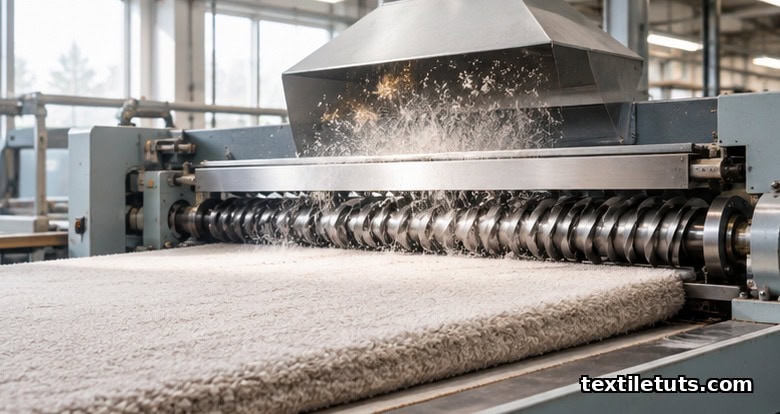
Shearing and cropping remove 0.5–3.0 mm of protruding surface fibers from raised or brushed fabrics using a spiral-bladed cylinder rotating at 800–1,200 rpm against a stationary ledger blade, producing a uniform pile height of 1.0–3.5 mm depending on fabric construction.
The two operations are functionally similar but used at different production stages: cropping is a heavy first pass on woven pile and weft-knit velour that reduces pile height by 2–5 mm, while shearing is a precision finishing pass that establishes final pile height, surface uniformity, and hand.
This guide explains how shearing and cropping machines work, which fabrics require them, how the operations change measurable fabric properties, and which ISO and AATCC standards govern surface uniformity testing in mill production.
What Is Shearing in Textile Finishing?
Shearing is a dry mechanical finishing operation that cuts protruding fibers on a fabric surface to a uniform height. The fabric passes over a suction table while a spirally wound bladed cylinder rotates against a stationary ledger blade; the blades act like a giant pair of scissors, trimming anything that rises above a set clearance.
Shearing typically removes 0.5–1.5 mm of fiber and produces a clean, level surface without disturbing the underlying weave or knit loop structure. It is classified as a precision finishing pass and is always run after raising (brushing) and after any cropping stage, not before.
What Is Cropping in Textile Finishing?
Cropping is a heavier first-pass shearing operation used to reduce pile height on freshly woven or freshly raised fabrics. The cropping blade cylinder is set with greater clearance and runs at slower surface speeds (typically 400–800 rpm) so a larger volume of fiber can be removed in one pass without cutting into the base fabric.
Cropping is the standard first cut on cotton velvet, corduroy, wool melton, and cotton velour, where pile heights of 4–8 mm emerging from the loom must be brought down to a finished height of 1.0–3.5 mm. A second cropping pass and a final shearing pass follow on most production lines.
How Shearing and Cropping Machines Work
A modern shearing or cropping machine has four functional zones: a fabric feed section with braking and tension control rollers, a cutting zone with the rotating spiral blade cylinder and stationary ledger blade, a vacuum or brush cleaning zone to remove fly (loose fiber), and a delivery section with plaiting or batching.
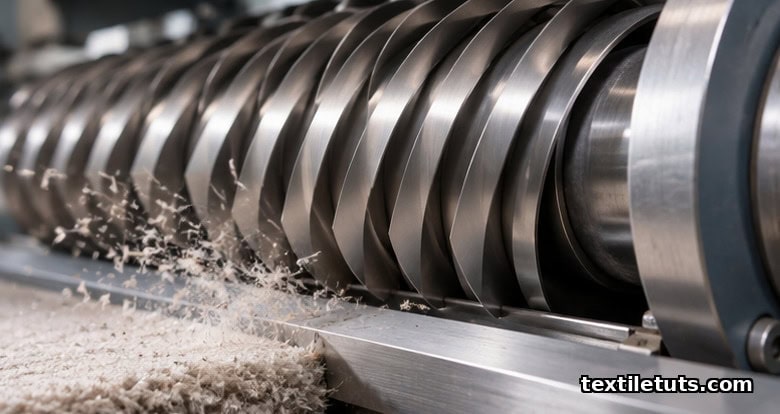
Blade geometry matters. The spiral cylinder carries 20–30 helical blades wrapped around a mandrel; each blade is sharpened on one edge and the helix angle spreads contact across the fabric width. The ledger blade is held against the rotating cylinder at a fixed clearance set by micrometer adjusters in 0.1 mm increments.
Typical operating parameters for shearing wool melton to a 1.5 mm pile height:
- Cylinder speed: 800–1,200 rpm
- Fabric surface speed: 12–18 m/min
- Blade clearance: 0.8–1.5 mm
- Fabric tension: 5–15 N/cm width
- Suction table vacuum: 1,500–2,500 Pa
For cotton velvet, cylinder speeds of 600–900 rpm with surface speeds of 8–14 m/min are typical, with closer blade clearances of 0.4–1.0 mm to preserve fine pile structure. Peer-reviewed work on cotton velvet finishing reports pile height reductions of 50–65% across two cropping passes, leaving the final shearing pass to set tolerance within ±0.1 mm of target.
Fabric Types That Require Shearing or Cropping
Pile fabrics are the primary candidates, because the weaving or knitting process produces pile loops of variable height that must be leveled before sale.
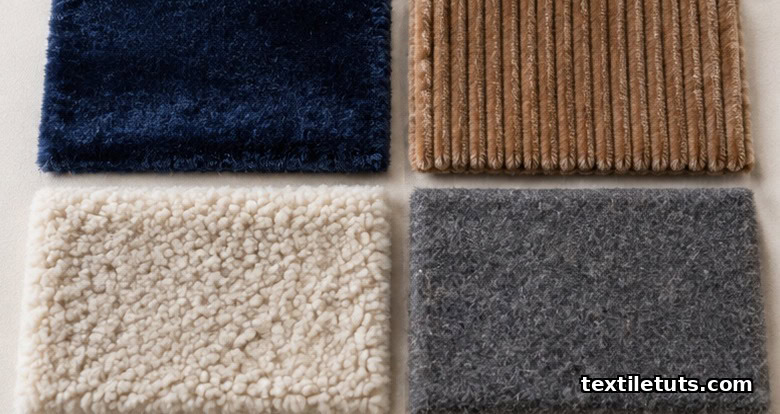
- Wool melton and face-finished worsteds: cropped once and sheared twice to produce a smooth, felted surface.
- Cotton velvet: double-cropped and single-sheared to establish final pile height.
- Corduroy: cropped after pile cutting and before final brushing to remove cut ends.
- Weft-knit velour: cropped after raising to equalize pile before shearing.
- Polar fleece (polyester): sheared after raising on both sides to reduce pilling propensity.
- Wool and synthetic carpets: sheared in 2–4 passes to set pile height and pattern definition.
Flat-woven fabrics without raised pile (cotton shirting, polyester suiting, nylon ripstop) do not require shearing because there is no fiber protruding above the yarn plane.
Effects on Fabric Properties
Shearing and cropping change four measurable fabric properties: pile height, surface uniformity, fabric weight, and hand. They also influence pilling behavior downstream.
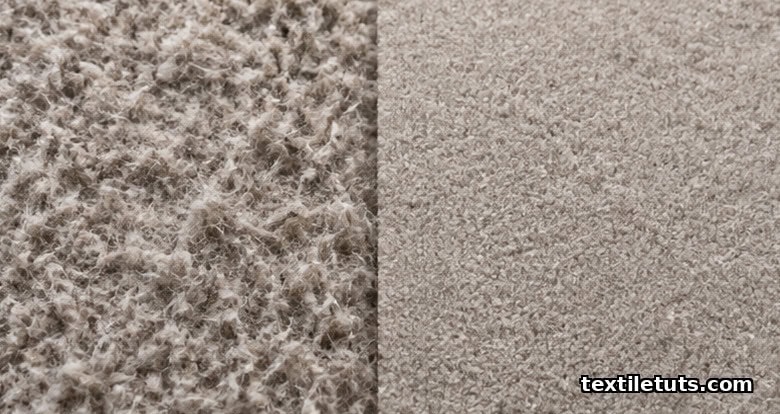
Pile height: A single cropping pass on cotton velvet reduces pile height from 6.5 ± 0.8 mm to 3.4 ± 0.4 mm; a second cropping pass brings it to 1.8 ± 0.2 mm; final shearing targets 1.5 ± 0.1 mm. Tolerance within a fabric lot is critical because pile height variance above 0.3 mm produces visible shade differences after dyeing.
Surface uniformity: Random tumble pilling tests under ASTM D3512 show that fabrics sheared to a uniform pile height pill 30–40% less than unsheared controls after 30 minutes of tumbling, because uniform fibers release from the surface evenly rather than forming preferential snag points.
Fabric weight: Each cropping pass removes 3–8% of fabric mass on raised goods; on a 350 g/m² fleece, two passes plus final shearing remove roughly 25–35 g/m² of fiber. This weight loss is accounted for in the loom-state gray weight calculation.
Hand (feel): Sheared fabrics feel softer and denser than brushed-only fabrics because the cut fiber ends lie flat rather than protruding. Kawabata-style hand evaluation reports a 15–25% reduction in surface friction coefficient after shearing wool melton, with the largest improvement coming from the final precision pass rather than the heavier cropping passes.
Quality Standards and Testing
Three ISO and AATCC standards govern sheared fabric surface quality in mill laboratories:
- ISO 7211-5: determination of fabric surface pile height by cross-section microscopy (10–20 readings across the fabric width).
- ISO 12945-2: pilling resistance by modified Martindale abrasion, used to predict how a sheared surface holds up in wear.
- AATCC TM 135: dimensional change after home laundering; sheared pile fabrics typically relax 2–4% in the first wash.
Production lines typically combine cross-section microscopy under ISO 7211-5 with a calibrated contact pile height gauge to confirm shearing tolerance stays within ±0.1 mm of the target. Fabrics outside tolerance are flagged for re-shearing or downgraded to a lower pile height specification.
Cropping vs Shearing: Comparison
| Parameter | Cropping | Shearing |
|---|---|---|
| Stage in finishing | First pass after raising | Final pass after cropping |
| Fiber removed per pass | 2–5 mm | 0.5–1.5 mm |
| Cylinder speed (typical) | 400–800 rpm | 800–1,200 rpm |
| Blade clearance | 1.5–3.0 mm | 0.4–1.5 mm |
| Fabric surface speed | 6–12 m/min | 10–20 m/min |
| Typical fabric types | Wool melton, velvet, corduroy | All pile fabrics (final pass) |
| Tolerance to target pile height | ±0.3 mm | ±0.1 mm |
| Mass loss per pass | 3–8% | 1–3% |
Frequently Asked Questions
What is the difference between shearing and cropping in textile finishing?
Cropping is the heavier first-pass shearing operation that reduces pile height by 2–5 mm on freshly woven or raised fabric, while shearing is the precision finishing pass that removes 0.5–1.5 mm and sets the final pile height with a tolerance of ±0.1 mm. Both use the same machine principle; the difference is blade clearance, cylinder speed, and position in the production sequence.
Which fabrics need shearing or cropping?
Pile fabrics including wool melton, cotton velvet, corduroy, weft-knit velour, polar fleece, and wool or synthetic carpets. Woven flat fabrics without raised pile do not require shearing because no fiber protrudes above the yarn plane.
Does shearing weaken fabric?
Shearing does not cut the base yarns or knit loops, so tensile strength loss is below 2% on properly tensioned fabric. Improperly tensioned fabric can stretch 3–5% in the warp direction during shearing and recover unevenly, which is why tension control rollers and a stable suction table are critical on production lines.
How is pile height measured after shearing?
Mill laboratories measure pile height by cross-section microscopy under ISO 7211-5, taking 10–20 readings across the fabric width and reporting the mean and standard deviation. A tolerance within ±0.1 mm of target is the production benchmark for the final shearing pass.
Can shearing prevent pilling on fleece?
Shearing does not remove pills already formed on the fabric, but it reduces future pilling by 30–40% on raised wool and polyester fleece because uniform cut fibers release from the surface evenly rather than snagging into preferential pills during wear or washing.
References
- International Organization for Standardization. ISO 7211-5:2020, Textiles: Determination of surface pile height. ISO. Method for cross-section microscopy measurement of pile height on pile fabrics.
- International Organization for Standardization. ISO 12945-2:2020, Textiles: Determination of fabric propensity to surface pilling, fuzzing or matting, Part 2: Modified Martindale method. ISO.
- American Association of Textile Chemists and Colorists. AATCC TM 135-2018, Dimensional Change of Fabrics after Home Laundering. AATCC.
- ASTM International. ASTM D3512/D3512M-22, Standard Test Method for Pilling Resistance and Other Related Surface Changes of Textile Fabrics: Random Tumble Pilling Tester. ASTM.
- ResearchGate. Effect of Shearing Parameters on Surface Properties of Wool Melton Fabrics. Peer-reviewed study reporting pile-height reduction and surface friction data on wool melton finishing.
- MDPI Textiles. Mechanical Finishing of Pile Fabrics: A Review of Cropping and Shearing Processes. Open-access review of cropping and shearing process variables.
- ScienceDirect, Journal of Materials Processing Technology. Surface Modification of Raised Cotton Fabrics by Precision Shearing. Peer-reviewed paper on cotton velvet finishing.
This article is the working reference for shearing and cropping in textile finishing. Editorial by Shahrukh Islam, TextileTuts. Sources: ISO 7211-5, ISO 12945-2, AATCC TM 135, ASTM D3512, and peer-reviewed studies on pile-fabric surface finishing as cited.


