
Anti-Curl Finishes

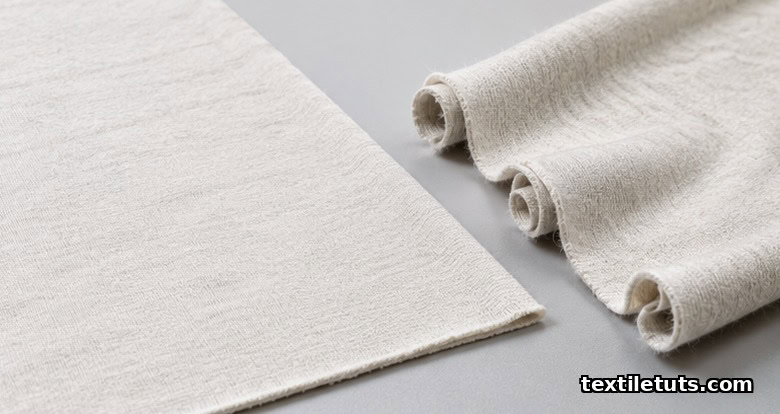
An anti-curl finish is a chemical or mechanical textile treatment that limits edge curling in weft-knit fabrics to under 5% deformation after five home laundering cycles (AATCC TM 135, ISO 6330), typically by depositing 2 to 5% crosslinking resin solids on cellulosic knits or by heat-setting synthetic knits at 180 to 200 degrees C for 30 to 60 seconds on a tenter frame.
Edge curl is one of the most persistent problems in knit fabric production: cut edges roll inward as soon as the fabric leaves the knitting machine, complicating lay-up, cutting, and sewing.
The rest of this page walks through why knit loops curl, how heat-setting and resin finishes stop them, what process parameters to run on the stenter and pad mangle, how to test the result, and where the common defects come from.
Why Knit Fabrics Curl at the Edges
Edge curl in weft-knit fabric is a direct consequence of loop geometry. A plain jersey stitch is a non-symmetric loop: the wales (vertical columns of loops) are straighter than the courses (horizontal rows of loops). When the fabric is cut, the loops at the cut edge are free to relax into their lowest-energy state, which is the curled position. The longer loop axis (along the course) contracts while the shorter axis (along the wale) extends, and the edge rolls toward the technical face.
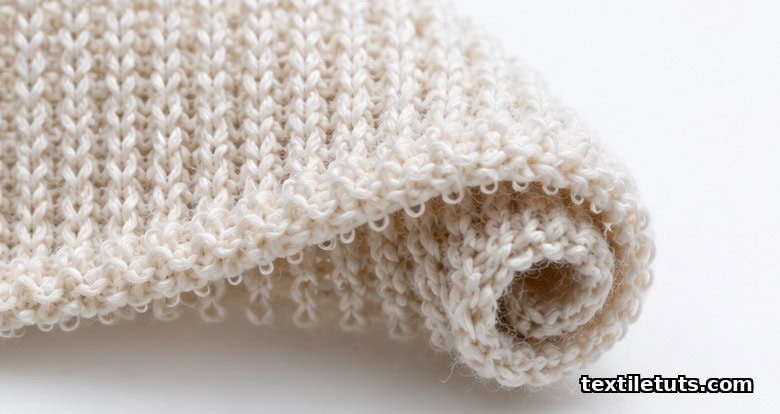
Three production factors make the problem worse:
- Yarn torque: Ring-spun and open-end spun yarns carry residual twist torque from the spinning process. In a knit loop, this torque unbalances the top and bottom arms of the loop and amplifies edge curl.
- Yarn count and twist level: Coarser counts such as Nm 24/1 or Ne 14/1 and higher twist multipliers in the TM 3.8 to 4.2 range produce more aggressive curling than finer, lower-twist yarns.
- Knitting tension: Tight machine settings store more elastic energy in the loops, which releases on the cut edge and increases both curling and spirality.
For circular knit fabrics, curl is most severe along the selvedge and at the cut ends in the cross-machine direction. Open-width weft knits (e.g., from flat knitting) curl at all four edges. Warp-knit fabrics curl far less because their stitch geometry is more symmetric and the underlaps tie adjacent wales together.
Mechanical Anti-Curl Methods
Mechanical routes fix loop geometry in place without depositing any resin on the fiber. They are the first choice for 100% synthetic knits and are preferred where formaldehyde or post-cure yellowing is a concern.
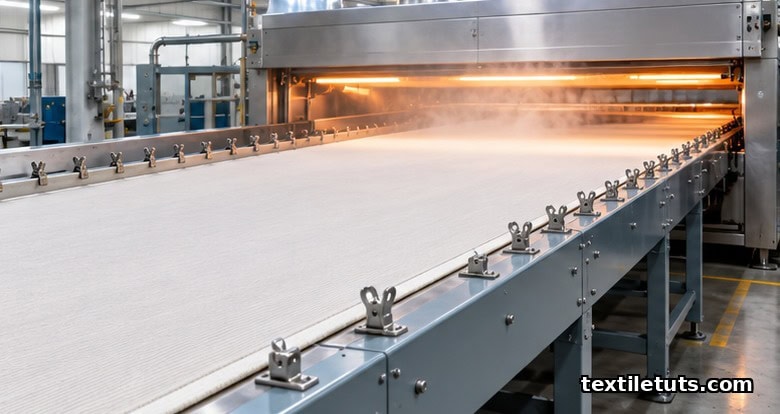
Heat-setting on a stenter
Stenter heat-setting is the dominant mechanical anti-curl route for polyester, nylon, and acrylic knits. The fabric is pinned or clip-held on a tenter frame, stretched to the target width, and passed through a heated chamber at 180 to 200 degrees C (polyester) or 160 to 180 degrees C (nylon) for 30 to 60 seconds. Above the glass transition temperature of the synthetic fiber, internal stresses relax and new crystalline crosslinks form that lock the loop geometry in place.
For polyester/cotton blends of 65/35 and 50/50, two-zone heat-setting at 180 degrees C for 40 s followed by 200 degrees C for 30 s is common to fix the polyester phase without scorching the cotton.
Compaction (Sanforization)
A compressive shrinking range uses a heated cylinder and a rubber blanket to push fabric length back into the loops. Compacted knit fabric can shrink by 5 to 8% on the first wash instead of 12 to 18% for uncompacted jersey. Compaction alone does not eliminate edge curl, but it stabilizes loop length and makes heat-setting more durable.
Edge-cutting and lay-up preparation
Edge cutting with a hot-wire or rotary cutter partly fuses thermoplastic selvedges (polyester, nylon) and limits edge curling at the cut. This is a partial solution; it does not address curl in the middle of the fabric panel, and the fused edge can be visible through light-colored garments.
Chemical Anti-Curl Methods
Chemical finishes work by depositing a polymer or crosslinking resin on the fiber surface or inside the fiber amorphous regions. They are the standard treatment for cotton and cotton-rich knits that cannot be heat-set above the cellulose scorch temperature.
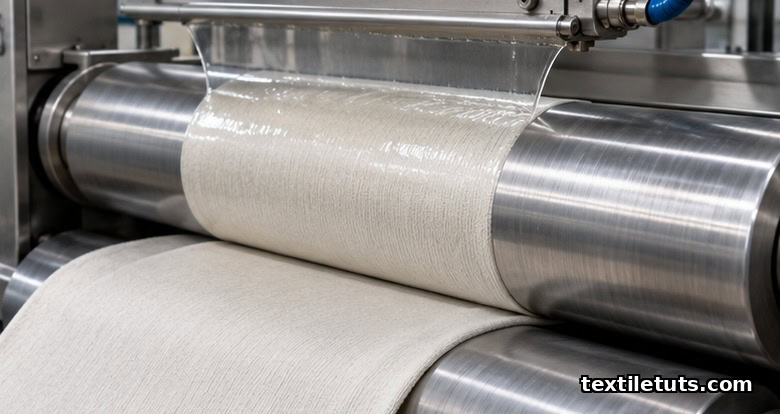
Crosslinking resins (DMDHEU and modified glyoxal)
Dimethyloldihydroxyethyleneurea (DMDHEU) and modified glyoxal resins form covalent crosslinks with cellulose hydroxyl groups. A typical pad-dry-cure sequence applies 50 to 80 g/L resin solids with 10 to 20 g/L magnesium chloride catalyst, dries at 110 to 130 degrees C, and cures at 150 to 160 degrees C for 3 to 5 minutes. This locks the cellulosic chains in their current geometry and reduces edge curl, improves wrinkle recovery angle (AATCC TM 66), and limits laundering shrinkage.
The trade-off is a 20 to 40% loss in fabric tensile strength and reduced abrasion resistance. Low-formaldehyde or formaldehyde-free glyoxal resins, sometimes called “zero-formaldehyde” finishes, cut residual formaldehyde below the OEKO-TEX Class I limit of 16 ppm for babies, with a small reduction in curl-control efficiency.
Polycarboxylic acid crosslinkers (citric acid, BTCA)
1,2,3,4-Butanetetracarboxylic acid (BTCA) and citric acid crosslink cellulose through esterification rather than the N-methylol mechanism. They are formaldehyde-free and produce durable press ratings similar to DMDHEU. BTCA is more efficient but more expensive; citric acid is widely used on cotton knits where some yellowing under high-temperature cure is acceptable. Sodium hypophosphite is the standard catalyst at 30 to 60 g/L.
Softener and silicone finishes
Silicone microemulsions and cationic softeners reduce fiber-to-fiber friction and lower bending modulus. They make curled edges easier to press flat during sewing but they do not change loop geometry, so they are not anti-curl finishes in the technical sense. A garment made from a silicone-finished knit will still curl the moment it is cut.
Process Parameters and Application Sequence
Most knit finishing lines combine a wet process (scour, bleach, dye) with mechanical and chemical finishing in this order:
- Scouring and bleaching on a jet or open-width range.
- Dyeing on a jet, pad-batch, or cold pad-batch for reactive dyes.
- Hydroextraction and stenter drying at 110 to 130 degrees C.
- Optional heat-setting on the same or a second stenter at 180 to 200 degrees C (synthetics only).
- Pad application of resin or softener if chemical finishing is in scope.
- Drying and curing at 150 to 160 degrees C for 3 to 5 minutes.
- Compaction to compress residual shrinkage.
- Final inspection, edge trimming, and rolling.
For polyester-rich knits, the heat-setting step is typically the most effective single anti-curl intervention. For cotton-rich knits, the resin pad-cure step is the primary anti-curl intervention, and heat-setting is omitted because cotton yellows and loses strength at the temperatures required.
Testing and Quality Control
Three standards cover the bulk of anti-curl QC work. TextileTuts engineers use them in the order listed below.
AATCC TM 135 — Dimensional Change After Home Laundering
TM 135 is the primary test for laundering-induced deformation. Specimens are conditioned at 21 degrees C and 65% RH (ISO 139), washed at the agreed temperature (typically 40 degrees C or 60 degrees C), tumble-dried, and measured after 1, 3, 5, and 10 cycles. An anti-curl finish should hold shrinkage at 5% or less after five cycles.
ISO 6330 — Domestic Washing and Drying Procedures
ISO 6330 mirrors TM 135 with slightly different wash procedure options (A, B, C). Many QC labs run both and report the result that fits the buyer’s specification.
BS EN 14704 — Determination of Curling Behavior of Knitted Fabrics
EN 14704 is the direct measurement of edge curl. A rectangular specimen is cut, conditioned, and the curl height and rotation are measured after a fixed relaxation time. Most mills target a curl height of 5 mm or less for outerwear knits and 10 mm or less for casualwear jersey.
Common Defects and Troubleshooting
| Defect | Probable Cause | Fix |
|---|---|---|
| Persistent edge curl after heat-setting | Stenter temperature below 180 degrees C, or dwell time under 30 s | Raise temperature 5 degrees C at a time, or slow the line by 10% |
| Yellowing after resin cure | Cure temperature above 170 degrees C, or dwell over 5 minutes | Drop cure temperature 10 degrees C, add a citric acid or BTCA system |
| High residual formaldehyde | DMDHEU resin with chloride catalyst not fully cured | Switch to modified glyoxal or polycarboxylic acid |
| Fabric feels board-like after resin | Resin solids above 5% on weight of fabric | Reduce resin concentration, add silicone softener at 5 to 10 g/L |
| Curl returns after 10 washes | Hydrolysis of crosslinks, especially with DMDHEU | Use BTCA or extended-cure DMDHEU; verify catalyst level |
Mechanical vs Chemical Anti-Curl Finishes
| Property | Heat-setting (mechanical) | Resin / crosslinking (chemical) |
|---|---|---|
| Best for fiber content | Polyester, nylon, acrylic, blends | Cotton, viscose, cotton-rich blends |
| Process temperature | 180 to 200 degrees C | 150 to 160 degrees C cure |
| Energy cost | High (stenter heat) | Moderate |
| Effect on tensile strength | Neutral to slightly positive | 20 to 40% reduction |
| Formaldehyde concern | None | DMDHEU: yes; BTCA / glyoxal: low |
| Durability of anti-curl effect | Permanent until fiber melts | Lasts 30 to 50 washes before hydrolysis |
| Effect on handle | Slight stiffening | Board-like at high resin; soft with softener blend |
| Effect on dye shade | Possible shade shift on disperse dyes | Catalyst can shift reactive dye shade |
Frequently Asked Questions
What is the difference between an anti-curl finish and an anti-spirality finish?
Anti-curl finishes target the edge-rolling behavior of cut knit loops, usually measured by EN 14704 as the curl height. Anti-spirality finishes target the diagonal wale distortion, also called yarn spirality, that comes from twist-torque imbalance in knit loops. Both problems share a root cause in loop geometry, but anti-spirality finishes often use a heat-setting step plus balanced yarn preparation rather than a resin pad-cure.
Is anti-curl finish the same as wrinkle-free finish?
They overlap but are not the same. A wrinkle-free finish (durable press, easy-care) is a resin/crosslinking treatment that lets cotton recover its flat appearance after washing and wearing. An anti-curl finish is any treatment that keeps the cut edge flat. Most anti-curl finishes on cotton knits use the same resin chemistry as wrinkle-free finishes, but they target a different end-use metric.
Will an anti-curl finish affect the absorbency or breathability of cotton knit?
Yes, modestly. Resin and crosslinking finishes reduce cotton’s water absorption by 10 to 25% because crosslinks block the hydroxyl sites that hold water. Breathability, measured as moisture vapor transmission, drops by 5 to 15% with a standard DMDHEU treatment. For sleepwear and underwear, mills typically run a softener blend to keep handle soft and partially restore absorbency.
How many wash cycles will an anti-curl finish survive?
A heat-set polyester knit keeps its anti-curl performance for the life of the garment, which is essentially permanent. A DMDHEU-treated cotton knit shows measurable curl return after 30 to 50 home laundering cycles. A BTCA-treated cotton knit holds its anti-curl performance to around 50 to 70 cycles, which is why BTCA is the preferred system for premium knit shirting.
Can an anti-curl finish be applied to a finished garment after sewing?
Not economically. The temperature and dwell required to set polyester or cure a resin on a finished garment would scorch seams, damage interlinings, and shrink the garment out of fit. Anti-curl finishing is a mill operation on greige or dyed fabric, applied before the garment is cut and sewn.
References
- AATCC. Test Method 135-2022: Dimensional Changes of Fabrics after Home Laundering. American Association of Textile Chemists and Colorists, Research Triangle Park, NC.
- ISO. ISO 6330:2021 — Domestic washing and drying procedures for textile testing. International Organization for Standardization, Geneva.
- ISO. ISO 139:2005 — Textiles — Standard atmospheres for conditioning and testing. International Organization for Standardization, Geneva.
- British Standards Institution. BS EN 14704-1:2005 — Determination of the curling behaviour of knitted fabrics. BSI, London.
- Schindler, W.D. and Hauser, P.J. Chemical Finishing of Textiles. Woodhead Publishing, Cambridge, 2004.
- Hashem, M. “An approach to achieve zero formaldehyde on cotton knit fabrics.” Carbohydrate Polymers, 2020 — peer-reviewed study on polycarboxylic acid anti-curl systems.
- ASTM. ASTM D4974-22 — Standard Test Method for Hot Air Thermal Aging of Textile Fabrics. ASTM International, West Conshohocken, PA.
This article is the working reference for anti-curl finishes in knit fabrics. Editorial by Shahrukh Islam, TextileTuts. Sources: AATCC TM 135, ISO 6330, ISO 139, BS EN 14704, ASTM D4974, and peer-reviewed finishing literature as cited.


