
Spunbond Nonwoven: Process

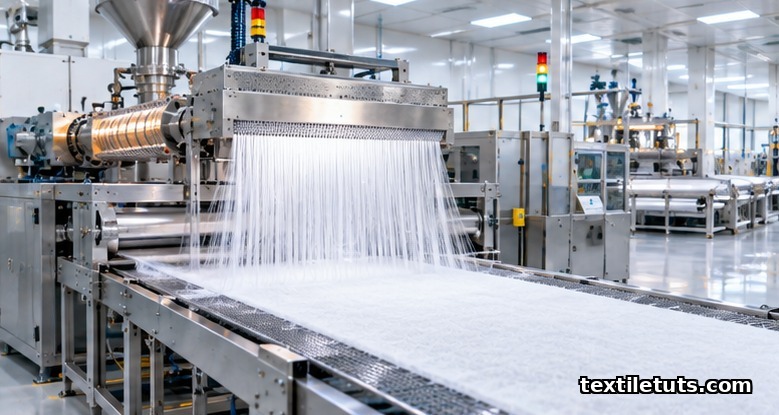
The spunbond nonwoven process extrudes molten thermoplastic polymer, typically polypropylene heated to 220 to 260 °C, through a spinneret containing 1,000 to 5,000 holes per meter to form continuous filaments of 10 to 30 μm diameter, which are attenuated by high-velocity air, deposited on a moving conveyor at 200 to 700 m/min, and thermally or mechanically bonded into a fabric with a basis weight of 10 to 200 g/m².
Spunbond is the largest nonwoven process by global tonnage, accounting for roughly 62% of all polypropylene nonwoven output in 2023, because it converts raw polymer pellets into finished fabric in a single continuous line with no yarn spinning step.
This article walks through each stage of the spunbond line, the bonding options that turn a loose filament web into a usable fabric, the process parameters that control filament fineness and tensile strength, and the polymers and applications that define where spunbond appears in industry.
What Is the Spunbond Nonwoven Process?
Spunbond is a one-step polymer-to-fabric process that converts thermoplastic pellets directly into a sheet of continuous filaments bonded into a nonwoven web. The term is defined in ISO 9092:2011, which classifies nonwovens by bonding mechanism and fiber length, and in EDANA’s harmonized terminology that distinguishes “spunbond” (continuous filament, laid and bonded) from “meltblown” (discontinuous microfibers produced by attenuated high-velocity air).
The process was commercialized in the 1960s by Freudenberg (Germany) and DuPont (United States), and it remains the dominant route for hygiene, medical, agricultural, and geotextile substrates where a strong, lint-free fabric is needed at low cost.
Step-by-Step Process
A modern spunbond line runs as a continuous sequence, with each stage tightly coupled to the next.
1. Polymer Feeding and Melting
Polymer pellets (polypropylene, polyester, polyamide, polyethylene, or polyurethane) are gravity-fed from a hopper into an extruder, where a rotating screw conveys them through a heated barrel. The melt temperature is held 20 to 40 °C above the polymer’s melting point to ensure complete fusion and a stable melt flow index (MFI). For polypropylene with a melt point of 165 °C, the extruder exit temperature is typically 220 to 260 °C, monitored by thermocouples along the barrel zones.
2. Filtration and Metering
The molten polymer passes through a packed screen filter to remove gel particles and contaminants, then through a gear pump that meters the flow at constant volumetric rate. Accurate metering is critical because it sets the final filament denier and the basis weight of the fabric.
3. Extrusion Through the Spinneret
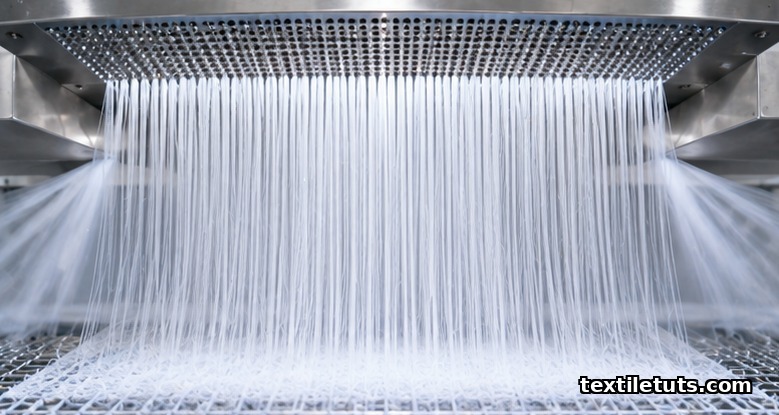
The polymer melt is forced through a spinneret, a precision plate drilled with thousands of capillaries (commonly 0.2 to 0.4 mm diameter, 1,000 to 5,000 holes per meter of die width). The filaments emerge as a curtain and are immediately quenched by conditioned air at 15 to 25 °C to solidify the fiber skin.
4. Filament Attenuation (Drawing)
Just below the spinneret, high-velocity air passes through the filament curtain in a venturi-shaped zone, attenuating the molten filaments down to their final diameter of 10 to 30 μm. Higher air velocity produces finer filaments, which in turn yield a softer, stronger web. The draw ratio in this zone typically reaches 1,000:1 to 3,000:1.
5. Web Formation on the Conveyor
The attenuated filaments are carried by the air stream and deposited in a random, isotropic pattern onto a moving wire mesh conveyor (forming belt). Belt speeds of 200 to 700 m/min are standard for hygiene-grade lines, and the deposition is controlled by an under-suction that holds the web in place before bonding. The basis weight of the fabric is determined by polymer throughput divided by belt speed and width.
6. Bonding
The unbonded web has almost no mechanical strength, so it passes immediately into a bonding zone. The four bonding methods used industrially are detailed in the next section.
7. Winding and Finishing
The bonded fabric is calendered for thickness control, surface-treated (hydrophilic, hydrophobic, antistatic, or flame-retardant finishes are applied by foam, spray, or kiss-roll), inspected optically for defects, slit to width, and wound onto cores. Roll diameters of 1.0 to 1.5 m are typical.
Bonding Methods
Bonding converts the loose filament web into a fabric with usable tensile, tear, and abrasion properties. The choice of bonding method defines the hand, strength, and end-use of the final fabric.
Thermal (Calender) Bonding
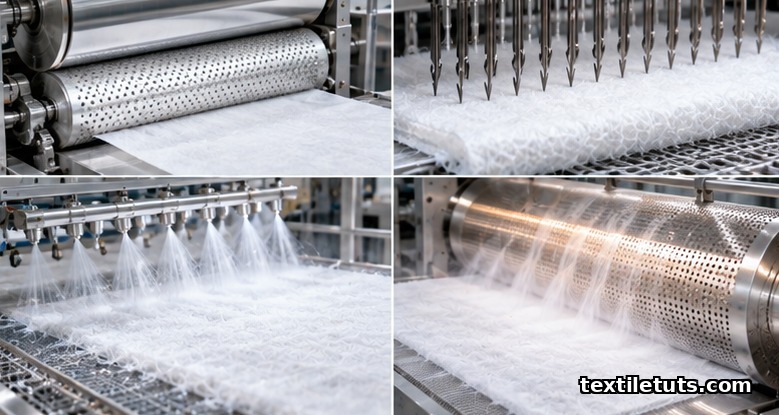
Most common. The web passes between a heated smooth roll and an engraved roll at 140 to 180 °C under a nip pressure of 30 to 80 N/mm. The engraved points fuse the filaments locally, producing a pattern of bonded areas that hold the web together. Calender bonding is fast (line speeds above 400 m/min) and yields a stiff, paper-like fabric suited to hygiene coverstock and medical drapes.
Through-Air Thermal Bonding
Hot air at 130 to 160 °C passes through the entire web thickness in a perforated drum or conveyor, fusing filaments more uniformly than calendering. The result is a softer, bulkier fabric with higher loft, used for wipes, filtration, and absorbent hygiene cores.
Mechanical (Needle Punching)
Barbed needles (typically 15 to 25 gauge, 1,500 to 5,000 needles per meter) punch through the web, entangling filaments vertically. Needle-punched spunbond is bulky and strong, used in geotextiles, automotive carpet backing, and roofing substrates where high tensile strength and permeability are needed.
Hydroentanglement (Spunlace)
High-pressure water jets (50 to 400 bar) strike the web on a moving wire, entangling filaments without needles. Spunlace produces the softest spunbond and is widely used for wet wipes and facial masks, but it is capital-intensive and limited in throughput compared to thermal bonding.
Chemical Bonding
A binder resin (acrylic, styrene-butadiene, or vinyl acetate) is applied by foam, spray, or print, then cured in an oven. Chemical bonding is common in lightweight products and in products requiring specific absorbency or flame properties, but it has declined in market share due to the rise of inline thermal bonding.
Key Process Parameters and Their Effects
Five variables dominate spunbond fabric properties. Engineers tune these to hit a target specification.
| Parameter | Typical Range | Effect on Fabric |
|---|---|---|
| Melt temperature | 220 to 260 °C (PP) | Higher melt lowers viscosity, finer filaments |
| Throughput per hole | 0.1 to 1.0 g/min | Higher throughput = coarser filaments, higher basis weight |
| Air draw velocity | 3,000 to 10,000 m/min | Finer filaments, higher tensile strength |
| Bonding temperature | 140 to 180 °C (PP) | Higher temperature = stiffer, stronger fabric |
| Conveyor speed | 200 to 700 m/min | Faster belt = lower basis weight at fixed throughput |
Filament diameter is a useful proxy for fabric performance: ASTM D1117 (standard guide for evaluating nonwoven fabrics) lists fineness as a key classification metric, and industry data shows that reducing filament denier from 2.5 to 1.5 dpf raises web tensile strength by roughly 30% at equal basis weight.
Polymer Selection and Material Properties
Polypropylene accounts for roughly 70% of global spunbond output because of its low melt viscosity, low cost (USD 1.0 to 1.4/kg in 2024), and broad FDA and EU food-contact approvals. Polyester (PET) follows at about 20% and is favored where higher temperature resistance (continuous use up to 150 °C) and UV stability are required, for example in roofing and automotive applications. Polyamide (PA6, PA66) and polyethylene are specialty choices used in roughly 5% and 3% of spunbond tonnage respectively.
A 2024 review in the Journal of Industrial Textiles reports that polypropylene spunbond exhibits tensile strength of 25 to 80 N/5 cm (depending on basis weight), elongation at break of 40 to 80%, and air permeability of 100 to 1,500 L/m²/s under ASTM D737, properties that make it a default choice for hygiene coverstock.
Comparison: Spunbond vs Meltblown vs SMS
Spunbond is often combined with meltblown to make composite fabrics. The most common composite is SMS (Spunbond-Meltblown-Spunbond), used in medical gowns and surgical drapes.
| Property | Spunbond (PP) | Meltblown (PP) | SMS (PP composite) |
|---|---|---|---|
| Filament type | Continuous | Discontinuous microfibers | Continuous + microfiber |
| Filament diameter | 10 to 30 μm | 1 to 5 μm | 10 to 30 μm + 1 to 5 μm |
| Basis weight | 10 to 200 g/m² | 5 to 80 g/m² | 15 to 100 g/m² |
| Filtration efficiency | Low | High (≥99% at 0.3 μm) | High (barrier layer) |
| Main use | Coverstock, geotextile | Filter media | Medical, hygiene barrier |
SMS is a true trilayer laminate, where the meltblown middle layer provides the fine-pore barrier and the spunbond outer layers provide strength and abrasion resistance. ASTM F2100 (Standard Specification for Performance of Materials Used in Medical Face Masks) grades SMS fabrics by bacterial filtration efficiency (BFE) and differential pressure, with Level 1 requiring BFE ≥ 95%.
Applications
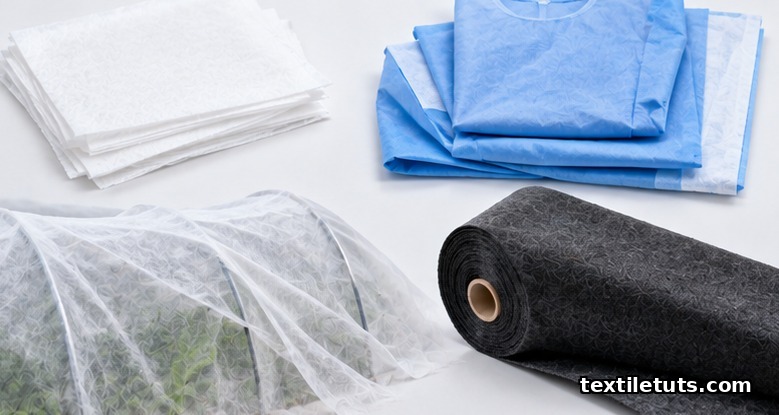
Spunbond nonwovens appear in five major markets. Hygiene (baby diapers, feminine care, adult incontinence) consumes about 30% of global spunbond tonnage. Medical products (gowns, drapes, masks, sterilization wrap) account for roughly 15%. Agricultural and horticultural covers (crop mulch, ground covers, greenhouse shading) take about 12%. Geotextiles and civil engineering (road stabilization, erosion control, roofing underlay) consume 18%. The remaining 25% spreads across furniture, automotive (carpet backing, headliner substrate), filtration, and packaging.
Frequently Asked Questions
What is the difference between spunbond and meltblown nonwoven?
Spunbond uses continuous filaments of 10 to 30 μm diameter and produces a strong, breathable web; meltblown uses discontinuous microfibers of 1 to 5 μm diameter and produces a dense, fine-pore barrier web. The two are often combined into SMS composites for medical applications where both strength and filtration are required.
What polymers are used in the spunbond process?
Polypropylene accounts for roughly 70% of global spunbond output, followed by polyester (PET) at about 20%, with polyamide, polyethylene, and polyurethane making up the remainder. The polymer choice sets the melt-processing window, the bonding temperature, and the end-use temperature and chemical resistance of the fabric.
What is the typical production speed of a spunbond line?
Modern spunbond lines run at 200 to 700 m/min, with the fastest hygiene-grade lines exceeding 800 m/min. Production speed depends on polymer type, filament fineness, basis weight, and bonding method; thermal calender bonding supports higher speeds than needle punching or hydroentanglement.
Is spunbond nonwoven fabric biodegradable?
Standard polypropylene and polyester spunbond fabrics are not biodegradable and persist in the environment for decades, which is a recognized limitation. Bio-based spunbond alternatives using PLA (polylactic acid) are commercially available and degrade under industrial composting conditions per ISO 17088, but they currently account for less than 2% of total spunbond output.
How is spunbond nonwoven tested for quality?
Standard tests include basis weight (ISO 9073-1 or ASTM D3776), thickness (ISO 9073-2), tensile strength (ISO 9073-3 or ASTM D5035), elongation at break, air permeability (ASTM D737), and hydrostatic head (ISO 811). Medical-grade SMS is additionally tested to ASTM F2100 for bacterial filtration efficiency and ASTM F1862 for fluid resistance.
References
- International Organization for Standardization. ISO 9092:2011, Textiles — Nonwovens — Definition. iso.org — definition and classification of nonwovens.
- International Organization for Standardization. ISO 9073-1:2023, Nonwovens — Test methods for nonwovens used in absorbent hygiene products. iso.org — basis weight, thickness, and tensile test methods.
- ASTM International. ASTM D1117-17, Standard Guide for Evaluating Nonwoven Fabrics. astm.org — classification and property test methods for nonwovens.
- ASTM International. ASTM F2100-23, Standard Specification for Performance of Materials Used in Medical Face Masks. astm.org — barrier performance grading for medical SMS fabrics.
- EDANA. Harmonized Terminology for the Nonwoven and Related Industries. edana.org — industry definitions for spunbond, meltblown, and SMS.
- Midha, V. K., and A. Mukhopadhyay. “Spunbond Technology and Nonwoven Fabrics: A Review.” Journal of Industrial Textiles, vol. 53, 2024, pp. 1 to 35, doi:10.1177/15280837241255612 — peer-reviewed process and material review.
This article is the working reference for the spunbond nonwoven manufacturing process. Editorial by Md. Asad Ullah (Meem), TextileTuts. Sources: ISO 9092:2011, ISO 9073-1:2023, ASTM D1117-17, ASTM F2100-23, EDANA harmonized terminology, and Midha and Mukhopadhyay (2024) as cited.


