
Meltblown Nonwoven: Filtration

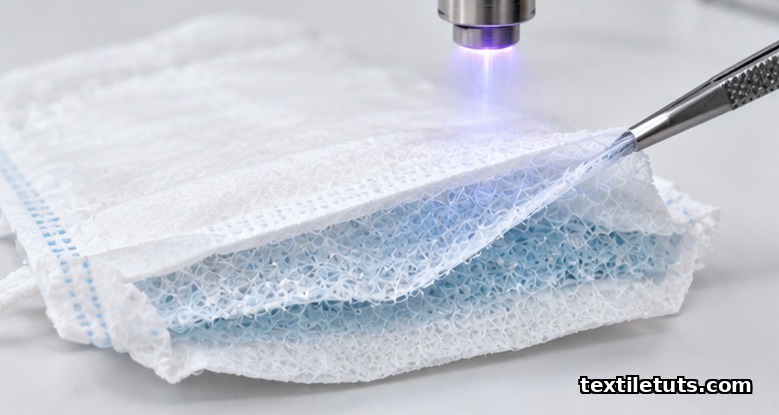
Meltblown nonwoven is a microfiber web with average fiber diameters of 1–5 µm and basis weights of 20–100 g/m², used as the electret-charged filtration layer that captures 95% of 0.3 µm sodium-chloride aerosols in NIOSH-certified N95 respirators. The same web, when charged to a surface potential above 500 V, raises bacterial filtration efficiency above 99% under ASTM F2101 testing, which is why almost every surgical mask, N95, FFP2, and KN95 respirator built since 2020 uses a polypropylene meltblown layer at its core.
This article walks through the polymer physics, the line design, the four capture mechanisms, the test standards (ASTM F2101, ASTM F2299, EN 14683, GB 2626, NIOSH 42 CFR Part 84), and the practical numbers a textile engineer needs to evaluate a meltblown filter medium.
What a meltblown nonwoven actually is
Meltblown is one of the three dominant polymer-laid nonwoven processes, alongside spunbond and spunlace. The line takes polymer pellets (most often polypropylene with a melt flow rate of 800–1800 g/10 min), melts them in an extruder at 230–290 °C, and forces the melt through a die containing 20–40 holes per inch. As the filaments exit, they are attenuated by two converging high-velocity air streams (primary air at 250–500 m/s and secondary air at 5–15 m/s), which stretch the polymer to fiber diameters 10–50 times thinner than a human hair.
The fibers deposit on a moving collector at 5–60 m/min in a random, self-bonded web. There are no binder fibers, no thermal calendering for bonding, and almost no orientation — properties that give meltblown its defining combination: very small pores, very high surface area, very low basis weight, and a soft, drapeable hand.
| Property | Meltblown | Spunbond | Spunlace (hydroentangled) |
|---|---|---|---|
| Typical fiber diameter | 1–5 µm | 15–35 µm | 10–25 µm (after splitting) |
| Basis weight range | 15–200 g/m² | 10–200 g/m² | 30–300 g/m² |
| Pore size (mean flow) | 5–25 µm | 80–500 µm | 30–150 µm |
| Filtration role | Primary fine filter | Carrier / outer cover | Wipe substrate |
| Typical polymer | Polypropylene (PP) | PP, PET, PA | Viscose, PET, cotton blends |
The four capture mechanisms inside a meltblown web
Air filtration through a meltblown web is rarely a simple sieve. Most penetrating particles are an order of magnitude smaller than the largest pores, so mechanical sieving contributes less than 40% of overall capture in an uncharged web. The other 60% comes from three particle-velocity-dependent mechanisms and, for electrets, a fourth.

Interception occurs when a particle following a streamline passes within one particle radius of a fiber. For a 0.3 µm droplet and a 3 µm fiber, interception removes particles efficiently in the 0.1–1 µm range and contributes 25–35% of single-fiber capture in a balanced filter.
Inertial impaction acts on larger or denser particles (typically >1 µm at face velocities near 0.1 m/s) that cannot follow curving streamlines around a fiber and collide with it instead. Above 5 µm, impaction dominates single-fiber efficiency and is the main reason rough dust is removed quickly at the front of a filter.
Diffusion (Brownian motion) takes over for ultrafine particles below 0.1 µm. Because thermal motion scales with smaller mass, particles in the 0.01–0.1 µm range wander across streamlines, collide with fibers, and are captured. The most-penetrating particle size (MPPS) for uncharged meltblown webs sits near 0.3 µm, where diffusion is weak and impaction has not yet engaged.
Electrostatic attraction is the force multiplier. When the polypropylene web is charged in a corona or hydrocharge field, the fibers become electrets — quasi-permanent dipoles holding a surface potential of 500–1500 V. Charged fibers attract oppositely charged or polarized particles even when the particle is far smaller than the pore, dragging sub-MPPS particles out of the airstream. This is why an N95 with 25 g/m² electret meltblown can match the filtration of a 200 g/m² uncharged web at comparable pressure drop.
How the line is set up for filtration grades
Three dial-up variables define a filtration-grade meltblown: polymer MFI, die-to-collector distance (DCD), and process air. Raising the MFI from 800 to 1500 g/10 min drops mean fiber diameter from roughly 4 µm to 2 µm at constant air pressure, because lower-viscosity polymer attenuates more readily. DCD is held tight at 100–250 mm for fine filtration grades, because longer flight times let coarse fibers form and reduce quality factor.

Process air temperature controls fiber bonding and surface area. Hot secondary air above 230 °C partially fuses fiber crossover points and yields a softer, lower-pressure-drop web; cold air below 150 °C produces a stiffer web with more loft. For respirator media, secondary air typically lands in the 200–240 °C window. Web speed ties to throughput — a 1.6 m wide line running at 30 m/min produces about 4 tonnes of meltblown per day at 25 g/m².
After laydown, the web is electret-charged. The two commercial routes are corona charging (5–30 kV across a wire electrode 10–25 mm above the web) and hydrocharging (water droplets carrying surface charge impinge on the web and bury the charge at fiber crossover points). Hydrocharging produces more thermally stable charges — important for meltblown that will be sterilized by autoclaving at 121 °C or stored for months in tropical humidity.
Test standards that define the performance numbers
Five standards cover almost every filtration claim on a meltblown data sheet. Knowing which test produced which number keeps the comparison honest.
ASTM F2101 measures bacterial filtration efficiency (BFE) of medical face masks using Staphylococcus aureus aerosol with a mean particle size of about 3 µm at a flow rate of 28.3 L/min. The percentage of colony-forming units blocked by the mask versus the control is reported. Surgical mask Type IIR (EN 14683) requires BFE ≥ 98%; the electret meltblown layer inside typically scores 99.5–99.9%.
ASTM F2299 measures particle filtration efficiency (PFE) using latex sphere or NaCl aerosol at 0.1–5 µm, again at a face velocity that mimics human breathing. PFE numbers are higher than BFE for the same medium because the test aerosol is monodisperse and the flow path is shorter.
NIOSH 42 CFR Part 84 is the U.S. respirator certification test. N95 filters must capture ≥ 95% of a 0.3 µm NaCl aerosol at 85 L/min (representing heavy work), with inhalation resistance ≤ 343 Pa and exhalation ≤ 245 Pa. FFP2 (EN 149) uses the same NaCl challenge but requires ≥ 94% capture at 95 L/min.
GB 2626-2019 sets the Chinese KN95 threshold at ≥ 95% on NaCl and ≥ 95% on paraffin oil at 85 L/min — a stricter dual-aerosol test that often differentiates between electrets charged by different routes, because oil aerosols discharge PP electrets faster than salt aerosols do.
EN 14683 is the European surgical-mask standard. It specifies BFE (≥ 95% Type I, ≥ 98% Type II/IIR), splash resistance (Type IIR), and differential pressure (breathability, ≤ 49 Pa/cm² for Type IIR). Meltblown in Type IIR masks is typically 25 g/m² electret PP with BFE above 99% and ΔP around 35–45 Pa/cm².
Quality factor: the single number that compares filters fairly
A filter with 99% capture and 50 Pa pressure drop is not automatically better than one with 95% capture and 25 Pa. The standard “quality factor” QF normalizes capture against pressure drop on a log scale:
QF = −ln(1 − E) / ΔP, where E is fractional efficiency (0.99 for 99%) and ΔP is pressure drop in pascals at the test face velocity. QF is reported in Pa⁻¹.
Commercial electret meltblown for N95 masks typically delivers QF of 0.20–0.35 Pa⁻¹. Uncharged meltblown of the same basis weight sits near 0.05–0.10 Pa⁻¹. Crossing 0.30 Pa⁻¹ generally requires hydrocharged PP with a basis weight of 25–40 g/m² and a tight DCD below 200 mm. Most published industrial filter media cite QF on NaCl; oil-loaded QF is typically 30–50% lower because the electrostatic component is partially deactivated by the dielectric oil.
Where meltblown filtration fails in the field
Three failure modes show up in real-world audits. First, charge decay: polypropylene electrets lose 30–50% of surface charge within 24 months at 25 °C and 50% RH, and more than 80% after a single 121 °C autoclave cycle. Masks that pass ASTM F2101 fresh off the line can fail PFE two years later if stored at high humidity. Second, oil aerosol loading: paraffin oil (used in some industrial respirator tests) wets PP electrets and collapses electrostatic capture; this is why GB 2626 tests both NaCl and oil, and why P100 / oil-only ratings use different web chemistries such as acrylic electrets or meltblown-staple blends. Third, mechanical loading: saliva, dust, and skin oils add pressure drop fast. A clean 25 g/m² mask with ΔP of 15 Pa can climb above 200 Pa within 8 hours of wear, which is why single-use respirators are not designed for re-use beyond a shift.
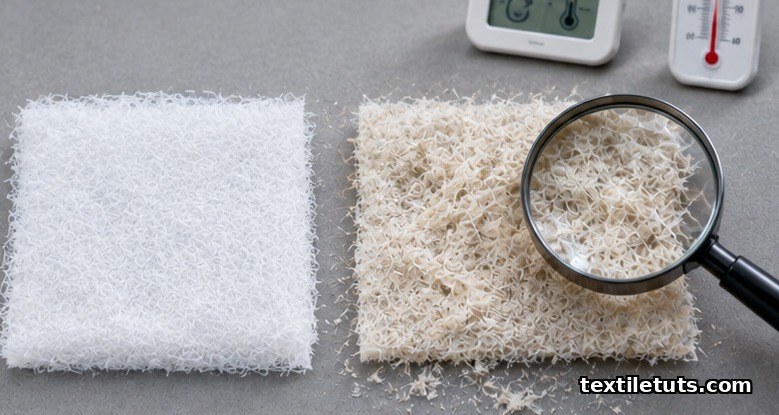
A fourth, less-discussed failure is microdefect shedding. Meltblown lines run at very high primary-air pressure, and any die-tip fouling releases loose fiber fragments that end up in the airstream downstream. A 25 g/m² web can shed 5–15 mg of fiber per square meter if the die is not cleaned at the 8-hour mark, which is why cleanroom-laid meltblown for surgical applications commands a 20–40% price premium over commodity respirator stock.
Frequently Asked Questions
What is the difference between meltblown and spunbond in a face mask?
Spunbond is the outer (cover stock) and inner (skin-contact) layer, with fiber diameters of 15–35 µm and visible pores that block only large droplets. Meltblown is the middle layer, with fiber diameters of 1–5 µm and pores of 5–25 µm, charged to capture sub-micron aerosols. A mask without meltblown is a cloth mask; a mask with meltblown is a respirator-grade mask.
How long does the electrostatic charge on meltblown last?
Untreated electret meltblown stored at 21 °C and 50% relative humidity retains roughly 70% of its initial surface potential after 12 months and 50% after 24 months, per accelerated shelf-life studies on polypropylene electrets. Storage above 40 °C or above 80% RH shortens this window sharply. Hydrocharged webs outlive corona-charged webs at high humidity by 20–40%.
Can meltblown be recycled?
Pure PP meltblown is thermoplastic and mechanically recyclable into lower-grade nonwovens (carpet backing, automotive insulation). Mixed-media masks with spunbond–meltblown–spunbond construction are harder to recycle because the layers must be separated first; mechanical recycling yields a downcycled PP blend. Chemical recycling to monomer is feasible but not yet economic at mask volumes.
Why does N95 use 0.3 µm as the test particle?
0.3 µm is the most-penetrating particle size (MPPS) for mechanical filters: particles larger than this are caught by impaction and interception, while smaller particles diffuse randomly into fibers. The 0.3 µm NaCl test therefore gives a conservative filter rating — a filter that captures 95% at the MPPS captures ≥ 99% at any other size in the 0.01–10 µm range.
Is meltblown the same as nanofiber?
No. Nanofiber nonwovens, typically produced by electrospinning or force-spinning, have fiber diameters of 50–500 nm (0.05–0.5 µm), an order of magnitude finer than meltblown. Nanofiber webs can match meltblown filtration at lower basis weight (5–10 g/m²) but are more expensive and slower to produce, which is why meltblown remains the dominant filtration medium at scale.
References
- ISO. ISO 14683:2019 — Medical face masks — Test methods for bacterial filtration efficiency, breathability and splash resistance. International Organization for Standardization.
- ASTM International. ASTM F2101-19 — Standard Test Method for Evaluating the Bacterial Filtration Efficiency (BFE) of Medical Face Mask Materials. ASTM International.
- NIOSH. 42 CFR Part 84 — Respiratory Protective Devices. U.S. National Institute for Occupational Safety and Health.
- Podgórski, A., Bałazy, A., & Gradoń, L. (2006). Application of nanofibers to improve the filtration efficiency of the most penetrating aerosol particles in fibrous filters. Chemical Engineering Science, 61(20), 6804–6815. ScienceDirect.
- Romay, F. J., Liu, B. Y. H., & Chae, S. J. (1998). Experimental study of electrostatic capture mechanisms in commercial electret filters. Aerosol Science and Technology, 28(3), 224–234. Taylor & Francis.
- European Committee for Standardization. EN 14683:2019+AC:2019 — Medical face masks — Requirements and test methods. CEN.
This article is the working reference for meltblown nonwoven filtration media. Editorial by Md. Asad Ullah (Meem), TextileTuts. Sources: ISO 14683, ASTM F2101, NIOSH 42 CFR Part 84, ScienceDirect, Taylor & Francis, EN 14683, as cited.


