
Spray Printing

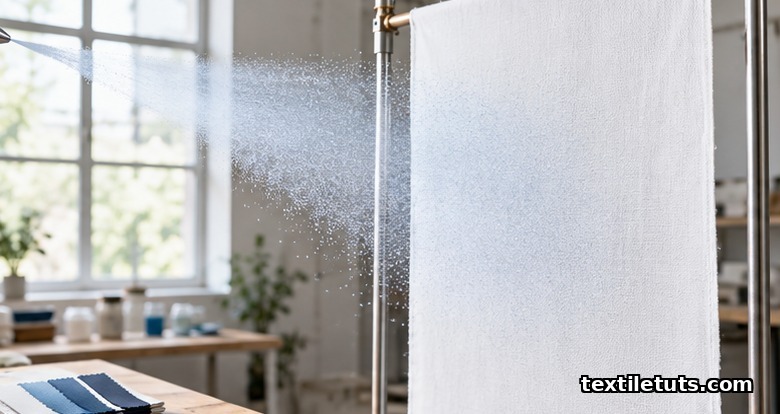
Spray printing applies dye or pigment to fabric through a nozzle that atomizes the liquid at working pressures of 2 to 4 bar, producing droplet diameters of 10 to 100 micrometers and color add-on rates of 15 to 40 grams per square meter for typical textile applications.
Unlike screen or digital inkjet methods, spray printing uses compressed air or electrostatic forces to disperse colorant onto fabric without a screen, plate, or digital print head, which makes it well suited for sample yardage, one-off designs, and surface-effect work such as ombres, gradients, and distressing.
This article covers how spray printing works, the equipment and chemistry involved, where textile manufacturers use it commercially, and how sprayed fabrics are tested for colorfastness against ISO and AATCC standards.
How Spray Printing Differs From Screen and Inkjet Printing
Spray printing is a non-contact, low-pressure coloration method in which a liquid colorant is broken into a fine mist and deposited onto fabric through a controlled spray pattern. It differs from screen printing in three measurable ways. First, no mesh or stencil is required, which removes the per-design tooling cost and the screen-fabrication step. Second, atomization produces soft, overlapping droplet edges rather than the sharp boundaries of a screen-printed motif. Third, material utilization in an enclosed booth is typically 70 to 90 percent, compared with 40 to 65 percent for hand-screen printing, because overspray can be recovered at the booth wall or filtered from the exhaust stream.
Spray printing also differs from digital inkjet printing. Inkjet ejects droplets from a print head under piezo or thermal actuation, with droplet volumes of 1 to 20 picoliters and drop-on-demand placement that produces a defined pixel grid. Spray application relies on continuous or air-assisted atomization, which yields larger droplets and a softer pattern definition. The trade-off is flexibility: a single spray system can switch between fabrics, garments, and three-dimensional objects without re-engineering the print head, which is harder for inkjet on curved or textured surfaces.
Atomization Principles and Process Parameters
Three atomization routes are used in textile spray printing. Pneumatic atomization uses compressed air at 2 to 6 bar to shear a liquid stream into droplets through a venturi or external-mix nozzle. Hydraulic atomization forces liquid through a small orifice under pressure alone, producing a coarser spray at 0.5 to 2 bar and droplet sizes above 100 micrometers. Electrostatic atomization charges droplets in the 5 to 30 micrometer range and drives them toward a grounded substrate, increasing transfer efficiency above 85 percent in well-tuned industrial systems.
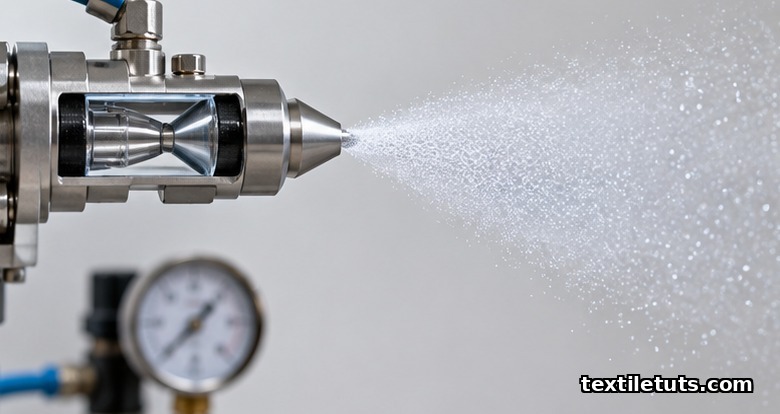
Key process variables are nozzle geometry, atomization pressure, traverse or conveyor speed, fabric wetness, and drying rate. For pigment sprays on woven cotton, working pressures of 2 to 3 bar with a 0.5 to 0.8 mm orifice and a wet add-on of 25 to 35 g/m² give uniform coverage in a single pass. For reactive dye sprays on cellulosic fabrics, dye concentration of 20 to 80 g/L, urea at 50 to 100 g/L, and a fix temperature of 150 to 160 °C for 2 to 3 minutes are common in published process recipes.
Colorants, Auxiliaries, and Substrate Preparation
Pigments, reactive dyes, acid dyes, and disperse dyes can all be sprayed, but pigment systems dominate because pigments require only binder curing rather than heat- or chemical-driven fixation. A typical spray-printing pigment paste contains 5 to 15 percent pigment, 10 to 25 percent acrylic or styrene-butadiene binder, 0.5 to 2 percent thickener, 1 to 3 percent wetting agent, and 1 to 5 percent crosslinker, with water making up the balance. The binder film is cured at 140 to 160 °C for 2 to 3 minutes, which anchors pigment particles to fiber surfaces.
Reactive dye sprays are used on cotton, viscose, and linen. The spray liquor contains the reactive dye at 20 to 60 g/L, sodium alginate thickener at 5 to 10 g/L to control droplet spread on the fabric, alkali (sodium carbonate) at 10 to 20 g/L, and urea at 50 to 100 g/L as a dye-dissolving aid. After spray application, the fabric is dried at 80 to 100 °C and then steamed or cured at 150 to 160 °C to form the dye-fiber covalent bond. Acid dye sprays follow a similar recipe for wool and silk, with acetic acid replacing alkali and a curing step at 100 to 110 °C.
Equipment and Workflow
Entry-level studios use HVLP (high volume low pressure) or LVLP (low volume low pressure) airbrushes driven by small compressors, with 0.3 to 0.8 mm nozzles for fine detail and 1.0 to 1.4 mm nozzles for coverage work. Production lines use reciprocating spray heads mounted over a conveyor belt, with the fabric moving at 5 to 30 m/min under one or more passes. Industrial systems are typically enclosed booths with water-curtain exhaust treatment to capture airborne dye and pigment, a critical feature because aerosolized colorants are respiratory hazards.
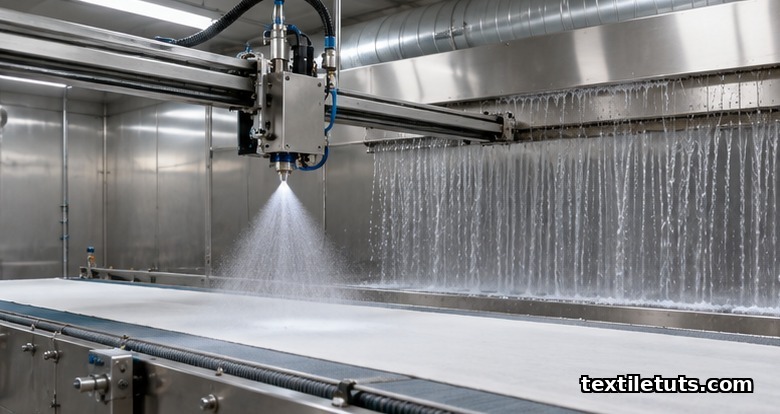
For repeatable pattern work, manufacturers use laser- or router-cut stencils, frameless Mylar templates, or programmable XY gantries that move the spray nozzle over a stationary fabric. In digital spray printing, the nozzle path is computer-controlled without a physical stencil, and the design file drives the spray head the same way an inkjet printer receives its image data, but with a coarser pattern unit and a higher wet add-on per pass.
Commercial Applications
Spray printing is widely used in three commercial settings. First, sample development and showroom yardage, where designers need 1 to 5 meter samples of a design for review before committing to a screen or digital print run. The cost of a spray-printed sample is typically 20 to 40 percent of the equivalent screen-printed sample, which is why most European and Asian design studios keep at least one spray booth for development work. Second, garment finishing effects such as stone-wash looks, distressed denim, color-spray fashion, and burnout effects, where the goal is irregular coverage rather than a defined pattern. Third, technical textile coatings, where functional finishes (water repellents, antimicrobials, UV blockers, flame retardants) are sprayed rather than padded to control add-on and reduce chemical use.
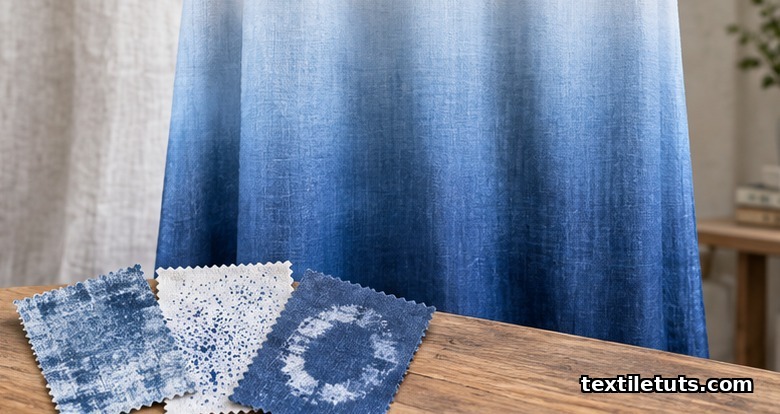
Smaller-volume niches include custom footwear uppers, hat crowns, automotive interior panels, and bespoke bridal fabrics. In each case, spray printing offers setup flexibility that screen or inkjet cannot match for short runs or for substrates with curved or textured surfaces.
Colorfastness and Performance Testing
Sprayed fabrics are evaluated against the same ISO 105 and AATCC colorfastness standards used for screen-printed and digitally printed textiles. Colorfastness to crocking (rubbing) is tested under ISO 105-X12 or AATCC Test Method 8, with wet and dry crock ratings reported on a 1 to 5 grey scale (5 = no transfer). For pigment-sprayed cotton, dry crock ratings of 3 to 4 and wet crock ratings of 2 to 3 are typical without resin treatment; with a correct binder and crosslinker load, both ratings rise to 4 to 5. ISO 105-B02 (Xenon arc light) and ISO 105-C06 (accelerated laundering at 40 to 60 °C) are the standard lightfastness and washfastness methods applied to sprayed fabrics, while ASTM D1729 supports visual shade-matching in production.
Comparison Table: Spray Printing vs Screen Printing vs Digital Inkjet
| Property | Spray printing | Screen printing | Digital inkjet |
|---|---|---|---|
| Setup cost (per design) | Low to medium | Medium to high (screen fabrication) | Low (file-based) |
| Run-length economy | Best under 50 m | Best above 200 m | Best above 5 m |
| Material utilization | 70 to 90 percent | 40 to 65 percent | Above 95 percent |
| Pattern resolution | 1 to 3 mm (stencil-based) | 0.1 to 0.3 mm (mesh) | 0.05 to 0.2 mm (drop) |
| Compatible substrates | Flat and 3D | Flat panels | Flat panels |
| Color changeover time | Minutes | 30 to 90 min per screen | Instant (file) |
| Typical wet add-on (g/m²) | 15 to 40 | 80 to 150 (paste) | 5 to 20 |
Frequently Asked Questions
How long does a spray-printed design last in the wash?
A correctly formulated and cured pigment spray application on cotton achieves washfastness ratings of 4 to 5 on the ISO 105-C06 grey scale after 5 to 10 home-laundering cycles, equivalent to screen-printed pigment designs. Reactive dye sprays typically perform better than pigments on cellulosics once the dye-fiber bond has formed during curing, often reaching ratings of 4 to 5 across 20 or more wash cycles. The two failure modes for spray-printed fabrics are under-cured binder (which leads to pigment loss on rubbing) and excess moisture during spray (which causes dye migration and blotchy edges).
Will spray-printed designs wash out after a few laundry cycles?
This is the most common concern, and the honest answer is that they will if the chemistry is wrong. A pigment spray with insufficient binder, below 10 percent on-weight-of-bath, will lose color visibly within 3 to 5 washes, particularly under hot-water cycles above 60 °C. A correctly bound spray application, fixed at 150 °C for 2 to 3 minutes, will hold its depth through 30 or more standard laundering cycles tested under AATCC Test Method 61. The cure step is the make-or-break variable, not the spray method itself.
Can spray printing be used on any fabric?
Spray printing works on most woven and knitted fabrics made from cotton, polyester, nylon, wool, silk, and blends. Tightly woven or water-repellent substrates require pre-wetting or plasma treatment to promote dye strike and reduce droplet beading. Very porous substrates such as nonwovens absorb too quickly, which causes wicking and blurred edges. Highly elastic fabrics above 30 percent elastane can distort during the curing step, so tension control during drying is required.
Is spray printing safe for indoor or studio use?
Spray printing is safe when the booth is exhausted, the operator wears a NIOSH-approved N95 or P100 respirator, and the colorant is water-based. Solvent-based sprays, dye-sublimation sprays, and pigment sprays containing heavy-metal colorants require local exhaust ventilation with water-curtain or HEPA filtration. Long-term exposure to aerosolized reactive dyes has been linked to respiratory sensitization in occupational studies, so a properly enclosed spray booth is non-negotiable for any production volume above sample work.
Does spray printing use more dye than screen printing?
Spray printing can use less dye per square meter because overspray is recoverable and there is no paste residue left in a screen. Water-based pigment sprays typically require 15 to 40 g/m² of wet add-on compared with 80 to 150 g/m² for a screen-print paste. The wet add-on is not the same as dye on fabric; the dried, fixed colorant load is usually lower for a spray application than for a screen print of comparable visual depth, because sprays lay a thinner, more even film.
References
- International Organization for Standardization. ISO 105-J01:1997 Textiles, Tests for colour fastness, Part J01: General principles for measurement of surface colour. iso.org. General colorimetric framework for evaluating surface colour on textile substrates.
- International Organization for Standardization. ISO 105-X12:2016 Textiles, Tests for colour fastness, Part X12: Colour fastness to rubbing. iso.org. Standard crockmeter method applied to sprayed fabrics for both wet and dry crock ratings.
- International Organization for Standardization. ISO 105-C06:2010 Textiles, Tests for colour fastness, Part C06: Colour fastness to domestic and commercial laundering. iso.org. Accelerated laundering method for washfastness at 40 to 60 °C.
- AATCC. Test Method 8-2016, Colorfastness to Crocking: AATCC Crockmeter Method. aatcc.org. North American standard for dry and wet crock fastness on printed and dyed textiles.
- AATCC. Test Method 61-2013, Colorfastness to Laundering: Accelerated. aatcc.org. Accelerated laundering test used to rate washfastness of sprayed colorants.
- ASTM International. ASTM D1729-16 Standard Practice for Visual Appraisal of Colors and Color Differences of Diffusely-Illuminated Opaque Materials. astm.org. Visual color-difference evaluation used in production shade matching of sprayed fabrics.
- Ujiie, H. (Ed.). Digital Printing of Textiles. Woodhead Publishing (now Elsevier), 2006. Reference text on textile printing methods including atomization and spray-based coloration routes.
Editorial by Shahrukh Islam, TextileTuts. Sources: ISO 105 series, AATCC Test Methods 8 and 61, ASTM D1729, and Woodhead Publishing’s Digital Printing of Textiles (2006) as cited.


