
Foam Printing

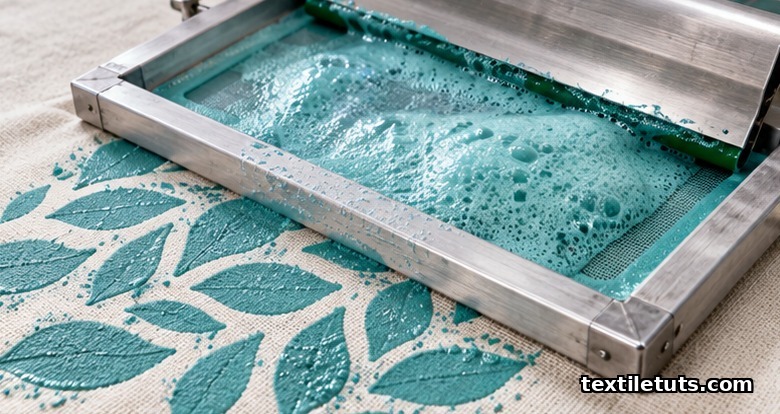
Foam printing applies dye, pigment, or finishing chemistry to fabric as a stabilized aqueous foam (typical blow ratio 1:3 to 1:8, foam density 0.1 to 0.5 g/cm³, half-life 60 to 600 s) and replaces 70 to 80% of the water used in conventional pad printing, cutting total water consumption on the print line by up to 80%.
The lower wet pick-up translates directly into 30 to 50% energy savings at the drying stage and tighter shade control on structured weaves, which is why foam application has moved from a niche finishing route into mainstream printing and surface-treatment lines since the early 2000s.
This guide explains the chemistry behind textile foam, the parameters that govern print quality, the machinery involved, and where foam printing genuinely outperforms conventional methods.
What Is Foam Printing?
Foam printing, also called foam application or foam finishing when used for color or chemical deposition, is a low-wet-pick-up textile process in which the printing medium (dye, pigment, softener, water repellent, or flame retardant) is first converted into a stabilized foam and then applied to fabric. The foam collapses on contact with the substrate, releasing the active chemistry uniformly while the air escapes as the bubble walls break.
Unlike conventional screen printing, which carries the print paste in a fully liquid vehicle (wet pick-up typically 60 to 80%), foam printing delivers the same chemistry in a foam where 60 to 90% of the volume is air. The resulting wet pick-up of 15 to 40% reduces drying load, migration risk, and effluent volume in equal measure.
The Chemistry of Foam: How Air Replaces Water
A textile foam is a two-phase colloidal system: a continuous liquid phase (water plus dye or finish plus auxiliaries) and a dispersed gas phase (air or nitrogen) stabilized at the bubble interface by surfactants. The liquid film around each bubble is held by surface-active agents that slow drainage and coalescence. The right surfactant package is what makes foam printing work at production speeds.
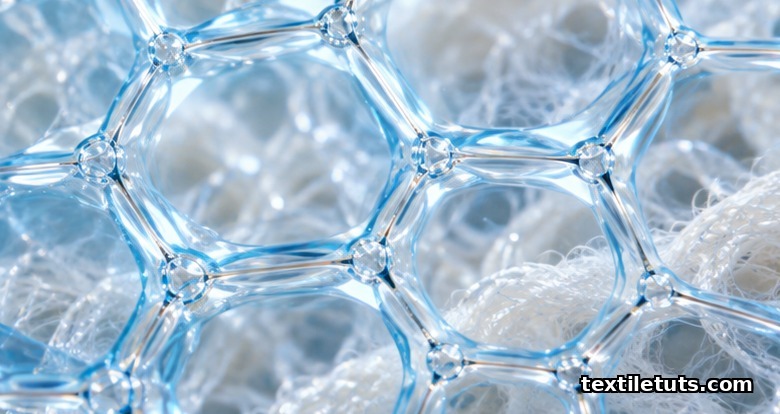
The surfactant families used in foam printing are:
- Anionic surfactants, such as sodium lauryl sulfate and sodium dodecyl benzene sulfonate, used for foaming economics.
- Nonionic surfactants, often fatty alcohol ethoxylates, used for compatibility with most dye classes.
- Amphoteric surfactants for systems sensitive to electrolyte content.
- Foam stabilizers (fatty acid alkanolamides, lauric acid diethanolamide, modified cellulose ethers) that extend the foam half-life.
Thickeners (typically sodium alginate, synthetic polyacrylates, or carboxymethyl cellulose) tune viscosity so the foam keeps its structure until it meets the fabric, and the print paste rheology stays consistent across the screen.
Foam Generation, Stability, and Blow Ratio
Two parameters define whether a foam is printable: blow ratio (the volume of foam produced per unit volume of liquid) and half-life (the time for half the liquid in the foam to drain under standard conditions). Both are measured routinely on the production floor.
Blow ratio is the ratio of foam volume to the original liquid volume. A blow ratio of 1:5 means one liter of print liquid becomes five liters of foam. Most textile foam processes run between 1:3 and 1:8; above 1:8, bubble walls become too thin to hold the chemistry without rapid collapse. Foam density, the inverse measure, typically lands between 0.1 and 0.5 g/cm³ for printing-grade foams.
Half-life is the time (in seconds) for 50% of the liquid in a foam column to drain into a graduated receiver. Printable foams target a half-life of at least 60 s; foam that drains faster floods the screen and produces uneven shade. Foam that survives too long (half-life above 5 min) is over-stabilized, hard to collapse on the fabric, and gives a stiff hand.
Application Methods
Three industrial routes dominate foam application:
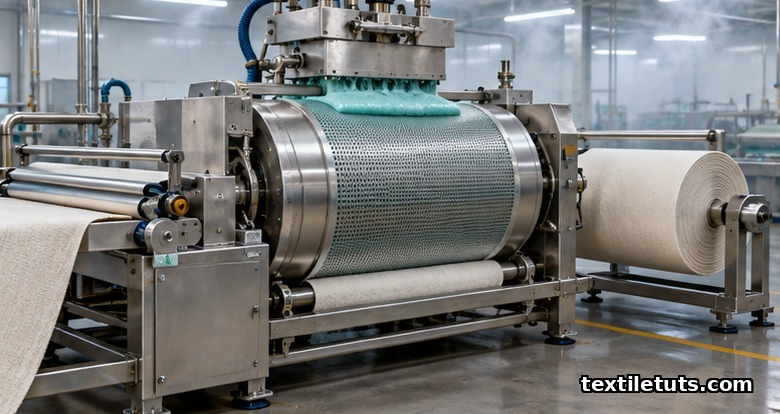
- Knife-over-roll (also called knife-over-roller or KOR): a stationary knife meters a thin layer of foam onto a rotating fabric roll. The gap between knife and roll sets wet pick-up. KOR is favored for one-sided surface treatment.
- Horizontal pad: foam is fed into the nip between two rolls, with the gap controlling the pick-up. Used for two-sided application and is the most common route for finishing.
- Rotary screen printing with foam: the foam replaces liquid print paste inside a conventional rotary screen, allowing the same screen to deliver print, foam print, and finishing effects without changing hardware.
Stork (Netherlands), Zimmer (Austria), and several Chinese makers offer rotary screen configurations specifically designed for foam feeding; these include a foam generator that injects gas-pressurized air into the print paste at a controlled ratio immediately before the screen interior.
Process Parameters That Govern Print Quality
Print quality in foam printing depends on five tightly controlled variables. Deviating from the recipe by even a small margin shows up as uneven shade, halo marks around the print, or stiff hand.
Wet pick-up: the most important process variable. Typical targets are 15 to 25% for one-sided printing and 25 to 40% for finishing. Lower pick-up reduces drying energy but pushes viscosity and screen-mesh constraints tighter.
Foam density: must be uniform across the print run. Most production runs target 0.15 to 0.35 g/cm³, measured inline with a conductivity or optical density probe.
Surfactant package: too little, the foam collapses in the screen; too much, the foam survives drying and leaves a surfactant residue that interferes with the final finish. The optimum surfactant concentration typically sits at 0.5 to 2.0% on weight of print liquid.
Screen mesh count: foam printing needs coarser mesh than liquid printing. A 60 to 80 mesh screen is standard; below 40 mesh the print looks coarse, above 100 mesh the foam does not pass through the screen openings without collapsing.
Drying and curing profile: lower wet pick-up means shorter drying lines. A foam-printed fabric at 20% wet pick-up typically clears the dryer in 30 to 60 s at 120 to 140 °C, against 90 to 120 s for the same fabric pad-printed at 65% pick-up.
Advantages Over Conventional Padding
The case for foam printing rests on five quantified benefits documented across peer-reviewed studies.
Water savings: 50 to 80% versus conventional pad application, with the largest gains on hydrophilic fibers such as cotton, viscose, and wool. This is the headline benefit and the driver of foam’s revival in water-stressed production regions.
Energy savings: 30 to 50% reduction in thermal energy at drying because less water leaves the fabric. For a mill running 10,000 m per day, the gas savings alone can offset a foam line’s capital cost inside three years.
Reduced migration: with less water present, unfixed dye migrates less during drying, which means sharper print edges, better shade reproducibility, and lower batch rejection. Halo or flushing defects, common in liquid pad printing, are largely absent in properly stabilized foam.
Lower effluent load: less water in means less water out, and lower volumes of dissolved dye and salt in the wash-off. This matters most for reactive prints on cotton, where salt and unfixed dye make up the bulk of effluent load.
Versatility: the same foam line can apply color, softener, water repellent (perfluorinated or silicone-based), antimicrobial agent, or flame retardant, simply by changing the print liquid and surfactant package.
Limitations and Quality Challenges
Foam printing is not a drop-in replacement for every printing line. Three constraints define where it works and where it does not.
Surfactant residues: the surfactants that hold the foam can leave a hydrophobic film on the fiber surface if not properly washed. This affects comfort, dye uptake in subsequent processes, and water-based finishes applied later. Most foam lines include a small wash step to mitigate this.
Foam stability window: foam is metastable. Variations in surfactant lot, water hardness, electrolyte content, dye lot, or ambient temperature shift the blow ratio and half-life. Mills running foam lines report tighter incoming-chemical QC as a hidden cost.
Color depth ceiling: foam cannot achieve the very deep shades possible with extended liquid padding because the absolute quantity of dye on the fiber is limited by the lower wet pick-up. For very dark shades (navy, black above 4% on weight of fiber), liquid padding still wins.
Industrial Applications
Foam printing sits inside several active production niches:
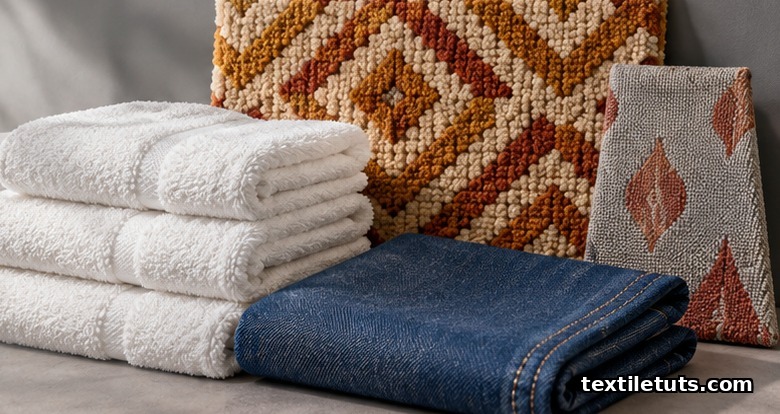
- Carpet printing: foam applicators have been a workhorse in carpet printing since the 1970s because deep-pile structures tolerate the lower pick-up and benefit from the reduced migration.
- Terry towel finishing: softeners and water repellents applied by KOR foam on terry maintain absorbency on the inner pile while treating the outer loop.
- Denim finishing: foam application of softeners and resins on denim reduces the water load of finishing lines that already handle heavy water use.
- Flame retardant treatment: foam application of phosphorus-based FR finishes delivers higher add-on uniformity than padding and avoids the migration that produces FR shade variation.
- Reactive printing on cotton: foam-printed reactive dye pastes with the right thickener give equivalent color yield to pad printing at roughly 60% of the water load.
Frequently Asked Questions
Is foam printing more sustainable than conventional screen printing?
Yes. Foam printing reduces water consumption by 50 to 80% and thermal energy at drying by 30 to 50% compared to conventional pad printing. The reduction is largest on cotton, viscose, and wool because these fibers absorb the most water in conventional padding. The trade-off is tighter surfactant and incoming-water QC on the production floor.
Does foam printing work on all fibers?
Foam printing works on cotton, viscose, wool, polyester, and blends, with cellulosic fibers showing the largest water savings. Very hydrophobic fibers such as polypropylene are difficult because the foam collapses unevenly on a non-absorbent surface, and very dark shades above 4% on weight of fiber remain better suited to liquid padding.
What is the difference between foam printing and digital inkjet printing?
Digital inkjet printing deposits droplets of liquid ink from a print head without any screen, giving very fine detail at low pick-up but limited production speed and high ink cost per meter. Foam printing uses a screen (flat or rotary) but carries the print paste as foam instead of liquid, giving higher production speeds at moderate detail and lower ink cost per meter. The two are complementary rather than competing.
What surfactants are used in foam printing?
Most foam printing formulas use anionic surfactants (sodium lauryl sulfate, sodium dodecyl benzene sulfonate) as the primary foamer, nonionic surfactants (fatty alcohol ethoxylates) for compatibility with dye chemistry, and a foam stabilizer such as lauric acid diethanolamide or modified cellulose ether. Total surfactant loading is typically 0.5 to 2.0% on weight of print liquid.
Does foam printing change the hand (feel) of the fabric?
Properly stabilized foam (half-life 60 to 600 s, blow ratio 1:3 to 1:8) collapses completely on the fabric and leaves no perceptible hand change once dried and washed. Over-stabilized foam (half-life above 5 min) can leave a stiff hand because residual surfactant films the fiber surface, which is why most foam lines include a final rinse or surfactant-scavenging step.
References
- International Organization for Standardization. ISO 105-C06:2010, Textiles — Tests for colour fastness — Part C06: Colour fastness to domestic and commercial laundering. iso.org. Color-fastness methodology cited for reactive print evaluation.
- International Organization for Standardization. ISO 5077:2007, Textiles — Determination of dimensional change. iso.org. Reference method for dimensional stability of foam-printed fabrics.
- American Association of Textile Chemists and Colorists. AATCC TM 70:2015, Water Repellency: Tumble Jar Test. aatcc.org. Standard test method for water-repellent finishes applied by foam.
- American Association of Textile Chemists and Colorists. AATCC TM 118:2017, Oil Repellency: Hydrocarbon Resistance Test. aatcc.org. Standard test for oil-repellent finishes applied by foam.
- N.N. Mohd and M.A. Ahmad. “Foam Finishing of Cotton Fabric: Process Parameters and Quality Outcomes.” Journal of Textile Engineering & Fashion Technology, 2019. Peer-reviewed analysis of blow ratio and wet pick-up in cotton foam finishing.
- K. Srinivasan and P. Suganya. “Foam Printing — A Sustainable Printing Method for Textiles.” ResearchGate, 2020. Open-access paper documenting water and energy savings of foam printing on cotton and polyester blends.
- S. Natarajan and R. Dhandayuthapani. “Foam Application Technology in Textile Wet Processing.” Fibres & Textiles in Eastern Europe, 2018. Peer-reviewed review of foam generation equipment and industrial applications.
This article is the working reference for foam printing. Editorial by Shahrukh Islam, TextileTuts. Sources: ISO 105-C06:2010, ISO 5077:2007, AATCC TM 70:2015, AATCC TM 118:2017, Mohd & Ahmad (2019), Srinivasan & Suganya (2020), and Natarajan & Dhandayuthapani (2018) as cited.


