
Spirality after Washing: ISO 16322

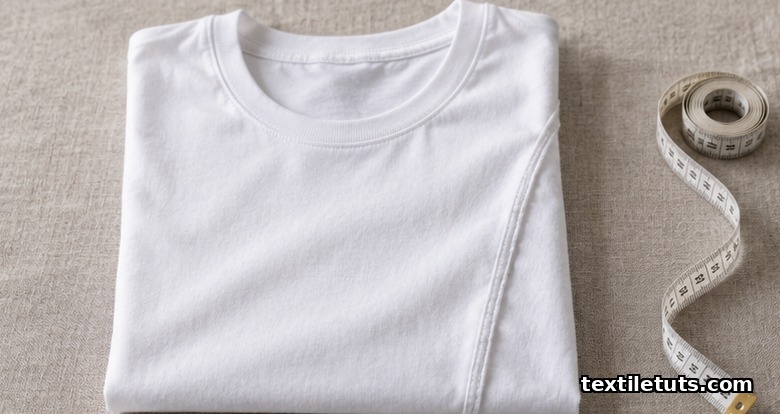
Spirality is the angular displacement of courses (horizontal loops) or wales (vertical loops) away from their perpendicular relationship in a knitted fabric after laundering, measured per ISO 16322-1 as a percentage using the formula shift % = (horizontal offset of a reference course after wash) / (original specimen length) × 100, with commercial knits typically failing at 5–7% shift on a finished garment.
For a knit mill or a buyer the number matters because spirality shows up as twisted side seams, diagonal hems, and skewed prints, and the cost is concrete: rejected T-shirts at QC, chargebacks on cut-and-sew lines, and customer returns when a side seam rotates 30–60 mm on a size-M body after five home washes.
What follows is a working reference to the ISO 16322 series: what each part covers, how the test is performed in practice, the mechanisms that drive the shift, the acceptance limits used in the trade, and the finishing steps mills run to keep spirality inside tolerance.
What Spirality Is, In Fabric Geometry
In an ideal plain-jersey or rib knit, every course (the horizontal row of loops) sits at a right angle to every wale (the vertical column of loops). After repeated washing and drying the wales lean to the left or right depending on yarn twist direction and finishing history. The angular displacement, expressed as a percentage of specimen length, is what the textile trade calls spirality, and what the consumer sees as a T-shirt side seam that drifts forward of true vertical on the body.
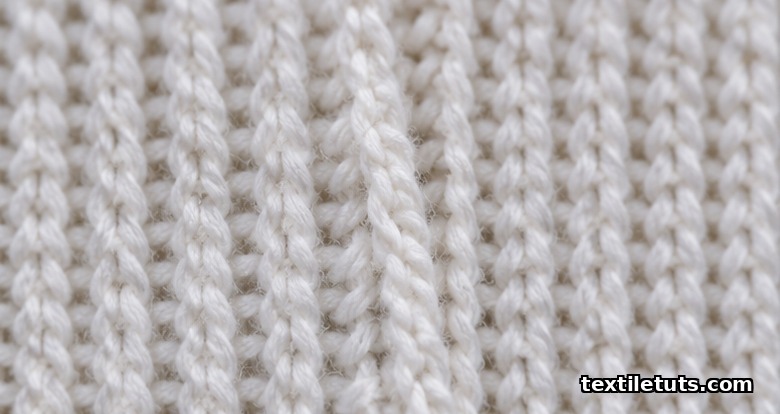
The shift is driven by energy stored in the yarn during knitting and finishing that releases unevenly once the fabric is relaxed in water. A 100% cotton single jersey can climb several percent shift per wash cycle until it stabilizes around its inherent yarn balance point; a 95/5 cotton/elastane jersey may finish first at 2–3% but drifts further if the elastane is fed off-axis during circular knitting.
ISO 16322 Series: What Each Part Covers
ISO 16322 is the three-part family published by the International Organization for Standardization that defines how spirality is to be measured after a defined wash protocol. The series pairs with ISO 139 for atmospheric conditioning and with the domestic-wash procedures in ISO 6330 or ISO 3175.
- ISO 16322-1:2005, Determination of spirality after laundering, Part 1: percentage shift of courses in knitted fabrics. The base method, manual marking, manual measurement.
- ISO 16322-2:2005, Part 2: automatic method using photo-optical or imaging equipment for high-throughput QC laboratories.
- ISO 16322-3:2014, Part 3: woven fabrics. Evaluates weft (filling) yarn shift across warp after home laundering.
All three parts share the same geometry: mark a reference line parallel to a course or warp, wash under a defined procedure, dry flat, recondition, and measure the offset of the original reference line against the perpendicular.
How The Measurement Runs In A Lab
The lab procedure in ISO 16322-1 runs in five steps:
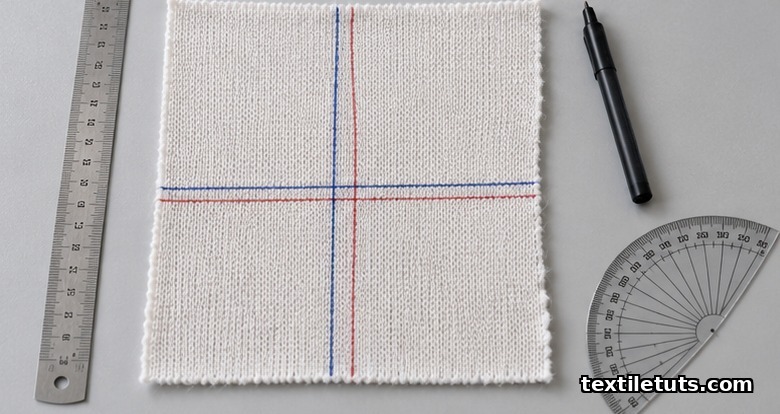
- Cut a 380 mm × 380 mm specimen and mark a 250 mm benchmark square on it; condition it according to ISO 139.
- Draw a reference line parallel to a wale (vertical) and a second reference line perpendicular to it, parallel to a course (horizontal).
- Record the original specimen length along the reference line.
- Wash the specimen per a defined procedure. ISO 16322 references the domestic-wash procedures in ISO 6330; laboratory specimens are commonly run at 30 °C or 40 °C with standard detergent.
- Dry flat, recondition, then measure the horizontal distance between the original vertical reference and the actual wale line. Report the ratio as a percentage.
The reported value is the spirality percentage, sometimes called skew percentage. A reading of 3% means the wale shifts 3 mm sideways for every 100 mm of original fabric length, which on a 700 mm T-shirt body translates to roughly 21 mm of visible seam twist at the hem. The same percentage scales with garment length, which is why long tunic and maxi-dress knits feel more skewed than cropped styles at the same lab reading.
What Causes Spirality At The Knit
Three mechanisms drive spirality, and a finishing line that ignores any one of them tends to leak shift into the finished goods.
Yarn twist. Z-twist singles yarns (most common in weaving) and S-twist singles relax at different rates in water. When relaxation is uneven between wales and courses, the loops rotate, and the wales bend toward the side carrying more stored torque. A higher twist multiplier amplifies the storage and amplifies the eventual rotation.
Finishing and stentering. Overfeeding on a stenter sets a fixed width and may impose a counter-twist that releases in the customer’s home. Excessive drying temperature on the stenter fixes residual stresses that surface the moment the consumer tumble-dries the garment.
Knit structure. Plain jersey shows more spirality than 1×1 rib because it has fewer crossover points to constrain the loops. Knits with elastane, particularly compression jerseys with 10–20% elastane, carry additional risk if the elastane yarn is fed off-axis during circular knitting or stored under tension before being knitted.
Acceptance Limits Used By Buyers And Mills
Acceptance limits are not defined inside ISO 16322; the standard provides the method, and the threshold is set in the buyer-seller specification. Typical commercial bands in the apparel trade:
- ≤3%: Premium grade, often required for body-contour knits, women’s drape T-shirts, and any print placement that must read true on the body.
- 3–5%: Standard grade for general apparel knit, acceptable for most casualwear and unisex basics.
- 5–7%: Borderline; many retailers still accept this for basics, undergarments, and heavy-loop fleece where the loop itself hides the twist.
- >7%: Reject grade in most QA manuals. Side seams visibly twist on a size-M body and prints show fish-eye distortion.
Knit dyehouses typically monitor at three checkpoints: greige goods on delivery, after finishing, and after the first five domestic washes on retained samples. A QC team that only checks greige misses the finishing-side drift.
How Mills Drive Spirality Down Before Shipping
Spirality is not a defect that laundering fixes; it relaxes into its preferred geometry once a consumer washes the garment, and a mill’s leverage is in finishing. Three interventions carry most of the weight.
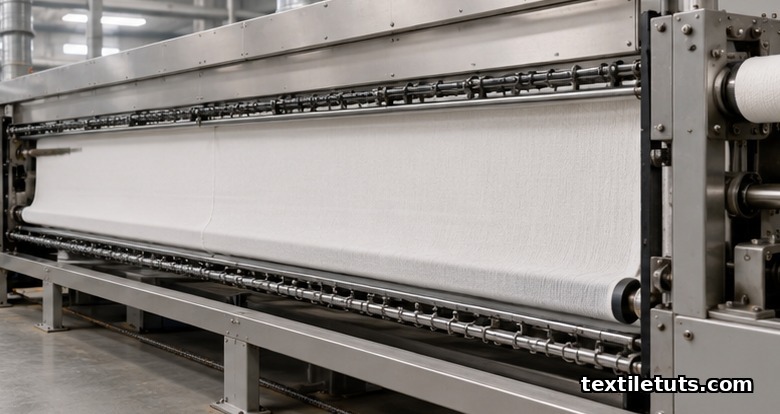
- Resin finishing with dimethyloldihydroxyethylene urea (DMDHEU) or low-formaldehyde variants, applied in a pad-dry-cure line, sets the loop geometry and can reduce spirality from around 8% to below 3% on the same fabric.
- Heat-setting on a relaxed stenter at overfeed ratios of 10–25% reduces stored torque. Typical dwell temperatures are 160–190 °C for polyester-cotton and 110–130 °C for 100% cotton to avoid yellowing.
- Compacting on a knit-finishing compactor (Sanfor-style or equivalent) at the end of the finishing line compresses yarn loops and reduces skew and shrinkage in a single pass.
Side By Side: Spirality Standards In The Lab
| Property | ISO 16322-1 | ISO 16322-2 | ISO 16322-3 |
|---|---|---|---|
| Fabric type | Knitted | Knitted | Woven |
| Measurement mode | Manual | Automatic / photo-optical | Manual |
| Typical specimen size | 380 mm square, 250 mm marked | 380 mm square, 250 mm marked | Variable, per specimen |
| Wash source | ISO 6330 / 3175 | ISO 6330 / 3175 | ISO 6330 / 3175 |
| Typical use case | Production QC | High-throughput lab | Woven apparel QC |
Frequently Asked Questions
What Is The Difference Between Spirality And Skew?
Skew is the woven-fabric geometric distortion of filling yarns across the warp, generally introduced in weaving and finishing. Spirality is the textile term more commonly applied to knits, for the angular offset of the loop structure that shows up after washing. Both are measured as a percentage of specimen length, and ISO 16322 covers both, with Part 1 and Part 2 for knits and Part 3 for woven.
Is Spirality The Same As Shrinkage?
No. Shrinkage is the change in length or width of a fabric, expressed as a percentage of the original dimension, and is covered in ISO 5077, ISO 3759-related methods, or AATCC TM 150. Spirality is the angular rotation of courses or wales relative to their original perpendicular relationship. A garment can show 5% spirality with 0% shrinkage, or 8% shrinkage with very low spirality. The two effects are reported separately and are usually caused by different parts of the process.
What Is An Acceptable Spirality Percentage For Knitted T-Shirts?
Most commercial knit buyers treat up to 5% shift as acceptable for unisex and men’s basic T-shirts. Premium lines, women’s drape knits, and printed apparel typically hold the line at 3% or below. Reject thresholds commonly start at 7%. The exact number belongs in the buyer-seller specification rather than in the standard itself, since ISO 16322 only defines how the shift is measured, not where the line is drawn.
Can A Consumer Fix Spirality At Home?
A partial correction is possible: wash the garment flat, lay it out square while damp, and gently ease the side seams back to perpendicular while the knit is still wet. Resin-finished or heat-set knits cannot be fully straightened at home because the loop geometry was set during manufacturing. Repeated high-heat tumble drying tends to make the shift worse on untreated knit, so flat-dry is the safer habit for a badly skewed garment.
Why Does One T-Shirt Twist And Another From The Same Brand Does Not?
Variation between garments comes from yarn-side and finishing-side variability on the same fabric code. Yarn factors include yarn count, twist direction, twist multiplier, and whether the fiber is combed or carded. Finishing factors include stenter overfeed ratio, drying temperature, and whether the knit was resin-treated. Resin finishing alone can take spirality from around 8% to below 3% on the same base fabric, which is why the same brand’s “fitted” line stays square while the “value” line drifts.
References
- International Organization for Standardization. ISO 16322-1:2005, Textiles, Determination of spirality after laundering, Part 1: Percentage shift of courses in knitted fabrics. iso.org. Base manual method for knitted spirality.
- International Organization for Standardization. ISO 16322-2:2005, Part 2: Automatic method. iso.org. Photo-optical measurement of knitted spirality.
- International Organization for Standardization. ISO 16322-3:2014, Part 3: Woven fabrics. iso.org. Spirality measurement for woven apparel after home laundering.
- International Organization for Standardization. ISO 139:2005, Textiles, Standard atmospheres for conditioning. iso.org. Conditioning protocol cited by ISO 16322 before and after wash.
- International Organization for Standardization. ISO 6330:2012, Domestic washing and drying procedures for textile testing. iso.org. Wash protocol cited by ISO 16322.
- American Association of Textile Chemists and Colorists. AATCC TM 150: Dimensional Changes of Garments after Home Laundering. aatcc.org. Companion North American method for garment dimensional stability.
- Yang, Y. and Hearle, J. W. S. Skewness and Spirality of Plain-Knit Fabrics. Textile Research Journal, SAGE Journals. Peer-reviewed analysis of the mechanism of spirality in plain-knit structures.
This article is the working reference for spirality measurement under ISO 16322. Editorial by Iftay Khairul Alam, TextileTuts. Sources: ISO 16322-1, ISO 16322-2, ISO 16322-3, ISO 139, ISO 6330, AATCC TM 150, Textile Research Journal (Yang and Hearle) as cited.


