
Pilling Resistance: ISO 12945 (Martindale)

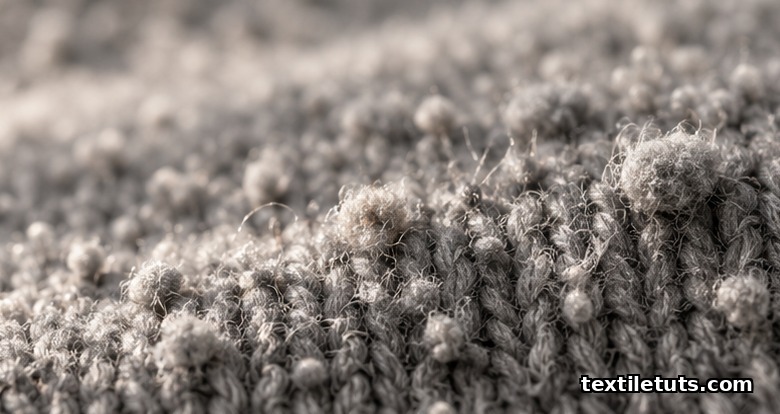
Pilling resistance is measured by ISO 12945-1 on a Martindale abrasion tester that rubs a 140 mm circular fabric specimen against a reference abrasive fabric under a 415 g load for up to 7,000 rubbing cycles, with pilling severity rated on a 1 to 5 scale against photographic standards after defined checkpoints (125, 500, 1,000, 2,000, 5,000 and 7,000 rubs).
This single test underwrites almost every “anti-pilling” label on knitwear, woven shirts, and upholstery because it reproduces the kind of multidirectional surface rubbing that knits and loose weaves suffer at the shoulders, inner thighs, and armrests. The number that appears on a spec sheet, usually called the “pilling grade” or “pilling rating,” is the score a sample earns in this exact protocol, so understanding what the test actually does is the only way to compare supplier claims.
What follows is a working reference for textile engineers, QC staff, sourcing teams, and advanced textile students who need to run, audit, or interpret an ISO 12945-1 Martindale pilling test. It walks through what pilling is, the four parts of the ISO 12945 series, the step-by-step Martindale procedure, the 1 to 5 rating scale, and the practical choices that determine whether your result is reliable.
What Pilling Is, and Why ISO 12945 Exists
Pilling is the formation of small balls of fibre (called pills or fuzz balls) on the surface of a fabric during wear or laundering. The mechanism is well documented in the textile literature: short or broken fibres migrate to the surface, entangle with neighbouring fibres, and roll into spheroids held in place by a few long anchor fibres. Once formed, pills are difficult to remove because the anchor fibres are still attached to the yarn body.
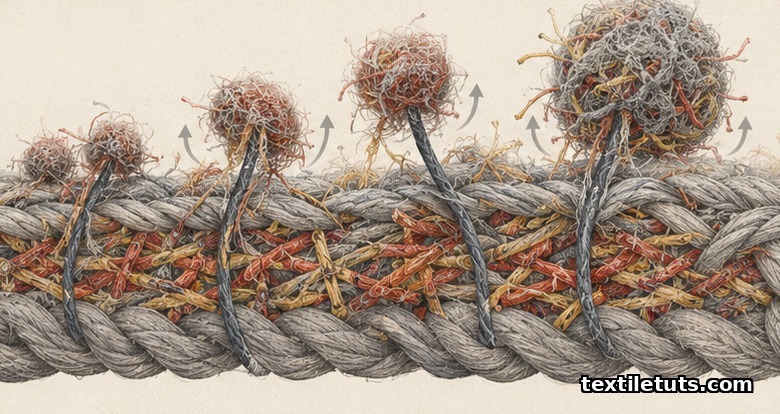
ISO 12945 was first published in the late 1990s to give the industry a single, repeatable way to score that behaviour. Before it, mills relied on in-house methods that used different rub counts, different abrasive fabrics, and different rating scales, which made buyer and supplier claims hard to compare. The current ISO 12945 series (revised most recently in 2020 and 2023) standardises the apparatus, the conditioning, the number of test specimens, the rubbing stages, and the visual evaluation so a grade 3.5 in a Dhaka lab should match a grade 3.5 in a Lisbon lab within half a grade.
For most apparel and home-textile buyers, ISO 12945-1 (Martindale) is the relevant method. The Martindale is preferred over the ICI pilling box (ISO 12945-2) and the tumble method (ISO 12945-3) because it produces a rubbing action that more closely mimics the multidirectional abrasion that garments actually receive at wear points.
The Four Parts of ISO 12945
The ISO 12945 series is split into parts, and buyers sometimes get them mixed up. A clean understanding prevents that.
- ISO 12945-1: Pilling box method (ICI type). Samples are sewn onto rubber tubes and tumbled inside a cork-lined wooden box for a defined number of revolutions. Best suited to knitted fabrics that are sensitive to flat-plate abrasion.
- ISO 12945-2: Martindale method. The version most buyers mean when they write “ISO 12945 pilling.” Circular specimens are rubbed against an abrasive fabric on a Martindale tester under a defined load. Used for woven, knit, and nonwoven fabrics.
- ISO 12945-3: Tumble method. Loose specimens tumble with a small amount of cotton sliver inside a rotating drum. Common for pile fabrics and floor coverings.
- ISO 12945-4: Visual assessment. Defines the photographic rating standards used to score specimens produced by parts 1, 2, and 3. Provides a 1 to 5 scale where 1 = very severe pilling and 5 = no pilling.
The Martindale pilling method (ISO 12945-2, in current revisions) is the test most spec sheets reference. The visual assessment described in ISO 12945-4 is shared across all three mechanical methods, which is why a single grading rubric works regardless of how the pills were produced.
The Martindale Pilling Procedure, Step by Step
The Martindale tester is the same machine used for abrasion resistance testing under ISO 12947, which is why many mills own both standards’ worth of fixtures. For pilling, the procedure runs as follows.
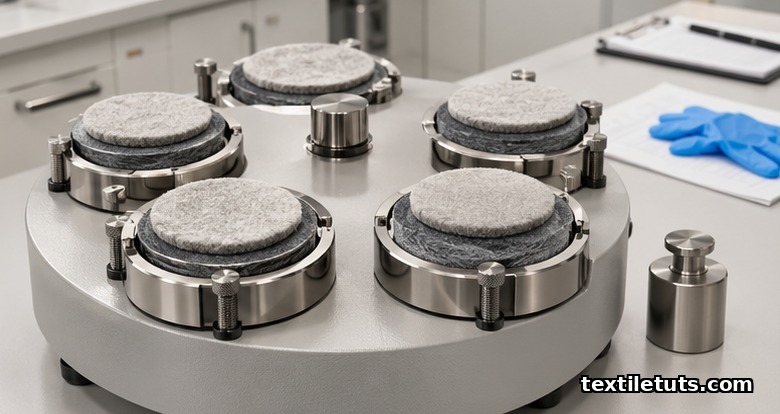
- Conditioning. Specimens are conditioned for at least 24 hours at 20 °C ± 2 °C and 65% ± 4% relative humidity, per ISO 139. This step matters: a sample tested dry-out-of-the-bag will pill differently from one that has equilibrated.
- Specimen preparation. At least three circular specimens of 140 mm diameter are cut, plus three additional specimens if both face and back are tested. Specimens must be free of creases, oil marks, or other surface contamination that would bias the result.
- Mounting. Each specimen is placed face-down on the Martindale table, a felt cushion is added, and the specimen is mounted in a specimen holder. A reference abrasive fabric (usually a wool abradant or a specified woven standard fabric, depending on the standard revision) is mounted on top.
- Load selection. For pilling, the standard nominal load is 415 g on the specimen holder (the “9 kPa” pressure). Some variants specify 235 g (lighter load) for delicate fabrics, but the 415 g load is the default in ISO 12945-2.
- Rubbing stages. The machine runs the specimens through defined checkpoints: 125, 500, 1,000, 2,000, 5,000, and 7,000 rubs. Most spec sheets report the result at 2,000 or 5,000 rubs; upholstery may be reported at 7,000 rubs.
- Visual evaluation. At each checkpoint, the specimens are removed and compared with photographic standards from ISO 12945-4 under a standard viewing box (illumination D65 at 45°, viewing distance approximately 30 cm). Three trained raters score each specimen; the median rating is reported.
The exact rubbing trajectory on a Martindale follows a Lissajous figure that produces multi-directional rubbing rather than back-and-forth. That detail is what makes the Martindale a better pilling simulator than a planar abrasion tester.
Reading the Rating: The 1 to 5 Pilling Scale
ISO 12945-4 defines five visual grades supported by photographic reference standards.
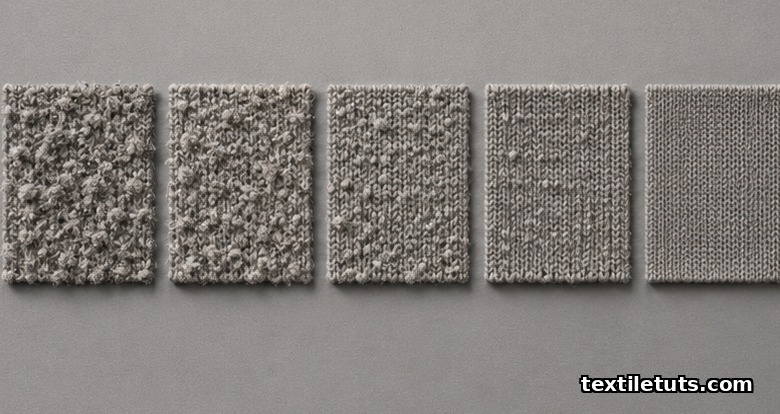
| Grade | Visual condition | What it means for a buyer |
|---|---|---|
| 5 | No pilling. | Surface change absent. Excellent for premium knitwear. |
| 4 | Slight pilling. | Few small pills visible only on close inspection. Acceptable for most apparel. |
| 3 | Moderate pilling. | Pills distributed across the surface. Acceptable for lower-tier apparel or hidden panels. |
| 2 | Severe pilling. | Dense pills covering most of the surface. Usually a fail for visible garment areas. |
| 1 | Very severe pilling. | Dense, large pills covering the entire surface. Almost always a reject. |
Many spec sheets use half-grades (3-4 or 4-5). This is acceptable provided the rating team is calibrated against the same photographic standards and uses a viewing booth that meets ISO 13020 lighting conditions.
ISO 12945-2 vs ASTM D4970 and Other Pilling Tests
ASTM D4970 (Standard Test Method for Pilling Resistance and Other Related Surface Changes of Textile Fabrics: Martindale Method) covers the same physics as ISO 12945-2 but with several practical differences. ASTM D4970 specifies a 4-inch (approximately 102 mm) specimen and uses a 9 kPa load, while ISO 12945-2 uses a 140 mm specimen. ASTM also requires ratings after 100, 500, 1,000, and 2,000 rubs as standard checkpoints, with 5,000 rubs optional. Buyers specifying “ISO 12945” typically want the ISO specimen size, the ISO 415 g nominal load, and the ISO 125 to 7,000 rub range.
AATCC TM 196 (Random Tumble Pilling Test) is an entirely different principle: loose fabric samples tumble with cork cubes in a cylindrical chamber. Results correlate loosely with Martindale ratings but cannot be substituted one-for-one. Where a buyer accepts both, the test report should clearly state which method was used.
For buyers sourcing knit fabrics, a useful rule of thumb: a fabric that earns grade 4 at 5,000 rubs on the Martindale will generally pass the 50-cycle home-launder test used by most retail QC programs. A grade 3 at 2,000 rubs will fail at retail.
Controlling the Variables That Move the Result
Pilling grades drift more than most textile engineers expect. The most common sources of variability are:
- Conditioning. A sample that has not equilibrated at 65% RH will pill differently from a fully conditioned one. Always precondition for 24 hours.
- Specimen handling. Fingerprints, oil from scissors, or static-induced folding all bias the result. Wear clean cotton gloves during cutting and mounting.
- Abrasive condition. The reference abrasive fabric degrades with use. ISO 12945 requires a fresh disc of abrasive for each test; reusing an abrasive that has been rubbed against a previous specimen changes the result by half a grade or more.
- Rater calibration. A single rater can drift by half a grade in a long day. Use three raters per specimen and report the median. Run a calibration sample (a known fabric with a known result) at the start of every rating session.
- Pre-test relaxation. Knitted fabrics in particular relax for the first few laundering cycles. If the buyer cares about post-launder pilling, pre-launder the specimens per ISO 6330 before conditioning and testing.
Documenting these controls in a single standard operating procedure is the difference between a test lab that produces repeatable results and one that produces numbers that drift from batch to batch.
Frequently Asked Questions
Q1: What is a “passing” pilling grade for a knit shirt?
For most retail buyers of single-jersey or pique knit shirts, grade 3.5 or higher at 2,000 rubs on the Martindale is the minimum acceptable result. Premium programmes targeting knitwear with a “no-pill” guarantee typically require grade 4 at 5,000 rubs. Anything below grade 3 at 2,000 rubs usually fails incoming quality control, regardless of how the fabric looks on hand inspection.
Q2: Can ISO 12945-2 results predict real-world pilling?
ISO 12945-2 results correlate reasonably well with wear at high-rub areas such as inner thighs and cuffs, especially on knit fabrics. They correlate less well with underarm pilling and seat abrasion, which involve different fibre migration patterns. For a complete picture, supplement Martindale pilling data with the Martindale abrasion result (ISO 12947) and a wash-and-wear trial per ISO 6330.
Q3: Is ISO 12945-2 the same as ASTM D4970?
They use the same Martindale apparatus and the same 1 to 5 rating logic, but the specimen size, the abrasive mounting details, and the standard checkpoint rub counts differ. A buyer who writes “ISO 12945” on a spec sheet expects the ISO 12945-2 procedure (140 mm specimen, 415 g load, full 125 to 7,000 rub range). A buyer who writes “ASTM D4970” expects the ASTM procedure. Do not substitute one method for the other without re-running the calibration samples.
Q4: Why does my lab get different results than the supplier lab?
Three causes explain most inter-lab discrepancies: conditioning (the sample was not equilibrated at 65% RH), abrasive condition (the reference fabric had been reused too many times), and rater calibration (the rating team had not been trained on the same photographic standards from ISO 12945-4). Run an inter-lab round-robin on three to five control fabrics before drawing conclusions from a one-off comparison.
Q5: How does yarn structure influence the pilling grade?
Loose, hairy yarns pill more readily than tight, smooth yarns of the same fibre. Compact ring-spun cotton pills less than rotor-spun cotton; long-staple cotton pills less than short-staple; synthetic microfibres pill less than coarse synthetic yarns because shorter exposed fibre ends are available. Fabric construction matters as much as yarn: tightly woven fabrics pill less than loose knits of the same yarn count, which is why most performance knitwear uses compact ring-spun or air-jet yarn constructions specifically to improve ISO 12945 results.
References
- International Organization for Standardization. ISO 12945-1:2020, Textiles — Determination of fabric propensity to surface fuzzing and to pilling — Part 1: Pilling box method. iso.org. Defines the ICI pilling box procedure.
- International Organization for Standardization. ISO 12945-2:2020, Textiles — Determination of fabric propensity to surface fuzzing and to pilling — Part 2: Martindale method. iso.org. Defines the Martindale pilling procedure, specimen size, and load.
- International Organization for Standardization. ISO 12945-3:2014, Textiles — Determination of fabric propensity to surface fuzzing and to pilling — Part 3: Tumble method. iso.org. Defines the loose-fabric tumble pilling procedure.
- International Organization for Standardization. ISO 12945-4:2020, Textiles — Determination of fabric propensity to surface fuzzing and to pilling — Part 4: Assessment of pilling, fuzzing, and matting by visual evaluation. iso.org. Defines the photographic reference standards used to score pilling grades.
- ASTM International. ASTM D4970 / D4970M-22, Standard Test Method for Pilling Resistance and Other Related Surface Changes of Textile Fabrics (Martindale Method). astm.org. The US equivalent Martindale pilling method.
- American Association of Textile Chemists and Colorists. AATCC TM 196-2020, Random Tumble Pilling Test. aatcc.org. Defines the cork-tumble pilling method used as an alternative to Martindale.
- Ukponmwan, J. O., and Needles, H. L. “A Study of Pilling on Knitted Fabrics.” Textile Research Journal, vol. 56, no. 10, 1986, pp. 607-613. Peer-reviewed paper on pilling mechanics in knitted fabrics.
This article is the working reference for ISO 12945-2 (Martindale) pilling testing on textile fabrics. Editorial by Iftay Khairul Alam, TextileTuts. Sources: ISO 12945-1, ISO 12945-2, ISO 12945-3, ISO 12945-4, ASTM D4970/D4970M-22, AATCC TM 196-2020, and Ukponmwan & Needles (1986, Textile Research Journal) as cited.


