
Shrinkage Testing: ISO 5077 and AATCC 135

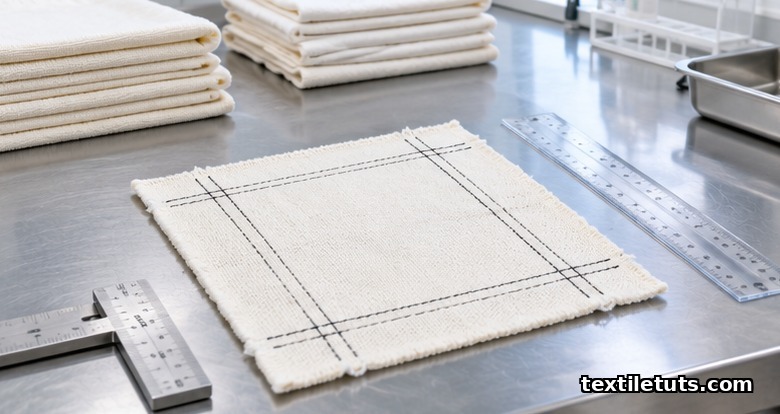
ISO 5077:2007 specifies that textile dimensional change is measured by marking paired benchmarks 250 mm apart on conditioned specimens, washing them through one to five normal-program cycles at 40 °C ± 3 °C in a horizontal drum machine per ISO 6330, and reporting the percentage change in length and width to ±0.1 %.
AATCC TM 135 covers the same property for the North American market, but runs specimens in an automatic top-loading or front-loading home washer at water temperatures of 27, 41, 49, or 60 °C with paired air-dry, line-dry, or tumble-dry finishing, and reports percent change after three or more wash cycles. Both standards exist because shrinkage drives consumer returns, label claims, and care-symbol compliance, and the two methods diverge just enough that a fabric passing one does not automatically pass the other.
Why Dimensional Stability Tests Matter for Every Textile Mill
Shrinkage is the single most common reason a consumer returns an apparel item, and it is also one of the easiest properties to fail before a garment reaches the shop. A 100 % cotton woven shirt that loosens 8 % in warp direction after three home washes will not match the size printed on the label, and the brand will eat the return. Repeat that across a 50,000-piece order and the failure cost dwarfs the test fee.
Mill-side, dimensional-change testing answers three practical questions. First, will the fabric meet the buyer’s care-label promise (for example, “machine wash cold, tumble dry low, ≤3 % shrinkage”)? Second, does the finishing line (sanforizing, compacting, resin-cure) actually deliver the value the dyer or finisher is being paid for? Third, will the fabric shrink compatibly with its lining, interlining, or trim so the finished garment does not distort?
The two dominant test methods in use worldwide, ISO 5077 and AATCC TM 135, address the same property with different machinery, water temperatures, and drying protocols. Buying offices, technical managers, and QA staff must understand which method their buyer spec calls for, because results from one method are not directly interchangeable with the other.
ISO 5077: Test Principle and Procedural Steps
ISO 5077:2007 is titled “Textiles: Determination of dimensional change (machine washing)” and is published by the International Organization for Standardization in Geneva. The standard is a procedure document, not a wash program; the wash conditions come from ISO 6330, which is the method that specifies water temperature, spin speed, detergent, agitation type, and drum dimensions.
The test works as follows. A conditioned specimen (usually 200 × 200 mm or larger) is marked with two pairs of reference points: one pair along the length (warp or wale direction) and one pair along the width (weft or course direction). The distance between each pair is typically 250 mm but can be longer for woven samples where higher precision is needed. Initial distances are measured with a ruler or calibrated gauge to ±1 mm after the specimen has been conditioned to standard atmosphere of 20 °C ± 2 °C and 65 % ± 4 % relative humidity per ISO 139.
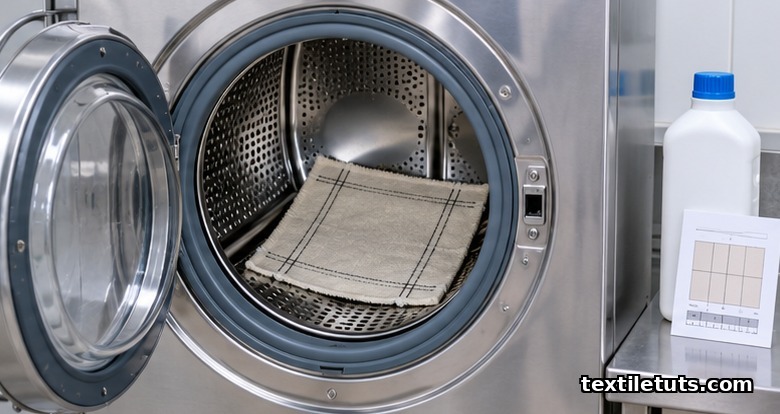
The specimen is then washed in a horizontal drum machine (Type A, the front-loading reference machine, or Type B, an alternative drum) using ISO 6330 wash procedures. The most commonly cited procedure is procedure 4N, which runs at 40 °C with normal agitation, a 5 kg load, 4 g/L ECE reference detergent, and a final spin. After washing, the specimen is dried per ISO 6330 procedure A (flat dry at ambient), procedure B (hang dry), procedure C (line dry), procedure D (flat drip dry), procedure E (button drip dry), or procedure F (tumble dry at 70 °C ± 5 °C). One drying cycle may follow each wash, or a defined number of wash cycles can be aggregated before drying.
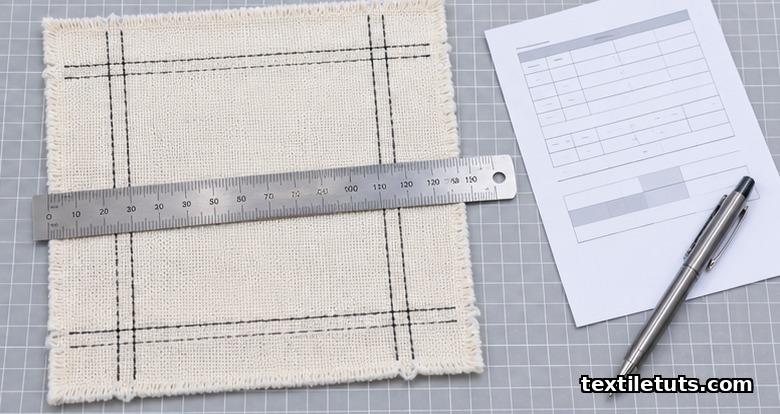
After drying and re-conditioning, the distances between the reference marks are re-measured. Dimensional change is calculated as (final length − initial length) ÷ initial length × 100, with separate values for length and width. ISO 5077 requires reporting to ±0.1 %, the number of wash cycles, the ISO 6330 wash procedure used, the drying procedure used, and whether results are after a single cycle or after five.
AATCC TM 135: Procedure and Differences from ISO 5077
AATCC Test Method 135, “Dimensional Changes of Fabrics after Home Laundering,” is the North American counterpart and is published by the American Association of Textile Chemists and Colorists. It is functionally similar to ISO 5077 but is built around the household washing machine as sold in the United States, not a drum specified to a European standard.
Specimens are marked in the same way as ISO 5077, typically with three pairs of benchmarks at least 250 mm apart, with pairs aligned to length, width, and (if relevant) a diagonal. Initial distances are measured after conditioning at 21 °C ± 1 °C and 50 % ± 2 % RH, the ASTM D1776 atmosphere for textile testing.
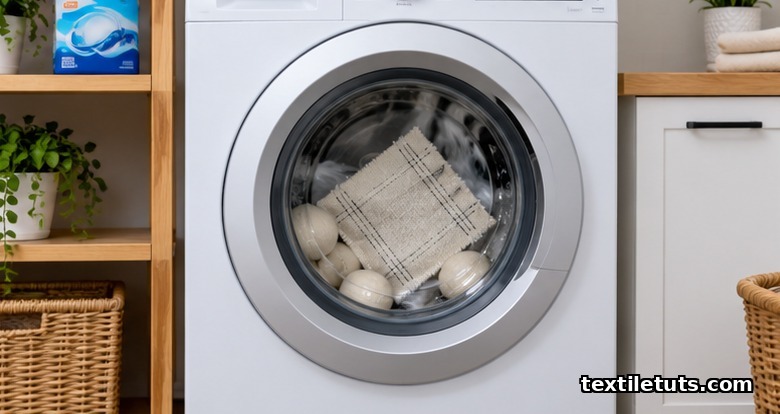
The wash is performed in an automatic domestic washer, either top-loading (Kenmore-style agitator) or front-loading (horizontal axis, no agitator), set to “normal” or “delicate” cycle at one of four water temperatures: 27 °C ± 3 °C (warm-cold), 41 °C ± 3 °C (warm), 49 °C ± 3 °C (hot), or 60 °C ± 3 °C (extra hot). The detergent is AATCC Standard Reference Detergent, with or without optical brightener, dosed at 66 g per wash when ballast is added. The load is made up to a target weight with ballast pieces of similar construction.
Drying options cover six procedures: tumble dry at 50 °C ± 5 °C (low) or 70 °C ± 5 °C (high), line dry, drip dry, flat dry, and a specified “screen dry.” The test typically runs three wash cycles minimum, but buyers may require five or ten. Final dimensional change is calculated as (final dimension − initial dimension) ÷ initial dimension × 100, reported to ±0.1 %.
Side-by-Side Comparison: ISO 5077 vs AATCC TM 135
| Parameter | ISO 5077 (with ISO 6330) | AATCC TM 135 |
|---|---|---|
| Wash machine | Type A or B horizontal drum, ISO-defined geometry | Domestic top-load (agitator) or front-load (HE) |
| Standard wash temperature | 40 °C ± 3 °C (procedure 4N) | 27, 41, 49, or 60 °C ± 3 °C |
| Detergent | ECE reference detergent (Type B, no optical brightener) | AATCC Standard Reference Detergent (with or without OB) |
| Water hardness | ≤0.7 mmol/L (soft) | Not specified; tap water acceptable |
| Default cycle count | 1 to 5 (often 5) | 3 minimum; 5 or 10 common |
| Conditioning atmosphere | 20 °C / 65 % RH (ISO 139) | 21 °C / 50 % RH (ASTM D1776) |
| Drying procedures | A, B, C, D, E, F (per ISO 6330) | Tumble, line, drip, flat, screen |
| Standard tumble temperature | 70 °C ± 5 °C (procedure F) | 50 °C ± 5 °C (low) or 70 °C ± 5 °C (high) |
| Benchmark distance | Typically 250 mm | Typically 250 mm (≥250 mm) |
| Reporting precision | ±0.1 % | ±0.1 % |
The two standards agree on the core physics: paired benchmarks, machine wash, machine or ambient dry, percent change in length and width. They differ on machine geometry, water hardness, detergent chemistry, cycle temperature, and the conditioning atmosphere used to measure the final distance.
Which Method Should a Mill Run?
The decision comes down to the buyer’s spec, not the mill’s preference. A US-based brand selling through Walmart, Target, or Costco almost always references AATCC TM 135. A European brand selling through Zara, H&M, or a UK retailer almost always references ISO 5077 paired with ISO 6330. A brand selling globally often asks for both, which means the mill runs two parallel swatches.
If a mill runs ISO 5077 first and the result looks marginal (say, 2.8 % warp shrinkage, just inside a 3 % tolerance), it is worth re-running under AATCC TM 135 before signing off. The hotter US water and the domestic agitator geometry can deliver a different number, sometimes higher, sometimes lower, depending on fiber and construction.
Common Pitfalls in Shrinkage Testing
Mis-marked benchmarks are the single most common error. If the markers are placed too close to a seam, a selvedge, or a fabric defect, the local distortion skews the measurement. Benchmarks should be at least 50 mm from any edge and away from any pattern repeat that might pull unevenly.
Insufficient conditioning ruins precision. A specimen that comes out of a 70 °C tumble and gets measured without 4 hours of conditioning will read shorter than it really is, exaggerating apparent shrinkage. Always condition to equilibrium.
Wrong ballast distorts the wash. If the mill uses 100 % cotton ballast on a polyester specimen, the cotton swells and holds water, changing the load profile and the abrasion energy. The standard says “comparable ballast”; a 50/50 poly-cotton ballast is a reasonable default when the specimen is synthetic.
Confusing relaxation shrinkage with felting shrinkage. Wool felts under heat and agitation, and the dimensional change reported by ISO 5077 will reflect both relaxation (recoverable on re-finishing) and felting (irreversible). For wool, ISO 5077 should be paired with a clear note that the result is total dimensional change, not recoverable change only.
Reading and Reporting the Result
Negative values mean shrinkage (the fabric got smaller). Positive values mean growth (the fabric stretched). A result of “−2.5 % warp, −1.0 % weft, after 5 washes, procedure 4N, procedure F drying” tells a buyer that the fabric shrinks 2.5 % in the length direction and 1.0 % in the width direction after five wash cycles at 40 °C with tumble dry at 70 °C.
Most apparel buyers specify a maximum of −3 % to −5 % shrinkage, depending on the garment and the fiber. Knit fabrics typically have a more generous tolerance than wovens because knits change shape more readily. Always record the conditioning atmosphere, the wash procedure, the dry procedure, and the cycle count alongside the number; without those, the result is not comparable to any other lab’s report.
Frequently Asked Questions
What is the difference between ISO 5077 and ISO 6330?
ISO 5077 is the procedure for measuring dimensional change, including how to mark specimens, condition them, and calculate the result. ISO 6330 is the companion wash-and-dry standard that specifies the machine, detergent, water temperature, and drying procedures. ISO 5077 always references ISO 6330 for the wash program.
Does AATCC TM 135 use the same washing machine as ISO 5077?
No. ISO 5077 paired with ISO 6330 specifies a horizontal drum with defined geometry, while AATCC TM 135 specifies a domestic automatic washer, either top-loading with an agitator or front-loading (HE). The two machines deliver different mechanical action to the fabric, which is one reason the standards are not interchangeable.
How many wash cycles should I run?
ISO 5077 commonly uses 1 to 5 cycles; AATCC TM 135 commonly uses 3 to 5. Many buyers now request 5 or even 10 wash cycles to simulate a year of home laundering. The choice should follow the buyer spec, and the result should always state the cycle count.
Why does my cotton fabric show different shrinkage numbers in two different labs?
The most common reasons are conditioning atmosphere, water hardness, detergent, drying temperature, and the wash machine itself. AATCC’s 21 °C / 50 % RH atmosphere and ISO’s 20 °C / 65 % RH atmosphere will give slightly different baselines; tap water hardness will affect cotton swelling; and the agitator geometry changes mechanical action. Always run a control fabric in parallel when you suspect lab-to-lab drift.
Can I use one standard to claim compliance with the other?
No. ISO 5077 and AATCC TM 135 are not equivalent, and most buyers will reject a result from the wrong method. If your buyer specs AATCC TM 135, run AATCC TM 135. If the buyer is European, run ISO 5077 paired with ISO 6330. If a buyer wants both, run both on adjacent specimens and report them separately.
Editorial by Sabbir Ahmed, TextileTuts. Sources: ISO 5077:2007 (Textiles — Determination of dimensional change), ISO 6330:2021 (Domestic washing and drying procedures for textile testing), ISO 139:2005 (Textiles — Standard atmospheres for conditioning and testing), AATCC TM 135-2022 (Dimensional Changes of Fabrics after Home Laundering), AATCC TM 150-2018 (Dimensional Changes of Garments after Home Laundering), and ASTM D1776-20 (Standard Practice for Conditioning and Testing Textiles) as cited.


