
Spinning: The Complete Guide to Yarn Formation Methods

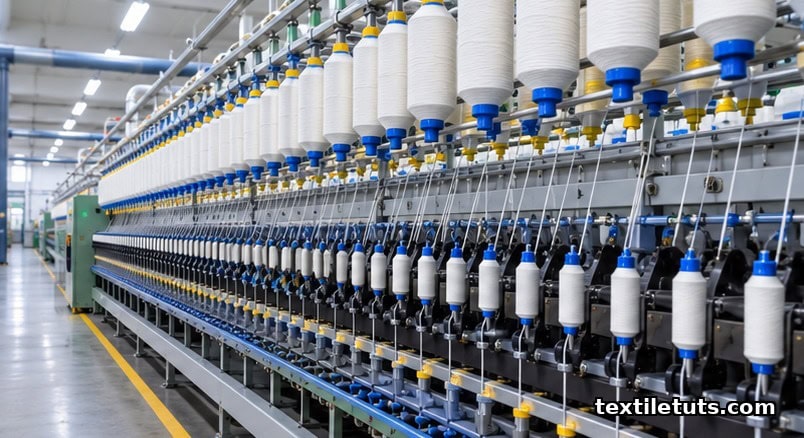
Short-staple yarn formation converts 25 to 40 mm cotton fibers into a continuous, twisted strand through six sequential stages: blowroom, carding, drawing, roving (for ring systems only), spinning, and winding, with the spinning stage itself accounting for 55 to 70 percent of total conversion energy.
Every cotton T-shirt, denim warp, and bed sheet starts as a loose tuft of fiber weighing less than 5 micrograms per filament and ends as a packaged yarn traveling at 25 to 35 m/min on a modern ring frame. The chain between those two states has been refined for two centuries, but the physics have not changed: fibers must be individualized, aligned, drafted to a target count, locked together with twist, and wound onto a package that a loom or knitting machine can unwind without breakage.
This guide walks through that chain stage by stage, compares the four spinning systems that dominate commercial production, and ties each step back to the ISO standards a textile engineer uses to verify the output.
Stage 1: Fiber Preparation in the Blowroom
The blowroom is the first quality gate. Hard-pressed bale plucks, blending hoppers, and a sequence of cleaning machines open the compressed cotton bale and remove 60 to 75 percent of the trash, dust, and broken seeds before the fiber ever sees a card. Modern multi-mixer blowrooms run 600 to 1,200 kg/h per line and combine 4 to 6 opening points with heavy trash extraction at each step.
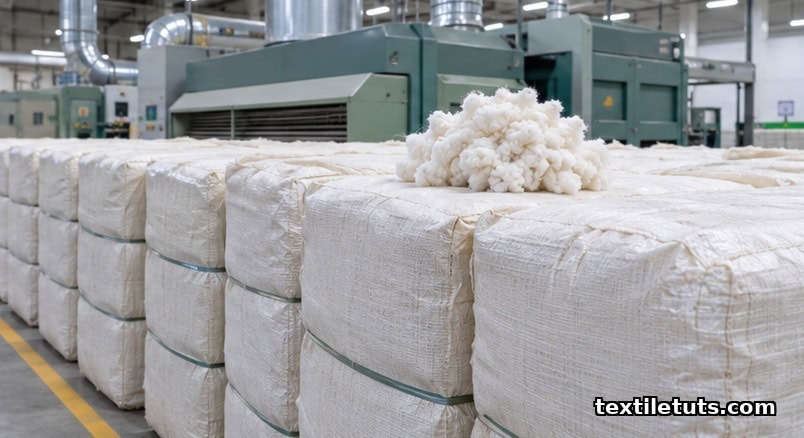
Three process decisions govern what comes out of the blowroom. First, the number of opening machines in series: more passages open the tufts more completely but increase fiber breakage, especially on immature cotton where nep count rises sharply above six passages. Second, the type of cleaning element: saw-tooth cylinders (Kirschner beaters, Rieter Uniflex) act aggressively on trash but also on fibers, while porous drum cleaners and Axi-Flo type units provide gentler separation at lower extraction efficiency. Third, blending fidelity: a 6 to 8 component lay-down using a multi-mixer achieves blend variation of less than 2 percent CV on the drawn sliver, while a simple stack-blend at the bale plucks often exceeds 5 percent CV.
Output of the blowroom is a lap (on older lines) or, more commonly on modern Rieter, Truetzschler, and Lakshmi lines, a chute-fed tuft stream delivered directly to the card via a vibratory chute or a direct-feed conveyor. Direct card feeding eliminates lap winding and reduces neps by 15 to 25 percent compared to lap-fed cards.
Stage 2: Carding
The card is the heart of the yarn formation chain. Its job is to individualize every fiber, remove the remaining trash and short fibers, and deliver a continuous sliver of parallel, clean fibers at 50 to 250 m/min. A modern flat-top card (for example, a Truetzschler TC 19 or Rieter C 70) processes 80 to 220 kg/h of cotton at production speeds that have roughly tripled since 1980.
The card has five working zones: feed, licker-in, main cylinder, flat strip (or fixed flat), and doffer. The licker-in opens the tuft and rejects heavy trash through a grid bar; the cylinder and flats (or revolving flats) individualize fibers against the clothing wire; and the doffer strips the web and condenses it into sliver through a coiler and calender rolls. Trash removal efficiency typically reaches 90 to 95 percent; short fiber removal (below 12 mm for cotton) ranges from 0.5 to 2.0 percent of feed weight depending on flat setting and draft distribution.
Card sliver linear density is set between 3.5 and 6.0 ktex (kilotex) for most downstream routes, with the higher values reserved for open-end rotor lines that benefit from a heavier feed sliver. Count CV of card sliver at the delivery typically runs 3 to 5 percent, a number that has direct downstream consequences for yarn evenness measured later under ISO 16549.
Stage 3: Drawing
Drawing does three jobs at once: it straightens the fibers, blends multiple card slivers into a homogeneous composite, and reduces sliver count by a calculated draft so the roving or feed sliver is at the weight the next stage expects. A modern draw frame runs 4 to 8 ends up at delivery speeds of 600 to 1,200 m/min with an autoleveler that continuously corrects count deviations.
Two drafting principles matter most. First, the doubling-draft ratio: feeding 8 ends of 5 ktex into a 6x draft delivers roughly 6.67 ktex, but the doubling smooths irregularity by the square root of the number of doublings. With 8 doublings, long-wave count variation from the card is reduced by a factor of about 2.83, which is why mills running compact or vortex yarn still rely on two draw frame passages. Second, the drafting wave: a poorly set roller drafting system adds its own periodic thick-and-thin places, classically at the wavelengths of the front roller and back roller peripheries. ISO 16549 detects these faults as “drafting waves” in the spectrogram and the CV values tell the technician where to look.
Draw frame sliver typically emerges at 3.0 to 4.5 ktex. Combed cotton routes interpose a combing stage (Hara 800, Rieter E 90) between the breaker draw frame and finisher draw frame to remove short fibers below a threshold of about 12.5 mm and residual neps, lowering the noil (waste) rate by 8 to 18 percent of feed weight but improving yarn strength by 10 to 20 percent.
Also Read:
- Cotton Spinning Process Step-by-Step
- Spinning Mill Workflow: From Bale to Cone
- Spinning Mill Layout and Planning
Stage 4: Roving (Ring Route Only)
The roving frame is unique to the ring spinning route. It inserts a small amount of protective twist into a slightly drafted sliver so the strand can be wound onto a bobbin and unwound at the ring frame without breaking. Roving twist is intentionally low, typically 18 to 30 turns per meter, just enough to give lateral cohesion for handling.
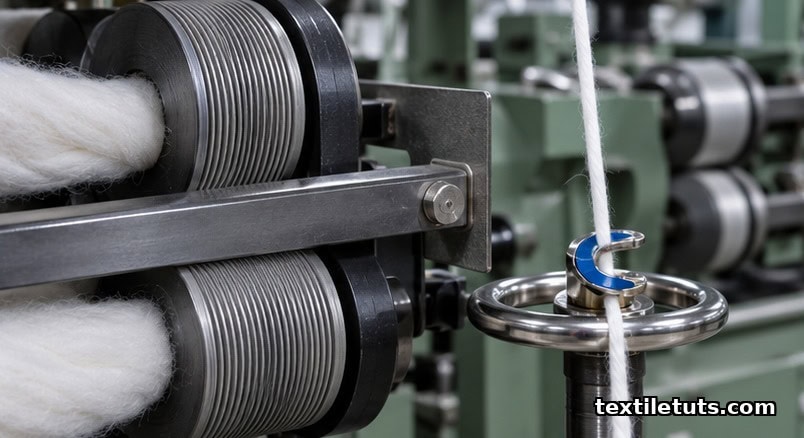
Roving count is set between 0.3 and 1.2 ktex depending on the target yarn count: a 20 tex (Ne 30) ring yarn typically draws from a 0.55 ktex roving at a draft of around 28 on the ring frame. Modern roving frames run at 1,200 to 1,800 rpm spindle speed and use pressure-drafting or apron-drafting systems to keep fibers under control during the high-draft zone.
Rotor, air-jet, and vortex routes skip roving entirely. Their feed packages are finisher-draw-frame sliver cans delivered directly to the spinning machine, which is one reason these systems are called “short-staple short-process” routes. Eliminating the roving frame saves floor space, energy, and labor, but it also limits the achievable draft in a single spinning step, which is why rotor yarn typically bottoms out at coarser counts than ring yarn.
Stage 5: Spinning (Ring, Rotor, Air-Jet, and Vortex)
The spinning stage is where the drafted fiber stream is twisted into yarn. Four systems dominate short-staple yarn production worldwide; each inserts twist by a different mechanism and produces a structurally different yarn.
Ring spinning
The ring frame drafts the roving to the final count at the front rollers and inserts twist by dragging a traveler around a ring at speeds up to 25,000 rpm on modern frames. The traveler orbits the stationary bobbin while the bobbin lifts and lowers to wind the yarn in a cop. Twist travels up into the spinning triangle, the small unsupported fiber zone between the front roller nip and the twist point, locking fibers into a parallel, helical structure. Ring yarn is the strongest of the four systems but the slowest and the most energy-intensive per kilogram, because of the ring/traveler drag.
Rotor (open-end) spinning
Rotor spinning eliminates the roving and the ring. The sliver is fed by a feed roller into a combing roller that individualizes fibers at 6,000 to 9,000 rpm, after which airflow carries them through a transport tube into a rotor running 60,000 to 150,000 rpm. Fibers collect against the rotor groove and are peeled off by the take-up rollers as a continuous yarn. Twist is inserted by the rotating rotor groove itself, propagating back into the fiber ring inside the rotor. The resulting yarn has a wrapper-fiber structure with two zones, a more random core and an outer helical binder, and is 10 to 25 percent weaker than ring yarn but significantly less hairy and more even in coarse counts. Production speeds reach 200 to 250 m/min per delivery.
Air-jet spinning
Air-jet spinning, exemplified by Murata Vortex Spinning (MVS), feeds drawn sliver through a drafting system and then uses one or two nozzles that inject tangential air jets to insert false twist and true twist into the fiber stream. Nozzle pressure of 0.4 to 0.6 MPa and delivery speeds of 300 to 450 m/min produce a yarn whose structure consists of a parallel core of wrapper-free fibers bound by surface wrapper fibers. MVS yarn falls between ring and rotor in tenacity, with hairiness comparable to rotor yarn and a count range that extends finer than rotor, reaching about 10 tex (Ne 60) on cotton. Single-end breaking elongation is characteristically lower than ring yarn.
Vortex spinning
Vortex spinning, the more recent iteration of air-jet technology, also runs on Murata machines and uses a single conical nozzle with a higher-pressure air stream and a hollow spindle to guide the yarn. It produces yarn at 400 m/min and above, with a count range from 10 to 60 tex on cotton. The structure is similar to air-jet yarn but with a tighter, more compact surface layer. Vortex yarn shows better pilling resistance than ring yarn in knit fabrics and is widely used in knit apparel and home furnishing.
Stage 6: Winding and Packaging
The winder takes the yarn package off the spinning machine and rewinds it onto a cross-wound package (cheese or cone) suitable for the next process, while also performing quality control that the spinning stage cannot do in real time. Modern automatic winders run at 1,200 to 2,000 m/min and integrate clearers, splicers, and knotters in a single head per spindle.
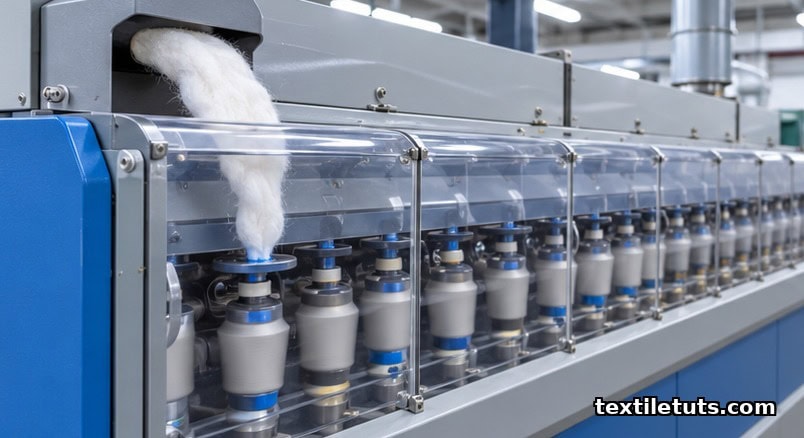
Three functions dominate the winding process. First, yarn clearing: a capacitive or optical sensor detects thick places, thin places, and slubs above user-defined thresholds (typically 50 percent for thick places and -50 percent for thin places, on a length basis), and the winder cuts the yarn, evacuates the fault, and splices a new end. Second, splicing: an air-spliced joint achieves 70 to 90 percent of parent yarn strength, with a visual mark typically 10 to 25 mm long, while a knot is 100 percent strong but bulky and visible. Third, package building: the traverse and drum angles set the package density, with cross-wound cones for knitting at 0.42 to 0.55 g/cm³ and for weaving at 0.55 to 0.70 g/cm³.
Final yarn testing per ISO 2062 (single-end breaking force and elongation at break), ISO 2061 (twist), ISO 2060 (linear density by skein), and ISO 16549 (yarn evenness by capacitance) confirms the package meets the customer’s specification before it leaves the spinning mill. Uster Statistics 2018 benchmarks provide the global comparison yardstick: a “5 percent” yarn on the Uster scale, meaning the mill is among the top 5 percent worldwide for evenness, is the realistic target for a modern fine-count ring yarn, and a “25 percent” yarn on the same scale signals process problems the spinning manager must fix.
Comparison Table: Spinning Systems for Short-Staple Cotton Yarn
| Property | Ring | Rotor (Open-End) | Air-Jet (MVS) | Vortex |
|---|---|---|---|---|
| Delivery speed (m/min) | 25 to 35 | 200 to 250 | 300 to 450 | 400 to 500 |
| Practical count range (cotton, tex) | 4 to 60 | 10 to 60 (coarser end) | 10 to 60 | 10 to 60 |
| Single-end tenacity vs. ring (%) | 100 (baseline) | 75 to 90 | 85 to 100 | 90 to 105 |
| Hairiness (ISO 7211-5, hairs/m, relative) | 100 (baseline) | 30 to 50 | 30 to 45 | 25 to 40 |
| Production per delivery (kg/shift, Ne 30) | 40 to 60 | 250 to 350 | 300 to 450 | 350 to 500 |
| End-use focus | Woven warp, fine knit, sewing thread | Coarse knit, denim weft, towels | Fine knit, shirting, technical | Knit apparel, home furnishing |
Frequently Asked Questions
What are the main stages of short-staple yarn formation?
The six stages are blowroom fiber preparation, carding, drawing, roving (for ring routes only), spinning (ring, rotor, air-jet, or vortex), and winding with package formation. Each stage reduces sliver weight, aligns and blends fibers, removes trash and short fiber, and progressively builds the structural properties that the finished yarn requires for weaving or knitting.
Why is the card called the heart of the spinning mill?
The card is the only machine that performs true fiber individualization on a production scale. It opens compressed fiber tufts into single fibers, removes 90 to 95 percent of trash, extracts short fibers below the cutoff length, and delivers a uniform, parallel sliver. Every downstream machine (draw frame, roving frame, ring frame) inherits the card’s blend quality and evenness, which is why card settings and maintenance dominate yarn quality in the modern short-staple mill.
Which spinning system produces the strongest cotton yarn?
Ring-spun yarn is consistently the strongest for a given fiber blend, count, and twist multiplier. The aligned fiber core and uniform helix angle of the ring frame transmit tensile load efficiently along the yarn axis. Measured per ISO 2062, rotor yarn tenacity is typically 10 to 25 percent below ring yarn, while modern air-jet and vortex yarns can approach ring tenacity on finer counts, particularly with optimized nozzle pressure and drafting settings.
Why does rotor yarn have wrapper fibers?
Inside the rotor groove, fibers are deposited one at a time against the rotor wall. When the take-up pulls the yarn out of the rotor, the trailing end of each newly deposited fiber is caught and twisted around the previously deposited fiber bundle, forming the wrapper fibers that bind the yarn. This wrapper-core structure explains the lower hairiness of rotor yarn, since most fiber ends are buried inside the yarn body rather than protruding from the surface.
What ISO standards are essential for verifying yarn quality?
The four key standards are ISO 2061 (determination of twist by the untwist-retwist method), ISO 2060 (determination of linear density, mass per unit length, by the skein method), ISO 2062 (single-end breaking force and elongation at break using a constant-rate-of-extension tester), and ISO 16549 (yarn evenness and approximation of yarn fineness by capacitance method). Together they cover the mechanical and geometrical properties that a fabric engineer needs to confirm yarn acceptability for weaving or knitting.
References
- ISO 2061:2015. Textiles, Determination of twist in yarns, Untwist/retwist method. International Organization for Standardization, Geneva.
- ISO 2060:1994. Textiles, Yarn from packages, Determination of linear density (mass per unit length) by the skein method. International Organization for Standardization, Geneva.
- ISO 2062:2009. Textiles, Yarns from packages, Determination of single-end breaking force and elongation at break using constant rate of extension (CRE) tester. International Organization for Standardization, Geneva.
- ISO 16549:2004. Textiles, Determination of yarn evenness and approximation of yarn fineness by capacitance method. International Organization for Standardization, Geneva.
- ISO 7211-5:2020. Textiles, Methods for analysis of woven fabrics, Part 5: Determination of number of hairs per unit length. International Organization for Standardization, Geneva.
- Klein, W. (1987). A Practical Guide to Opening, Carding and Cleaning of Cotton. The Textile Institute, Manchester.
- Lawrence, C.A. (2003). Fundamentals of Spun Yarn Technology. CRC Press, Boca Raton. ISBN 978-1566768138.
- Rieter (2019). The Rieter Manual of Spinning, Volume 1 to 7. Rieter Machine Works Ltd, Winterthur.
Editorial by Iftay Khairul Alam, TextileTuts


