
Weaving: Complete Guide to Loom Types and Weave Structures

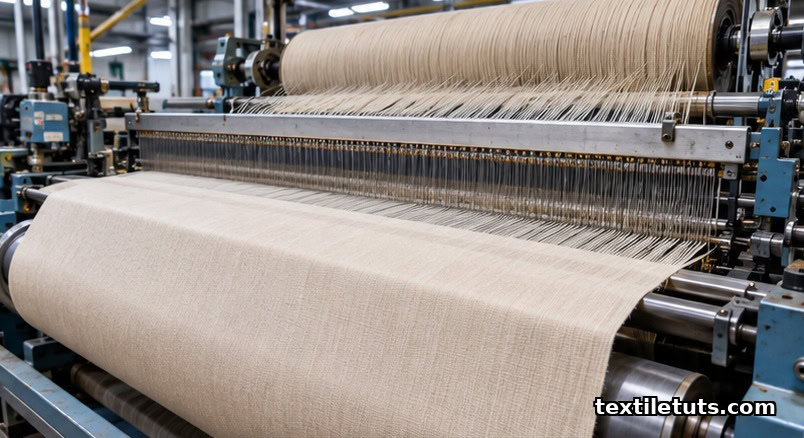
Jacquard weaving is a method of producing complex woven patterns, florals, damasks, brocades, tapestries, figured fabrics, on a loom by individually controlling each warp thread. The Jacquard machine, developed by Joseph Marie Jacquard in Lyon around 1804, replaced the draw-loom and its team of “draw boys” with a chain of punched cards that programmatically raised the required warp threads for each pick. Modern electronic Jacquard machines replace the card chain with computer-controlled solenoid or piezo actuators, but the principle is identical: one shed per warp end, with the pattern stored as a binary sequence.
Jacquard weaving is what makes figured upholstery, neckties, table linens, and the patterned sections of luxury apparel possible. The capacity to control hundreds or thousands of warp ends independently turns the loom from a weft-repetition machine (which can only make geometric repeats) into a programmable image-rendering machine. This article covers the mechanics of the Jacquard device, the practical loom configuration, the design and manufacturing process for a Jacquard pattern, and the most common defects and how to prevent them.
How a Jacquard machine works
A Jacquard machine sits on top of a loom and is mechanically or electronically linked to the harness. The traditional mechanical Jacquard uses a stack of punched cards; each card is one pick (one weft insertion), and the holes in the card determine which warp ends are raised for that pick. As the loom cycles, the card chain advances one card per pick, and a set of horizontal needles passes through (or not) the holes to actuate the lifting mechanism for each warp end.
The number of needles equals the number of warp ends the machine can control. Common configurations: 240, 480, 720, 1,200, 2,400, 4,800, and 10,000+ ends. The largest commercial Jacquards, used for figured upholstery and luxury brocades, control 10,000–20,000 individual warp ends. The harness consists of one heddle per end, all hung from a lifting mechanism that can raise or lower each end independently.
Modern electronic Jacquards replace the card stack with a digital pattern file and an array of actuators. The dominant manufacturers are Staubli (Switzerland) and Bonas (UK); their machines use either pneumatic, solenoid, or piezo actuators to control each warp end independently, with cycle rates up to 1,000+ picks per minute on high-speed looms. The pattern file is typically a binary image (1 = warp up, 0 = warp down) generated from a CAD design.
The mechanical and electronic Jacquards produce identical fabric. The electronic version is faster, more flexible (patterns can be changed in minutes rather than hours of card punching), and easier to set up for short runs. Card Jacquards still exist in heritage mills producing traditional figured silks, but new installations are almost universally electronic.
The loom beneath the Jacquard
Jacquard machines are mounted on top of standard weaving looms: rapier, air-jet, water-jet, or projectile. The Jacquard only controls the warp shedding; the weft insertion, beat-up, and let-off are handled by the underlying loom. Almost any modern loom can be fitted with a Jacquard head, although rapier and air-jet are the most common for fine figured fabrics because of their gentle weft handling and good pattern definition.
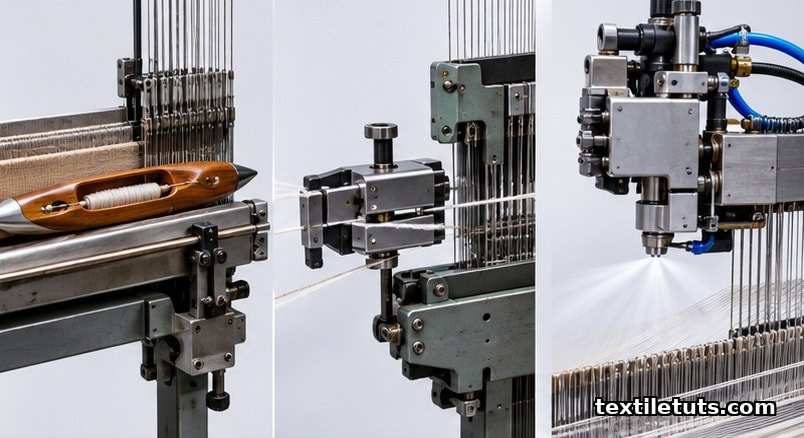
A typical configuration: a 2,400-end electronic Jacquard on a rapier loom running at 250–400 ppm (picks per minute) for apparel fabrics, or 100–200 ppm for upholstery where the larger repeat and higher density require slower insertion. The harness depth (the number of warp ends controlled per unit) is fixed by the machine; the loom width is fixed by the reed and temple.
For very wide figured fabrics (furniture upholstery, drapery, technical textiles), the loom may carry two Jacquard machines side by side, each controlling half the warp. This is called a “double-Jacquard” or “twin-Jacquard” setup and gives a 20,000-end capacity without requiring a single machine that wide.
Designing a Jacquard pattern
Jacquard design is a separate discipline from dobby or plain weave design. The pattern is built up in a CAD system that represents each warp end as a vertical column and each pick as a horizontal row; each cell in the resulting grid is the binary “up or down” decision for that intersection. The CAD file is then exported as a binary pattern file and loaded onto the Jacquard controller.
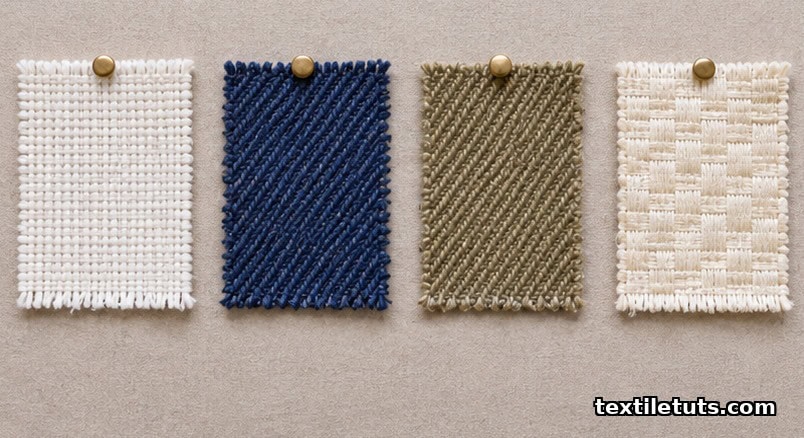
The most common design systems are:
- Point-paper design – the traditional method. The designer works on a grid sheet (“point paper”) coloring each cell by hand or with a CAD equivalent. Used for figured silks, brocades, and heritage designs where the designer’s hand is the deliverable.
- CAD / direct-from-artwork – modern method. A bitmap (typically a high-resolution scan of a hand drawing or a digital painting) is converted into the binary weave grid by a Jacquard CAD program (Staubli, Bonas, ScotWeave, NedGraphics, etc.). Used for photo-realistic figured upholstery and fashion prints.
- Programming from yarn color sequences – for yarn-dyed patterns (e.g., men’s suiting stripes, gingham), the pattern is derived from the color sequence of the warp and weft yarns rather than from artwork. Used for yarn-dyed figured fabrics.
The pattern file is enormous: a single repeat of 1,000 ends × 1,000 picks = 1,000,000 cells, each storing 1 bit of information. The file is then woven at loom speed: a 1,000-pick repeat at 300 ppm takes 3.3 minutes to complete. For a figured upholstery fabric with a 5,000-pick repeat, the loom runs for 16 minutes on each repeat before cycling.
Also Read:
- Jacquard Weaving: How Complex Patterns Are Made
- Dobby vs Jacquard: Differences and Applications
- Carpet Weaving: Wilton, Axminster
Yarn preparation for Jacquard
Jacquard weaving imposes unusual demands on the warp. Each end is under independent control, which means:
- Warp tension uniformity is critical. A single slack or tight end shows as a vertical line defect in the fabric. Beam quality and yarn-on-yarn friction control are far more important than for plain or dobby weaving.
- Yarn quality is critical. Slubs, neps, thick places, and weak spots in the warp will all produce visible defects in the figured area, where the eye is drawn by the pattern.
- Yarn count and twist must be tightly controlled. The figure is built from the contrast between the warp floats (long warp threads that skip over weft) and the ground weave (where the warp interlaces normally). A yarn that is even slightly off-count produces uneven floats and a fuzzy, indistinct pattern.
For figured silks, the warp is typically high-quality long-staple silk (mulberry, 20/22 denier for apparel, 30/40 for heavier figured fabrics) with low twist to maximize luster. For figured cotton, the warp is combed, gassed, and mercerized for smoothness. For upholstery brocades, the warp is often a filament polyester or viscose for luster at lower cost than silk.
Warp and weft arrangement
The pattern in a Jacquard fabric is the contrast between warp-faced areas (where the warp covers the weft) and weft-faced areas (where the weft covers the warp). On the loom, this is achieved by:
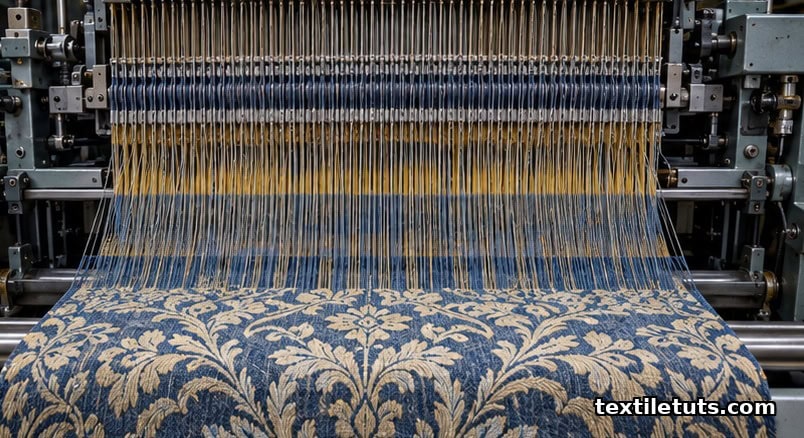
- Floating the warp in the figure area, the warp end skips over 3–10 picks of weft, then tucks in for one pick, then floats again. The warp floats on the surface of the fabric, and the figure is created by the pattern of floats.
- Floating the weft in the ground area, the ground weave is a weft-faced structure (often a satin or twill), so the weft covers the warp. The contrast is between a lustrous warp float (figure) and a weft-covered ground.
To get a true two-sided fabric (figure on both sides, with reversed colors), the fabric is woven double, with two warps and two wefts running face-to-face, and split at the loom. This is the technique for silk damasks, where the same pattern appears in positive on one side and negative on the other. The loom carries two Jacquards (one per warp), the weft is inserted in two layers, and the split happens at the take-up.
Common defects and fixes
Jacquard fabrics are unforgiving of process errors. The most common defects and their causes:
- Missing or extra end (vertical line) – a single warp end is in the wrong shed for one or more picks. Cause: harness or actuator failure, harness threading error, missed needle. Fix: inspect the harness; re-thread if necessary; replace the actuator if the fault is mechanical.
- Float error (figure line broken or distorted) – a portion of the pattern reads wrong. Cause: pattern file error, controller error, harness mis-wire. Fix: re-check the pattern file against the artwork; inspect the harness wiring.
- Uneven tension (wavy or tight picks) – some picks are tighter than others. Cause: weft tension variation, beat-up force variation, take-up rate mismatch. Fix: check weft tensioner, beat-up profile, take-up roller.
- Streaks in figure area (vertical) – narrow vertical lines through the pattern. Cause: a single harness eyelet or needle is damaged, or one warp end has different tension or different yarn count. Fix: inspect the harness; check yarn count along the beam.
- Pattern repeat shift (figure misaligned) – the pattern does not line up across the fabric width or length. Cause: pattern file phase error, pick-wheel calibration error, harness phase error. Fix: re-calibrate the pick wheel and harness phasing.
End uses of Jacquard fabrics
Jacquard weaving is the standard method for any fabric that needs a complex, large-repeat, or pictorial pattern. Major end uses:
- Upholstery and drapery – figured velvets, brocades, damasks, tapestries. The largest-volume Jacquard end use, with repeats of 50–150 cm and 5,000–20,000 warp ends controlled per machine.
- Apparel – neckties, scarves, formalwear fabrics, designer dress prints. Smaller repeats (10–50 cm) and 1,000–4,800 ends.
- Table linens – damask napkins and tablecloths, often with heraldic or geometric repeats. Both single-piece and double-woven (split) constructions.
- Traditional textiles – kimono, sari, songket, brocade, Jacquard is the standard modern method for weaving these traditional figured fabrics.
- Technical textiles – Jacquard is increasingly used for 3D spacer fabrics, where each layer is independently controlled.
Frequently Asked Questions
What is the difference between a Jacquard loom and a dobby loom?
A dobby loom controls a small number of harnesses (typically 4–32) and can produce geometric repeats, diamonds, houndstooth, small geometrics, by selecting which combination of harnesses is lifted for each pick. A Jacquard loom controls each warp end independently (hundreds to tens of thousands of ends) and can produce any pattern the designer can draw, including florals, pictorials, and large geometric repeats. Dobby is the right tool for small geometric repeats; Jacquard is the right tool for complex or large-repeat patterns.
Is the original Jacquard card system still used?
In a few heritage mills producing traditional figured silks (Lyon, Como, Suzhou), card Jacquards are still in use, partly for tradition, partly because the punched card is itself an archival record of the pattern. For all new installations, electronic Jacquards are dominant. They are faster, more flexible, and allow patterns to be changed in minutes rather than hours of card cutting. The pattern design process is the same in either case; only the actuation mechanism differs.
How long does it take to design and weave a Jacquard pattern?
The design phase is typically 1–4 weeks for a new pattern: artwork preparation, point-paper layout or CAD programming, technical check (float length, yarn interlacing, repeat alignment), and pattern file generation. The weaving phase depends on the fabric: a small-repeat necktie fabric at 300 ppm produces about 4–6 m per hour; a large-repeat upholstery brocade at 100 ppm produces 0.5–1 m per hour. From first design to first meter of acceptable fabric is typically 2–8 weeks.
What is the largest practical repeat for a Jacquard?
For a single-loom Jacquard, the practical limit is the warp count times the pick count of the repeat. A 10,000-end machine with a 2,000-pick repeat can produce a fabric with a 100 × 200 cm repeat at 50 ends/cm and 25 picks/cm. Larger repeats require either two Jacquards side by side (giving 20,000 ends) or a wider loom. The largest commercial Jacquards today control around 25,000 ends, producing figured upholstery and tapestries with repeats up to 250 cm in either direction.
Can Jacquard weave non-image patterns like logotypes or QR codes?
Yes, in principle. Any binary image can be converted to a Jacquard pattern file. Practical considerations: the float length must be controlled (long floats snag and pull out in use), the fabric must have enough contrast (typically via different yarn colors, luster, or float structure), and the repeat size must fit the loom configuration. QR codes and logotypes are occasionally woven into decorative textiles (luxury scarves, commemorative upholstery) but are not common because the contrast available in a single woven structure is limited compared to print.
References
- Wikipedia (2001, last revised 2024). Jacquard machine. https://en.wikipedia.org/wiki/Jacquard_machine, historical and mechanical overview of the Jacquard device, including the punched-card mechanism and its role in early computing (Babbage, Hollerith).
- Staubli (Switzerland). Technical documentation for LXL and LX Jacquard machines. https://www.staubli.com, specifications for modern electronic Jacquard systems.
- IntechOpen (peer-reviewed open-access publisher). Weaving technology chapters, including Jacquard mechanics and CAD design. https://www.intechopen.com, open-access academic chapters on modern Jacquard design and CAD workflows.
- ISO 3572:1976, Textiles, Weaves, Definitions of general terms and basic weaves – covers the basic weave structures (plain, twill, satin) used as ground weaves in Jacquard fabrics.
This article is the working reference for Jacquard weaving. Editorial by Mohammad Yousuf (Anik), TextileTuts. Sources: Wikipedia (Jacquard machine), IntechOpen, ISO standards as cited.


