
Cotton Spinning Process Step-by-Step

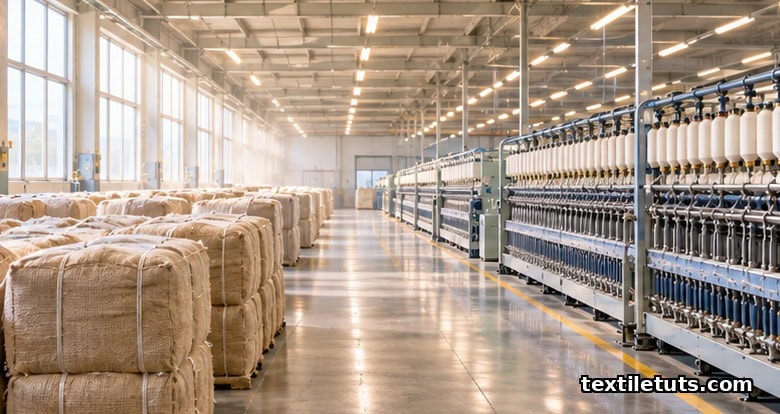
Cotton spinning converts raw cotton lint into finished yarn through five sequential mechanical stages (blowroom, carding, drawing, roving, and ring or rotor spinning), progressively reducing linear density from roughly 4-6 ktex at the bale to 15-40 tex in the finished yarn while raising fiber alignment from random tufts to near-parallel arrangement. Each stage drafts, parallels, and twists the fibers further, with humidity held at 50-65% RH and ambient temperature near 25 °C to keep fibers pliable and free of static. Below is the engineering walk-through of how a 227 kg cotton bale becomes the knit or woven yarn on a fabric loom.
Spinning is the cost bottleneck of cotton yarn manufacturing. About 60% of the energy consumed in yarn manufacturing is used between carding and ring spinning, and the choice between ring and rotor routes changes the yarn’s internal structure, hand-feel, and acceptable end-use. Understanding each step explains why a 30 Ne single jersey behaves so differently from a 10 Ne terry towel loop, even when both start from the same cotton lot.
Stage 1: Blowroom — Bale Opening and Cleaning
The blowroom is the first mechanical contact point between raw fiber and machine. Cotton arrives as compressed 227 kg bales (sometimes smaller South Asian bales at 170 kg) containing seeds, leaf trash, dust, and motes. Multi-blend bale openers feed layered tufts into a series of cleaning machines that use beater bars, sawtooth cylinders, and air suction to remove impurities.
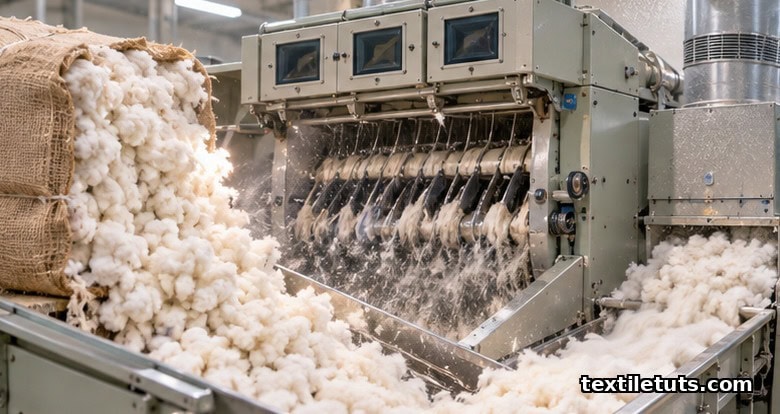
A modern blowroom line includes a bale opener, multi-mixer, AxiFlow cleaner, and fine cleaner, with foreign-fiber detectors (optical or infrared cameras that flag polypropylene strings, jute, or hair) placed before the chute feed. Trash removal at this stage typically extracts 0.5-1.5% of bale weight, which is critical because carding cannot remove particles smaller than 0.5 mm without fiber loss. Fiber moisture is conditioned to 7-8% regain here to prevent static buildup and fiber breakage downstream.
Stage 2: Carding — Individualizing and Aligning Fibers
Carding is the only step that genuinely individualizes cotton tufts into single fibers. The carding machine feeds lap through a taker-in (licker-in) cylinder rotating at 1,000-1,400 rpm, then transfers the web through a main cylinder (250-400 rpm) covered with metallic wire clothing that combs the fibers between cylinder and flats. Flat speeds, flat settings, and cylinder-to-flat gauge (typically 0.20-0.30 mm) determine nep and short-fiber content.
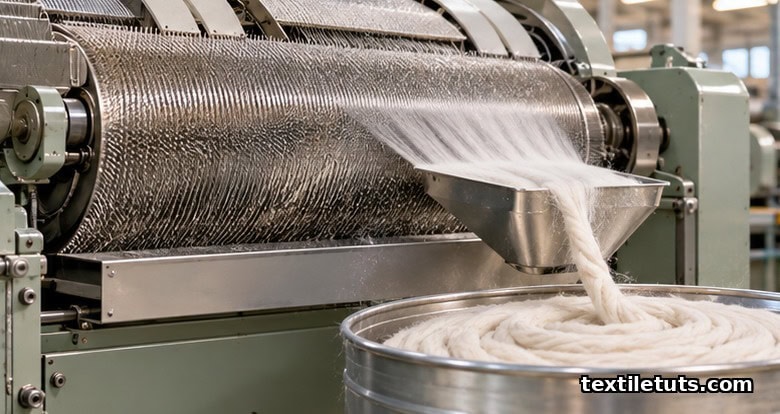
Modern high-production cards run at 80-120 kg/hour and deliver sliver at 4-6 ktex linear density, condensed into a coiled sliver can. Card production removes another 0.3-0.8% of waste as flat strips, but its primary role is mechanical disentanglement, not cleaning. A well-tuned card reduces neps to fewer than 80 per gram and aligns most fibers within ±10° of the sliver axis, setting the foundation for drafting consistency in later passes.
Stage 3: Drawing — Doubling and Parallelizing
The card sliver is too irregular (CV 4-6%) to spin directly. Drawing frames double 6-8 slivers together and pass them through 3-4 roller drafting zones, which reduces linear density by a draft ratio of 6-8× per passage while averaging out thick and thin places. Two drawing passages (breaker and finisher) are standard for ring spinning; rotor yarn often needs only one breaker drawing pass.
Roller drafting relies on weighted top rollers pressing fiber against a bottom steel fluted roller. Pressure loading typically reaches 30-40 daN per centimeter of roller length at the front zone, and roller gauges (back to middle to front) widen progressively, e.g., 50 mm → 45 mm → 40 mm. After two drawing passages, sliver linear density falls to around 3.0-4.5 ktex with a CV of 1.5-2.5%, suitable for roving frame input.
Stage 4: Roving — Adding a Gentle Protective Twist
The roving frame reduces drawn sliver by another 8-12× draft and inserts a low-level false twist (15-30 TPM) to give the fiber strand enough cohesion to be wound and unwound at the next stage. Roving is essentially a coarse, weak, slightly twisted intermediate that survives creel-to-creel transport without breaking.
Roving packages are wound on paper or plastic cores at spindle speeds of 1,000-1,500 rpm, and roving twist direction (typically Z-twist) is chosen opposite to the final yarn twist direction so that plying or knitting releases residual torque. For rotor spinning the roving stage is skipped entirely; drawn sliver feeds the rotor directly.
Stage 5: Ring Spinning vs. Rotor Spinning — Final Yarn Formation
Ring spinning drafts roving 20-40× through a drafting zone and inserts real twist with a traveler running around a stationary ring at spindle speeds of 15,000-25,000 rpm. Twist levels typically range from 600 TPM (for 30 Ne knitting yarn) to 1,200 TPM (for 10 Ne weft yarn), with the twist multiplier (TM = TPM ÷ √Ne) held between 3.5 and 4.5 for most woven applications.
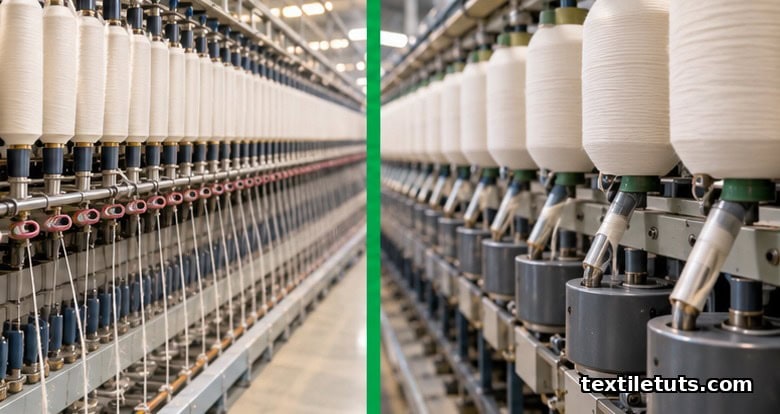
Rotor spinning (also called open-end) feeds drawn sliver into a rapidly spinning rotor (up to 150,000 rpm for small rotors, 80,000-100,000 rpm for production rotors up to 46 mm diameter). Fibers are peeled off the feed roll, individualized by the opening roller, and deposited in the rotor groove, where centrifugal force and twist from the yarn tail consolidate them. Rotor yarn is more even, more extensible, and bulkier than ring yarn, but it is slightly weaker in tensile strength.
| Property | Ring Spun Yarn | Rotor (Open-End) Yarn |
|---|---|---|
| Yarn structure | Fibers parallel, Z- or S-twist, compact | Fibers wrapped with random wrapper fibers, more open |
| Tensile strength (Ne 30) | Higher (CV 8-12%) | Lower (CV 10-14%) |
| Hairiness | Lower | Higher (more protruding fibers) |
| Production speed | 25-40 m/min per spindle | 100-220 m/min per rotor |
| Typical linear density | 10-80 Ne | 6-40 Ne |
| Main end-uses | Woven shirting, fine knits, sewing thread | Denim weft, towels, terry, home textiles |
Post-Spinning: Winding, Conditioning, and Packing
After the spindle or rotor, yarn is wound onto cross-wound packages (cones or cheeses) at 1,200-1,800 m/min on auto-coners. Yarn clearers (electronic capacitance or optical sensors) cut out thick places, slubs, and thin places beyond programmable limits, typically rejecting 0.5-2.0% of yarn length. Conditioning cabinets at 27 °C and 65% RH relax the yarn for 8-24 hours before final packing.
Each cone is then weighed, label-checked for count, twist, and lot number, and palletized for delivery. Cross-linking between spinning and weaving or knitting is now digital: most mills deliver yarn with electronic lot data so that downstream operators can trace any defect back to the bale lot, card number, and rotor or spindle that produced it.
Frequently Asked Questions
How long does it take to spin cotton from bale to yarn?
Modern high-speed mills produce finished yarn 4-8 hours after the bale is opened, with ring spinning adding roughly 30-45 minutes of residence time per kilogram. Small-batch or hand-spinning can extend this to several days if intermediate winding and conditioning steps are included.
What is the difference between yarn count and yarn number?
In cotton, yarn count is expressed in English Cotton Count (Ne), the number of 840-yard lengths per pound. A 30 Ne yarn is finer than a 10 Ne yarn, and the spinning process is tuned around the target Ne because draft ratios, twist multipliers, and traveler weights all scale with the count.
Why is humidity controlled during spinning?
Cotton fibers are hygroscopic, and relative humidity below 45% causes static, fly loss, and increased ends-down at the ring frame, while humidity above 70% makes fibers too soft and produces uneven drafting. Most mills target 50-65% RH at 25 °C throughout blowroom through winding.
Which spinning method is most energy efficient?
Rotor spinning typically uses 30-40% less energy per kilogram of yarn than ring spinning because it skips the roving stage and runs at higher delivery speeds. However, ring spinning produces yarn that can be combed and mercerized, opening higher-value end-uses that often offset the energy difference on a value-per-kilogram basis.
What is combed cotton, and at what stage is it added?
Combing is an additional process inserted between carding and drawing. A combing machine removes short fibers (typically below 12.5 mm) and remaining neps, leaving a cleaner, more uniform sliver that produces stronger, smoother yarn. Combed cotton yarn commands a price premium of 15-30% over carded yarn of the same count.
References
- ASTM International. ASTM D1422 / D1422M – Standard Test Method for Twist in Single Spun Yarns by the Untwist-Retwist Method. ASTM International, West Conshohocken. Test method cited for the yarn twist verification values shown in the roving and ring spinning sections.
- ASTM International. ASTM D2256 / D2256M – Standard Test Method for Tensile Properties of Yarns by the Single-Strand Method. ASTM International. Single-strand tensile test method cited for the tensile strength comparison in the ring vs. rotor table.
- International Organization for Standardization. ISO 20645:2004 – Textiles — Determination of Antibacterial Activity of Textile Products (Agar Diffusion Plate Test). ISO. Reference for fiber and yarn condition testing protocols used post-spinning.
- Klein, W. Man-Made Fibres and Their Processing. Manchester: The Textile Institute, 1994. Cited for ring spinning draft, twist, and traveler mechanics.
- Lawrence, C. A. Fundamentals of Spun Yarn Technology. Boca Raton: CRC Press, 2003. Cited for rotor and ring spinning process data, draft ratios, and twist levels.
- Pourdeyhimi, B. and Xin, B. Yarn Hairiness: A Review. ResearchGate preprint. Background reference on fiber protrusion in rotor versus ring yarn.
- Textile Research Journal (peer-reviewed). SAGE Publications. Cited for cotton fiber hygroscopicity and drafting-zone mechanics.
This article is the working reference for the cotton spinning process. Editorial by Iftay Khairul Alam, TextileTuts. Sources: ASTM D1422, ASTM D2256, ISO 20645, Klein (1994), Lawrence (2003), the Textile Research Journal, and the Pourdeyhimi and Xin hairiness review as cited.


