
Knitting: A Complete Guide to Weft and Warp Knit Fabrics

Knitting is a fabric-formation method in which a single yarn is shaped into a chain of interlocking loops, each loop pulled through the loop below it, producing fabrics that are stretchier, softer, and more dimensionally unstable than woven fabrics. Knit fabrics split into two structural families, weft knit (one yarn traveling horizontally across courses, producing jersey, rib, interlock, and fleece) and warp knit (many yarns running vertically, producing tricot and raschel), and the structural difference drives every property that follows, from T-shirt drape to lingerie stability. This guide covers both families, their major structures, the manufacturing machinery that makes them, the defects that show up on the production floor, and the ISO and AATCC test methods that govern knit quality.
Knit vs. Woven: Why It Matters
The two families are not interchangeable. Some properties invert entirely depending on which method produced the fabric. In a woven fabric, yarns lie perpendicular and cannot stretch without the yarn itself deforming. In a knit fabric, loops can open or close like a fish scale. When you pull a knit T-shirt lengthwise, the loops flatten sideways to accommodate. This loop geometry is the master variable for every property that follows.
| Property | Knit (most types) | Woven (most types) |
|---|---|---|
| Stretch | High, especially crosswise | Low (unless elastane added) |
| Drape | Fluid, conforming | Stiffer, structural |
| Wrinkle recovery | Excellent | Moderate to poor |
| Dimensional stability | Lower (knits relax and shrink) | Higher |
| Production speed | High (circular knitting) | Moderate (weaving) |
| Tailoring difficulty | Higher (curling edges, stretch complicates seams) | Lower |
| Cost per meter | Typically lower (less yarn per unit area for many knits) | Variable |
The Two Families: Weft Knit and Warp Knit
Weft Knitting
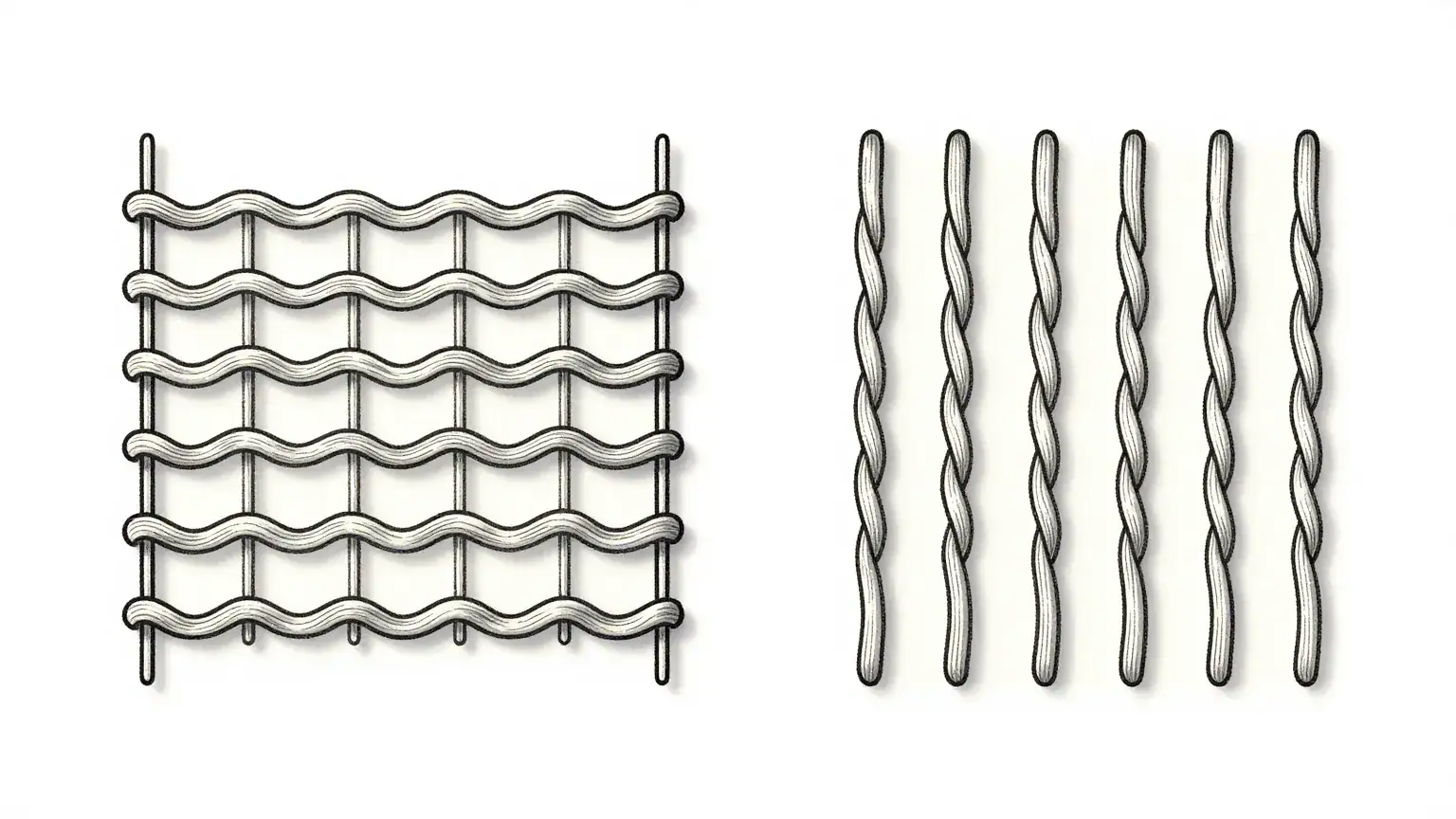
In weft knitting, a single yarn travels horizontally across the fabric, forming loops in successive courses (rows). Each wale (vertical column) is built by the same yarn bending back and forth. The fabric can unravel from the last row if a yarn breaks, a property called run-back or laddering. Weft knit accounts for the majority of knit apparel worldwide. Virtually every T-shirt, sweater, underwear, and sock is weft knit. The dominant machine type is the circular knitting machine (a cylinder of needles producing a tube of fabric) or the flat-bed knitting machine (a straight needle bed producing flat panels).
Warp Knitting
In warp knitting, multiple yarns run vertically (lengthwise) down the fabric, each yarn forming loops across many courses simultaneously. Warp-knit fabrics do not run when cut. The structure is locked across the warp, which makes them more dimensionally stable and easier to cut-and-sew than weft knits. The dominant warp-knit machine types are tricot (fine, smooth, used for lingerie, linings, sports mesh) and raschel (heavier, open-structured, used for lace, nets, automotive textiles, and some geotextiles). Milanese is a finer third type, now rare.
Major Weft-Knit Structures
Single jersey is the world’s most-produced knit fabric, the substrate of basic T-shirts, dresses, and lightweight knit linings. It is the simplest weft-knit structure: one set of needles on a circular machine, all knitting in the same direction. Single jersey is typically 100 to 180 GSM for apparel, stretchy in both directions (more across the width than along the length), and exhibits curling at the cut edges, a defining behavior where jersey curls to the back on the lengthwise edges and to the front on the crosswise edges. This complicates sewing but can be controlled with starching or edge coating in production. Common uses: T-shirts, dresses, lightweight tops, lining fabric, fashion jersey.
Rib knitting alternates knit and purl wales. For example, 1×1 rib knits one course plain, then one course purl. The structure creates vertical cords on both faces, with much greater crosswise stretch and recovery than single jersey. Rib is the basis of sweater cuffs, collars, waistbands, and the body of most fitted knit tops.
Interlock is essentially two layers of 1×1 rib knitted together back-to-back on a circular machine with two opposed needle cylinders. The result: a double-faced, balanced knit with no curling, better dimensional stability than single jersey, and a smooth surface on both sides. Interlock is heavier than single jersey at the same yarn count (typically 180 to 280 GSM), has higher lengthwise and crosswise stretch than jersey but lower than rib, and offers better recovery and shape retention. Common uses: polo shirts, premium T-shirts, dresses, knit shirts where a more structured hand is desired.
Pique (also called Lacoste) is a knit structure with a waffle-like or honeycomb surface texture, produced on circular machines using a combination of knit and tuck (miss-knit) stitches. The original Lacoste polo shirt was the iconic use case; today pique is standard for polo shirts and some knit shirting. Two main variants exist. Single pique (Lacoste) has one tuck row alternating with plain rows and weighs 170 to 220 GSM. Double pique has two tuck rows and weighs 220 to 280 GSM, more structured.
Fleece is a knit fabric (typically single jersey or interlock base) that has been brushed on the back side to raise fibers. The brushing creates a soft, insulating pile that traps air and feels warm against the skin. Two important distinctions: polar fleece is made from polyester (often recycled rPET) and is itself a knit fabric. Sweatshirt fleece is a brushed-back cotton or cotton-poly jersey, heavier at 280 to 450 GSM. The “Does Fleece Shrink?” question traces to this: polyester fleece is dimensionally stable; cotton fleece shrinks on first wash unless pre-shrunk.
French terry is jersey with loops (not sheared) on the back, a halfway point between smooth jersey and full fleece. Common in athleisure and casual sweatshirts at 200 to 320 GSM. Ponte di Roma (Ponte) is a double-knit structure with the appearance of a fine rib on both faces. Heavier and more structured than interlock at 250 to 400 GSM, it holds its shape, resists wrinkles, and is popular for dresses, skirts, pants, and structured knit tops.
Other notable weft knits: scuba (a double-knit polyester/spandex fabric with a smooth, slightly rubbery hand, used in bodycon dresses and structured knit fashion), velour (knit with a cut pile surface that mimics velvet), mesh (knit with deliberate open holes for breathability, used in athletic jerseys and linings), and sweater knit (bulky gauge knit with a hand-knitted look, used in pullovers).
Major Warp-Knit Structures
Tricot is the dominant warp-knit fabric, produced on a tricot machine with bearded needles and 2 to 4 guide bars. It produces a smooth, fine fabric with lengthwise wales visible on the face and a slight diagonal on the back. Tricot is the standard substrate for lingerie and intimate apparel, lining fabric, athletic mesh, and lightweight apparel.
Raschel machines use latch needles (not bearded) and can produce heavier, more open structures than tricot. Raschel fabrics include lace, net and tulle, carpet backing, automotive textiles, geotextile netting, and athletic nets.
Milanese is a finer warp-knit produced on a Milan machine with two sets of yarn. It is smoother than tricot but more expensive and now rarely used.
Circular vs. Flat-Bed Knitting
A circular knitting machine is a cylinder of needles (typically 3 inches to 60+ inches in diameter) producing a tube of fabric continuously. Production speed is high; modern circular machines run at 1,000 to 3,000 courses per minute. Common outputs include single jersey, rib, interlock, fleece base, pique, and French terry.
A flat-bed knitting machine has a straight needle bed. The carriage moves back and forth, building the fabric row by row. Flat-bed is slower per area but allows shaped panels: sweater bodies with set-in sleeves, fully-fashioned knits, and even whole garments (the “seamless knit” or “whole garment” technology pioneered by Shima Seiki). Common outputs include sweater bodies, scarves, shaped knit panels, and technical textiles.
Knit Fabric Manufacturing Steps
A simplified production sequence for weft-knit apparel fabric:
- Yarn selection. Count, twist, fiber content, blend ratio. Affects hand, drape, durability.
- Knitting. Circular or flat-bed; structure selection (jersey, rib, interlock, and so on).
- Greige inspection. Check for holes, barre, slubs, dropped stitches before finishing.
- Relaxation. Let the fabric rest 24 to 72 hours to allow loops to stabilize.
- Pre-treatment. Scouring, bleaching if needed.
- Dyeing or printing. The dye class is dictated by the fiber content. Cotton knits take reactive dyes; polyester knits take disperse dyes; wool takes acid dyes; acrylic takes cationic dyes. See the Wet Processing guide for the dye-class details.
- Finishing. Compactor for dimensional stability, calendering for surface smoothness, decating for surface stabilization, brushing for fleece.
- Final inspection. Check GSM, shrinkage, color, and defects.
- Packing and shipping.
Common Knit Defects
Knit defects are largely distinct from woven defects because the formation mechanism is different.
| Defect | Description | Likely cause | Severity |
|---|---|---|---|
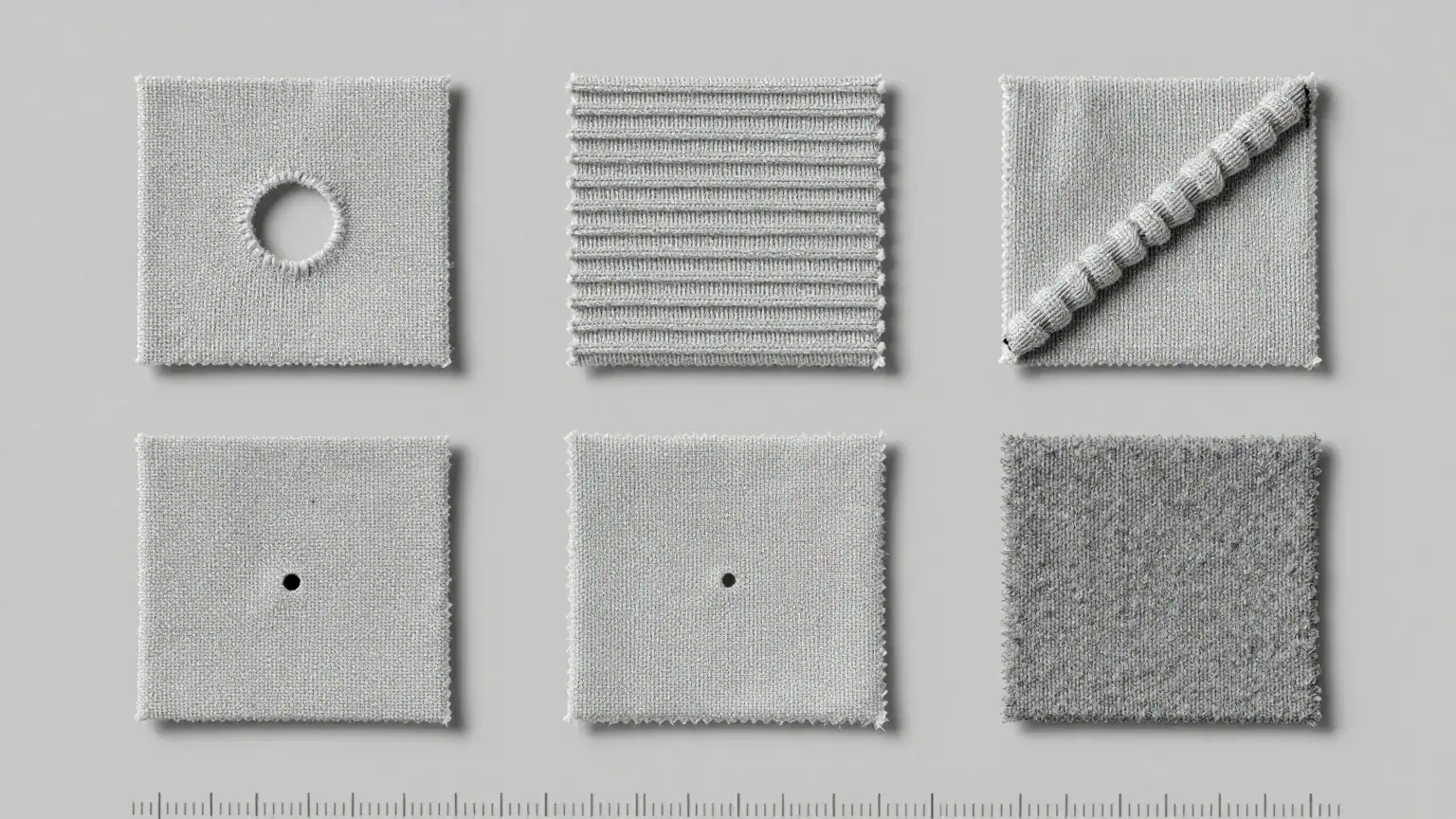
| Hole | Full needle or wale missing | Needle broken; yarn break not caught | Critical |
| Barré | Horizontal bands of uneven appearance | Yarn variation (count, dye uptake, luster) | Critical |
| Spirality | Fabric skew, wales not perpendicular to courses | Improper relaxation; aggressive twisting | Moderate |
| Dropped stitch | Run in the fabric | Needle latch malfunction | Critical |
| Pin holes | Tiny holes along wales | Yarn quality issue | Moderate |
| Slubs | Thick yarn spots | Foreign fiber or yarn defect | Cosmetic to moderate |
| Needle lines | Vertical lines | Damaged or dirty needles | Cosmetic |
| Stitch distortion | Local unevenness | Tension variation | Cosmetic |
Knit Fabric Quality Tests
Per ISO and AATCC standards, the key quality tests for knit fabrics are:
- GSM (fabric weight): ISO 3801, grams per square meter. Critical for apparel fit and cost.
- Bursting strength: ISO 13938-1 (hydraulic method). Knits burst (rather than tear) under load.
- Dimensional stability (shrinkage): ISO 5077 (used in combination with ISO 6330 for the wash procedure) and AATCC 135 (the US home-laundering counterpart, using automatic home washing machines). Both methods wash and measure.
- Spirality after washing: ISO 16322, measure skew after laundering.
- Pilling resistance: ISO 12945 (Martindale method), surface pilling under friction.
- Snagging resistance: ISO 14704 / BS 8479, propensity for yarns to snag.
- Stretch and recovery: ASTM D2594, extension at a defined load, plus recovery.
- Air permeability: ISO 9237, breathability.
For yarn testing within knit manufacturing (count, twist, evenness), see the Textile Testing pillar.
Choosing the Right Knit Fabric
The right knit structure depends on the garment’s intended end-use:
| Application | Recommended structure | GSM range |
|---|---|---|
| Basic T-shirt | Single jersey | 140 to 180 |
| Premium T-shirt | Interlock or single jersey (long staple cotton) | 180 to 220 |
| Polo shirt | Pique | 180 to 240 |
| Sweatshirt | Fleece (brushed-back) or French terry | 280 to 450 |
| Underwear | Single jersey (cotton or modal) | 100 to 160 |
| Lingerie | Tricot warp-knit | 80 to 140 |
| Athleisure | Interlock, French terry, scuba | 200 to 320 |
| Dress (fluid) | Single jersey or modal jersey | 140 to 200 |
| Dress (structured) | Ponte di Roma | 250 to 400 |
| Sportswear | Mesh, interlock | 150 to 250 |
For yarn-count and GSM calculations when specifying knit fabrics, use the Yarn Count to GSM Calculator.
Care and Durability
Knit fabrics require gentler care than woven. The recommendations: wash cool (30°C / cold), especially for cotton knits. Heat triggers relaxation shrinkage. Avoid high-heat tumble drying for polyester knits. Heat can scorch and cause pilling. Fold, don’t hang heavy knits. Hangers cause shoulder distortion. Pre-shrink knit fabric before cutting if your pattern doesn’t allow for shrinkage. For per-fabric care detail, see our Garments Manufacturing & Care hub.
Frequently Asked Questions
What is the difference between knit and woven fabric? Knit fabrics are made from a single yarn forming interlocking loops; woven fabrics are made from two perpendicular yarn systems interlaced at right angles. Knits stretch more, drape more fluidly, and (generally) shrink more than wovens.
What is the most common knit fabric? Single jersey, used in the majority of T-shirts and lightweight knit apparel worldwide. It is produced on a circular knitting machine with one set of needles all knitting in the same direction.
Do knit fabrics shrink? Yes, especially cotton knits on first wash. Polyester knits are dimensionally stable. Always pre-shrink knit fabric before cutting. Shrinkage is measured per ISO 5077 and AATCC 135.
Can knit fabric be used for tailored garments? Yes. Ponte di Roma, interlock, and some double knits are designed for structured knit garments. Tailoring knit requires ballpoint needles, a walking foot, and a twin needle for hems.
What GSM is best for T-shirts? 140 to 180 GSM for a basic single-jersey T-shirt; 180 to 220 GSM for a premium tee. Below 120 GSM the fabric tends to be transparent; above 220 GSM it loses the soft drape that defines a T-shirt.
Are knit fabrics sustainable? Depends on the fiber. Recycled polyester knits (rPET) and organic cotton knits are increasingly common; circular fashion is pushing mono-material knit garments that are easier to recycle than multi-fiber blends.
References
- ISO 3801:1977 — Textiles — Woven fabrics — Determination of mass per unit length and mass per unit area. (Method also applied to knits per industry convention.)
- ISO 5077:2007 — Textiles — Determination of dimensional change. Used with ISO 6330 for the wash procedure.
- ISO 6330:2021 — Textiles — Domestic washing and drying procedures for textile testing.
- ISO 9237:1995 — Textiles — Determination of permeability of fabrics to air.
- ISO 12945-2:2000 — Textiles — Determination of fabric propensity to surface fuzzing and to pilling. Part 2: Modified Martindale method.
- ISO 13938-1:1999 — Textiles — Bursting properties of fabrics. Part 1: Hydraulic method for determination of bursting strength and bursting distension.
- ISO 16322:2005 — Textiles — Determination of spirality after laundering.
- AATCC TM 135 — Dimensional Changes of Fabrics after Home Laundering.
- ASTM D2594 — Standard Test Method for Stretch Properties of Knitted Fabrics Having Low Power.
- Spencer, D. J. (2001). Knitting Technology (3rd ed.). Woodhead Publishing.
- Raz, S. (1987). Flat Knitting: The New Generation. Meisenbach GmbH.
Reviewed by Iftay Khairul Alam, Senior Lecturer at European University of Bangladesh and Master’s in Textile Engineering from Bangladesh University of Textiles (BUTEX). Spinning and knit-fabric specialist.


