
Spinning Mill Layout and Planning

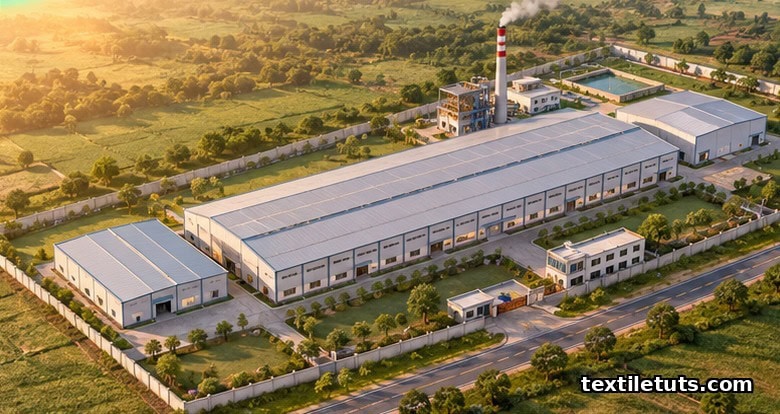
A cotton ring spinning mill of 25,000 spindles sized for 30s Ne yarn production requires a total plot area of 7 to 10 acres (28,000 to 40,000 m²) and a built-up area of 14,000 to 22,000 m² arranged in 8 to 14 bays of 7.5 to 10 m column spacing, with a forward process flow from cotton bale intake at one gable end to finished yarn despatch at the opposite end.
Those numbers shift with product mix. A combed compact mill, a denim rotor mill, and a worsted top-and-yarn plant each distribute that same 14,000 to 22,000 m² differently because bale opening, carding, and winding occupy different footprints per spindle.
This guide walks through every layer of a greenfield layout, starting with the site envelope and finishing with the per-spindle capital benchmarks used by spinners in Bangladesh, India, and Türkiye.
Plot Area, Building Footprint, and Vertical Clearance
For a ring spinning mill operating at 25,000 spindles, the conventional plot envelope sits between 28,000 and 40,000 m², of which roughly 55% becomes the main process block. Ancillary blocks, including the bale godown, finished-goods warehouse, boiler house, ETP, admin office, and canteen, take the remaining area.
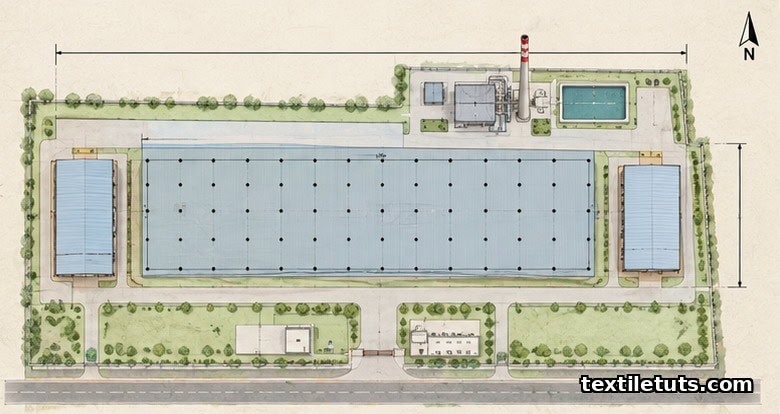
Two practical benchmarks help engineers at the planning stage. The Rieter spinning manuals and Lawrence’s “Fundamentals of Spun Yarn Technology” both recommend keeping the building aspect ratio at or below 1.6:1 along the long axis of process flow. A wider or squarer block forces excess travel for silver cans, which directly raises handling labour. The truss height at the eave should sit at 5.5 to 6.5 m for ring spinning (to clear overhead blowroom ducts and lighting trays) and 4.5 to 5.0 m for the winding hall, where headroom is set by creel ceiling clearance.
Slab flatness tolerance matters more than is often realised. Modern ring frames run at 18,000 to 22,000 rpm, and any slab deviation above 5 mm over 3 m shows up as traveller vibration, increased end breaks, and short traveller life. Power-floated concrete with a tolerance tighter than FF 35 (ACI 117 floor flatness classification) is the accepted industry bench mark for new civil work on these halls.
Forward Process Flow and One-Way Material Handling
The single most important rule in spinning mill planning is to never allow the silver path to double back on itself. From bale opening through finished cone packing, material must walk in one direction along a single axis, with by-products (waste, dust, fly, comber noil) moving perpendicular to that axis into a separate scrap hall.
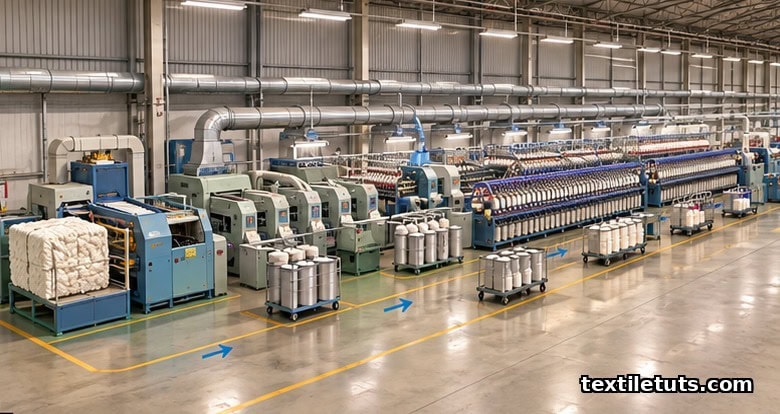
A typical cotton ring mill arranges its bays in this order:
- Blowroom (bale plucker, mixer, cleaner, fine opener, scutcher)
- Carding (cards lined in parallel rows)
- Pre-drawframe (breaker drawframe)
- Combing preparation (lap former) and combers, if producing combed yarn
- Finisher drawframe
- Speed frame (roving)
- Ring frame (the largest single floor area)
- Winding (autoconer or equivalent)
- Conditioned yarn storage and despatch
Waste generated at each stage moves laterally to chutes that drop to a basement or ground-floor scrap room on the trailing side of the building. Return-air ducts for the HVAC plant lie in that same zone, leaving the front half of the truss clear for lighting trays and sprinkler heads.
Spinning Bay Geometry: Column Spacing, Aisle Width, and Machine Pitch
For ring frames, the dominant driver of bay geometry is machine width. A modern 1,440-spindle ring frame measures about 16 to 18 m long and 1.0 to 1.2 m wide, including its enclosure ceiling. Standard column spacing of 8 m along the row, paired with 7.5 to 10 m cross-bay spacing, allows two frames to sit under one column row and gives 2.4 m of headway in front of each machine for silver-can transit and piecing gangways.
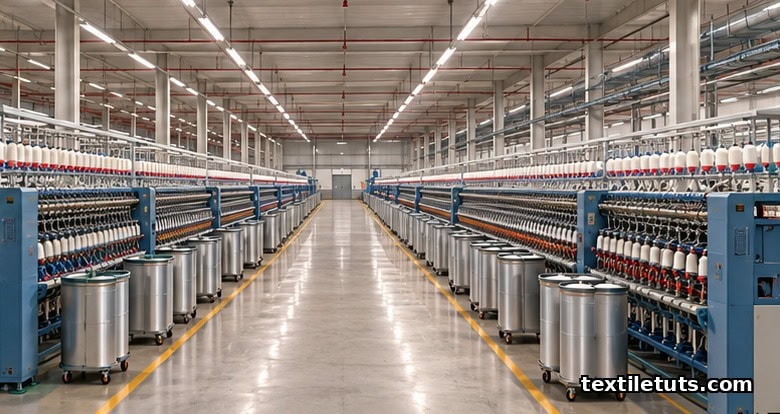
Aisle widths in spinning mills follow empirical rules. The central aisle along the length of the frame should be at least 1.8 m wide so two piecers can pass with silver cans. Cross aisles every 30 to 35 m break long bays into manageable fire-fighting and supervisory zones, and they prevent what is often called the “long tunnel” effect, where a single stalled frame blocks half the floor.
The cross-bay geometry should also align with the column grid. A typical cotton ring-frame layout uses 8 m × 8 m columns at the ring hall, dropping to 7.5 m × 7.5 m or 6 m × 6 m at the more densely packed drawframe and winding zones. Winding halls, in particular, can save 8 to 10% of footprint by going to a tighter column grid because autoconer units accept ceiling heights as low as 3.5 m.
Machine-Wise Floor Space Allocation
Per-spindle floor space varies widely by process stage. The numbers below come from published planning data in the Rieter spinning manual (Volume 1) and the distribution tables used by leading Bangladesh mill engineers when laying out a fresh site.
| Process | Floor area per machine (m²) | Machines per 25,000-spindle mill | Total area (m²) |
|---|---|---|---|
| Blowroom (line) | 250-350 | 2 lines | 500-700 |
| Cards | 14-18 | 30-36 | 420-650 |
| Drawframes | 12-16 | 8-12 | 96-192 |
| Combers | 25-30 | 8-12 | 200-360 |
| Speed frames | 30-45 | 6-10 | 180-450 |
| Ring frames | 60-110 | 18-22 | 1,080-2,420 |
| Winders | 40-65 | 6-10 | 240-650 |
| Conditioned store + despatch | — | 1,500-2,500 | |
The ring-frame row alone accounts for 35 to 50% of the main process floor. Speed frames and winding together add another 20 to 25%, and the remaining 30% sits in blowroom, carding, drawframe, and combing. These breakdowns match the working spindle distribution tables printed in ASTM D123 textile terminology reference and the planning examples in Lawrence’s textbook.
HVAC, Lighting, and Acoustic Targets for the Spinning Hall
Cotton spinning creates dust, fly, and heat. The hall has to balance three environmental targets at the same time, and each one shifts the HVAC design.
- Relative humidity: 55 to 60% RH for carded cotton, 60 to 65% RH for combed cotton, 65 to 70% RH for worsted, with an upper limit of 75% to keep steel components safe from flash rust.
- Temperature: 25 to 30 °C in summer, with a maximum allowable drift of 7 °C across the floor (kept within the envelope set by isotherm-based tests on traveller break rate).
- Lux level: 500 to 700 lux at machine height on the spinning floor; 300 lux is the lower bound for winding and packing zones, per the IES Industrial Lighting Standard reference used in spin-plant electrical design.
- Noise ceiling: 85 dB(A) is the typical exposure trigger for mandatory hearing protection in spinning halls, set by most national OSHA-equivalent rules. Acoustic treatment on the ceiling grid is used to drop the reverberant field by 8 to 12 dB.
Air changes are sized to the dust load. Carded cotton yarn lines need 18 to 22 air changes per hour; combed cotton drops slightly to 14 to 18 because most dust is removed earlier in the line. These figures match the design guidelines often used in Rieter and Trützschler project engineering notes and are corroborated by ambient engineering references such as the ACGIH Industrial Ventilation Manual.
Manpower, Utilities, and Per-Spindle Capital Benchmarks
Labour distribution in a modern ring spinning mill follows spindle productivity. A good layout achieves 800 to 1,200 ring spindles per operator with an automated doffing cycle, but the same plant may need closer to 500 spindles per operator on a counted-yarn fine-count line above 80s Ne.
The utility footprint sits outside the process block but must be planned into the same square-metre envelope.
- Compressed air: 6 to 8 bar, with 0.6 to 0.8 m³/min per ring frame for pneumatic suction and pneumatic clearer systems.
- Steam and power: 1.5 to 2.2 kWh per kg of yarn at the ring-frame busbar, with a 0.7 to 1.0 kg steam:kg yarn ratio at the humidification plant.
- Water: 1.5 to 2.0 m³ per 100 kg of yarn for humidification and for the laboratory conditioning loop used in QC tests such as ISO 2060 single-end tensile checks.
Capital intensity for a greenfield 25,000-spindle cotton ring mill runs in the band of $25 to $40 per spindle (machinery and buildings combined), based on the buying price guides widely circulated by Rieter, Lakshmi Machine Works, and Zinser supplier references. Working capital for six months of cotton inventory and finished-stock float pushes the all-in figure toward $35 to $55 per spindle, depending on local civil and power costs.
Layout Mistakes That Eat Margin
Three planning errors come up repeatedly in commissioning audits. Each one is fully avoidable if spotted on the general arrangement drawing before civil work begins.
- Reversing the silver path. Folding the process loop to fit a tight site adds silver-can travel and raises handling staff by 8 to 12%. Carry the layout out of the linear envelope first; expand the plot if the shape forces a fold.
- Ignoring column-grid mismatch. A 6 m × 6 m column grid over a ring hall wastes usable space; cards and ring frames are designed around 7.5 to 8 m grids. Civil engineers default to a single structural grid, which silently loses up to 10% of usable floor area in spinning bays without anyone noticing the gap in the drawing.
- Undersized waste and dust shaft. Filter dust, card strip, and comber noil all need to fall out of the process hall by gravity. Plan a basement or under-floor plenum sized for at least 8 hours of accumulation, otherwise the floor turns into a fire-load risk and the operators have no clean route to clear drops.
These are the same failure modes flagged in operating-quality reviews by the Industrial Hygiene Foundation and in energy benchmarks reported through the Bangladesh Textile Mills Association, and they are worth catching on the drawing board where the cure is a red marker, not a retrofit.
Frequently Asked Questions
What plot size does a 25,000-spindle ring mill need?
A 25,000-spindle cotton ring mill needs 28,000 to 40,000 m² (7 to 10 acres) of plot, of which 14,000 to 22,000 m² becomes the main process block. Combed or compact yarn plants run slightly larger because of the added combers and the wider drawframe section, pushing the upper bound toward 45,000 m².
How many ring spindles can one operator attend?
For 30s Ne carded cotton, 800 to 1,200 spindles per operator is realistic on a modern frame with auto-doff and pneumafil suction. For fine counts above 60s Ne and on combed yarn, that figure drops to 500 to 700 spindles because end-break frequency roughly doubles and piecing labour grows with it.
What relative humidity should I hold in a cotton spinning hall?
Carded cotton: 55 to 60% RH. Combed cotton: 60 to 65% RH. Above 70% RH, the floors become slippery and steel components corrode. Below 50% RH, static causes traveller friction and end breaks rise by 15 to 30%. Specifying within these bands is the practical way to align with the standard atmospheres cited in ASTM D2256 and ISO 2060, both of which reference 65 ± 2% RH for yarn conditioning before tensile testing.
Does a compact or air-jet mill change the building footprint?
Compact ring spinning uses 15 to 20% more floor space per spindle than a conventional ring frame, because compact drafting elements and the suction unit are 200 to 300 mm wider on the frame. Air-jet spinning, by contrast, cuts the spinning hall in roughly half because a single Vortex or Murata jet spinner handles 5 to 7 times the spindle equivalent of a ring frame, so fewer machines occupy the same area.
What is a realistic payback period for a 25,000-spindle mill?
On a 30s Ne carded cotton yarn with steady-state capacity utilisation above 90%, most published industry studies put the payback at 5 to 7 years, including the sales-tax and working-capital costs typical of a South Asian plant. Running above 95% utilisation shortens that to 4 to 5 years; running below 75% extends the payback beyond the equipment service life.
References
- ASTM International. ASTM D2256/D2256M-21 Standard Test Method for Tensile Properties of Yarns by the Single-Strand Method. https://www.astm.org/d2256_d2256m-21.html – tensile test method for ring and rotor yarn, with the 65 ± 2% RH laboratory atmosphere referenced for conditioning.
- ASTM International. ASTM D123 Standard Terminology Relating to Textiles. https://www.astm.org/d123.html – canonical definitions for yarn, roving, sliver, spindle, and other layout-relevant terms.
- International Organization for Standardization. ISO 2060:1994 Textiles – Yarn from packages – Determination of single-end breaking force and elongation at break using constant rate of extension (CRE) tester. https://www.iso.org/standard/1207.html – the basis for QC yarn strength testing and the conditioning environment used in mill QC labs.
- International Organization for Standardization. ISO 1144:2015 Textiles – Universal system for designating linear density (Tex system). https://www.iso.org/standard/63549.html – global yarn-count reference used in layout output calculations.
- Lawrence, C.A. Fundamentals of Spun Yarn Technology. CRC Press, 2003. https://www.routledge.com/9780849327881 – academic reference covering process flow, machine footprint, and planning benchmarks for cotton and synthetic yarn production.
- Klein, W. The Rieter Manual of Spinning (Volume 1, Spinning Preparation). Rieter Machine Works, 1994 (reprinted 2008). https://www.rieter.com – reference for blowroom line layout, carding room footprint, and per-machine energy loadings.
- American Conference of Governmental Industrial Hygienists. Industrial Ventilation Manual (30th Edition). https://www.acgih.org – reference for air-change rates, hood design for cards, and dust loadings used to size spinning mill HVAC.
This article is the working reference for spinning mill layout and planning. Editorial by Iftay Khairul Alam, TextileTuts. Sources: ASTM D2256, ASTM D123, ISO 2060, ISO 1144, Lawrence (CRC Press), the Rieter Spinning Manual, and the ACGIH Industrial Ventilation Manual as cited.


