
Yarn Conditioning: Humidity Control in Spinning

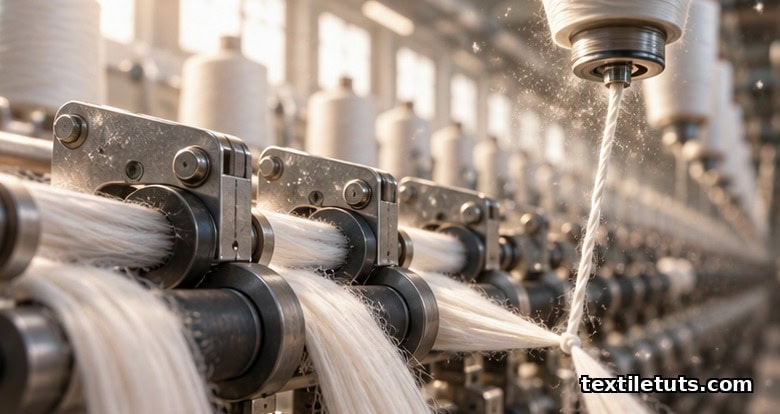
Yarn conditioning is the controlled adjustment of moisture regain in spun yarn, typically to 8 to 13% depending on fiber type, by holding the yarn in a standard atmosphere of 65% relative humidity and 20 C as defined by ISO 139 before further processing or testing.
Humidity governs almost every measurable property of yarn, from linear density and twist to tensile strength and hairiness, because hydrophilic fibers such as cotton, wool, and viscose gain or lose water with the surrounding air.
This guide explains why the standard atmosphere matters, how moisture changes yarn properties, what conditioning equipment spinning mills use, and how HVAC and humidification systems keep relative humidity inside the narrow band that textile standards require.
Why Humidity Control Matters in Spinning
Spinning is a sequence of drafting, twisting, and winding steps in which a fiber assembly is reduced from a thick sliver to a fine, uniform yarn. Every step stresses the fiber, and the fiber’s response depends on its moisture content. When relative humidity (RH) drops below 40%, cotton and wool fibers become brittle, fly loss rises, yarn hairiness increases, and ends down spike on the ring frame. When RH climbs above 75%, fibers become plastic, drafting becomes unstable, and yarn count variation (CV%) worsens.
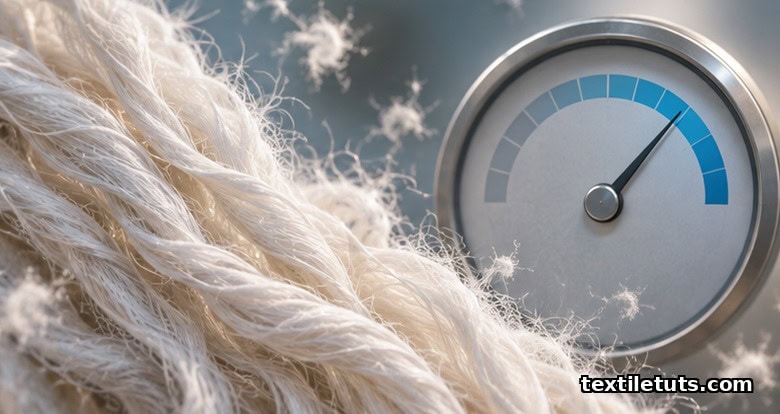
The economic stakes are concrete: a 1% change in cotton yarn moisture regain shifts the measured linear density by roughly 1% as well (ISO 2061, 2015). A spinner selling 30 Ne yarn that drifts 0.3 Ne off count because of poor conditioning loses commercial value on every kilogram. Humidity control is therefore not a comfort issue but a process-control and quality-control parameter on par with spindle speed and twist multiplier.
The Standard Atmosphere: ISO 139 and Moisture Regain
ISO 139:2005, “Textiles: Standard atmospheres for conditioning and testing,” defines the reference atmosphere for all textile work as a relative humidity of 65% with a tolerance of plus or minus 2% and a temperature of 20 C with a tolerance of plus or minus 2 C. For tropical work, a second atmosphere at 27 C plus or minus 2 C and 65% plus or minus 2% RH is permitted (ISO 139, 2005).
Yarn conditioning means exposing the yarn to this standard atmosphere until it reaches equilibrium with the air, a state called equilibrium moisture regain. For cotton, the standard regain is 8.5%, for viscose 13.0%, for wool 16.0% to 18.0%, and for polyester around 0.4% (ASTM D1909, Table 1). Conditioning rooms in spinning mills typically hold yarn for 24 to 48 hours before count testing or winding, so the moisture content of the package reflects what the customer will measure in their own lab.
Without conditioning, two laboratories measuring the same yarn can report different counts simply because their room RH differs by ten points, which is why ISO 2061 (the method for determining yarn linear density) requires pre-conditioning at a lower humidity (under 25% RH) followed by conditioning to the standard atmosphere before weighing.
How Humidity Affects Yarn Properties
Yarn is a porous, hygroscopic structure, so any change in ambient moisture shifts fiber dimensions, fiber friction, and inter-fiber cohesion. The table below summarizes the directional effect of increasing humidity from dry (around 30% RH) to standard (65% RH) to damp (80% RH) on the most commonly tested yarn properties.
Humidity vs. Yarn Properties (Cotton Ring-Spun Yarn, 30 Ne)
| Property | 30% RH (dry) | 65% RH (standard) | 80% RH (damp) |
|---|---|---|---|
| Moisture regain (%) | 4 to 5 | 7 to 8.5 | 10 to 12 |
| Yarn count (Ne, measured) | Apparent count reads finer | True count per ISO 2061 | Apparent count reads coarser |
| Twist liveliness | High, snarling risk | Stable, balanced | Low, untwist tendency |
| Single yarn strength (cN/tex) | Lower, brittle fiber | Maximum | Slips at fiber joints |
| Elongation at break (%) | Low, brittle | Optimum | Higher, ductile |
| Hairiness (S3 value, mm) | High, fiber ends protrude | Lowest | Fibers cling, looks lower but weak |
| Static charge / electrification | Strong, fiber fly | Minimal | Minimal but corrosion risk |
| Yarn count CV% (Uster) | Unstable | Best (mill-spec reference) | Drafting waves appear |
The directional trend holds across fibers: dry yarn is brittle and hairy, damp yarn is heavy and under-twisted, and conditioned yarn sits in the narrow band where count, twist, and strength all read true.
Yarn Conditioning Rooms and Equipment
A yarn conditioning room is a sealed chamber that holds bobbins, cones, or hanks at the standard atmosphere long enough for the moisture to equalize. The chamber is built with insulated panels, an airtight door, and a humidification unit sized to the chamber volume. The simplest design uses steam-baffled water spray nozzles that inject fine droplets into the air stream, raising RH without dripping onto the yarn. More sophisticated designs use adiabatic humidifiers, which atomize water through high-pressure nozzles and absorb the heat of evaporation, or ultrasonic humidifiers, which break water into a cold fog at room temperature.

For larger mills, package conditioning conveyors move yarn on a continuous track through a tunnel held at 65% RH and 20 C, so each package gets a controlled residence time (usually 24 to 36 hours for cotton) before reaching the winding or shipping end. Some mills pre-condition yarn with radio-frequency (RF) drying, which warms the wet package from the inside out so it absorbs moisture uniformly during the conditioning dwell.
Conditioning rooms are governed by ISO 2061 for count testing and by ISO 7211-5 for laboratory sample preparation, both of which require the standard atmosphere for at least 24 hours or until successive weighings at 30-minute intervals differ by less than 0.1%. The governing sensor in the chamber is a calibrated RH probe, typically a chilled-mirror hygrometer for the reference chamber and a capacitive polymer probe for shop-floor units.
HVAC and Humidification in the Spinning Mill
Spinning halls run hot. Ring frames, roving frames, and preparatory machines each add several kilowatts of motor heat per machine, and a 10,000-spindle mill can add 200 to 300 kW of sensible heat to the air. The mill HVAC system must remove this heat, control fresh-air intake, and add moisture to keep RH in the 55 to 70% band recommended for cotton ring spinning (typically 60% plus or minus 5%) and 65% plus or minus 5% for rotor spinning. ISO 139 itself is a testing standard, so mills operate in a slightly wider band than 65% plus or minus 2% to absorb day and night load swings.

Three humidification systems dominate:
- Steam humidification: dry steam from a boiler is injected through dispersion manifolds. Steam is clean, hot, and quick to respond, but it requires a separate boiler, water treatment, and steam traps.
- Water-spray (adiabatic) humidification: high-pressure nozzles atomize water directly into the air stream. The system is simple and cheap to run but needs softened, demineralized water to prevent nozzle scale and white dust on the yarn.
- Evaporative pad / wetted-media humidification: air passes through a wetted cellulose pad, picking up moisture as it goes. This is the lowest-cost option, used on cellulosic spinning halls where the water-quality risk is manageable.
Whatever the humidifier, the control loop is the same: a humidity transmitter in the spinning hall feeds back to a controller that modulates the steam or water valve, with the supply-air fan holding temperature steady. Modern mills add dew-point control on the return air so the humidifier cannot spray more moisture than the air can hold, preventing condensation on cold ducts and yarn packages.
Static Electricity and Fiber Electrification
Synthetic fibers (polyester, polyamide, acrylic) carry almost no moisture regain, so they build static charge in dry air. Below 50% RH, polyester yarn on a winder can reach surface voltages of several kilovolts, attracting fly, breaking the web at the doffer, and causing wraps on card and comber cylinders. Conditioning in this case means adding moisture to the air (typically to 55 to 65% RH for polyester blends) and adding antistatic finishes during the preparatory draw-texturing or sizing step. Cotton-rich blends sit in the middle and behave well at 60 to 65% RH because the cotton component carries enough moisture to bleed off charge.
Most mills now add an ionization bar or grounded copper brushes at the winding unit to neutralize residual charge, but the first line of defense is still humidity control at the source.
Process Control and Energy Cost of Humidity
Humidification is one of the largest utility loads in a spinning mill. Adiabatic humidification consumes roughly 1 kWh per kg of evaporated water, and a cotton ring-spinning hall in a dry climate may evaporate 30 to 50 L of water per hour per 1,000 spindles. The payback for accurate humidity control is short: every 1% RH that drifts off target in either direction shows up in Uster CV%, in end-break rate on the ring frame, and in claims from the weaving or knitting customer downstream. Mills that hold 65% plus or minus 2% inside the conditioning room and 60% plus or minus 5% in the spinning hall typically report 10 to 20% lower end-break rates and tighter count CV than mills that run dry.
Frequently Asked Questions
Q1: What is the standard relative humidity for yarn testing?
The standard atmosphere for all textile testing, including yarn count and yarn strength, is 65% relative humidity plus or minus 2% at 20 C plus or minus 2 C, as defined by ISO 139:2005. A tropical variant at 27 C plus or minus 2 C is permitted for work in hot climates, with RH held at 65% plus or minus 2%.
Q2: How long should yarn be conditioned before count testing?
ISO 2061 requires conditioning until successive weighings taken at 30-minute intervals differ by less than 0.1%. For cotton packages of 1 to 2 kg, this normally takes 24 to 48 hours. Loose fiber or yarn hanks condition faster, often within 4 to 8 hours.
Q3: Can humidity make a yarn count read higher or lower than the real value?
Yes. Cotton yarn measured at 30% RH can read 1 to 1.5% finer than the same yarn measured at 65% RH, because lower moisture means less weight on the same length. This is why ISO 2061 mandates conditioning to the standard atmosphere before any count determination: the count is a weight-length ratio, and both terms must be measured at the same moisture state.
Q4: What RH should a spinning hall run at in practice?
Most cotton ring-spinning mills run at 60% plus or minus 5% RH in the spinning hall and 65% plus or minus 2% in the conditioning and testing room. Rotor spinning tolerates 65% plus or minus 5%. Synthetic-rich blends (polyester-cotton, polyamide) need 55 to 60% RH plus antistatic treatment to keep electrification under control.
References
- International Organization for Standardization. ISO 139:2005, Textiles: Standard atmospheres for conditioning and testing. iso.org – the reference atmosphere for all textile work (65% RH, 20 C).
- International Organization for Standardization. ISO 2061:2015, Textiles: Determination of linear density (yarn number by the skein method). iso.org – method that mandates ISO 139 conditioning before weighing yarn.
- International Organization for Standardization. ISO 7211-5:1984, Textiles: Woven fabrics, construction, methods of analysis, part 5: determination of linear density of yarn removed from fabric. iso.org – sample-preparation conditioning requirements.
- ASTM D1909-13, Standard Tables of Commercial Moisture Regains for Textile Fibers. astm.org – reference moisture regains used in this article (cotton 8.5%, wool 16 to 18%, polyester 0.4%).
- Marshal, W. J. (1949). The conditioning and testing of textile yarns. Journal of the Textile Institute, 40, T1-T12. Taylor & Francis – peer-reviewed work linking humidity to yarn strength and count accuracy.
- Morton, W. E., & Hearle, J. W. S. (2008). Physical Properties of Textile Fibres (4th ed.). Woodhead Publishing (now Elsevier) – chapter on moisture absorption and its effect on fiber mechanical properties.
This article is the working reference for humidity control and yarn conditioning in spinning. Editorial by Iftay Khairul Alam, TextileTuts. Sources: ISO 139, ISO 2061, ISO 7211-5, ASTM D1909, and peer-reviewed textile literature as cited.


